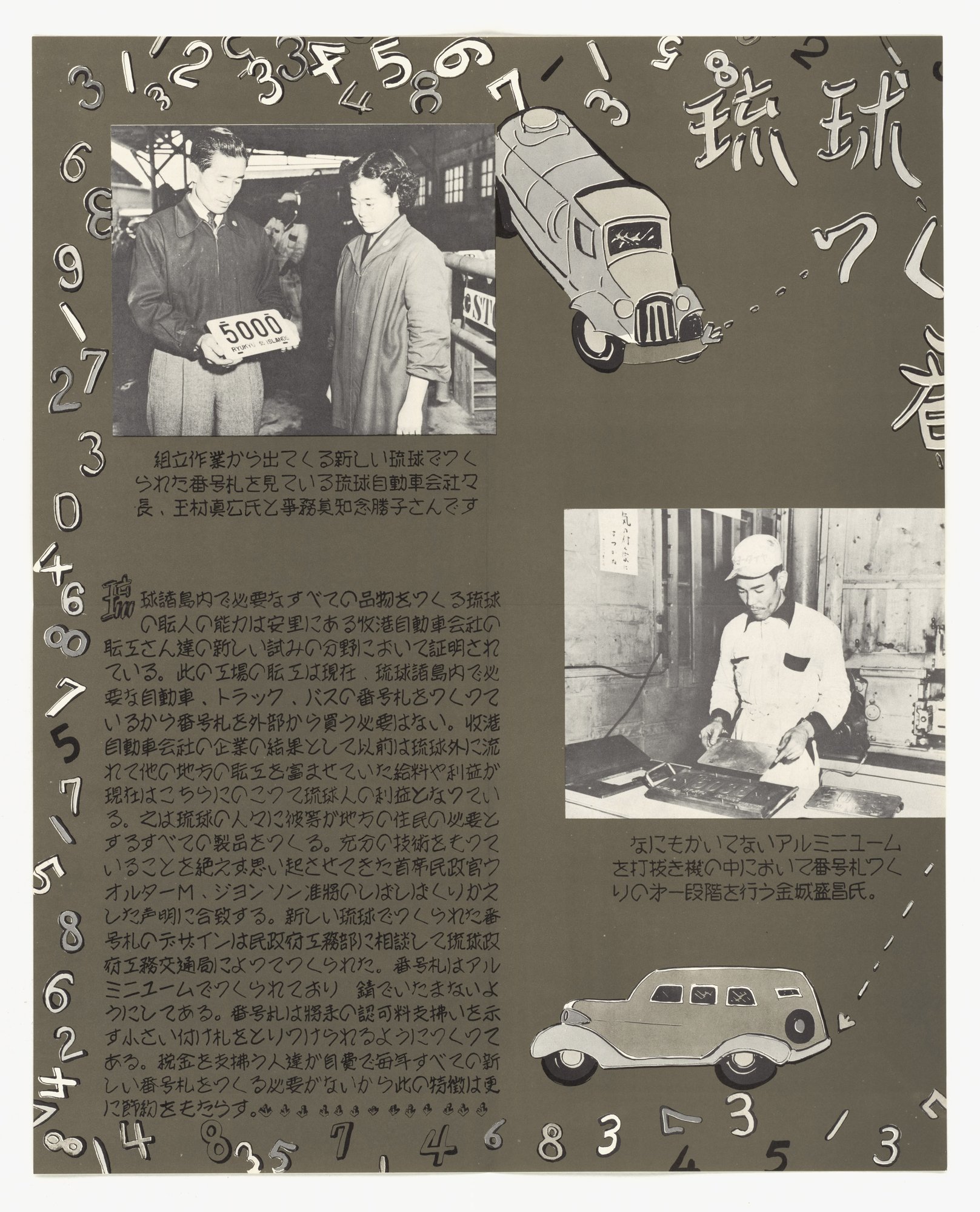
Ryukyuan-Made License Tags: Makiminato Motor Company Plant and the 5000 Plate (Japanese poster distributed in the Ryukyu Islands)
A Japanese-language photo and text sheet on a brown ground with drawn cars and scattered digits. Two photographs show a company president and an office worker examining plate number '5000 Ryukyu Islands' and a worker feeding blank aluminium into a punching machine. The long text says locally made plates keep wages and profits in the islands, cites the Chief Civil Administrator's repeated statements, and says the plate takes a yearly tab. The tell is transfer: an official's statement lends weight to a local-industry claim.
Propaganda techniques used in this poster
- Date
- March 23, 1955
- Period
- Cold War
- Made by
- U.S. Information Agency (predecessor: State Department International Information and Educational Exchange Program), Propaganda Posters Distributed in Asia series
- Region
- North America
- Country
- United States
- Medium
- Poster
- Issuer type
- State
- Regime
- Eisenhower Administration
- Leader
- Dwight D. Eisenhower
- Audience
- Foreign public
- Purpose
- Persuade or win support
- Themes
- Economy and finance, Labor
- Event
- Cold War
- Source
- Unidentified Source blurred: contractors, cutouts, buried disclosure
- Source
- U.S. National Archives (NARA), Record Group 306, Propaganda Posters Distributed in Asia, retrieved October 3, 2026
- Rights
- Public domain (U.S. government work; NARA RG 306)
U.S. Information Agency / Department of State, March 23, 1955. National Archives, Record Group 306 (NAID 5730069, 306-PPA-170).
Text on the object
琉球
つく
番

組立作業から出てくる新しい琉球でつくられた番号札を見ている琉球自動車会社々長、王村真広氏と事務員知念勝子さんです。

琉球諸島内で必要なすべての品物をつくる琉球の職人の能力は安里にある牧港自動車会社の職工さん達の新しい試みの分野において証明されている。此の工場の職工は現在、琉球諸島内で必要な自動車、トラック、バスの番号札をつくっているから番号札を外部から買う必要はない。牧港自動車会社の企業の結果として以前は琉球外に流れて他の地方の職工を富ませていた給料や利益が現在はこちらにのこって琉球人の利益となっている。これは琉球の人々に彼等が地方の住民の必要とするすべての製品をつくる。充分の技術をもっていることを絶えず思い起させてきた首席民政官ウオルターM、ジョンソン准将のしばしばくりかえした声明に合致する。新しい琉球でつくられた番号札のデザインは民政府工務部に相談して琉球政府工務交通局によってつくられた。番号札はアルミニユームでつくられており 錆でいたまないようにしてある。番号札は将来の認可料支払いを示す小さい付け札をとりつけられるようにつくってある。税金を支払う人達が自費で毎年すべての新しい番号札をつくる必要がないから此の特徴は更に節約をもたらす。

なにもかいてないアルミニユームを打抜き機の中においで番号札つくりのオー段階を行う金城盛昌氏。

[plate in photo:] 5000 RYUKYU ISLANDS
Ryukyu ... made ... tags (title cut off at the right edge)

Mr. Tamamura [or Ōmura] Shinkō [name read approximately], president of the Ryukyu Motor Company, and office worker Miss Chinen Katsuko look at a license tag made in the new Ryukyus, coming out of the assembly work.

The ability of Ryukyuan craftsmen to make all the goods needed within the Ryukyu Islands is demonstrated in the new venture of the workmen of the Makiminato Motor Company in Asato. The workmen of this factory are now making the plates for the automobiles, trucks and buses needed within the Ryukyu Islands, so there is no need to buy plates from outside. As a result of the Makiminato Motor Company's enterprise, wages and profits that formerly flowed out of the Ryukyus to enrich workmen elsewhere now remain here and become the benefit of the Ryukyuan people. This accords with the statement often repeated by the Chief Civil Administrator, Brigadier General Walter M. Johnson, who has continually reminded the people of the Ryukyus that they have sufficient skill to make all the products that the local residents need. The design of the plates made in the new Ryukyus was made by the Ryukyu Government Public Works and Communications Bureau in consultation with the Civil Administration's Public Works Department. The plates are made of aluminium and are treated so as not to be damaged by rust. They are made so that a small tab showing payment of future licence fees can be fitted. Because taxpayers need not make all new plates at their own expense every year, this feature brings further savings.

Mr. Kinjō Seishō [name read approximately] performs the first stage of plate-making, placing a blank piece of aluminium in the punching machine.
Hand-lettered text in a stylised hand; names and a few characters are read approximately. Scattered numerals in the border are decoration and are not transcribed.