
Area: Cognitive biases and heuristics · Evidence: strong (How we rate the evidence). The preference for belief-consistent information is well replicated and confirmed by meta-analysis; the stronger claim that contrary evidence routinely pushes people further apart has not held up.
In brief
Confirmation bias is the tendency to seek, notice, interpret and remember information in ways that fit what one already believes. It works at every stage: which questions get asked, which sources get read, how ambiguous facts are read, and how hard a disliked study is scrutinized. Political messages rarely need to create this bias. They mostly need to supply the confirming material and let the audience's own habits do the filtering.
What the research shows
Peter Wason's 1960 "2-4-6" task is the classic starting point [1]. Participants were told that the sequence 2, 4, 6 fit a rule and were asked to discover the rule by proposing their own sequences. The actual rule was simply "any ascending numbers." Most people formed a narrower idea, such as "numbers increasing by two," and then proposed only sequences that fit it (8, 10, 12), which kept confirming their guess without ever testing it. Few tried a sequence that could prove them wrong, and many announced incorrect rules with confidence.

Wason's 2-4-6 task: any sequence that fits the typical guess also fits the actual rule, so tests chosen to fit the guess can only be answered "yes". Drawn by FRAME from Wason (1960) [1]. CC BY 4.0.
Charles Lord, Lee Ross and Mark Lepper took the idea into a charged topic [2]. They gave supporters and opponents of the death penalty two fictional studies, one suggesting capital punishment deters crime and one suggesting it does not, with the methods swapped between groups. Each side rated the study that agreed with it as more convincing and found flaws in the other. The authors called this "biased assimilation." They also reported that after reading the same mixed evidence, both sides said their views had grown stronger.
Raymond Nickerson's 1998 review brought together decades of such findings and showed the bias in medicine, law, science and everyday reasoning [3]. He described it as ubiquitous and noted that it operates without any intent to deceive: people usually believe they are weighing evidence fairly.
On the question of which information people choose to see, William Hart and colleagues pooled the experimental literature in a 2009 meta-analysis [4]. They found a moderate preference for congenial over uncongenial information (an effect size of d = 0.36, where 0.2 is conventionally small and 0.5 medium). The preference was stronger when people were highly committed to a view and weaker when accurate information was useful to them, for example when they had to act on it.
Has it held up?
The core findings are among the best established in the field. Positive testing of the kind Wason found appears reliably, and the Hart meta-analysis confirms a real if moderate preference for agreeable information. Joshua Klayman and Young-Won Ha pointed out an important qualification: testing cases that fit a hypothesis is often a reasonable strategy, and it only misleads under particular conditions, as in the 2-4-6 task [5]. Not every instance of "looking for confirmation" is an error.
The most dramatic claim, that exposure to balanced or contrary evidence drives people further apart, has fared worse. Lord and colleagues measured polarization by asking people whether their views had changed, not by measuring the views themselves. Andrew Guess and Alexander Coppock ran three large survey experiments designed to give "backlash" its best chance and found none; people on both sides moved modestly in the direction of the evidence they saw [6]. The broad "backfire effect" is now considered rare.
Researchers also dispute how much of what looks like confirmation bias in politics reflects motivation rather than reasonable weighting of evidence against different prior beliefs. That debate, including whether the left and right are equally prone to it, is covered on Motivated reasoning.
How it shows up in political messaging
- The Dreyfus affair, France, 1894 onward. French army officers identified Captain Alfred Dreyfus, a Jewish officer, as the author of a document passed to Germany, on the basis of disputed handwriting comparisons and amid open antisemitism. When evidence emerged in 1896 pointing to another officer, Ferdinand Walsin Esterhazy, senior officers resisted it, and Major Hubert-Joseph Henry forged documents to shore up the case against Dreyfus [7]. The case shows how a settled conclusion can shape the reading of every new document.
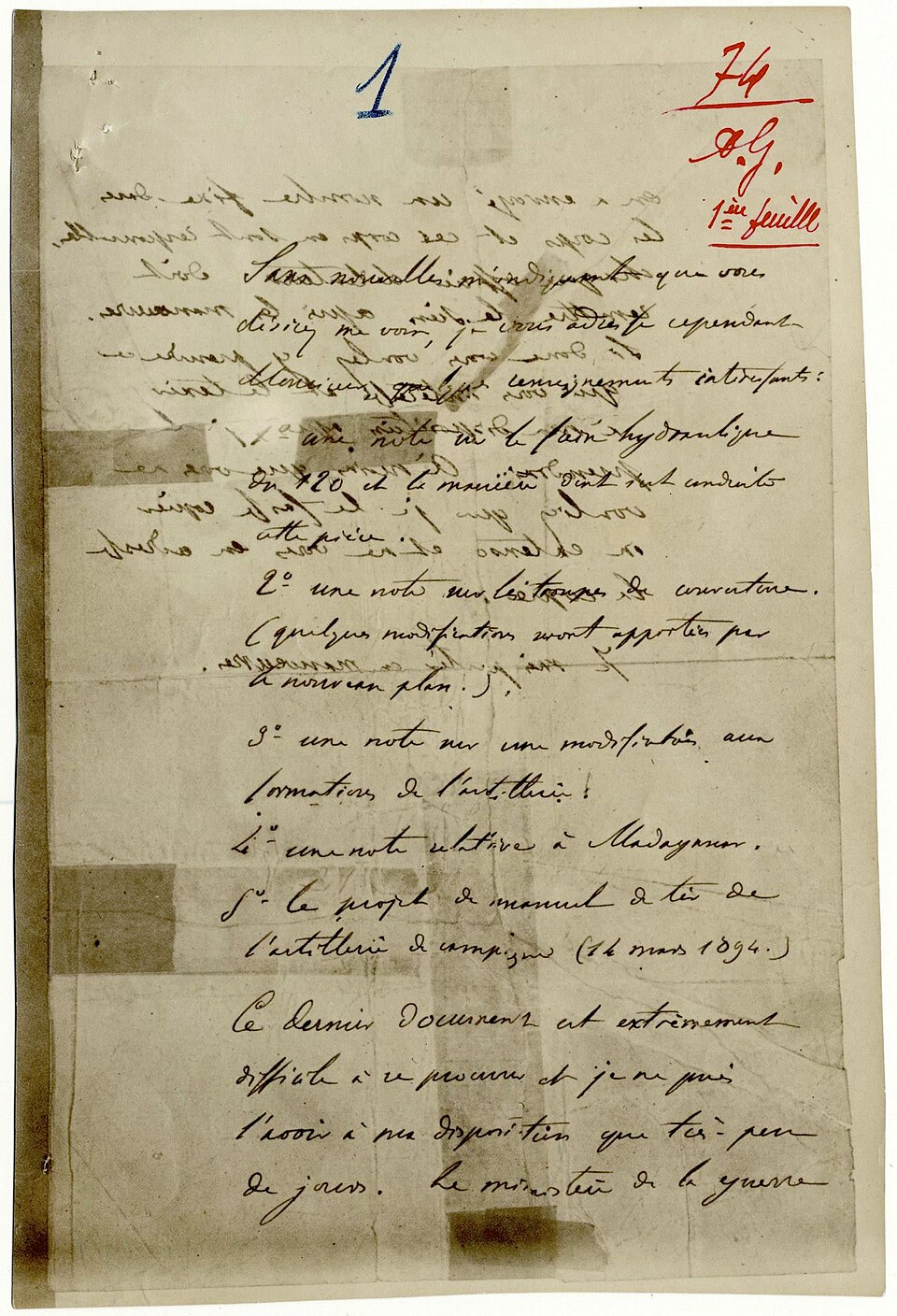
The bordereau, first page: the unsigned handwritten list of documents offered to the German military attaché in Paris, written in 1894 and later attributed to Ferdinand Walsin Esterhazy. Photographic copy, Service historique de la Défense (France). Source: Wikimedia Commons. Public domain.

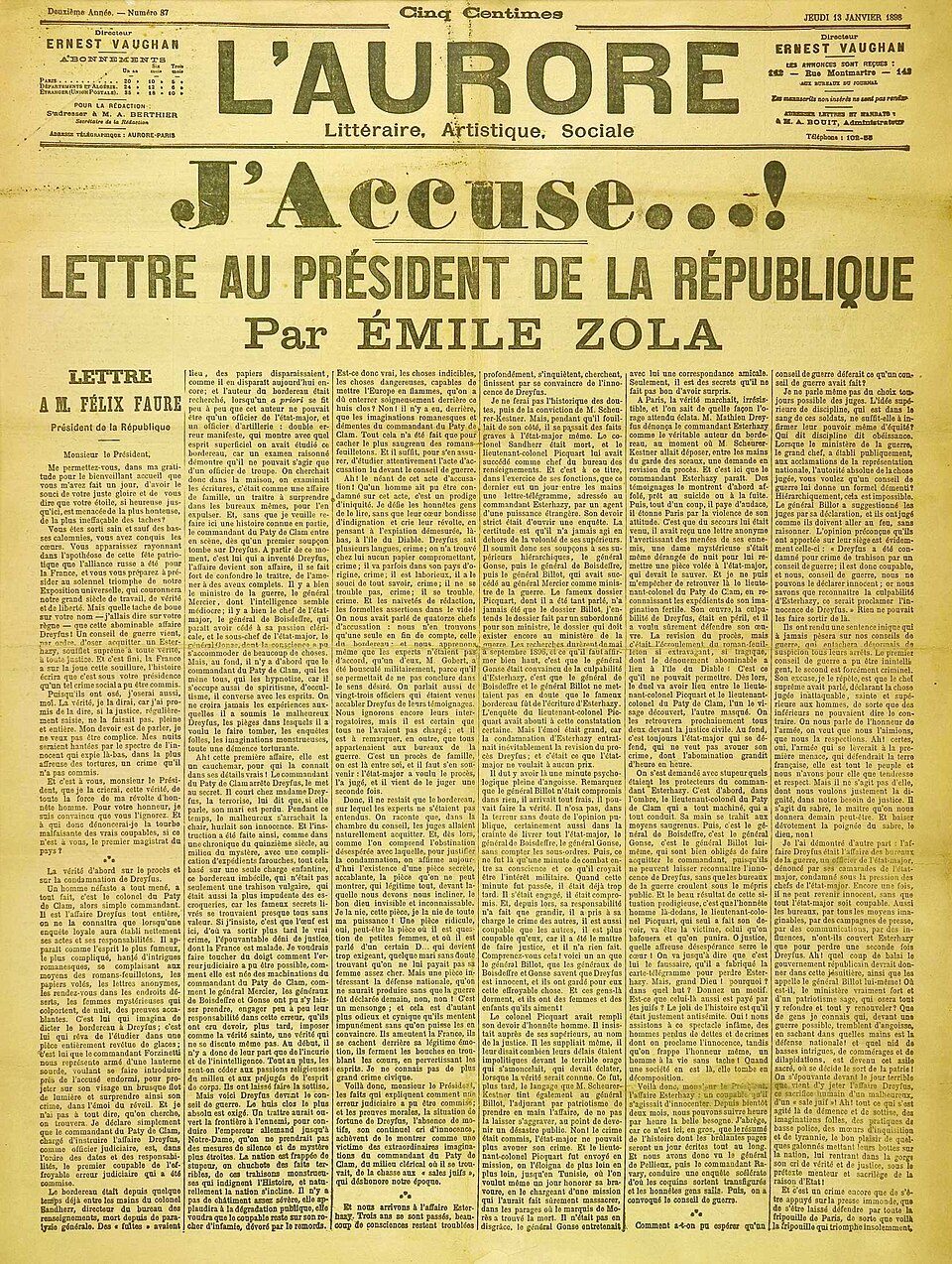
Front page of L'Aurore, Paris, 13 January 1898, carrying Émile Zola's open letter "J'accuse…!" to the President of the Republic on the Dreyfus case. Source: Wikimedia Commons. Public domain (published 1898). Thumbnailed and re-encoded.

- Iraq intelligence, 2002 to 2003. The U.S. Senate Intelligence Committee's 2004 report concluded that the intelligence community suffered from "group think": a shared presumption that Iraq had active weapons programs led analysts to read ambiguous evidence as conclusive and to ignore or minimize evidence to the contrary [8]. Those assessments then underpinned the public case for war.
- Economic perceptions under the other party. Larry Bartels found that during Ronald Reagan's presidency many Democrats reported that inflation had worsened when it had in fact fallen sharply [9]. The pattern runs both ways. Gallup found that Republicans' economic confidence rose 77 points between 2016 and 2017, after their party took the White House, while Democrats' fell 38 points, a swing that tracked the change of party in the White House [10]. Partisan messages about "our" and "their" economy land on audiences primed to accept them.
- Death penalty evidence. In Lord's study, both proponents and opponents of capital punishment praised the method of whichever study agreed with them [2]. Advocacy on any side that cites only its favorable studies meets little scrutiny from its own supporters.
The same dynamic is why Card stacking works on committed audiences: a one-sided pile of facts is exactly what they are already inclined to look for.
How to spot it
- A message offers only evidence for its conclusion and no account of the strongest evidence against it.
- Sources are chosen by whether they agree, not by their track record.
- The standard of proof shifts depending on which side a finding helps. A useful test is to imagine the same study reaching the opposite conclusion and ask whether its method would be judged the same way.
- Ambiguous events are described as if their meaning were obvious.
- Readers are invited to search for "more proof" rather than for what would change their mind.
Persuasion or manipulation?
Every argument selects evidence, and it is honest to lead with the facts that support a case. Honest material also acknowledges the strongest contrary evidence, links to sources a skeptical reader can check, and says what finding would change the author's view. It becomes manipulation when a message is built so that the audience never meets disconfirming evidence, when contrary studies are dismissed on grounds that would be ignored if they agreed, or when the audience's existing belief is treated as proof in itself.
Archive techniques that lean on this
- Card stacking — Card stacking: selective, one-directional evidence fits the audience's own preference for confirming information, so it passes without scrutiny.
Related topics
- Motivated reasoning — Motivated reasoning
- Illusory truth effect — Illusory truth effect
- Continued influence effect — Continued influence effect
- Group polarization — Group polarization
- Social identity — Social identity
Sources
- Wason, P. C. (1960). On the failure to eliminate hypotheses in a conceptual task. Quarterly Journal of Experimental Psychology, 12(3), 129–140. https://doi.org/10.1080/17470216008416717
- Lord, C. G., Ross, L., & Lepper, M. R. (1979). Biased assimilation and attitude polarization: The effects of prior theories on subsequently considered evidence. Journal of Personality and Social Psychology, 37(11), 2098–2109.
- Nickerson, R. S. (1998). Confirmation bias: A ubiquitous phenomenon in many guises. Review of General Psychology, 2(2), 175–220. https://doi.org/10.1037/1089-2680.2.2.175
- Hart, W., Albarracín, D., Eagly, A. H., Brechan, I., Lindberg, M. J., & Merrill, L. (2009). Feeling validated versus being correct: A meta-analysis of selective exposure to information. Psychological Bulletin, 135(4), 555–588. https://doi.org/10.1037/a0015701
- Klayman, J., & Ha, Y.-W. (1987). Confirmation, disconfirmation, and information in hypothesis testing. Psychological Review, 94(2), 211–228.
- Guess, A., & Coppock, A. (2020). Does counter-attitudinal information cause backlash? Results from three large survey experiments. British Journal of Political Science, 50(4), 1497–1515.
- United States Holocaust Memorial Museum. "Alfred Dreyfus and the 'Dreyfus Affair'." Holocaust Encyclopedia. https://encyclopedia.ushmm.org/content/en/article/alfred-dreyfus-and-the-dreyfus-affair ; see also Encyclopaedia Britannica, "Alfred Dreyfus." https://www.britannica.com/biography/Alfred-Dreyfus
- U.S. Senate Select Committee on Intelligence. (2004, July 9). Report on the U.S. Intelligence Community's Prewar Intelligence Assessments on Iraq, conclusions. Text of conclusions as published by NBC News: https://www.nbcnews.com/id/wbna5403731
- Bartels, L. M. (2002). Beyond the running tally: Partisan bias in political perceptions. Political Behavior, 24(2), 117–150. https://doi.org/10.1023/A:1021226224601
- Gallup. (2018, February 2). 2017 partisan gap in economic confidence one of the largest. https://news.gallup.com/poll/226649/2017-partisan-gap-economic-confidence-one-largest.aspx
Images
| Image | Source | Licence |
|---|---|---|
| Nested-set diagram of Wason's 2-4-6 task | Drawn by FRAME from source 1 (make_cognitive_bias_diagrams.py) |
CC BY 4.0, FRAME |
| The bordereau (1894) | Wikimedia Commons; Service historique de la Défense | Public domain |
| L'Aurore, 13 January 1898 | Wikimedia Commons | Public domain (published 1898) |