Area: Cognitive biases and heuristics · Evidence: strong (How we rate the evidence). Repetition raising belief is one of the most replicated findings in cognitive psychology, confirmed by meta-analysis, though the size of the boost is modest and much of the evidence uses trivia statements and short delays.
In brief
The illusory truth effect is the finding that people rate statements as more likely to be true after they have encountered them before. Repetition makes a claim easier to process, and that ease is mistaken for a sign of truth. The effect works on true and false statements alike, it survives relevant knowledge, and a single prior exposure is enough to produce it. This is the psychological core of the old observation that a claim repeated often enough starts to sound right.
What the research shows
Lynn Hasher, David Goldstein and Thomas Toppino reported the effect in 1977 [1]. Participants rated how true a set of plausible but obscure statements seemed, some true and some false, in three sessions two weeks apart. Some statements appeared in every session, while others were new each time. Ratings of the repeated statements rose from session to session, while ratings of new statements did not. Nothing about the statements had changed except that people had seen them before.
Lisa Fazio and colleagues tested whether knowing the answer protects people [2]. They used statements that contradicted facts most participants knew, such as a claim that the short pleated skirt worn by Scots is called a sari rather than a kilt, and checked separately what each participant knew. Repetition still increased the rated truth of false statements, even among people who demonstrated they knew the correct answer. The authors describe this as "knowledge neglect": when a statement feels familiar, people often do not stop to consult what they know.
Gordon Pennycook, Tyrone Cannon and David Rand brought the effect to online misinformation [3]. Participants saw fake news headlines formatted as they would appear on social media. A single earlier exposure increased how accurate the headlines seemed later, the effect was still present a week afterward, and it grew with a second exposure. It appeared even when the headlines had carried a warning that they were disputed by fact-checkers, and even for headlines that ran against the participant's own political views. The increase was small in absolute terms, but it was consistent.
Has it held up?
Yes. Alice Dechêne and colleagues' 2010 meta-analysis pooled several decades of experiments and found a reliable effect of moderate size [4]. The effect held across different kinds of statements and procedures and appeared whether the repeated statements were true or false.
Later work has clarified its boundaries. Fazio, Rand and Pennycook found that repetition raised perceived truth for implausible statements as well as plausible ones, although implausible claims still started, and stayed, far lower [5]. Aumyo Hassan and Sarah Barber found that belief keeps rising with more repetitions but with diminishing returns, with the largest single increase coming from the second exposure [6]. Nadia Brashier, Emmaline Eliseev and Elizabeth Marsh found that asking people to judge accuracy when they first encounter a statement reduced the later effect for claims they could recognize as false [7].
The main limits are about generalization. Most studies use short trivia statements, student or online samples and delays of minutes to weeks. Real political claims are embedded in identities and arguments, and repetition is only one of many influences on whether people accept them.
How it shows up in political messaging
- Der Stürmer, Germany, 1923 to 1945. Julius Streicher's antisemitic weekly printed the slogan "Die Juden sind unser Unglück!" ("The Jews are our misfortune!") at the foot of its front page, issue after issue from 1927, alongside dehumanizing caricatures [8]. The slogan was never argued for. It was simply repeated.
Content note: Nazi-era antisemitic slogans and a caricature on a newspaper display case. This object is shown as it was published. Why 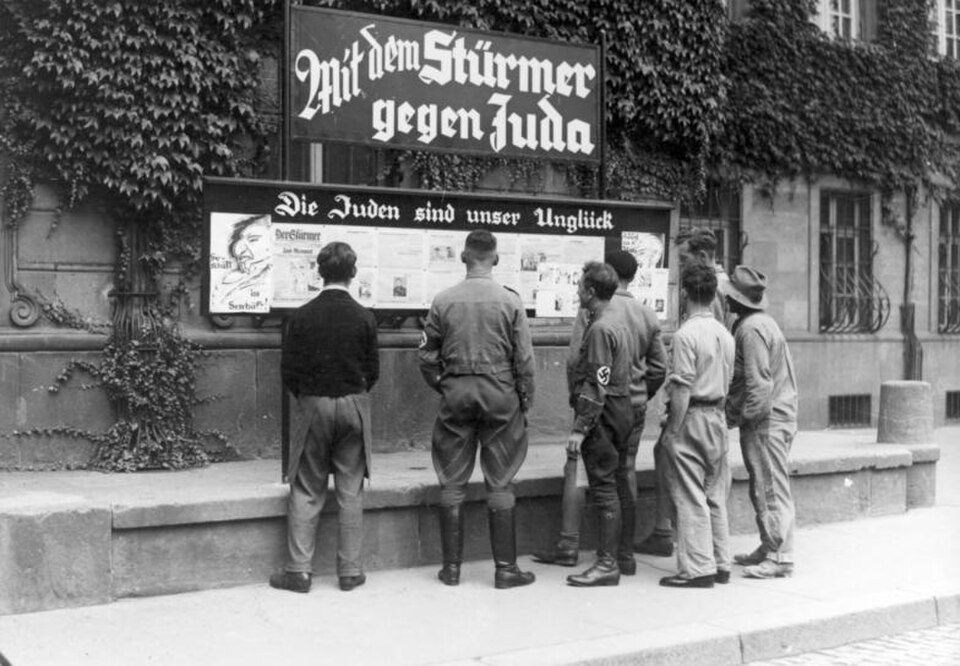
Men reading a Der Stürmer display case ("Stürmerkasten") headed "Mit dem Stürmer gegen Juda" with the slogan "Die Juden sind unser Unglück," Worms, Germany, August 1935 (Bundesarchiv, Bild 133-075, Gaubildarchiv Worms, photographer unknown). Source: Wikimedia Commons. CC BY-SA 3.0 DE.

- Operation INFEKTION, 1983 to 1987. A Soviet-bloc disinformation campaign claimed that the U.S. government had created the AIDS virus. The story was first planted in a small pro-Soviet Indian newspaper, then cited and reprinted by Soviet outlets and picked up by press around the world, each repetition giving it apparent independent confirmation [9]. This laundering through many outlets is the pattern described in Narrative laundering.
- The £350 million bus, 2016. Vote Leave repeated its figure for Britain's weekly payment to the EU on its campaign bus and in its messaging after the UK Statistics Authority called it misleading, and Boris Johnson repeated it again in 2017 [10]. In June 2016, 47 percent of the public believed it was true [11].

Ipsos MORI poll, June 2016, on the £350 million a week claim: 78 percent had heard it and 47 percent thought it true. Drawn by FRAME from Ipsos MORI (2016) [11]. CC BY 4.0.
- "Stolen election" claims, United States, 2020 onward. Claims that widespread fraud had changed the 2020 presidential result were repeated by the defeated incumbent and allies across speeches, broadcasts and social media for months, although courts rejected dozens of lawsuits making them and the House select committee found the claims false [12].
- "Hands up, don't shoot," United States, 2014 onward. After the police shooting of Michael Brown in Ferguson, Missouri, the phrase spread as a national protest slogan. The Justice Department's 2015 investigation concluded that the account of Brown surrendering with his hands raised was not supported by the physical evidence or by credible witness testimony, while a separate report released the same day documented a pattern of unconstitutional policing in Ferguson [13].
High-volume campaigns such as Firehosing need no single claim to be convincing. Sheer repetition across channels does part of the work.
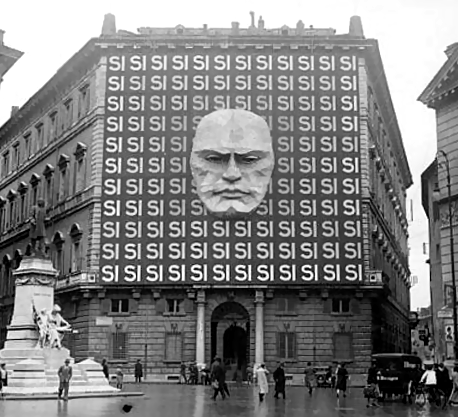
Palazzo Braschi, Rome, dressed for the March 1934 plebiscite: the word SI (Yes) repeated in rows around a large face of Benito Mussolini, Fascist Federation of Rome. From the FRAME gallery: Palazzo Braschi dressed for the 1934 plebiscite: rows of "SI" around the Duce
How to spot it
- A claim is familiar but it is hard to remember where it came from or what the evidence was.
- The same wording recurs across many outlets or accounts that all trace back to one origin.
- A slogan is repeated in place of an argument.
- A claim keeps circulating after an authoritative correction, sometimes in the correction's own headline.
- A useful check is to ask, before judging whether something is true, whether it simply feels familiar.
Persuasion or manipulation?
Repetition is not deceptive in itself. Teachers, public health campaigns and advocates of every kind repeat messages because repetition helps people remember them, and a true claim stated often is still true. It becomes manipulation when repetition is used to substitute for evidence, to keep a claim alive after it has been shown to be false, or to create the impression that many independent sources agree when they share one origin. Honest material repeats its claim together with its source, so that familiarity and evidence travel together.
Archive techniques that lean on this
- Firehosing — Firehosing: high-volume, multichannel repetition raises familiarity, and with it perceived truth, whether or not the stories are consistent.
- Narrative laundering — Narrative laundering: passing one claim through many outlets multiplies exposures and hides the single source.
Related topics
- Continued influence effect — Continued influence effect
- Sleeper effect — Sleeper effect
- Confirmation bias — Confirmation bias
- Social proof — Social proof
- Flooding the zone — Flooding the zone
Sources
- Hasher, L., Goldstein, D., & Toppino, T. (1977). Frequency and the conference of referential validity. Journal of Verbal Learning and Verbal Behavior, 16(1), 107–112. https://doi.org/10.1016/S0022-5371(77)80012-1
- Fazio, L. K., Brashier, N. M., Payne, B. K., & Marsh, E. J. (2015). Knowledge does not protect against illusory truth. Journal of Experimental Psychology: General, 144(5), 993–1002. https://doi.org/10.1037/xge0000098
- Pennycook, G., Cannon, T. D., & Rand, D. G. (2018). Prior exposure increases perceived accuracy of fake news. Journal of Experimental Psychology: General, 147(12), 1865–1880. https://doi.org/10.1037/xge0000465
- Dechêne, A., Stahl, C., Hansen, J., & Wänke, M. (2010). The truth about the truth: A meta-analytic review of the truth effect. Personality and Social Psychology Review, 14(2), 238–257. https://doi.org/10.1177/1088868309352251
- Fazio, L. K., Rand, D. G., & Pennycook, G. (2019). Repetition increases perceived truth equally for plausible and implausible statements. Psychonomic Bulletin & Review, 26(5), 1705–1710.
- Hassan, A., & Barber, S. J. (2021). The effects of repetition frequency on the illusory truth effect. Cognitive Research: Principles and Implications, 6, 38. https://doi.org/10.1186/s41235-021-00301-5
- Brashier, N. M., Eliseev, E. D., & Marsh, E. J. (2020). An initial accuracy focus prevents illusory truth. Cognition, 194, 104054.
- United States Holocaust Memorial Museum. "Julius Streicher: Biography." Holocaust Encyclopedia. https://encyclopedia.ushmm.org/content/en/article/julius-streicher-biography
- Boghardt, T. (2009). Operation INFEKTION: Soviet Bloc intelligence and its AIDS disinformation campaign. Studies in Intelligence, 53(4). https://www.cia.gov/resources/csi/studies-in-intelligence/volume-53-no-4/soviet-bloc-intelligence-and-its-aids-disinformation-campaign
- Office for National Statistics. Leave campaign claims during Brexit debate (freedom of information release summarizing the UK Statistics Authority's 2016 statements). https://www.ons.gov.uk/aboutus/transparencyandgovernance/freedomofinformationfoi/leavecampaignclaimsduringbrexitdebate ; Huffington Post UK. (2017, September). Boris Johnson guilty of a "clear misuse of statistics" over £350m claim. https://www.huffingtonpost.co.uk/entry/boris-johnson-350-million-brexit_uk_59be7e51e4b02da0e142a246
- Ipsos MORI. (2016, June 16). Immigration is now the top issue for voters in the EU referendum. https://www.ipsos.com/en-uk/immigration-now-top-issue-voters-eu-referendum
- Select Committee to Investigate the January 6th Attack on the United States Capitol. (2022). Final Report (H. Rept. 117-663). U.S. House of Representatives.
- U.S. Department of Justice. (2015, March 4). Department of Justice Report Regarding the Criminal Investigation into the Shooting Death of Michael Brown by Ferguson, Missouri Police Officer Darren Wilson; and U.S. Department of Justice, Civil Rights Division. (2015, March 4). Investigation of the Ferguson Police Department.
Images
| Image | Source | Licence |
|---|---|---|
| Der Stürmer display case, Worms (1935) | Wikimedia Commons; Bundesarchiv, Bild 133-075 | CC BY-SA 3.0 DE |
| Bar chart: Ipsos MORI poll on the £350 million claim (2016) | Drawn by FRAME from source 11 (make_cognitive_bias_diagrams.py) |
CC BY 4.0, FRAME |
| Palazzo Braschi, Rome (1934) | FRAME gallery, Palazzo Braschi dressed for the 1934 plebiscite: rows of "SI" around the Duce | Public domain (PD-Italy; PD-URAA) |
Image gaps
Photographs of the Vote Leave bus (the available photograph is non-free), of 2020 election-claim rallies, of the Patriot newspaper article that started Operation INFEKTION and of the 2014 Ferguson protests were not hosted; they are cited, not hosted.