Area: Cognitive biases and heuristics · Evidence: strong (How we rate the evidence). That corrections only partly undo misinformation is well replicated and meta-analyzed; the stronger claim that corrections often backfire is not.
In brief
Once people have heard a claim, a later correction reduces its influence but usually does not erase it. People can remember and accept the correction and still lean on the false detail when they explain events or make judgments. This is the continued influence effect. A related and much more famous idea, the "backfire effect", holds that corrections can make people believe a falsehood more firmly. Large studies have found that backfiring is rare.
What the research shows
Johnson and Seifert used a simple story about a warehouse fire [1]. Participants read a series of news bulletins, one of which said the fire was probably caused by paint cans and gas cylinders stored carelessly in a closet. A later bulletin said the closet had in fact been empty. Asked afterward to explain features of the fire, such as its thick smoke and small explosions, many participants still cited the paint and gas, even though they correctly recalled that the closet had been empty. The correction was remembered, but the original explanation kept doing its work.

Sequence of the warehouse-fire experiment: a bulletin names a cause, a later bulletin retracts it, and many participants still cite the retracted cause when explaining the fire. Drawn by FRAME from Johnson and Seifert (1994) [1]. CC BY 4.0.
The researchers' account, developed further in a review by Lewandowsky and colleagues, is that people build a mental model (a working story of what happened) [2]. A correction that only says "that was false" leaves a hole in the story, and people would rather keep a coherent story with a discredited part than an incomplete one. Corrections worked better when they offered an alternative explanation that filled the gap, when people were warned in advance that they might be misled, and when the correction was repeated. The review also noted that retractions are especially weak when the false claim fits the audience's worldview.
A political version appeared during the 2003 Iraq War. Lewandowsky, Stritzke, Oberauer and Morales surveyed people in the United States, Germany and Australia about war-related news reports, some of which had later been officially retracted [3]. American participants who knew a report had been retracted often continued to believe it, while German and Australian participants were more likely to discount retracted claims. Across countries, people who were more skeptical of the official reasons for the war were better at setting retracted information aside.
Walter and Tukachinsky's meta-analysis pooled experiments on correcting misinformation [4]. Corrections reliably reduced reliance on false information but did not bring it back to the level of people who had never been misinformed. Corrections were weaker when the misinformation came from a credible source, had been repeated before being corrected, or when time had passed between the two. They were stronger when they were coherent, fitted the audience's existing views, and came from the same source that spread the error.
Has it held up?
The continued influence effect has replicated well across laboratory stories, news topics and health claims, and the meta-analysis confirms it [4].
The backfire effect has not. Nyhan and Reifler's 2010 experiments gave participants mock news articles containing a misleading statement by a politician, sometimes followed by a correction [5]. In one experiment, among the most conservative participants, a correction stating that Iraq had not had weapons of mass destruction before the 2003 invasion increased belief that it had. In a later experiment, a correction about the effect of tax cuts on revenue backfired in the same way. Liberal participants were also resistant to a correction on a claim congenial to them (that George W. Bush had banned stem cell research), though that correction did not backfire. The paper was widely cited as showing that facts can make things worse.
Later work tested this at scale. Wood and Porter ran experiments with more than 10,000 participants on 52 contested issues, correcting misstatements by politicians of both major US parties [6]. They found no backfire on any of the 52 issues except the original WMD item: they reproduced that backfire with Nyhan and Reifler's original wording, and it vanished when the question was worded more simply. On average, corrections moved people toward the accurate answer, including when the correction was unwelcome to their side. Swire-Thompson, DeGutis and Lazer reviewed the literature and concluded that backfire effects are rare and that many reported instances may reflect unreliable measurement rather than a real reversal [7]. Nyhan, one of the original authors, has since joined work finding that fact-checks improve accuracy [8]. The balanced summary is that corrections work partially and reliably, rarely backfire, and still leave a residue.
How it shows up in political messaging
- The "corpse factory," Britain, 1917. British newspapers spread a claim that Germany was boiling down its soldiers' bodies for fats. The story was later discredited and acknowledged as false, and it became a standard example of wartime atrocity falsehood [9]. It circulated widely long before any retraction could reach the same audience.
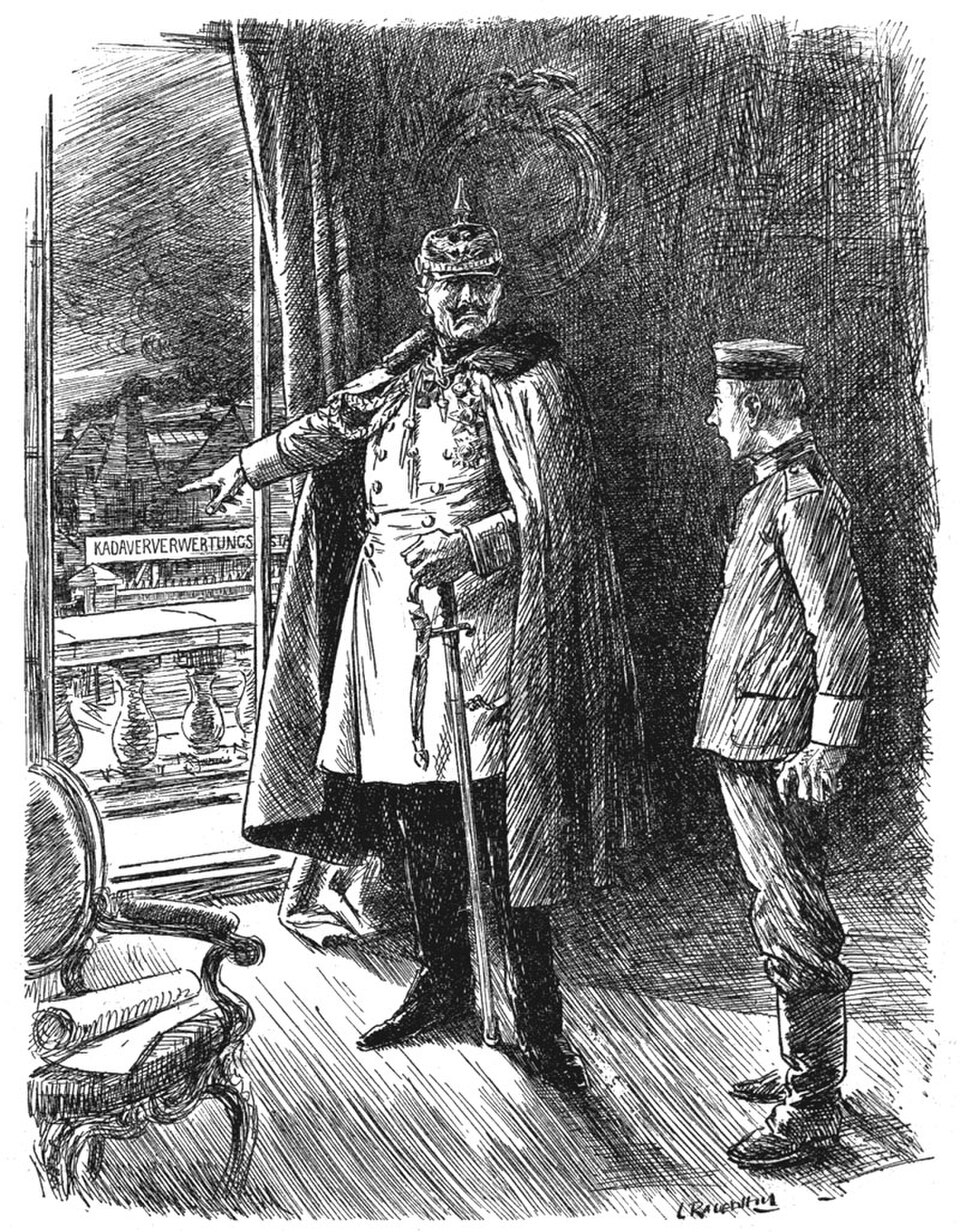
"Cannon-Fodder—and After," cartoon by Leonard Raven-Hill, Punch, 25 April 1917: Kaiser Wilhelm II points to a factory labeled "Kadaververwertungs[anstalt]" and tells a recruit, "And don't forget that your Kaiser will find a use for you—alive or dead." Source: Wikimedia Commons. Public domain (published 1917).

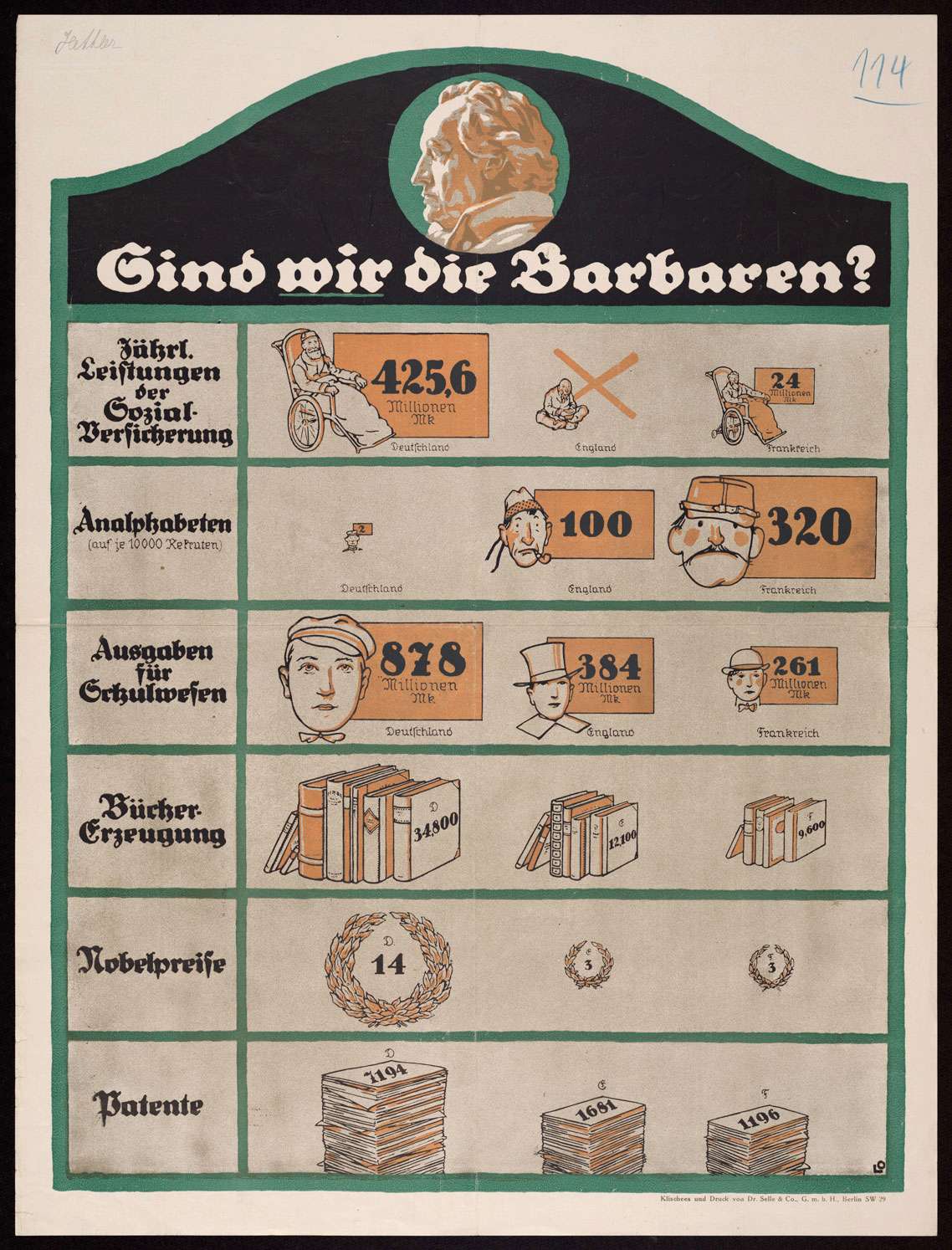
"Sind wir die Barbaren?" (Are We the Barbarians?), German poster by Louis Oppenheim, 1916, answering Allied charges of German barbarism with a comparison of Germany, England and France. From the FRAME gallery: Sind wir die Barbaren? (Are We the Barbarians?)
- Iraq, 2003. Retracted battlefield reports continued to shape American beliefs even among people who knew of the retraction [3].
- Fact-checking campaign claims, 2016. Experiments on corrections of Donald Trump's campaign statements found that fact-checks made supporters more accurate about the facts but did not change how much they liked him [8]. Wood and Porter found the same pattern of successful correction for misstatements by Democratic and Republican figures [6].
- Congenial claims on either side. In the 2010 experiments, conservatives resisted corrections on Iraq and tax revenue while liberals resisted a correction on stem cell funding [5]. Resistance to unwelcome corrections appeared on both sides, though the stronger backfire pattern in that study appeared only among conservatives, on the Iraq and tax items.
How to spot it
- A claim is repeated after it has been corrected, often with "questions remain" or "reports suggested."
- A correction only negates ("that is false") without explaining what actually happened, leaving the original story in place.
- The false claim arrived first and loudly; the correction arrived later and quietly.
- Notice what you still "know" about an event and check whether its source was ever retracted.
Persuasion or manipulation?
Being first with a clear, memorable explanation is a legitimate advantage when the explanation is true, and honest corrections that supply the accurate story are the most effective kind. The mechanism turns manipulative when a sender releases a claim it cannot support, relying on the fact that a later retraction will not fully undo it, or keeps repeating a debunked claim so the residue builds up. Honest writing corrects its own errors as prominently as it made them and replaces the false account with the accurate one.
Archive techniques that lean on this
- Sleeper effect — Sleeper effect: a discounted claim outlives its discounting cue, the same residue the continued influence effect measures.
- Firehosing — Firehosing: high-volume first claims outrun any correction, and each leaves some residue behind.
Related topics
- Illusory truth effect — Illusory truth effect
- Motivated reasoning — Motivated reasoning
- Confirmation bias — Confirmation bias
- Narrative transportation — Narrative transportation
Sources
- Johnson, H. M., & Seifert, C. M. (1994). Sources of the continued influence effect: When misinformation in memory affects later inferences. Journal of Experimental Psychology: Learning, Memory, and Cognition, 20(6), 1420–1436.
- Lewandowsky, S., Ecker, U. K. H., Seifert, C. M., Schwarz, N., & Cook, J. (2012). Misinformation and its correction: Continued influence and successful debiasing. Psychological Science in the Public Interest, 13(3), 106–131. https://doi.org/10.1177/1529100612451018
- Lewandowsky, S., Stritzke, W. G. K., Oberauer, K., & Morales, M. (2005). Memory for fact, fiction, and misinformation: The Iraq War 2003. Psychological Science, 16(3), 190–195.
- Walter, N., & Tukachinsky, R. (2020). A meta-analytic examination of the continued influence of misinformation in the face of correction: How powerful is it, why does it happen, and how to stop it? Communication Research, 47(2), 155–177.
- Nyhan, B., & Reifler, J. (2010). When corrections fail: The persistence of political misperceptions. Political Behavior, 32(2), 303–330.
- Wood, T., & Porter, E. (2019). The elusive backfire effect: Mass attitudes' steadfast factual adherence. Political Behavior, 41(1), 135–163.
- Swire-Thompson, B., DeGutis, J., & Lazer, D. (2020). Searching for the backfire effect: Measurement and design considerations. Journal of Applied Research in Memory and Cognition, 9(3), 286–299. https://doi.org/10.1016/j.jarmac.2020.06.006
- Nyhan, B., Porter, E., Reifler, J., & Wood, T. J. (2020). Taking fact-checks literally but not seriously? The effects of journalistic fact-checking on factual beliefs and candidate favorability. Political Behavior, 42(3), 939–960.
- Ponsonby, A. (1928). Falsehood in War-Time: Containing an Assortment of Lies Circulated Throughout the Nations During the Great War. George Allen & Unwin.
Images
| Image | Source | Licence |
|---|---|---|
| Flow diagram: the warehouse-fire experiment (Johnson and Seifert 1994) | Drawn by FRAME from source 1 (make_cognitive_bias_diagrams.py) |
CC BY 4.0, FRAME |
| "Cannon-Fodder—and After," Punch (25 April 1917) | Wikimedia Commons | Public domain (published 1917; artist died 1942) |
| Sind wir die Barbaren? (1916) | FRAME gallery, Sind wir die Barbaren? (Are We the Barbarians?) | Public domain |
Image gaps
Photographs or screenshots of the retracted 2003 battlefield reports and of fact-check experiments were not sourced from open collections, so they are cited, not hosted.