Fear appeal:when the warning comes with only one way out
Illustration, not an archive object
By the end: Tell a proportionate warning from a fear appeal, and check whether the message gives size, likelihood and more than one response. About 8 minutes.
What it is
Definition
Imminent harm is staged so the audience accepts the offered protection without comparing base rates or alternatives.
The tell
Catastrophe language plus a single prescribed remedy; no time for tradeoffs.
Not this
A dated, sourced warning with magnitude and uncertainty.
A fear appeal stages an imminent harm so that the audience accepts the one protection on offer, without comparing it to base rates or alternatives.
The idea goes back to Aristotle's account of pathos. It became a mass-produced genre in the recruitment and home-front posters of the two world wars.
Fear itself is not the test. A frightening subject is fine. What matters is what the message leaves out.
Illustration, not an archive object How it works
A fear appeal has four parts:
- A concrete threat. A face, a figure, a colour on a chart.
- Closeness. The harm looks near in place and time.
- One remedy. Enlist, buy the bond, stay silent, vote, do not smoke.
- An omission. How likely the harm is, how large it is next to other risks, what the remedy costs, and whether another remedy exists.
The omission is the heart of it. A warning that carries its size and its uncertainty is not this technique, however frightening its subject.
The remedy is always what the sender wants, which is why the missing comparison matters.
Why it works on people
Fear can move people, but only under some conditions.
- Efficacy. Kim Witte's model (1992) predicts that people act on a recommendation when they feel both a high threat and a high ability to respond. If they feel the threat but not the ability, they tend to avoid the message. Meta-analyses by Witte and Allen (2000) and by Tannenbaum and colleagues (2015) found fear appeals persuasive on average, more so with an efficacy message and a one-time action. That is why they end on one easy remedy.
- Vividness. Tversky and Kahneman (1973) showed that vivid harms feel more frequent than they are. Paul Slovic (1987) found that "dread" risks are judged more serious than their frequency implies.
Same device, different stakes (1 of 3)
Three real objects from the archive. The technique is the same in each; the setting, the choice the audience had and what was at stake are not.
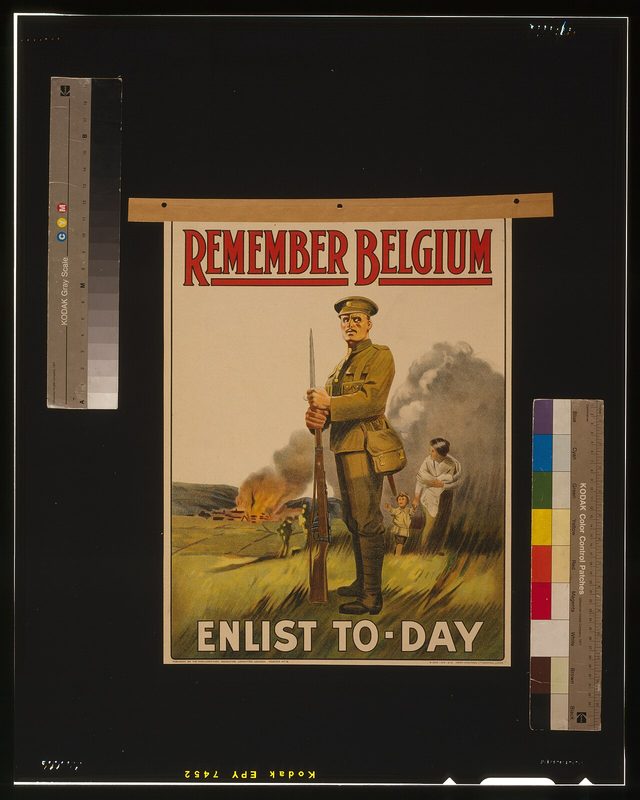
Remember Belgium — Enlist To-Day · 1915 · Parliamentary Recruiting Committee (United Kingdom) · Full record Notice: A soldier stands between the viewer and a woman and child fleeing a burning village. The 1914 invasion of Belgium was real and documented; the poster compresses it into one silhouette so that enlisting reads as the only response. Later research (Horne and Kramer, 2001) counted about 6,500 civilians killed in 1914 and found no evidence for some widely circulated stories, such as children's severed hands.
Same device, different stakes (2 of 3)
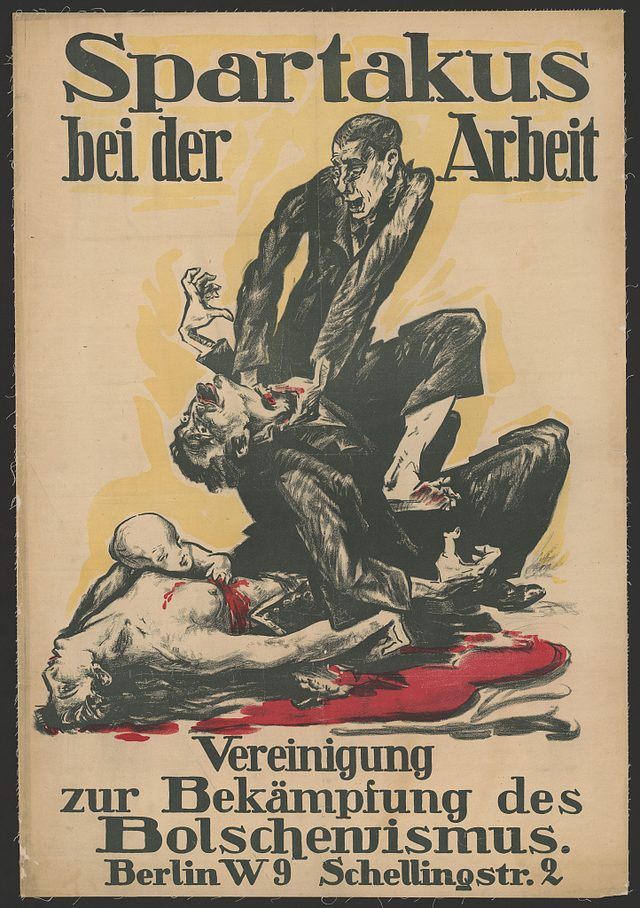
Spartakus bei der Arbeit (Spartacus at Work) · 1919 · Vereinigung zur Bekämpfung des Bolschewismus, Berlin; artist unknown · Full recordContent note: Graphic violence: a strangling above a woman and infant lying in blood. Notice: A gaunt man strangles another man while a woman and an infant lie in blood. No incident, place or date is named. Unlike the Belgium poster, it does not refer to a documented event: it makes a domestic political faction, the Spartacus League, the author of a generic family murder, and offers the sponsoring anti-Bolshevik association as the only remedy.
Same device, different stakes (3 of 3)

Peace, Little Girl ("Daisy") · Sep 7, 1964 · Lyndon B. Johnson presidential campaign (Democratic); agency Doyle Dane Bernbach with Tony Schwartz · Full record Notice: A girl counts petals, then the picture cuts to a nuclear explosion. Goldwater is never named, so the link is left to the viewer. The remedy is a vote, not enlistment or a bond, and the audience was voters in a contested election choosing between two candidates.
Check yourself
A weather service issues a hurricane warning with a forecast track, probabilities and evacuation zones. It is frightening. Is it a fear appeal?
Show the answer
No. It gives size, uncertainty and options. The test is the missing comparison, not the fear. Right. A warning that names the threat, quantifies it and offers more than one response is legitimate even when alarming. It becomes a fear appeal when those parts are removed so the remedy is accepted without comparison.
Spot it in the archive

The Real Cost — "Your Skin" · Feb 4, 2014 · U.S. Food and Drug Administration, Center for Tobacco Products · Full recordContent note: Graphic body-horror imagery. In this 2014 television public-service ad from a US health agency, a teenager's face is shown with the skin visibly peeling away, to deter teenage smoking. Which technique is doing the work?
A slow harm is staged as instant bodily horror, with one remedy (do not smoke) and no timeframe or base rate. The health claim behind it is well documented, and a CDC-published evaluation associated the campaign with lower youth smoking initiation. The archive still tags the method, because it applies the same test to every sender and scores the method, not the purpose.
Show the answer
Fear appeal A slow harm is staged as instant bodily horror, with one remedy (do not smoke) and no timeframe or base rate. The health claim behind it is well documented, and a CDC-published evaluation associated the campaign with lower youth smoking initiation. The archive still tags the method, because it applies the same test to every sender and scores the method, not the purpose.
How to spot it, and what next
- Does the message say how likely the harm is, how many people it affects and over what period?
- Is only one remedy offered, and does the sender gain from it (recruits, votes, sales, compliance)?
- Is the closeness of the threat documented (a named plot, place or date) or only suggested by an image?
- Is a worst case or maximum penalty presented as the expected outcome?
Read the full page: Fear appeal in the technique library · All 92 examples in the collection