Area: Emotion and fear · Evidence: moderate (How we rate the evidence). The link between liking something and judging it safe and useful is robust and replicated; how far the feeling causes the judgment, rather than accompanying it, is less settled.
In brief
People often judge risks and benefits by consulting a quick feeling of good or bad about the thing in question. If they like it, they tend to see it as both beneficial and safe; if they dislike it, as both risky and useless. How dangerous something is and how useful it is are separate questions, so a message that shifts the feeling can shift both judgments at once without offering evidence on either.
What the research shows
"Affect" in psychology means the quick, often faint sense that something is good or bad. In a widely cited 1980 paper, Robert Zajonc argued that such reactions can arise very fast and do not always wait for deliberate thought [1].
Paul Slovic and colleagues turned this into a theory of risk judgment. Ali Alhakami and Slovic asked people to rate the risks and benefits of a range of activities and technologies [2]. Logically the two ratings could vary independently. Instead they were inversely related: things judged high in risk were judged low in benefit, and the reverse. The pattern tracked people's overall positive or negative feeling about each item.
Melissa Finucane and colleagues then tested whether feeling was doing the work [3]. In one study, putting people under time pressure, which leaves less room for careful analysis, made the inverse link between risk and benefit stronger. In another, people read short passages about technologies such as nuclear power, natural gas and food preservatives. Some were told only that the benefits were high. They then rated the risks as lower, even though they had been told nothing about risk. Others were told only that the risks were high, and rated the benefits as lower. Information about one side changed the feeling, and the feeling carried over to the other side.
Slovic, Finucane, Ellen Peters and Donald MacGregor gathered this work under the name "the affect heuristic" [4]. A heuristic is a mental shortcut. In their account, people carry a pool of positive and negative "tags" attached to things and draw on it because it is faster and easier than weighing pros and cons. Usually this works well enough. It misleads when the feeling is out of line with the facts, or when someone else has deliberately attached the feeling.
A related finding concerns probability. Yuval Rottenstreich and Christopher Hsee compared outcomes rich in feeling, such as a painful electric shock or a kiss from a favorite film star, with emotionally flat ones, such as a small cash loss [5]. People's valuations of the emotionally rich outcomes were much less sensitive to how likely those outcomes were. A small chance of something vivid and frightening can feel almost as bad as a large one.
Has it held up?
The core pattern has replicated well. In 2022 a team led by Emir Efendić and Gilad Feldman repeated the Finucane experiment in two large, well-powered studies with a stricter analysis [6]. They again found a strong negative relationship between judged risk and judged benefit across three technologies, and again found that telling people about high risk lowered judged benefit. One part did not replicate: highlighting low benefits did not raise judged risk. The effect of new information on the feeling, and through it on the other judgment, may be less symmetric than first reported.
Two limits are worth keeping in view. First, much of the evidence is correlational: people who like something rate it as safe, but that does not by itself show that liking produced the safety judgment. The experiments address this in part, not fully. Second, feelings are one input among several. When Thorsten Pachur, Ralph Hertwig and Florian Steinmann compared explanations for how people judge the risks of various causes of death, they found that recall of instances from people's own lives accounted for some judgments better than feelings did, and that the affect heuristic fit some kinds of judgment better than others [7].
How it shows up in political messaging
- Attaching dread to a candidate. The Lyndon Johnson campaign's "Daisy" advertisement, broadcast on NBC on September 7, 1964, shows a girl counting petals as a countdown begins; her eye fills the screen, then a nuclear explosion. Johnson's voice says "These are the stakes!" [8]. The spot offers no argument about his opponent Barry Goldwater's policies. It attaches the feeling of nuclear dread to the choice, and relies on viewers to make the connection (see Fear appeal).

Frame from "Peace, Little Girl" ("Daisy"), Lyndon B. Johnson presidential campaign (Democratic), broadcast 7 September 1964. From the FRAME gallery: Peace, Little Girl ("Daisy")
- Renaming a policy. Campaigners seeking repeal of the US federal estate tax popularized the term "death tax," a phrase that frames the tax as a penalty on dying itself [9]. The label changes the feeling before any figures are discussed (see Name-calling).
- Enemy imagery and its rebuttal. In the First World War, American posters such as Beat Back the Hun with Liberty Bonds gave the enemy a bloody, ape-like form, loading a whole nation with disgust and fear. German posters answered Allied charges of barbarism in part with statistical charts such as Sind wir die Barbaren? (Are We the Barbarians?), which offered its own selective comparison. The contrast shows the affect heuristic's advantage: a single image of a brute sets the feeling before a chart can be read (see Transfer).
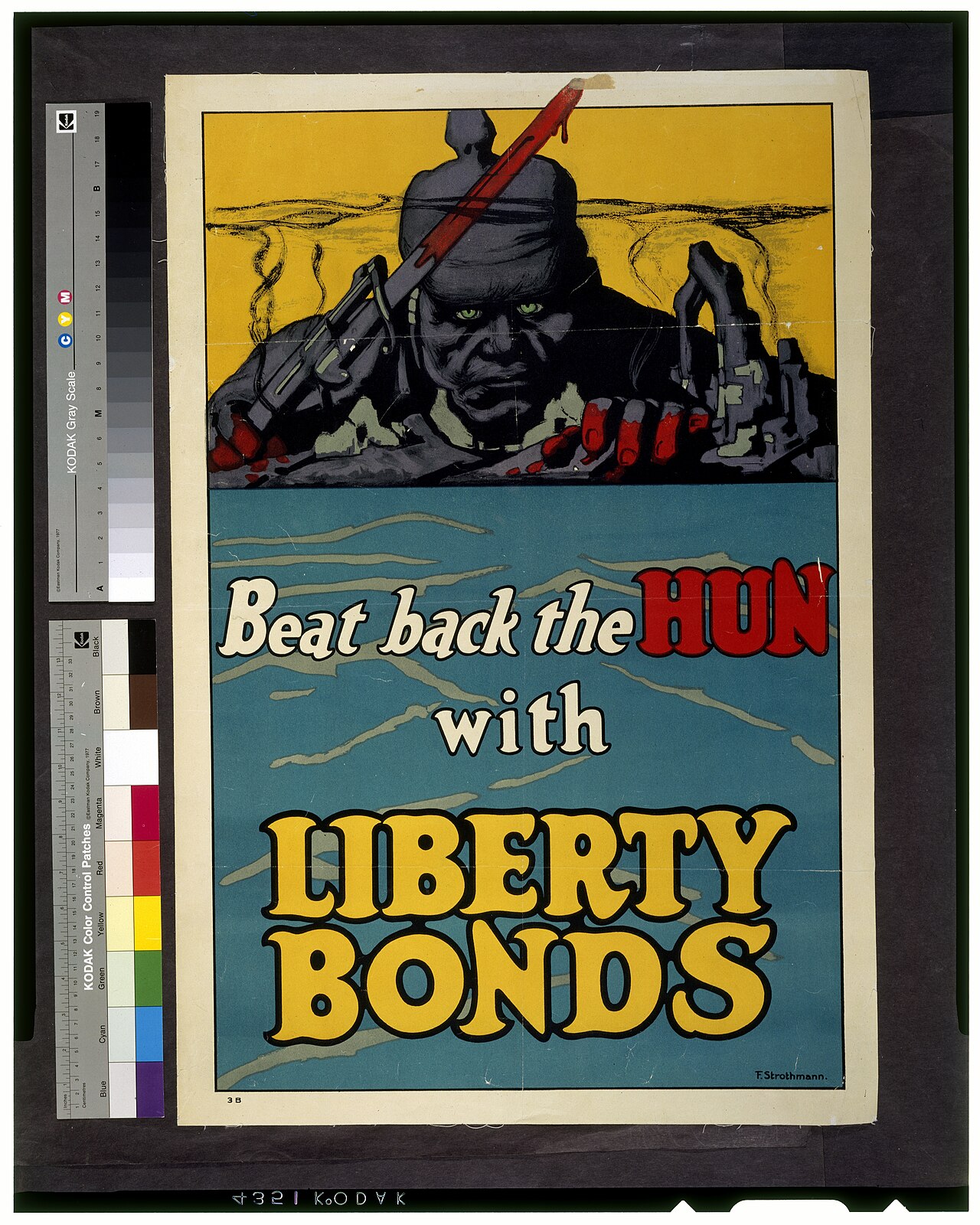
"Beat Back the Hun with Liberty Bonds," US poster, 1918. From the FRAME gallery: Beat Back the Hun with Liberty Bonds
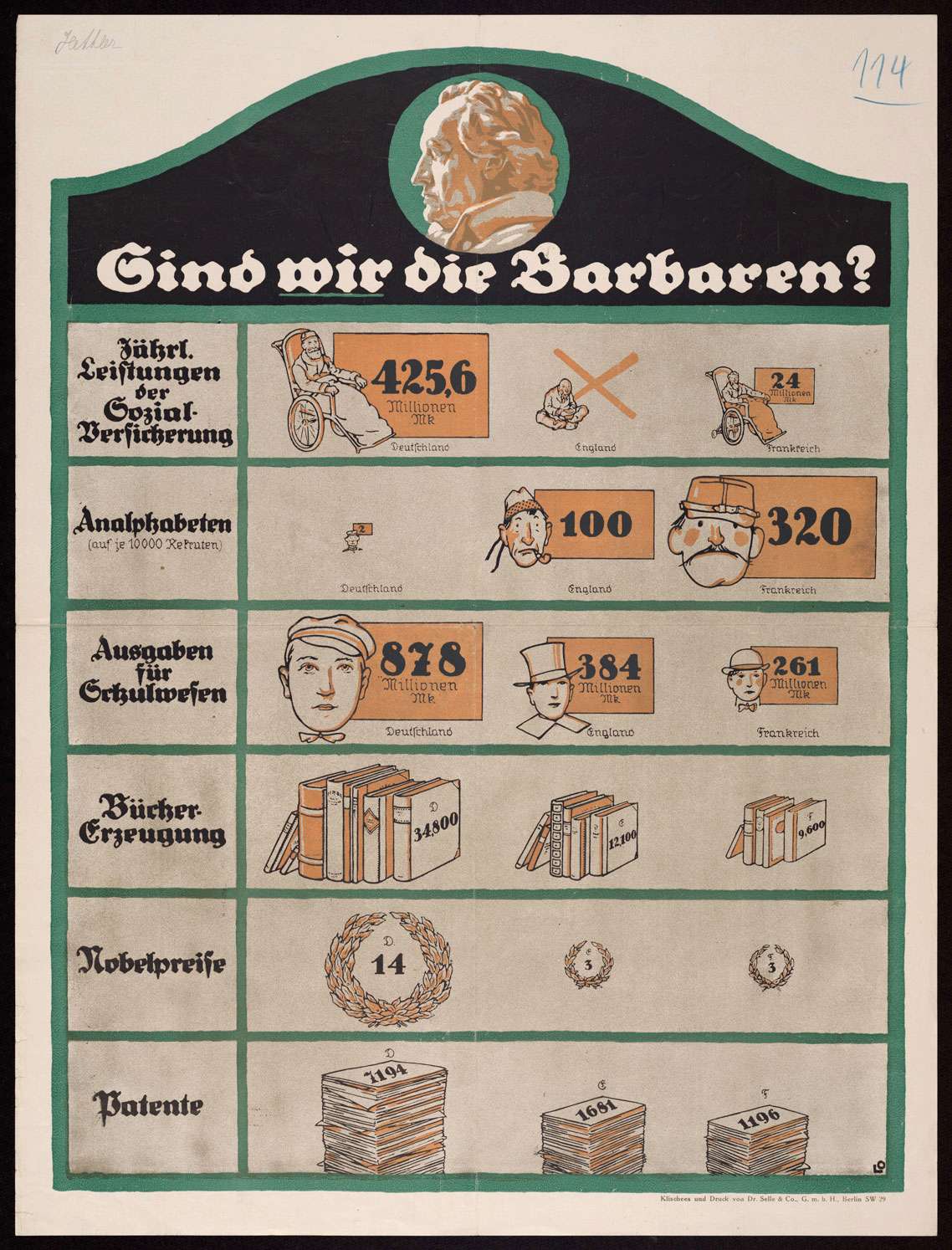
"Sind wir die Barbaren?" (Are We the Barbarians?), German statistical chart issued in 1916 in answer to Allied atrocity charges. From the FRAME gallery: Sind wir die Barbaren? (Are We the Barbarians?)
- Contested technology. When Slovic, James Flynn and Mark Layman asked people what came to mind when they thought of a proposed underground nuclear waste repository, the images were overwhelmingly negative, dominated by words such as "dangerous" and "death" [10]. The authors argued that this imagery, combined with low trust in the agencies responsible, made opposition to the proposed Yucca Mountain site in Nevada very hard to shift with technical reassurance.
How to spot it
- A label that carries a verdict ("death tax," "brute") where a description would do.
- Images of children, blood, explosions or disease attached to a policy without numbers.
- A thing presented as all risk and no benefit, or all benefit and no risk.
- Vivid possible harms with no statement of how likely they are.
- A quick self-check: before the feeling, what was the size of the risk, the size of the benefit, and the alternative?
Persuasion or manipulation?
Feelings about risk are not irrational, and honest writing can make readers feel the weight of a real danger. The honest version ties the feeling to something the reader can check: how large the risk is, how likely, compared with what, and what the benefits are. It tips into manipulation when a feeling is attached to a target by association alone (an image, a label, a juxtaposition) so that readers stop weighing benefits and costs, or when a vivid image is used to hide how small or uncertain the risk actually is.
Archive techniques that lean on this
- Fear appeal — Fear appeal: staged dread attaches a negative feeling to one option so the offered remedy is accepted without comparison.
- Name-calling — Name-calling: a loaded label sets the good-or-bad feeling before the claim is examined.
- Transfer — Transfer: borrowing stigma or prestige from a symbol pastes a ready-made feeling onto the target.
Related topics
- Fear messaging — Fear messaging
- Framing effect — Framing effect
- Availability heuristic — Availability heuristic
- Negativity bias — Negativity bias
- Disgust — Disgust
Sources
- Zajonc, R. B. (1980). Feeling and thinking: Preferences need no inferences. American Psychologist, 35(2), 151–175.
- Alhakami, A. S., & Slovic, P. (1994). A psychological study of the inverse relationship between perceived risk and perceived benefit. Risk Analysis, 14(6), 1085–1096. https://doi.org/10.1111/j.1539-6924.1994.tb00080.x
- Finucane, M. L., Alhakami, A., Slovic, P., & Johnson, S. M. (2000). The affect heuristic in judgments of risks and benefits. Journal of Behavioral Decision Making, 13(1), 1–17.
- Slovic, P., Finucane, M. L., Peters, E., & MacGregor, D. G. (2007). The affect heuristic. European Journal of Operational Research, 177(3), 1333–1352. https://doi.org/10.1016/j.ejor.2005.04.006
- Rottenstreich, Y., & Hsee, C. K. (2001). Money, kisses, and electric shocks: On the affective psychology of risk. Psychological Science, 12(3), 185–190.
- Efendić, E., Chandrashekar, S. P., Lee, C. S., Yeung, L. Y., Kim, M. J., Lee, C. Y., & Feldman, G. (2022). Risky therefore not beneficial: Replication and extension of Finucane et al.'s (2000) affect heuristic experiment. Social Psychological and Personality Science, 13(7), 1173–1184. https://doi.org/10.1177/19485506211056761
- Pachur, T., Hertwig, R., & Steinmann, F. (2012). How do people judge risks: Availability heuristic, affect heuristic, or both? Journal of Experimental Psychology: Applied, 18(3), 314–330.
- Library of Congress. (n.d.). [Peace, little girl: political spot] ("Daisy"), broadcast September 7, 1964, NBC. Tony Schwartz Collection. https://www.loc.gov/item/2024601043/
- Graetz, M. J., & Shapiro, I. (2005). Death by a thousand cuts: The fight over taxing inherited wealth. Princeton University Press.
- Slovic, P., Flynn, J. H., & Layman, M. (1991). Perceived risk, trust, and the politics of nuclear waste. Science, 254(5038), 1603–1607.
Images
| Image | Source | Licence |
|---|---|---|
| "Daisy" frame, 1964 | FRAME gallery, Peace, Little Girl ("Daisy") (provenance in the entry) | See entry |
| Beat Back the Hun, 1918 | FRAME gallery, Beat Back the Hun with Liberty Bonds (provenance in the entry) | See entry |
| Sind wir die Barbaren?, 1916 | FRAME gallery, Sind wir die Barbaren? (Are We the Barbarians?) (provenance in the entry) | See entry |
Image gaps
- Slovic and colleagues' risk-perception materials (Yucca Mountain imagery surveys) and the "death tax" campaign material: searched for; no openly licensed images found, so cited in the Sources rather than hosted.