
Area: Emotion and fear · Evidence: moderate (How we rate the evidence). People reliably mimic each other's expressions, and emotional language spreads online, but the measured effects on how people actually feel are small.
In brief
People tend to catch the moods of those around them: they mirror faces, voices and postures, and their own feelings can drift toward what they see. Face-to-face mimicry is well documented. Emotion spreading through screens is also real, but the measured effects are small, and much of what spreads online may be emotional wording rather than felt emotion.
What the research shows
Elaine Hatfield, John Cacioppo and Richard Rapson gave the idea its modern definition: a tendency to automatically mimic and synchronize with another person's expressions, voice, posture and movements, and as a result to converge with them emotionally [1]. Their model has two steps: people copy the outward signs of someone else's emotion, and feedback from those copied expressions then shifts their own feelings.
The first step has good support. In a study by Ulf Dimberg and colleagues, participants were shown happy, neutral or angry faces for 30 milliseconds, each immediately covered by a neutral face so that they could not consciously report what they had seen [2]. Sensors on their faces (electromyography, which records tiny muscle movements) still picked up smile-muscle activity in response to the happy faces and frown-muscle activity in response to the angry ones. Mimicry, in other words, can begin before awareness.
The largest test of contagion through media came from Facebook. For one week in January 2012, Adam Kramer, Jamie Guillory and Jeffrey Hancock altered the News Feeds of 689,003 users so that they saw fewer positive posts or fewer negative posts [3]. People shown fewer positive posts went on to write slightly fewer positive words and slightly more negative ones, and the reverse held for people shown fewer negative posts. The authors reported that the effects were tiny, with standardized effect sizes "as small as d = 0.001" [3]. One plain-language estimate put the change at roughly one emotional word per thousand words written over the following week [4]. The authors argued that such effects still matter when multiplied across a very large network [3].
The study also became a landmark ethics case. Users were not asked for consent and had no chance to opt out. The journal published an Editorial Expression of Concern, noting that Facebook, as a private company, was not bound by the US rules for research on human subjects, but that the data collection "may have involved practices that were not fully consistent with the principles of obtaining informed consent" [5].
Other work looks at emotion and sharing. William Brady and colleagues analyzed more than half a million tweets about three contested issues: gun control, same-sex marriage and climate change [6]. Each additional moral-emotional word in a tweet (words that carry both a moral judgment and a feeling) was associated with about a 20 percent increase in retweets. The spread was strongest inside like-minded networks, liberal and conservative alike, and weaker between them. Reviewing this literature, Amit Goldenberg and James Gross describe "digital emotion contagion" as a distinct process because it runs through platforms that have their own incentives to raise users' emotional engagement [7].
Has it held up?
Automatic mimicry of faces is among the better-established findings. The second step, from copying an expression to actually feeling the emotion, is weaker. A meta-analysis (a study that pools many studies) of 138 facial-feedback experiments found that changing people's facial expressions does affect how they feel, but the effect is small and varies a great deal across studies [8].
The Facebook experiment measured the words people posted, not what they felt. Critics argued that counting emotion words in status updates is a weak window into anyone's emotional state [9].
The online "moral contagion" finding has had a real test. Jason Burton, Nicole Cruz and Ulrike Hahn reanalyzed the approach and found that the moral-emotional model predicted new data no better than a deliberately implausible "XYZ contagion" model [10]. In response, Brady and colleagues ran a pre-registered replication and pooled 27 studies from five research groups, covering about 4.8 million posts [11]. Each additional moral-emotional word was associated with about 13 percent more shares, a smaller figure than the original 20 percent but consistent across datasets and methods. That result concerns what people share, not what they feel.
How it shows up in political messaging
- Filmed crowds as the message. Leni Riefenstahl's Triumph of the Will (1935) recorded the 1934 Nazi Party Congress at Nuremberg, attended by more than 700,000 supporters. Scenes were staged and rehearsed, and the film was later shown in German schools, where attendance was compulsory [12]. Its central image is a vast, synchronized, jubilant crowd offered to the viewer as a feeling to join.
Content note: Photograph of a Nazi Party rally with swastika banners and massed SA and SS ranks. This object is shown as it was published. Why 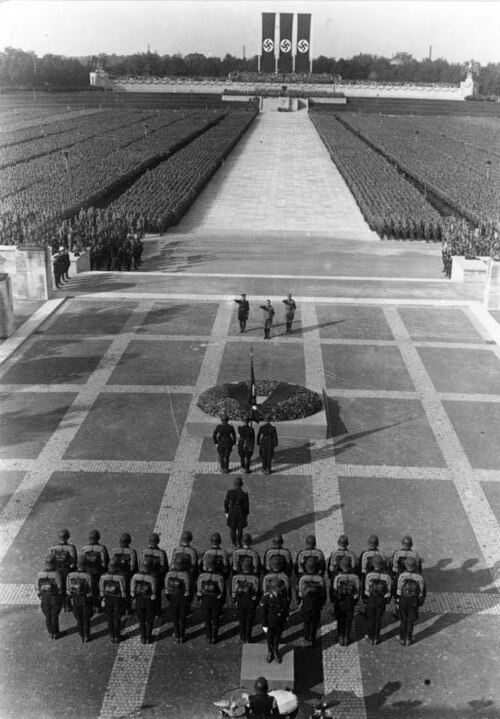
SA and SS roll call, Luitpold Arena, Nuremberg, Party Rally of 5–10 September 1934. Photo: Georg Pahl, Bundesarchiv, Bild 102-04062A. Source: Wikimedia Commons. CC BY-SA 3.0 DE.

- The leader's face. Denis Sullivan and Roger Masters showed viewers short televised excerpts of political leaders, including President Ronald Reagan, displaying happiness and reassurance, anger and threat, or fear and evasion. They recorded both self-reported feelings and facial muscle activity [13]. Viewers' emotional responses tracked the displays, and those responses were linked to their support for the leader alongside their existing party loyalties.
- The audience as a cue. Steven Fein, George Goethals and Matthew Kugler edited the 1984 Reagan–Mondale debate, removing either Reagan's one-liners or the audience's laughter and applause after them. In later experiments, viewers saw supposed reactions from fellow participants or sat beside planted confederates during a live debate. In every study, the reactions of others produced large shifts in judgments of who performed well [14]. Reaction shots and cheering clips work partly this way, for candidates of every party.

Crowd at the March on Washington for Jobs and Freedom, seen from the Lincoln Memorial, 28 August 1963. Photo: Warren K. Leffler, US News & World Report collection. From the FRAME gallery: Civil rights March on Washington, D.C.
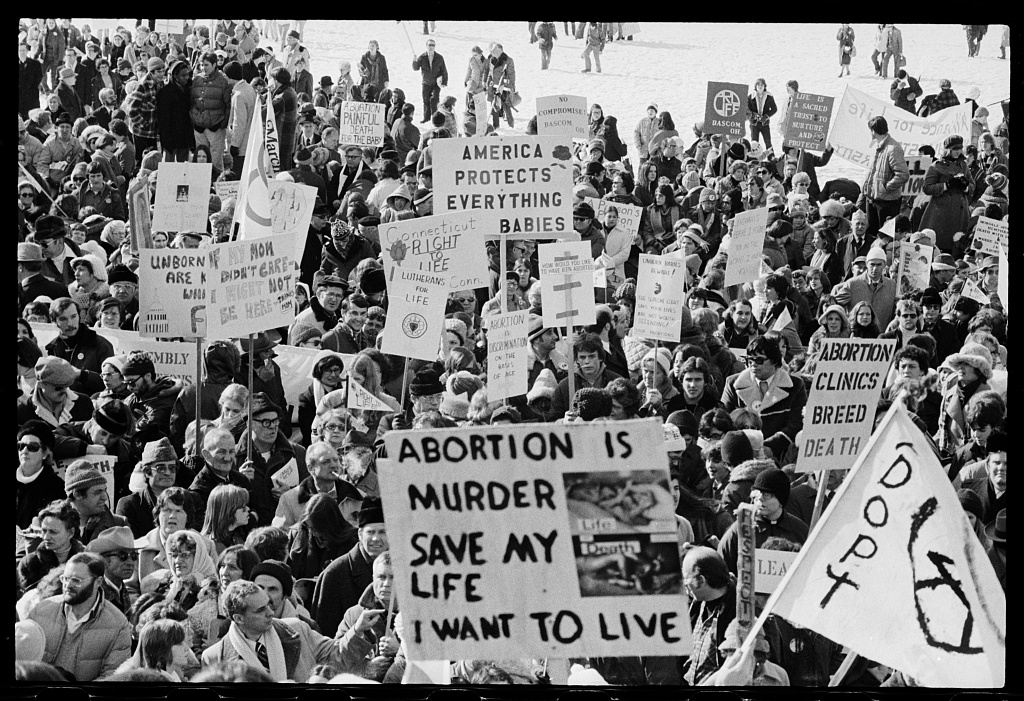
"Right to Life" demonstration, Washington, 23 January 1978. From the FRAME gallery: "Right to Life" demonstration, at White House and Capitol
- Moral-emotional language online. The tweets Brady's team studied came from both sides of each issue, and the pattern held on the left and the right [6]. Posts that pair a moral charge with strong feeling travel further within each camp, which is the mechanism Outrage bait depends on.
How to spot it
- Cutaways to cheering, weeping or furious crowds in place of evidence.
- Applause, laughter or "the room erupted" doing the work of an argument (a form of Bandwagon).
- Short posts stacked with words like "disgusting," "evil" or "shameful" and little information.
- A feed where everyone seems to feel the same thing at the same moment.
- A useful check after reading or watching: what fact did you learn, and what feeling did you pick up?
Persuasion or manipulation?
Showing real emotion is not manipulation. A speaker who is angry about a documented harm, or a film that shows how people genuinely reacted to an event, is giving the audience true information about how others feel. Honest political writing can convey conviction and let readers see real people's reactions. It tips into manipulation when the emotion on display is manufactured (planted audiences, edited reaction shots, inflated crowds, coordinated accounts performing outrage) or when rising feeling is used in place of the facts that would let a reader judge the claim.
Archive techniques that lean on this
- Outrage bait — Outrage bait: moral-emotional wording is shared more within each camp, so the reader's fury does the distribution.
- Bandwagon — Bandwagon: visible crowd enthusiasm and audience reactions stand in for the merits of the claim.
Related topics
- Moral outrage — Moral outrage
- Social proof — Social proof
- Conformity — Conformity
- Group polarization — Group polarization
- Fear messaging — Fear messaging
Sources
- Hatfield, E., Cacioppo, J. T., & Rapson, R. L. (1993). Emotional contagion. Current Directions in Psychological Science, 2(3), 96–100. https://doi.org/10.1111/1467-8721.ep10770953
- Dimberg, U., Thunberg, M., & Elmehed, K. (2000). Unconscious facial reactions to emotional facial expressions. Psychological Science, 11(1), 86–89. https://doi.org/10.1111/1467-9280.00221
- Kramer, A. D. I., Guillory, J. E., & Hancock, J. T. (2014). Experimental evidence of massive-scale emotional contagion through social networks. Proceedings of the National Academy of Sciences, 111(24), 8788–8790. https://doi.org/10.1073/pnas.1320040111
- Pew Research Center. (2014, July 2). Facebook's experiment causes a lot of fuss for little result. https://www.pewresearch.org/short-reads/2014/07/02/facebooks-experiment-is-just-the-latest-to-manipulate-you-in-the-name-of-research/
- Verma, I. M. (2014). Editorial expression of concern: Experimental evidence of massive-scale emotional contagion through social networks. Proceedings of the National Academy of Sciences, 111(29). https://doi.org/10.1073/pnas.1412469111
- Brady, W. J., Wills, J. A., Jost, J. T., Tucker, J. A., & Van Bavel, J. J. (2017). Emotion shapes the diffusion of moralized content in social networks. Proceedings of the National Academy of Sciences, 114(28), 7313–7318. https://doi.org/10.1073/pnas.1618923114
- Goldenberg, A., & Gross, J. J. (2020). Digital emotion contagion. Trends in Cognitive Sciences, 24(4), 316–328.
- Coles, N. A., Larsen, J. T., & Lench, H. C. (2019). A meta-analysis of the facial feedback literature: Effects of facial feedback on emotional experience are small and variable. Psychological Bulletin, 145(6), 610–651.
- Panger, G. (2016). Reassessing the Facebook experiment: Critical thinking about the validity of Big Data research. Information, Communication & Society, 19(8), 1108–1126. https://doi.org/10.1080/1369118X.2015.1093525
- Burton, J. W., Cruz, N., & Hahn, U. (2021). Reconsidering evidence of moral contagion in online social networks. Nature Human Behaviour, 5(12), 1629–1635. https://doi.org/10.1038/s41562-021-01133-5
- Brady, W. J., Rathje, S., Globig, L. K., & Van Bavel, J. J. (2025). Estimating the effect size of moral contagion in online networks: A pre-registered replication and meta-analysis. PNAS Nexus, 4(11), pgaf327. https://doi.org/10.1093/pnasnexus/pgaf327
- United States Holocaust Memorial Museum. (n.d.). Propaganda film: Triumph of the Will. Experiencing History: Holocaust Sources in Context. https://perspectives.ushmm.org/item/propaganda-film-triumph-of-the-will
- Sullivan, D. G., & Masters, R. D. (1988). "Happy warriors": Leaders' facial displays, viewers' emotions, and political support. American Journal of Political Science, 32(2), 345–368. https://doi.org/10.2307/2111127
- Fein, S., Goethals, G. R., & Kugler, M. B. (2007). Social influence on political judgments: The case of presidential debates. Political Psychology, 28(2), 165–192. https://doi.org/10.1111/j.1467-9221.2007.00561.x
Images
| Image | Source | Licence |
|---|---|---|
| SA and SS roll call, Luitpold Arena, Nuremberg, 1934 | Wikimedia Commons, Georg Pahl, Bundesarchiv Bild 102-04062A | CC BY-SA 3.0 DE |
| March on Washington, 1963 | FRAME gallery, Civil rights March on Washington, D.C. (provenance in the entry) | See entry |
| Right to Life demonstration, 1978 | FRAME gallery, "Right to Life" demonstration, at White House and Capitol (provenance in the entry) | See entry |
Image gaps
- Frames from Triumph of the Will (1935) and from the 1984 Reagan–Mondale debate broadcast, and the tweets in the Brady study: not verified as open, not hosted.