Area: Group identity · Evidence: moderate (How we rate the evidence). The basic effect is real and repeatable, but field effects are usually small and some famous demonstrations replicated only partly.
In brief
When people are unsure what to think or do, they look at what others around them are doing and treat it as evidence. Researchers call information about what most people actually do a "descriptive norm." Messages that report such norms reliably nudge behavior, though usually by modest amounts, and they work best when the "others" seem similar and nearby. Because the cue is the crowd rather than the argument, social proof is also the psychology that faked crowds try to exploit.
What the research shows
The term "social proof" was popularized by the psychologist Robert Cialdini, who listed it among six broad principles of influence: we decide what is correct partly by finding out what other people think is correct, especially when a situation is ambiguous and the others resemble us [1].
One of the simplest demonstrations came on a New York sidewalk. Stanley Milgram, Leonard Bickman and Lawrence Berkowitz had groups of 1 to 15 confederates (people working for the researchers) stop and stare up at a sixth-floor window for a minute, then counted how 1,424 passersby reacted. The bigger the staring crowd, the larger the share of pedestrians who looked up, and the more who stopped to stare too [2]. Nobody told anyone to look. The crowd's behavior was treated as a sign that something was worth seeing.
Cialdini, Raymond Reno and Carl Kallgren later drew a distinction that matters for anyone reading political messages. A descriptive norm says what people do. An injunctive norm says what people approve or disapprove of. In field experiments on littering, a littered environment (a descriptive cue that "people litter here") increased littering, while a clean one reduced it, and norms steered behavior mainly when people's attention was drawn to them [3]. The practical lesson is that a message which complains "everyone is doing the bad thing" can accidentally advertise the bad thing as normal.
The most cited applied study took the idea into hotel bathrooms. Noah Goldstein, Cialdini and Vladas Griskevicius compared the standard "help save the environment" towel card with cards saying that most guests reuse their towels. The descriptive-norm cards produced more towel reuse, and the most effective version said that most previous guests in the same room had done so, a very local reference group [4].

Drawn by FRAME from Bohner and Schlüter (2014) [6], first study. CC BY 4.0 (FRAME).
Has it held up?
Mostly, with caveats about size. A 2020 meta-analysis (a study that pools the results of many studies) by Nancy Rhodes, Hillary Shulman and Nikki McClaran combined findings from 110 articles and found consistent support for social-norm messages across many outcomes, but the effects were generally small [5].
The hotel-towel study shows how a headline finding can shrink. When Gerd Bohner and Lena Schlüter repeated it in two German hotels, the same-room norm message again produced the highest reuse rate in their first study (49.3 percent, against 42.8 percent for the other norm messages combined and 37.2 percent for the standard environmental message), but in their smaller second study (204 guests) the norm messages worked no better than the standard environmental message, and the same-room advantage did not reappear consistently [6]. The advantage of norm messages over a standard appeal proved fragile.
Evidence from elections is similar. In a large Dutch survey experiment with more than 23,000 participants, Tom van der Meer and colleagues found that simply showing poll standings did not change vote intentions, though emphasizing that a party was rising in the polls produced a small bandwagon effect [7]. Matthew Barnfield's review of the field argues that "bandwagon effect" has been used loosely for several different things, which makes the overall literature hard to sum up [8].
How it shows up in political messaging
- Wartime participation drives. The US Treasury's World War II payroll-savings campaign used workplace participation itself as the pitch: flags, window cards and "everybody at least 10 percent" quotas made buying bonds look like what the whole shop was already doing. See Let's Fly This Flag: Everybody at Least 10 Percent in War Bonds.
- Get-out-the-vote messages. In two field experiments, Alan Gerber and Todd Rogers found that telling people turnout was expected to be high motivated them more than warning that turnout would be low, especially among occasional voters [9]. Campaigns of every party now use "your neighbors are voting" framing, which is honest when the turnout figures are real.
- State-run fake crowds. Gary King, Jennifer Pan and Margaret Roberts estimated that the Chinese government fabricates roughly 448 million social media posts a year, written as if by ordinary citizens, mostly cheerleading and distraction rather than argument [10]. The aim is to shape what the online crowd appears to be saying.
- Western state-linked fake accounts. In 2022 the Stanford Internet Observatory and Graphika analyzed networks of accounts that Twitter and Meta had removed for coordinated inauthentic behavior. The accounts posed as local voices in Central Asia and the Middle East while promoting pro-Western narratives, and Twitter named the United States and Britain as presumptive countries of origin [12]. In 2024 Reuters reported that the US military had run fake social media accounts in the Philippines during the COVID-19 pandemic to cast doubt on China's Sinovac vaccine [13]. State use of fabricated crowds is not limited to any one bloc.
- Impostor accounts across borders. The US Senate Intelligence Committee's bipartisan 2019 report found that Russia's Internet Research Agency ran social media personas posing as ordinary Americans on both the left and the right, targeting divisive issues such as race, immigration and guns [11]. Apparent grassroots voices on each side were, in part, one operation.
- Poll momentum. Candidates and parties across democracies advertise surges, crowd sizes and "the tide" as reasons to join, which is the move the Dutch experiment found had a small real effect [7].
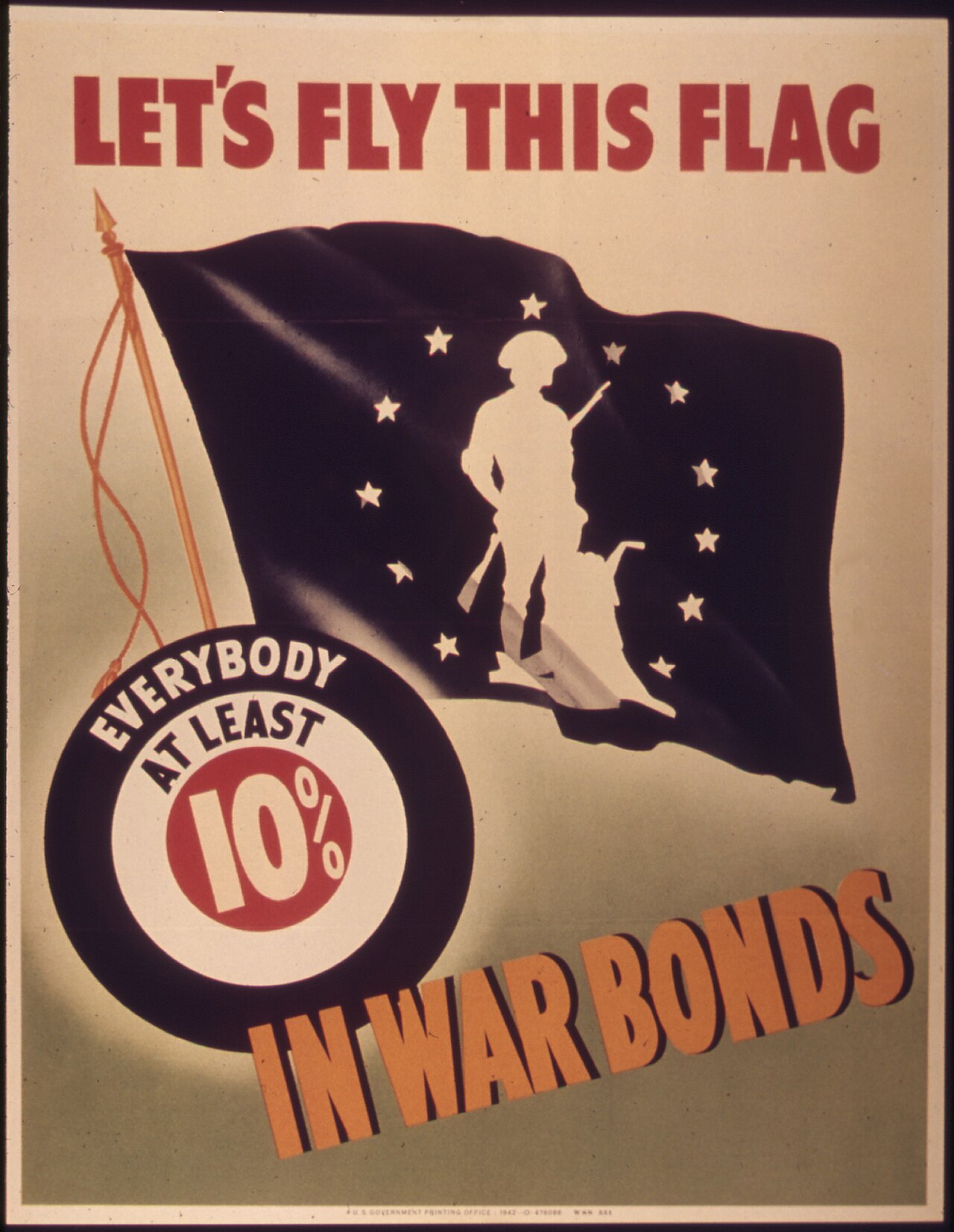
Let's Fly This Flag: Everybody at Least 10 Percent in War Bonds: U.S. Treasury Department War Bonds payroll-savings poster, 1943. Participation itself as the pitch. Public domain (U.S. government work).
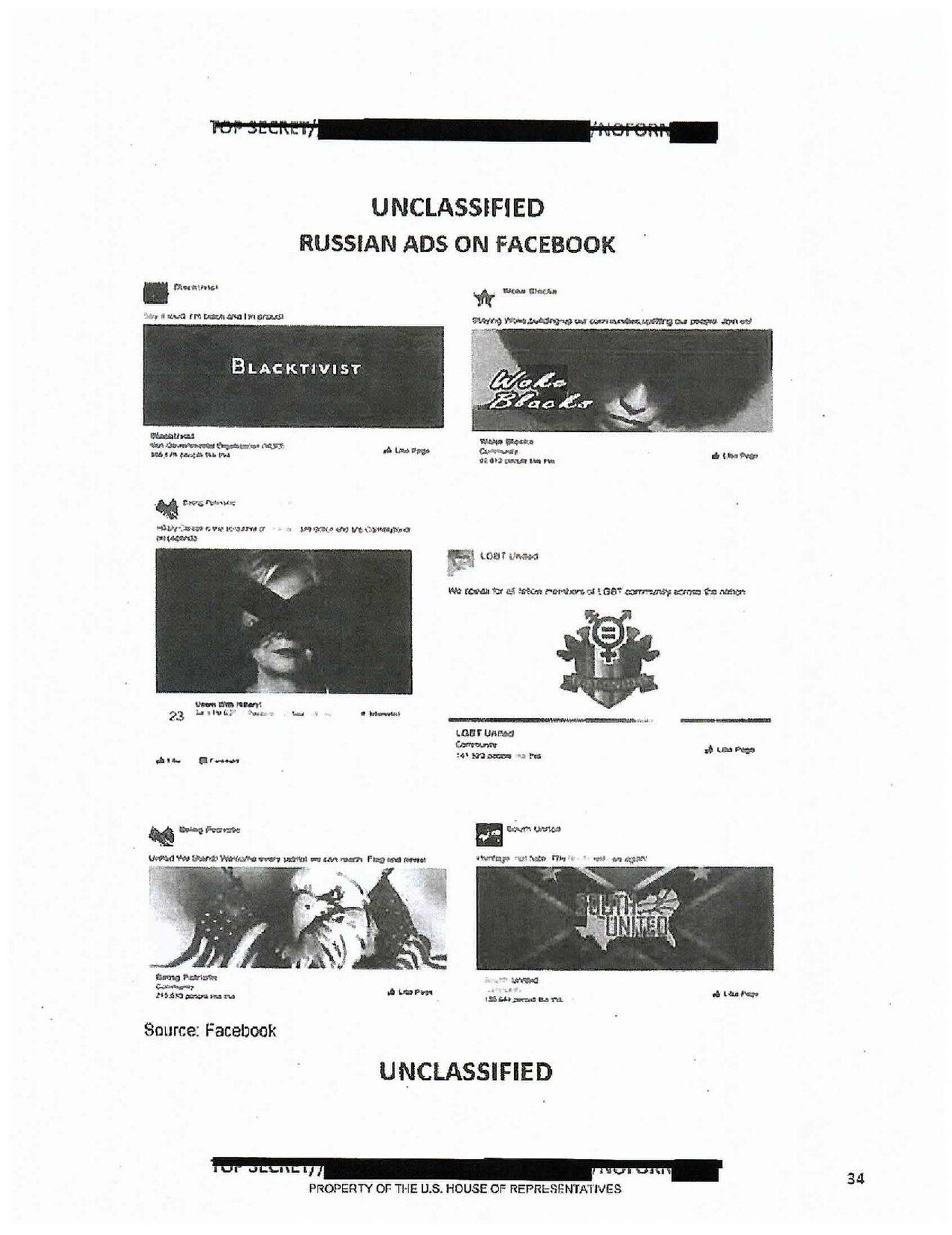
'Russian Ads on Facebook' (House Intelligence Committee exhibit): Exhibit from the House Permanent Select Committee on Intelligence, 2018, reproducing pages the Internet Research Agency ran while posing as American communities, 2016. Public domain (U.S. government work).
How to spot it
- The main reason offered is how many people agree, not why they are right.
- Crowd size, follower counts, trending status or "momentum" are presented without a source or method.
- The "people like you" in the message are vague ("patriots," "real Americans," "everyone on the right side of history").
- Many accounts or outlets repeat the same phrasing at the same time, which may signal one origin rather than independent agreement.
- A complaint that "everyone is doing" something bad, which can quietly normalize it.
Persuasion or manipulation?
Reporting a real, well-measured majority is legitimate. If most of a community genuinely supports a measure, saying so, with the source of the figure, gives readers true information about their neighbors. Social proof becomes manipulation when the crowd is invented or inflated: fake accounts, rented supporters, cherry-picked polls, or a handful of voices made to look like many. The test is whether a reader could check where the numbers come from and whether the voices are independent.
Archive techniques that lean on this
- Bandwagon — Bandwagon: treats popularity or momentum as proof, the everyday political form of social proof.
- Manufactured consensus — Manufactured consensus: stages the appearance that independent voices converged, borrowing the credibility social proof gives to agreement.
- Astroturfing — Astroturfing: supplies a fake crowd so that social proof has something to point at.
Related topics
- Conformity — Conformity
- Pluralistic ignorance — Pluralistic ignorance
- Group polarization — Group polarization
- Illusory truth effect — Illusory truth effect
Sources
- Cialdini, R. B. (2009). Influence: Science and practice (5th ed.). Boston: Pearson Education.
- Milgram, S., Bickman, L., & Berkowitz, L. (1969). Note on the drawing power of crowds of different size. Journal of Personality and Social Psychology, 13(2), 79–82. https://doi.org/10.1037/h0028070
- Cialdini, R. B., Reno, R. R., & Kallgren, C. A. (1990). A focus theory of normative conduct: Recycling the concept of norms to reduce littering in public places. Journal of Personality and Social Psychology, 58(6), 1015–1026. https://doi.org/10.1037/0022-3514.58.6.1015
- Goldstein, N. J., Cialdini, R. B., & Griskevicius, V. (2008). A room with a viewpoint: Using social norms to motivate environmental conservation in hotels. Journal of Consumer Research, 35(3), 472–482. https://doi.org/10.1086/586910
- Rhodes, N., Shulman, H. C., & McClaran, N. (2020). Changing norms: A meta-analytic integration of research on social norms appeals. Human Communication Research, 46(2–3), 161–191. https://doi.org/10.1093/hcr/hqz023
- Bohner, G., & Schlüter, L. E. (2014). A room with a viewpoint revisited: Descriptive norms and hotel guests' towel reuse behavior. PLoS ONE, 9(8), e104086. https://doi.org/10.1371/journal.pone.0104086
- van der Meer, T. W. G., Hakhverdian, A., & Aaldering, L. (2016). Off the fence, onto the bandwagon? A large-scale survey experiment on effect of real-life poll outcomes on subsequent vote intentions. International Journal of Public Opinion Research, 28(1), 46–72.
- Barnfield, M. (2020). Think twice before jumping on the bandwagon: Clarifying concepts in research on the bandwagon effect. Political Studies Review. https://doi.org/10.1177/1478929919870691
- Gerber, A. S., & Rogers, T. (2009). Descriptive social norms and motivation to vote: Everybody's voting and so should you. Journal of Politics, 71(1), 178–191. https://doi.org/10.1017/S0022381608090117
- King, G., Pan, J., & Roberts, M. E. (2017). How the Chinese government fabricates social media posts for strategic distraction, not engaged argument. American Political Science Review, 111(3), 484–501.
- US Senate Select Committee on Intelligence. (2019). Report on Russian active measures campaigns and interference in the 2016 U.S. election, Volume 2: Russia's use of social media. Washington, DC: US Senate. https://www.intelligence.senate.gov/2019/10/08/press-senate-intel-committee-releases-bipartisan-report-russia-e2-80-99s-use-social-media/
- Graphika & Stanford Internet Observatory. (2022, August 24). Unheard voice: Evaluating five years of pro-Western covert influence operations. Stanford Internet Observatory. https://purl.stanford.edu/nj914nx9540
- Bing, C., & Schectman, J. (2024, June 14). Pentagon ran secret anti-vax campaign to undermine China during pandemic. Reuters.
Images
| Image | Source | Licence |
|---|---|---|
| Bar chart: towel reuse by message (Bohner and Schlüter 2014) | Drawn by FRAME from the cited study (make_group_identity_charts.py) |
CC BY 4.0, FRAME |
| Let's Fly This Flag (1943) | FRAME gallery, Let's Fly This Flag: Everybody at Least 10 Percent in War Bonds | Public domain (U.S. government work) |
| IRA Facebook pages exhibit (2018) | FRAME gallery, 'Russian Ads on Facebook' (House Intelligence Committee exhibit) | Public domain (U.S. government work) |
Image gaps
No open image of the Milgram, Bickman and Berkowitz street crowd, of hotel towel cards, or of the state-run account networks discussed (Chinese, Western and Russian) was available; only the Russian operation has a cleared exhibit above, so the images on this page are not balanced across the state actors named in the text.