Also called Slopaganda, Engagement bait, Ragebait
Craft the item so the profitable reaction is fury, which then does the distribution.
The tell
The hook is an insult or desecration; the body is thin; comments are the product.
Not this
Reporting an actually outrageous, documented event.
History and effect
A product of engagement-optimized platform ranking, where the reaction that spreads fastest — fury — is the one content gets built around.
It converts the audience's anger into free distribution, while the underlying claim never has to survive scrutiny to succeed.
Lineage: Engagement-optimized distribution; 'slopaganda'
How it works
The item is designed backward from the reaction. The sender chooses a trigger the target audience already cares about (an insult to its group, the desecration of a symbol, an apparent double standard, a threat to children or animals), attaches it to a named villain, and removes context that might dampen the response. The body can be thin, exaggerated or false. What matters is the hook: the first line, the thumbnail, the image. Ranking systems that reward comments, shares and reactions then carry the item further than a calmer version of the same content would travel.
Two audiences do the work. People who agree share the item in anger at the villain. People who are its target share it in anger at the sender, often quote-posting it to condemn it. Both count as engagement, so rebuttal can extend reach. The Matryoshka's midterm clips: borrowed faces and a borrowed logo case shows an operation that sent its own fakes to fact-checkers so that warnings about the clips would carry them further. Motives vary: commercial senders earn advertising revenue per click, political senders want reach for a party or cause, and state influence operations use the same material to widen existing divisions in another country.
The method depends on four conditions. Distribution systems count reactions without weighing whether they are approving or hostile. The audience has real, pre-existing grievances that can be activated. Production is cheap, and generative tools have made it cheaper still, which is what the term "slopaganda" describes: mass-produced, low-effort synthetic items built for reaction rather than information. And the reaction comes before verification, because anger shortens the time between seeing and sharing. The claim underneath never has to survive scrutiny, since by the time it is checked the distribution has already happened.
Why it works
Jonah Berger and Katherine Milkman (2012) studied which New York Times articles readers emailed most and found that content evoking high-arousal emotions, including anger, was more likely to spread, while sadness, a low-arousal emotion, made sharing less likely. William Brady and colleagues (2017) found that tweets about contested political issues were retweeted more when they contained more moral-emotional words, an effect they called moral contagion. This finding is contested: Jason Burton, Nicole Cruz and Ulrike Hahn (2021) reanalyzed the approach and found the effect was not robust across datasets and specifications. Later work by Brady, Crockett and colleagues (2021) found that users who received more likes and retweets for outraged posts expressed more outrage in later posts, which suggests platforms train the behavior as well as spread it. FRAME's Learn library covers this in Moral outrage and Emotional contagion.
Molly Crockett (2017) argued that digital media lowers the cost of expressing outrage and raises its social reward, detaching it from the local stakes that once limited it. Steve Rathje, Jay Van Bavel and Sander van der Linden (2021) found that posts about a political out-group drew substantially more shares and comments than posts about the in-group, and that this held for both liberal and conservative accounts. Soroush Vosoughi, Deb Roy and Sinan Aral (2018) found that false news on Twitter spread farther and faster than true news, and that replies to false stories showed more surprise and disgust, which fits the outrage-bait pattern of emotional hooks on weak claims.
The link between ranking systems and attitudes is less settled than the link between emotion and sharing. Andrew Guess and colleagues (2023), in a large study run with Meta during the 2020 U.S. election, moved some users from ranked feeds to chronological ones for three months and found no measurable change in their polarization, although what they saw did change. The safest reading of the evidence is that outrage reliably increases spread, while its effect on what people believe over time is harder to show.
Examples across eras and sides
- Yellow journalism and the Maine (United States, 1890s). William Randolph Hearst's New York Journal and Joseph Pulitzer's New York World competed for circulation with sensational coverage of Spanish rule in Cuba, and after the USS Maine exploded in Havana harbor in February 1898 the Journal blamed an enemy before any inquiry had reported. The profit motive and the anger-driven hook are the pre-digital form of the technique. Historian W. Joseph Campbell argues that the press's role in causing the Spanish-American War has been overstated, so the case shows the method more clearly than its effect. (Sources: Campbell 2001)
- The Veles websites (North Macedonia, 2016). Young people in the town of Veles ran more than a hundred websites publishing U.S. political content during the 2016 campaign, much of it sensational or false, and promoted it on Facebook for advertising revenue. Their operators reported that the most inflammatory pro-Trump material earned the most, and the motive was commercial rather than ideological. (Sources: Silverman and Alexander 2016; Subramanian 2017)
- The Internet Research Agency on both sides (Russia, targeting the United States, 2015 to 2017). The Senate Intelligence Committee found that the IRA's social media content focused on socially divisive issues, with race the most frequent theme, and that it ran pages aimed at both left-leaning and right-leaning Americans at the same time ('Russian Ads on Facebook' (House Intelligence Committee exhibit)). The goal documented in the report was to widen existing divisions rather than to win one argument. (Sources: Senate Select Committee on Intelligence 2019; DiResta et al. 2018)
- Myanmar military accounts (Myanmar, 2010s). Reporting and a UN fact-finding mission found that members of Myanmar's military ran Facebook pages disguised as news and entertainment pages that spread inflammatory posts about Rohingya Muslims, and that Facebook had been a useful instrument for spreading hate in the country. This case ended in mass killing and the flight of hundreds of thousands of Rohingya, and is not comparable in scale to the other entries here. (Sources: Mozur 2018; UN Human Rights Council 2018)
- Facebook's 2018 ranking change and European parties (Europe, 2018 to 2021). Internal Facebook documents reported in 2021 showed that a 2018 change to reward "meaningful social interactions" also rewarded divisive content, and that political parties in Europe, including in Poland, told the company they had shifted toward more negative messaging as a result. Separate reporting found the ranking system had for a time weighted emoji reactions, including "angry," more heavily than likes. (Sources: Hagey and Horwitz 2021; Merrill and Oremus 2021)
- Members of Congress from both parties (United States, 2016 to 2020). Rathje and colleagues found that posts from Democratic and Republican members of Congress, and from liberal and conservative news outlets, drew more engagement when they attacked the other side. The incentive to post out-group anger applied across the spectrum rather than to one party. (Sources: Rathje, Van Bavel and van der Linden 2021)
- U.S. military accounts in the Philippines (2020 to 2021). A Reuters investigation found that the U.S. military ran fake social media accounts that sought to undermine confidence in China's Sinovac vaccine among Filipinos, including posts under a Tagalog hashtag meaning "China is the virus." The campaign mixed fear about the vaccine with resentment toward China, so it overlaps with Fear appeal. (Sources: Bing and Schectman 2024)
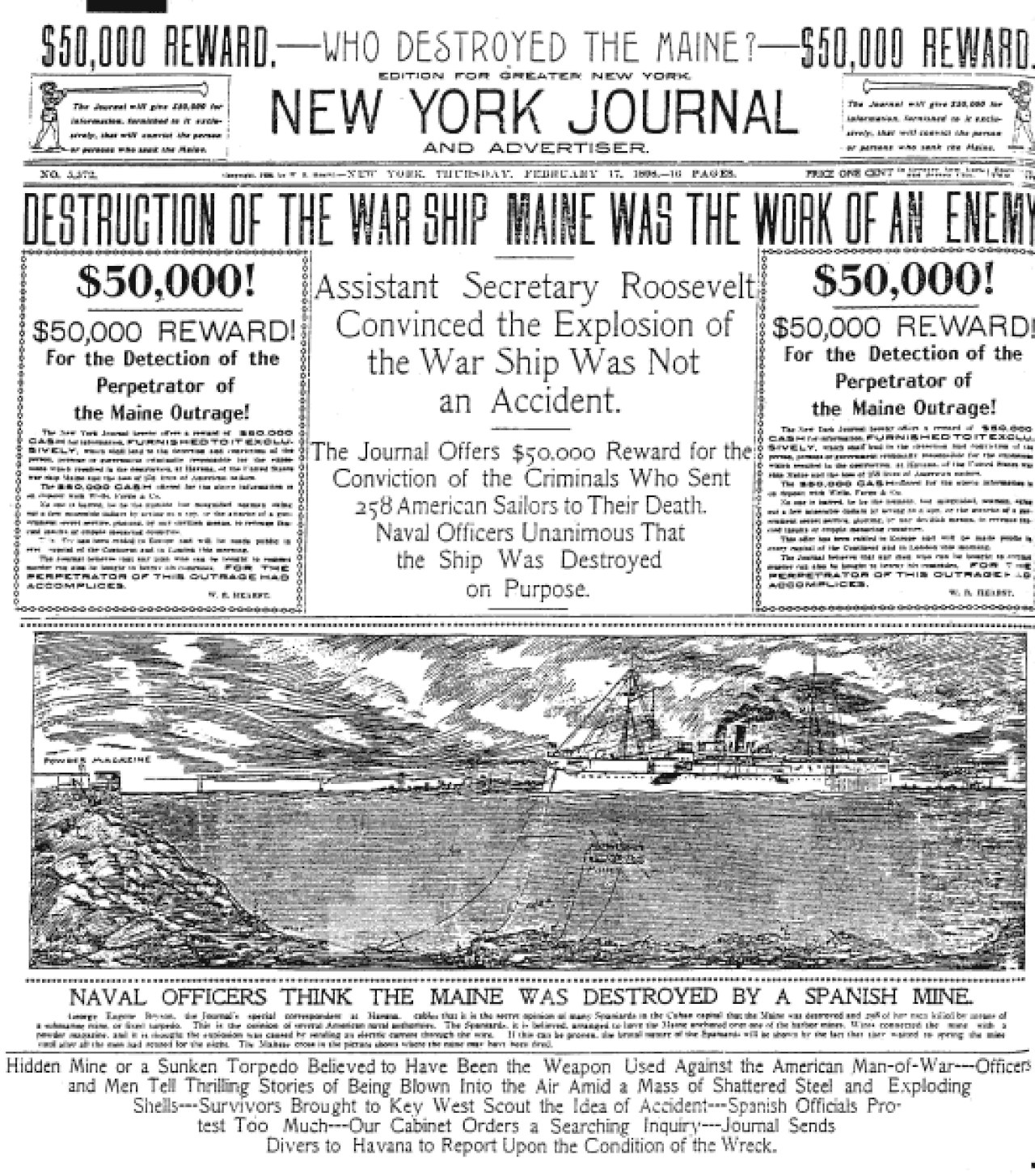
Front page, New York Journal and Advertiser, 17 February 1898, two days after the explosion of the USS Maine, from Remember the Maine: the yellow press and Spain, 1895-1898. Via Wikimedia Commons. Public domain.
Content note: Caricature mocking Joseph Pulitzer's accent. This object is shown as it was published. Why 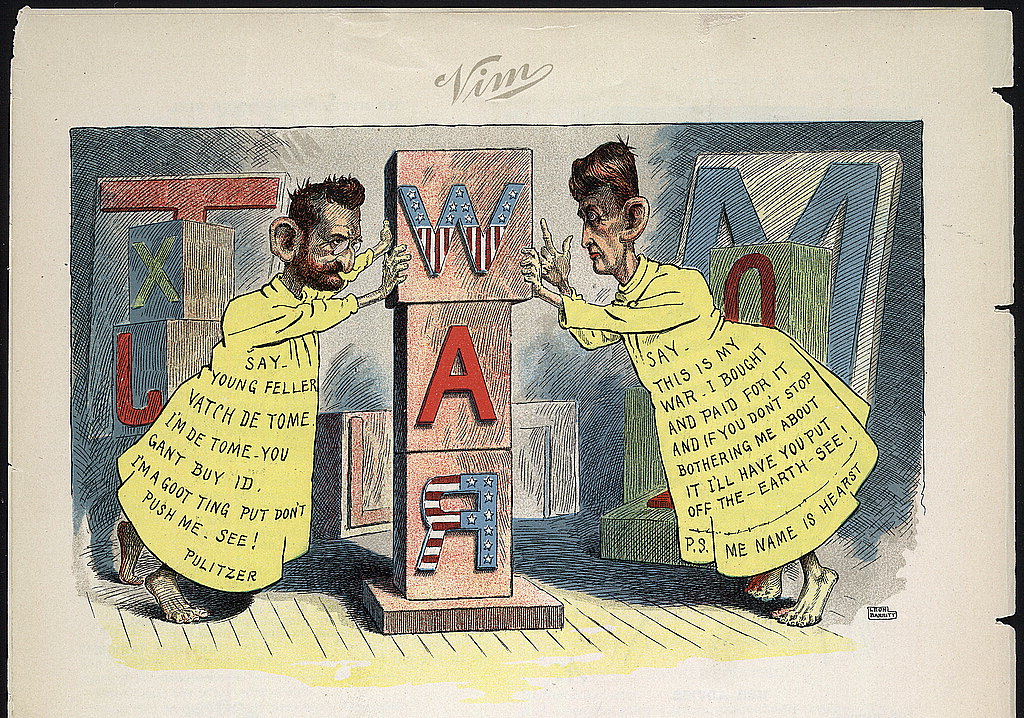
"The big type war of the yellow kids", Leon Barritt, in Vim, 29 June 1898. Library of Congress. Public domain.
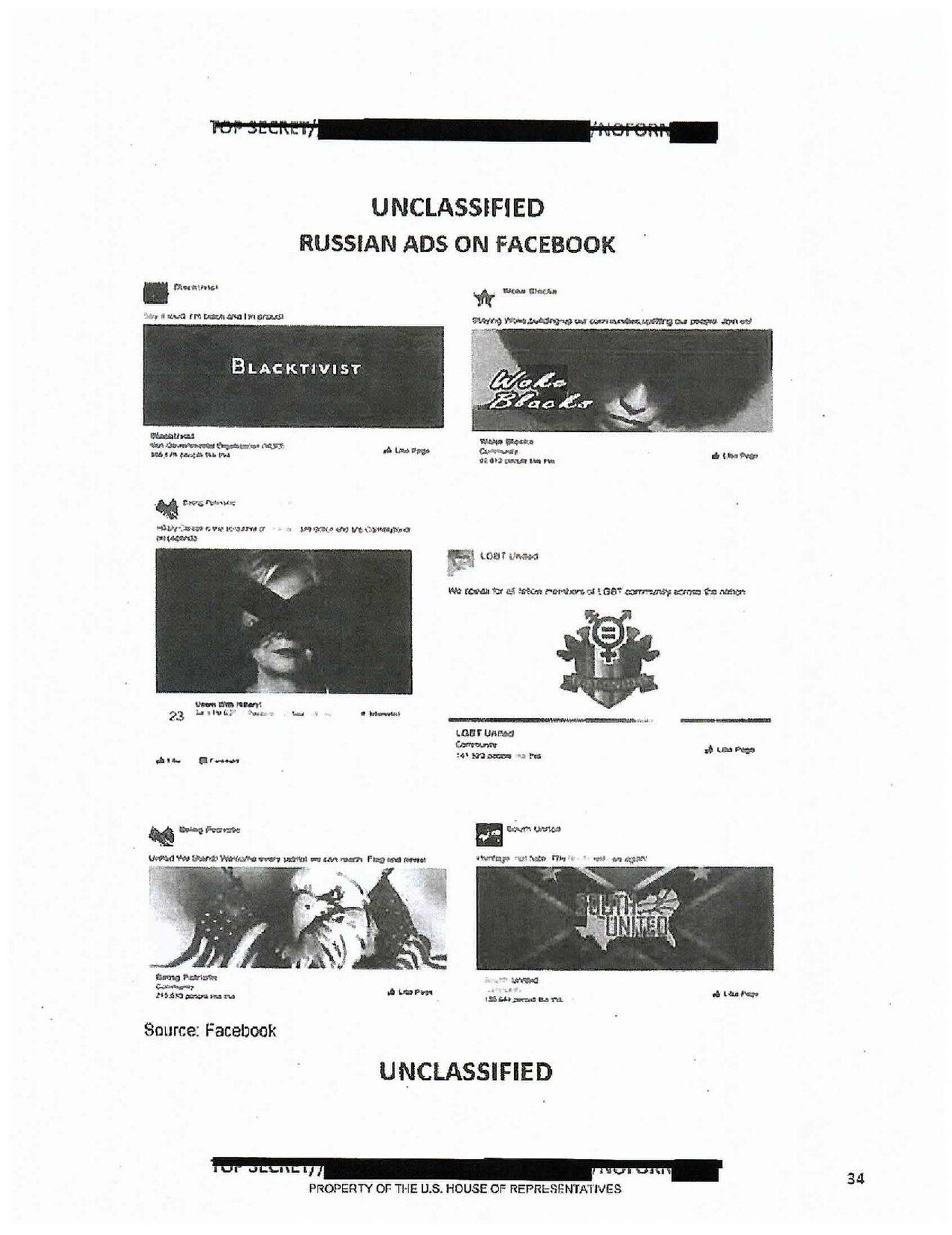
A page of the House Intelligence Committee's 2018 report reproducing Facebook pages the Internet Research Agency ran while posing as American communities, including "Blacktivist", "Woke Blacks", "Being Patriotic", "LGBT United" and "South United"; gallery entry 'Russian Ads on Facebook' (House Intelligence Committee exhibit).
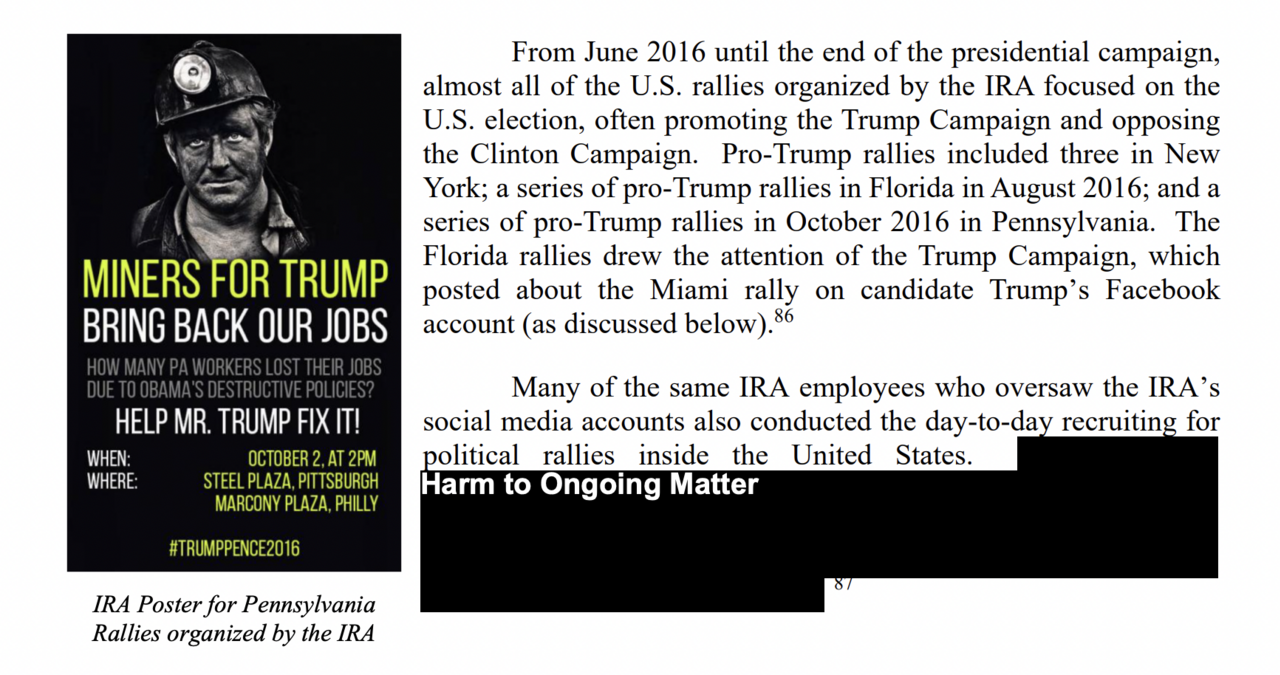
"Miners for Trump" rally poster reproduced in the Special Counsel's report; the Internet Research Agency used it to promote rallies in Pittsburgh and Philadelphia in October 2016. Gallery entry 'Miners for Trump' rally poster (Internet Research Agency).
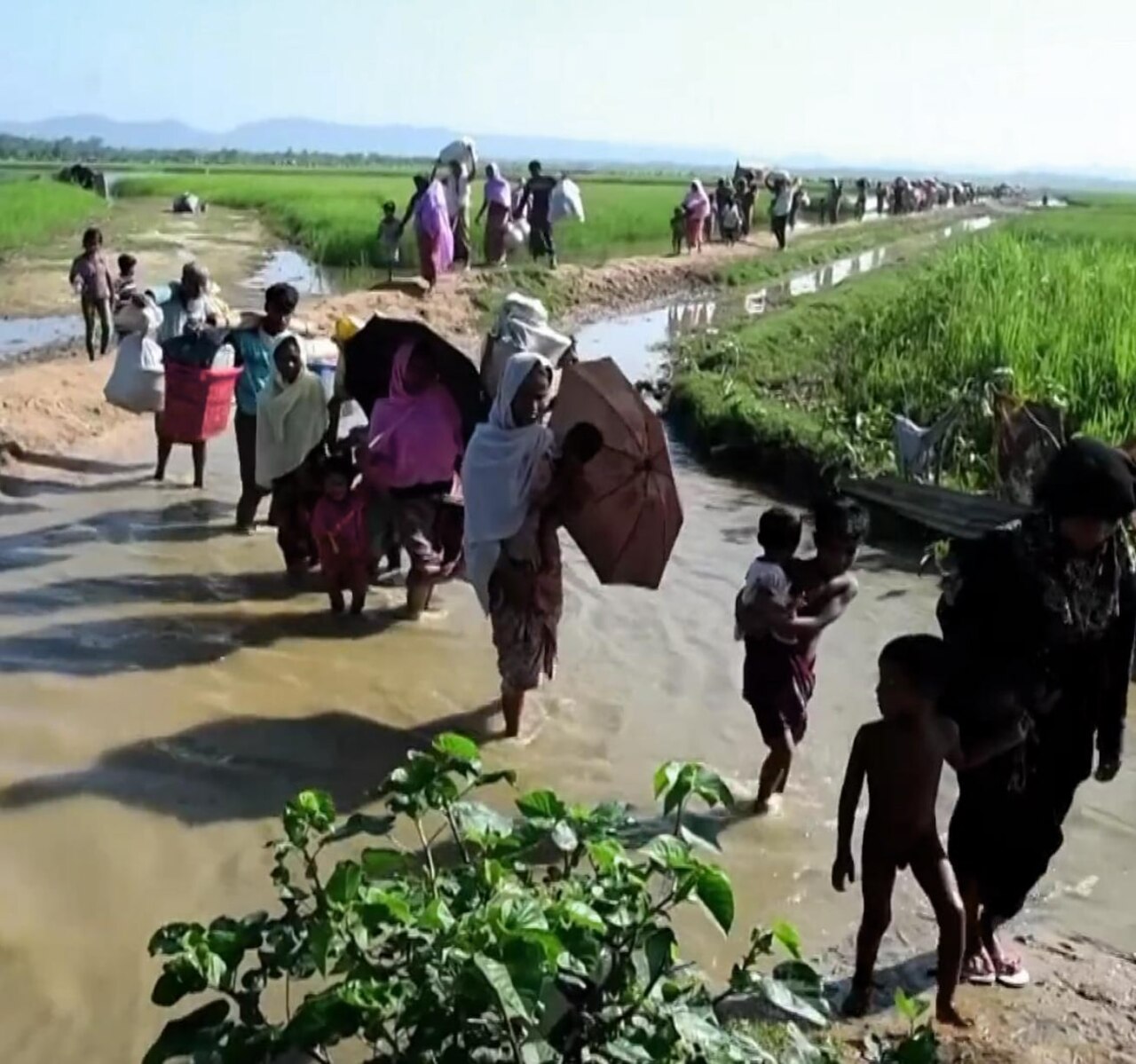
Rohingya refugees entering Bangladesh after leaving Myanmar, 2017, from Anti-Rohingya propaganda in Myanmar, 2012-2018: the 'Bengali' label, the monks' sermons and the military's covert Facebook pages. Voice of America, public domain (U.S. government work).
How to spot it
- The hook is an insult, a desecration or a threat, and the body is short, vague or missing a primary source.
- The headline or caption goes further than the body or the linked source supports.
- The villain is a whole group rather than a named person with a documented act.
- The item invites reaction directly ("share if this makes you angry," "can you believe this?") or is built to be quote-posted.
- The posting account is new or anonymous, or posts a stream of unrelated high-heat items that lead to ad-heavy pages.
- Near-identical versions appear across many accounts at once, often before any outlet has verified the underlying event.
- Your own reaction is the last check: if you want to share before you have looked for the source, the item may have been built for that.
Where it ends: edge cases and legitimate persuasion
Named variants include engagement bait (posts that ask for comments, tags or shares as the main content), rage farming by creators paid through platform revenue sharing, and "slopaganda," mass-produced synthetic images and videos tuned for reaction. The technique sits next to Firehosing and Flooding the zone, which work by volume, whereas outrage bait works item by item through emotional design. Synthetic media is often its means of production, and Scapegoating and Name-calling often supply the villain. Fear appeal is the close cousin: fear asks the audience to accept protection, while outrage asks it to punish or broadcast.
Anger is not proof of manipulation. Some events are outrageous, and journalism or advocacy that reports them with evidence will make people angry. The muckraking tradition and investigative reporting on abuse both provoke strong reactions and are not this technique. The difference lies in what carries the item: in reporting, the documented facts carry it and the anger follows; in outrage bait, the anger carries it and the facts are optional.
The reader's test is to strip the anger out. Does the item still contain a specific, checkable claim with a source? Does the headline match what the source actually shows? Is the target a named actor with a documented act, or a whole group? Is the intensity of the framing proportionate to what the evidence establishes? If the item collapses once the emotional hook is removed, the hook was the product.
Sources
- Berger, Jonah, and Katherine L. Milkman. 2012. "What Makes Online Content Viral?" Journal of Marketing Research 49(2): 192-205.
- Bing, Chris, and Joel Schectman. 2024. "Pentagon Ran Secret Anti-Vax Campaign to Undermine China during Pandemic." Reuters, 14 June.
- Brady, William J., Julian A. Wills, John T. Jost, Joshua A. Tucker, and Jay J. Van Bavel. 2017. "Emotion Shapes the Diffusion of Moralized Content in Social Networks." Proceedings of the National Academy of Sciences 114(28): 7313-7318.
- Brady, William J., Killian McLoughlin, Tuan N. Doan, and Molly J. Crockett. 2021. "How Social Learning Amplifies Moral Outrage Expression in Online Social Networks." Science Advances 7(33): eabe5641.
- Burton, Jason W., Nicole Cruz, and Ulrike Hahn. 2021. "Reconsidering Evidence of Moral Contagion in Online Social Networks." Nature Human Behaviour 5(12): 1629-1635.
- Campbell, W. Joseph. 2001. Yellow Journalism: Puncturing the Myths, Defining the Legacies. Praeger.
- Crockett, M. J. 2017. "Moral Outrage in the Digital Age." Nature Human Behaviour 1(11): 769-771.
- DiResta, Renee, et al. 2018. The Tactics and Tropes of the Internet Research Agency. New Knowledge.
- Guess, Andrew M., et al. 2023. "How Do Social Media Feed Algorithms Affect Attitudes and Behavior in an Election Campaign?" Science 381(6656): 398-404.
- Hagey, Keach, and Jeff Horwitz. 2021. "Facebook Tried to Make Its Platform a Healthier Place. It Got Angrier Instead." The Wall Street Journal, 15 September.
- Merrill, Jeremy B., and Will Oremus. 2021. "Five Points for Anger, One for a 'Like': How Facebook's Formula Fostered Rage and Misinformation." The Washington Post, 26 October.
- Mozur, Paul. 2018. "A Genocide Incited on Facebook, With Posts From Myanmar's Military." The New York Times, 15 October.
- Rathje, Steve, Jay J. Van Bavel, and Sander van der Linden. 2021. "Out-Group Animosity Drives Engagement on Social Media." Proceedings of the National Academy of Sciences 118(26): e2024292118.
- Senate Select Committee on Intelligence. 2019. Report on Russian Active Measures Campaigns and Interference in the 2016 U.S. Election, Volume 2: Russia's Use of Social Media. United States Senate, 116th Congress.
- Silverman, Craig, and Lawrence Alexander. 2016. "How Teens in the Balkans Are Duping Trump Supporters with Fake News." BuzzFeed News, 3 November.
- Subramanian, Samanth. 2017. "Inside the Macedonian Fake-News Complex." Wired, 15 February.
- UN Human Rights Council. 2018. Report of the Independent International Fact-Finding Mission on Myanmar. A/HRC/39/64.
- Vosoughi, Soroush, Deb Roy, and Sinan Aral. 2018. "The Spread of True and False News Online." Science 359(6380): 1146-1151.
Case studies
- Matryoshka's midterm clips: borrowed faces and a borrowed logo — Matryoshka's midterm clips: borrowed faces and a borrowed logo
- Anti-Rohingya propaganda in Myanmar, 2012-2018: the 'Bengali' label, the monks' sermons and the military's covert Facebook pages — Anti-Rohingya propaganda in Myanmar, 2012-2018
- The Islamic State's media machine: Dabiq, Rumiyah, Amaq and the 'virtual caliphate' — The Islamic State's media machine: Dabiq, Rumiyah, Amaq and the 'virtual caliphate'
- Remember the Maine: the yellow press and Spain, 1895-1898 — Remember the Maine: the yellow press and Spain, 1895-1898
- Brazil 2018 and 2022: WhatsApp blasts, removal orders against both campaigns, and the electoral court's new powers — Brazil 2018 and 2022: WhatsApp blasts, removal orders against both campaigns, and the electoral court's new powers
- Black Lives Matter and Blue Lives Matter: two slogans, their campaigns, and a foreign operation that posed as both — Black Lives Matter and Blue Lives Matter: two slogans, their campaigns, and a foreign operation that posed as both
- Britain's Ministry of Information and Political Warfare Executive: posters at home, black radio abroad — Britain's Ministry of Information and Political Warfare Executive: posters at home, black radio abroad
Images
| Image | Source | Licence |
|---|---|---|
| New York Journal front page, 17 February 1898 | Wikimedia Commons (via Remember the Maine: the yellow press and Spain, 1895-1898) | Public domain (published before 1929) |
| "The big type war of the yellow kids", 1898 | Library of Congress (via Remember the Maine: the yellow press and Spain, 1895-1898) | Public domain (no known restrictions) |
| IRA Facebook pages, House Intelligence Committee exhibit, 2018 | Gallery entry 'Russian Ads on Facebook' (House Intelligence Committee exhibit) | See the gallery entry |
| "Miners for Trump" poster, 2016 | Gallery entry 'Miners for Trump' rally poster (Internet Research Agency) | See the gallery entry |
| Rohingya refugees entering Bangladesh, 2017 | Wikimedia Commons (via Anti-Rohingya propaganda in Myanmar, 2012-2018: the 'Bengali' label, the monks' sermons and the military's covert Facebook pages) | Public domain (U.S. government work, Voice of America) |


Image gaps
- The Veles websites, Facebook's 2018 ranking documents, the Rathje et al. engagement study and the Reuters Philippines investigation: screenshots and reports are copyrighted; cited in Sources, not hosted.
- Posts from the Myanmar military pages: removed from Facebook and not available with a verified free licence.