Area: Group identity · Evidence: moderate (How we rate the evidence). Misperceiving what others privately think is well documented; the related "spiral of silence" has much weaker support than its fame suggests.
In brief
Pluralistic ignorance is when most members of a group privately reject a view or practice but each wrongly assumes that most others accept it. Because everyone reads the public silence or public conformity of others as sincere, the unpopular norm survives. It matters for politics because what people think the majority believes shapes what they say out loud, and messages that distort that picture can keep people quiet or pull them along. Correcting the misperception with accurate information can change behavior.
What the research shows
Deborah Prentice and Dale Miller's studies at Princeton in the early 1990s are the standard example [1]. Students were asked how comfortable they were with campus drinking habits and how comfortable they thought the average student was. On average, students said they were less comfortable than they believed their peers to be. Each assumed the others were fine with heavy drinking and kept their own reservations private. Over a semester, male students' private attitudes drifted toward the norm they wrongly believed others held, while women's attitudes did not shift in the same way, and students who felt out of step with the imagined norm reported feeling more alienated from campus life.
The German pollster Elisabeth Noelle-Neumann proposed a broader political version, the "spiral of silence" [2]. People, she argued, constantly sense which opinions are gaining or losing ground. Those who believe their view is in the minority fall silent to avoid isolation; their silence makes the view seem even rarer, which silences more people, until one side dominates public talk far beyond its real support.

Drawn by FRAME from Noelle-Neumann (1974) [2]; the effect is small in meta-analyses [6], [7]. CC BY 4.0 (FRAME).
The strongest recent evidence that correcting such misperceptions changes behavior comes from Saudi Arabia. Leonardo Bursztyn, Alessandra González and David Yanagizawa-Drott surveyed young married men in Riyadh and found that most privately supported women working outside the home, but substantially underestimated how many other men agreed [3]. When a random half were shown the true level of support among their peers, they became more willing to sign their wives up for a job-matching service, and months later their wives were more likely to have applied for and interviewed for jobs outside the home.

Drawn by FRAME from Bursztyn, González and Yanagizawa-Drott (2020) [3]. CC BY 4.0 (FRAME).
The economist Timur Kuran applied a related idea, "preference falsification" (publicly stating views one privately rejects), to politics [4]. He argued it helps explain why the collapse of Eastern European communist regimes in 1989 surprised almost everyone, including the participants: when enough people discovered that others shared their private opposition, public support for the regimes evaporated very quickly [5].
Has it held up?
The core observation, that people often misjudge what their peers privately think, is well replicated across many settings. The spiral of silence is another matter. A 1997 meta-analysis by Carroll Glynn, Andrew Hayes and James Shanahan found only a very small relationship between believing one's opinion has majority support and being willing to speak out [6]. A later meta-analysis by Jörg Matthes, Johannes Knoll and Christian von Sikorski also found the relationship to be small, though statistically reliable, and dependent on context [7]. Silence under perceived minority status is real, but it is a modest tendency, not an inevitable spiral.
Misperception runs in every political direction. In a 1968 survey analyzed by Hubert O'Gorman, many white Americans overestimated how much other whites supported racial segregation [8]. Leaf Van Boven found that students overestimated their peers' support for affirmative action, a view many students believed was the campus norm [9]. Gregg Sparkman, Nathan Geiger and Elke Weber found that Americans underestimated public support for major climate policies by nearly half [10]. Updating beliefs about others can move public expression in any direction: Bursztyn, Georgy Egorov and Stefano Fiorin found that Donald Trump's rising 2016 popularity made Americans more willing to express anti-immigrant views publicly, because they updated their belief about how many others shared them [11].
How it shows up in political messaging
- Eastern Europe, 1989. The events of 1989 in Eastern Europe, as Kuran describes them, show pluralistic ignorance breaking down all at once when private opinion became visible [5].
- Segregation-era America. O'Gorman's data show a public norm propped up partly by overestimates of how many people endorsed it [8].
- Campus norms. Van Boven's affirmative-action study found students assuming more agreement with a perceived progressive norm than actually existed [9].
- Social change in Saudi Arabia. Accurate information about peers' private views increased women's job seeking, showing how correcting a misperceived norm can shift behavior [3].
- Public expression after electoral signals. The 2016 US campaign shifted what people felt free to say in public about immigration [11]. In each case, the signal about what "everyone" thinks mattered as much as the underlying views.
Messages that exploit pluralistic ignorance usually do one of two things: they exaggerate how isolated the reader's view is ("nobody believes that anymore," "you're the only one who thinks this"), or they inflate the apparent size of their own side through staged crowds and coordinated accounts, a form of Manufactured consensus.
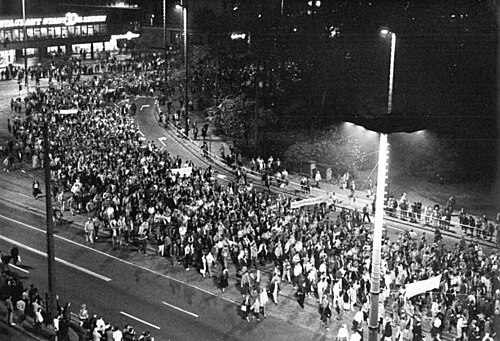
Monday demonstration, Leipzig, 23 October 1989. Photo by Friedrich Gahlbeck, Bundesarchiv, Bild 183-1989-1023-022, CC BY-SA 3.0 DE. Kuran's account of 1989 [5] concerns how private opposition became visible.
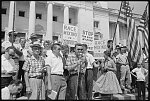
Crowd at the Arkansas State Capitol protesting school integration, with signs reading "Race mixing is Communism," Little Rock, Arkansas: Rally against the integration of Little Rock's schools, Arkansas State Capitol, 20 August 1959. Public domain. O'Gorman's survey data [8] concern white Americans' estimates of how many others supported segregation; the photograph shows a public expression, not private opinion.
How to spot it
- Claims about what "most people" or "everyone" thinks are made without a survey or with a hand-picked one.
- The reader is told their view is isolated or shameful, rather than being shown evidence it is wrong.
- Loud public displays of agreement coincide with a lack of anonymous data on private opinion.
- Anonymous polls and public statements disagree sharply about the same issue.
- A sudden public shift ("overnight everyone is saying it") follows a single event that changed perceptions, not facts.
Persuasion or manipulation?
Sharing accurate information about what people actually believe is one of the most effective honest tools available, as the Saudi study shows. Quoting a well-designed anonymous survey, with its source and margin of error, lets readers correct a false picture of their neighbors. It tips into manipulation when the "majority" is invented, when a minority view is made to seem universal through coordinated voices, or when readers are told they are alone in order to make them stay quiet. The honest test is whether the claim about public opinion can be checked.
Archive techniques that lean on this
- Bandwagon — Bandwagon: claims that everyone has already moved exploit uncertainty about what others really think.
- Manufactured consensus — Manufactured consensus: staged agreement widens the gap between private opinion and apparent public opinion.
- Overton window shifting — Overton window shifting: once people learn others share a previously unspoken view, it moves quickly into open discussion, as the 2016 study found.
Related topics
- Social proof — Social proof
- Conformity — Conformity
- Group polarization — Group polarization
- Social identity — Social identity
Sources
- Prentice, D. A., & Miller, D. T. (1993). Pluralistic ignorance and alcohol use on campus: Some consequences of misperceiving the social norm. Journal of Personality and Social Psychology, 64(2), 243–256. https://doi.org/10.1037/0022-3514.64.2.243
- Noelle-Neumann, E. (1974). The spiral of silence: A theory of public opinion. Journal of Communication, 24(2), 43–51. https://doi.org/10.1111/j.1460-2466.1974.tb00367.x
- Bursztyn, L., González, A. L., & Yanagizawa-Drott, D. (2020). Misperceived social norms: Women working outside the home in Saudi Arabia. American Economic Review, 110(10), 2997–3029. https://doi.org/10.1257/aer.20180975
- Kuran, T. (1995). Private truths, public lies: The social consequences of preference falsification. Cambridge, MA: Harvard University Press.
- Kuran, T. (1991). Now out of never: The element of surprise in the East European revolution of 1989. World Politics, 44(1), 7–48. https://doi.org/10.2307/2010422
- Glynn, C. J., Hayes, A. F., & Shanahan, J. (1997). Perceived support for one's opinions and willingness to speak out: A meta-analysis of survey studies on the "spiral of silence." Public Opinion Quarterly, 61(3), 452–463. https://doi.org/10.1086/297808
- Matthes, J., Knoll, J., & von Sikorski, C. (2018). The "spiral of silence" revisited: A meta-analysis on the relationship between perceptions of opinion support and political opinion expression. Communication Research, 45(1), 3–33. https://doi.org/10.1177/0093650217745429
- O'Gorman, H. J. (1975). Pluralistic ignorance and white estimates of white support for racial segregation. Public Opinion Quarterly, 39(3), 313–330. https://doi.org/10.1086/268231
- Van Boven, L. (2000). Pluralistic ignorance and political correctness: The case of affirmative action. Political Psychology, 21(2), 267–276. https://doi.org/10.1111/0162-895X.00187
- Sparkman, G., Geiger, N., & Weber, E. U. (2022). Americans experience a false social reality by underestimating popular climate policy support by nearly half. Nature Communications, 13, 4779. https://doi.org/10.1038/s41467-022-32412-y
- Bursztyn, L., Egorov, G., & Fiorin, S. (2020). From extreme to mainstream: The erosion of social norms. American Economic Review, 110(11), 3522–3548. https://doi.org/10.1257/aer.20171175
Images
| Image | Source | Licence |
|---|---|---|
| Diagram: spiral of silence | Drawn by FRAME from Noelle-Neumann (1974) (make_group_identity_charts.py) |
CC BY 4.0, FRAME |
| Bar chart: Saudi men's own views and their guesses | Drawn by FRAME from Bursztyn et al. (2020) | CC BY 4.0, FRAME |
| Leipzig Monday demonstration, 23 October 1989 | Bundesarchiv via Wikimedia Commons | CC BY-SA 3.0 DE |
| Little Rock rally (1959) | FRAME gallery, Crowd at the Arkansas State Capitol protesting school integration, with signs reading "Race mixing is Communism," Little Rock, Arkansas, Library of Congress | Public domain (no known restrictions, per LoC) |

Image gaps
Photographs from Prague and Berlin in 1989 and from the Prentice and Miller campus studies were not sought or verified; none is hosted.