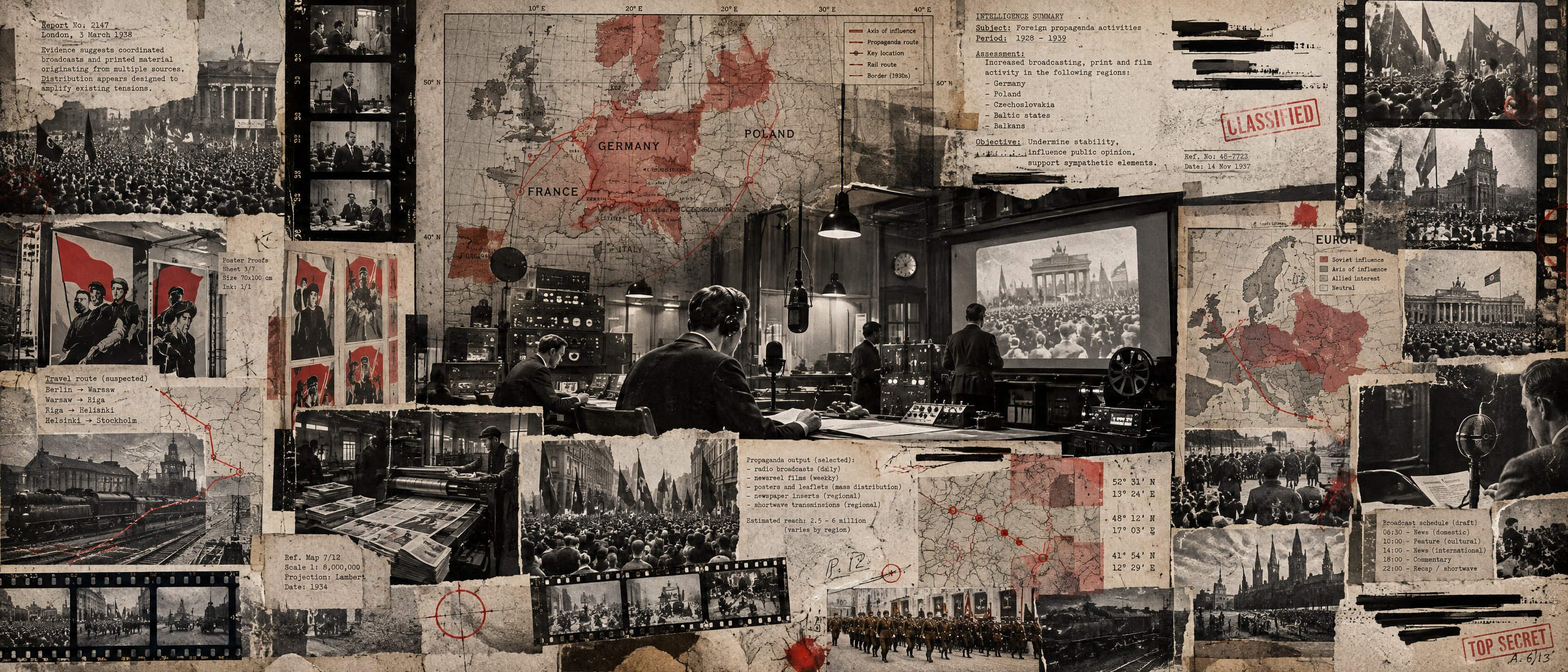
Content note: Repeats First World War atrocity stories, including invented ones, and their wording. This object is shown as it was published. Why
carefully manufactured but serves its purpose at the moment, even though it be eventually exposed.
There is the omission of passages from official documents of which only a few of the many instances are given ;» and the “ correctness ” of words and commas in parliamentary answers which conceal evasions of the truth.
There is deliberate exaggeration, such, for instance, as the reports of the destruction of Louvain : “ The intellectual metropolis of the Low Countries since the fifteenth century is now no more than a heap of ashes ” (Press Bureau, August 29, 1914), “ Louvain has ceased to exist ” (“ The Times,” August 29, 1914). Asa matter of fact, it was estimated that about an eighth of the town had suffered.
There is the concealment of truth, which has to be resorted to so as to prevent anything to the credit of the enemy reaching the public. A war correspondent who mentioned some chivalrous act that a German had done to an EngUshman during an action received a rebuking telegram from his employer : “ Don’t want to hear about any good Germans ” ; and Sir Philip Gibbs, in Kealities of W'ar, says : “ At the close of the day the Germans acted with chivalry, which I was not allowed to tell at the time.”
There is the faked photograph (“ the camera cannot lie ”).* These were more popular in France than here. In Vienna an enterprising firm supplied atrocity photographs with blanks for the headings so that they might be used for propaganda purposes by either side.
The cinema also played a very important part, especially in neutral countries, and helped considerably in turning opinion in America in favour of coming in on ■ See page 140. ’ See page 13;.
the side of the Allies. To this day in this country attempts are made by means of films to keep the wound raw.
There is the “ Russian scandal,” the best instance of which during the war, curiously enough, was the rumour of the passage of Russian troops through Britain.* Some trivial and imperfectly understood statement of fact becomes magnified into enormous proportions by constant repetition from one person to another.
Atrocity lies were the most popular of all, especially in this country and America; no war can be without them. Slander of the enemy is esteemed a patriotic duty. An English soldier wrote (“ Tie Tims,” September 15, 1914): “The stories in our papers are only exceptions. There are people like them in every army.” But at the earliest possible moment stories of the maltreatment of prisoners have to be circulated deliberately in order to prevent surrenders. This is done, of course, on both sides. Whereas naturally each side tries to treat its prisoners as well as possible so as to attract others.
The repetition of a single instance of cruelty and its exaggeration can be distorted into a prevailing habit on the part of the enemy. Unconsciously each one passes it on with trimmings and yet tries to persuade himself that he is speaking the truth.
There arc lies emanating from the inherent unreliability and fallibility of human testimony. No two people can relate the occurrence of a street accident so as to make the two stories tally. When bias and emotion are introduced, human testimony becomes quite valueless. In war-time such testimony is accepted as ‘ See page 65.
conclusive. The scrappiest and most unreliable evidence is sufficient—“ the friend of the brother of a man who was killed,” or, as a German investigator of his own liars puts it, “ somebody who had seen it,” or, “ an extremely respectable old woman.”
There is pure romance. Letters of soldiers who whiled away the days and weeks of intolerable waiting by writing home sometimes contained thrilling descriptions of engagements and adventures which had never occurred.
There are evasions, concealments, and half-truths which are more subtly misleading and gradually become a governmental habit.
There is official secrecy which must necessarily mislead public opinion. For instance, a popular English author, who was perhaps better informed than the majority of the public, wrote a letter to an American author, which was reproduced in the Press on May 21, 1918, stating :
There are no Secret Treaties of any kind in which this country is concerned. It has been publicly and clearly stated more than once by our Foreign Minister, and apart from honour it would be political suicide for any British official to make a false statement of the kind.
Yet a series of Secret Treaties existed. It is only fair to say that the author, not the Foreign Secretary, is the liar here. Nevertheless the official pamphlet. The Truth about the Secret Treaties, compiled by Mr. McCurdy, was published with a number of unacknowledged excisions, and both Lord Robert Cecil in 1917 and Mr. Lloyd George in 1918 declared (the latter to a deputation from the Trade Union Congress) that our policy was not directed to the disruption of Austro-Hungary, although they both knew that under the Secret Treaty concluded with Italy in April 1915 portions of Austria-Hungary were to be handed over to Italy and she was to be cut off from the sea. Secret Treaties naturally involve constant denials of the truth.
There is sham official indignation depending on genuine popular indignation which is a form of falsehood sometimes resorted to in an unguarded moment and subsequently regretted. The first use of gas by the Germans and the submarine warfare are good instances of this.i Contempt for the enemy, if illustrated, can prove to be an unwise form of falsehood. There was a time when German soldiers were popularly represented cringing, with their arms in the air and crying “ Kamerad,” until it occurred to Press and propaganda authorities that people were asking why, if this was the sort of material we were fighting against, had we not wiped them off the field in a few weeks.
There are personal accusations and false charges made in a prejudiced war atmosphere to discredit persons who refuse to adopt the orthodox attitude towards war.
There are lying recriminations between one country and another. For instance, the Germans were accused of having engineered the Armenian massacres, and they, on their side, declared the Armenians, stimulated by the Russians, had killed i; 0,000 Mohammedans {Germania, Oetober 9, 1913).
Other varieties of falsehood more subtle and elusive might be found, but the above pretty well cover the ground.
A good deal depends on the quality of the lie. You must have intellectual lies for intellectual people and crude lies for popular consumption, but if your popular > See page 146.
lies are too blatant and your more intellectual section are shocked and see through them, they may (and indeed they did) begin to be suspicious as to whether they were not being hoodwinked too. Nevertheless, the inmates of colleges are just as credulous as the inmates of the slums.
Perhaps nothing did more to impress the public mind—and this is true in all countries—than the assistance given in propaganda by intellectuals and literary notables. They were able to clothe the rough tissue of falsehood with phrases of literary merit and passages of eloquence better than the statesmen. Sometimes by expressions of spurious impartiality, at other times by rhetorical indignation, they could by their literary skill give this or that lie the stamp of indubitable authenticity, even without the shadow of a proof, or incidentally refer to it as an accepted fact. The narrowest patriotism could be made to appear noble, the foulest accusations could be represented as an indignant outburst of humanitarianism, and the meanest and most vindictive aims falsely disguised as idealism. Everything was legitimate which could make the soldiers go on fighting.
The frantic activity of ecclesiastics in recruiting by means of war propaganda made so deep an impression on the public mind that little comment on it is needed here. The few who courageously stood out became marked men. The resultant and significant loss of spiritual influence by the Churches is, in itself, sufficient evidence of the reaction against the betrayal in time of stress of the most elementary precepts of Christianity by those specially entrusted with the moral welfare of the people.
War is fought in this fog of falsehood, a great deal of z 6 FALSEHOOD IN WAR-TIME it undiscovered and accepted as truth. The fog arises from fear and is fed by panic. Any attempt to doubt or deny even the most fantastic story has to be condemned at once as unpatriotic, if not traitorous. This allows a free field for the rapid spread of lies. If they were only used to deceive the enemy in the game of war it would not be worth troubling about. But, as the purpose of most of them is to fan indignation and induce the flower of the country’s youth to be ready to make the supreme sacrifice, it becomes a serious matter. Exposure, therefore, may be useful, even when the struggle is over, in order to show up the fraud, hypocrisy, and humbug on which all war rests, and the blatant and vulgar devices which have been used for so long to prevent the poor ignorant people from realizing the true meaning of war.
It must be admitted that many people were conscious and willing dupes. But many more were unconscious and were sincere in their patriotic zeal. Finding now that elaborately and carefully staged deceptions were practised on them, they feel a resentment which has not only served to open their eyes but may induce them to make their children keep their eyes open when next the bugle sounds.
Let us attempt a very faint and inadequate analogy between the conduct of nations and the conduct of individuals.
Imagine two large country houses containing large families with friends and relations. When the members of the family of the one house stay in the other, the butler is instructed to open all the letters they receive and send and inform the host of their contents, to listen at the keyhole, and tap the telephone. When a great match, say a cricket match, which excites the whole district, is played between them, those who are not present are given false reports of the game to make them think the side they favour is winning, the other side is accused of cheating and foul play, and scandalous reports are circulated about the head of the family and the hideous goings on in the other house.
All this, of course, is very mild, and there would be no specially dire consequences if people were to behave in such an inconceivably caddish, low, and underhand way, except that they would at once be expelled from decent society.
But between nations, where the consequences are vital, where the destiny of countries and provinces hangs in the balance, the Uves and fortunes of millions are affected and civilization itself is menaced, the most upright men honestly believe that there is no depth of duplicity to which they may not legitimately stoop. They have got to do it. The thing cannot go on without the help of lies.
This is no plea that lies should not be used in wartime, but a demonstration of how lies must be used in war-time. If the truth were told from the outset, there would be no reason and no will for war.
Anyone declaring the truth: “ Whether you are right or wrong, whether you win or lose, in no circumstances can war help you or your country,” would find himself in gaol very quickly. In war-time, failure to lie is negligence, the doubting of a lie a misdemeanour, the declaration of the truth a crime.
In future wars we have now to look forward to a new and far more efficient instrument of propaganda— the Government control of broadcasting. Whereas, therefore, in the past we have used the word “ broadcast ” symbolically as meaning the efforts of the Press and individual reporters, in future we must use the word literally, since falsehood can now be circulated universally, scientifically, and authoritatively.
Many of the samples given in the assortment are international, but some are exclusively British, as these are more easily found and investigated, and, after all, we are more concerned with our own Government and Press methods and our own national honour than with the duplicity of other Governments.
Lies told in other countries are also dealt with in cases where it has been possible to collect sufficient data. Without special investigation on the spot, the career of particular lies cannot be fully set out.
Wffien the people of one country understand how the people in another country arc duped, like themselves, in war-time, they will be more disposed to sympathize with them as victims than condemn them as criminals, because they will understand that their crime only consisted in obedience to the dictates of authority and acceptance of what their Government and Press represented to them as the truth.
The period covered is roughly the four years of the war. The intensity of the lying was mitigated after 1918, although fresh crops came up in connection with other of our international relations. The mischief done by the false cry “ Make Germany pay ” continued after 1918 and led, more especially in France, to high expectations and consequent indignation when it was found that the people who raised this slogan knew all the time it was a fantastic impossibility. Many of the old war lies survived for several years, and some survive even to this day.
There is nothing sensational in the way of revelations contained in these pages. Ail the cases mentioned are well known to those who were in authority, less well known to those primarily affected, and unknown, unfortunately, to the millions who fell. Although only a small part of the vast field of falsehood is covered, it may suffice to show how the unsuspecting innocence of the masses in all countries was ruthlessly and systematically exploited.
There are some who object to war because of its immorality, there are some who shrink from the arbitrament of arms because of its increased cruelty and barbarity; there are a growing number who protest against this method, at the outset known to be unsuccessful, of attempting to settle international disputes because of its imbecility and futility. But there is not a living soul in any country who does not deeply resent having his passions roused, his indignation inflamed, his patriotism exploited, and his highest ideals desecrated by concealment, subterfuge, fraud, falsehood, trickery, and deliberate lying on the part of those in whom he is taught to repose confidence and to whom he is enjoined to pay respect.
None of the heroes prepared for suffering and sacrifice, none of the common herd ready for service and obedience, will be inclined to listen to the call of their country once they discover the polluted sources from whence that call proceeds and recognize the monstrous finger of falsehood which beckons them to the battlefield.
Falsehood in War-Time, Arthur Ponsonby. Published in the United Kingdom in 1928, more than 95 years ago, so in the public domain in the United States. Ponsonby died in 1946, so the text is also in the public domain in countries that count the author's life plus 70 years. Provenance and rights.