Content note: Repeats First World War atrocity stories, including invented ones, and their wording. This object is shown as it was published. Why
(a) Germany.
The similarity of the lines on which lying was conducted in Germany to our own in this country shows well how duping the people is a necessary adjunct of war all the world over.
Within the nation the censorship was stricter than it was here. No decent word with regard to the enemy was allowed, and the good treatment of prisoners in British camps was suppressed. The same amazing stupidity with regard to concealments was shown as in this country. But a worse mistake was made in depicting the situation up to the end in rose colour and with exaggerated optimism. The real truth as to the course of events was concealed, every enemy success was understated, the effect of American intervention was minimized, the condition of German resources exaggerated, so that when the final catastrophe came, many people were taken by surprise. In this connection the Germans have got a stronger indictment against their authorities than we have. Cautions and warnings were not omitted in this country.
The Press Bureau (Pressekonferenz) was presided over by a soldier. Casualties were, so far as possible, concealed. On November 15, 1914, the Pressekonferenz stated there were a few hundred casualties, while the official list contained at the time 55,000 names. One of the members of the Pressekonferenz echoed our War Office circular' when he said, on one occasion, in dealing with a false official report : “ It is not so much the accuracy of the news as its effect that matters.” * The Turks were embarrassing allies. The massacres of Armenians had to be concealed, although attempts were made in some papers to defend them.
Our poet-writers and professors had their exact counterparts in Germany and gave orthodox “ patriotism ” an intellectual and literary tone.
Abroad, German lying was not very skilful. It was cither too subtle or too clumsy. They had a wide field to cover with so many nations against them. “ Encirclement ” was the chief cry and, in the case of Russia and France, aggression.
In October 1914 Prince Rupprecht of Bavaria declared that England’s ambition “ for years had been turned to surround us with a ring of enemies in order to strangle us ” (uns mit einem Ring von Feinden zu umgeben um uns zu erdrosseln), and there were many similar declarations.
With regard to the deliberate policy of encirclement, so far as Great Britain is concerned, Herr Rudolf Kircher remarks, in his book Englander (1926) :
Grey’s personality is the living proof that a policy of encirclement as a war aim, as was imagined in Germany, never existed. All these were fantastic suppositions, as fantastic as the idea that the German people were ripe and ready for an attack and struggle for world supremacy.
The German Government, like all the other Governments, was blameless and at the mercy of the machinations of enemy Governments. They had no chief Monster to depict as the Allies had, but only a number ' See page 20. * Die groise Zeit der Luge, Hellmut v. Geilach.
of not very distinguished statesmen. In the early days of panic they started with “ a military report ” that “ French aviators had dropped bombs in the vicinity of Nuremberg” on August 3, 1914, and flaming headlines appeared in the newspapers. But the Prussian Minister at Munich telegraphed to Berlin that there was “ no evidence of dropping of bombs and still less, naturally, that the aviators were French” (Kautsky documents. No. 758). At the same time there was a report from the Governor of Diisscldorf that “ eighty French officers in the uniform of Prussian officers, in twelve automobiles, had made a vain attempt to cross the frontier at Walbeck.” Both these reports were telegraphed by Herr Jagow, the Minister of Foreign Affairs, to the Ministers at Brussels and The Hague, to be brought to the attention of the Governments as a violation of international law. Both were no doubt believed, but neither of them had any foundation. On the other hand, there were several instances of the violation of French territory by German frontier patrols before August 3, 1914.
Apart from the absurdities of “ Gott strafe England ” and “ the Hymn of Hate,” Great Britain was naturally singled out for special attention. On September 3, 1914, the Frankfurter Zeitung printed a speech by Mr. John Burns which was purely imaginary. In October there appeared in the New York American an interview with a “ highly placed representative of the British Government ” which was proved to be entirely false. Aeroplanes were used to drop on French trenches and billets picture-postcards of ruined French churches with the legend on them, “ Wrecked by the English.” There were the usual exaggerated reports and startling statements as to what was going on in enemy countries.
despair, demoralization and panic, accusations of abuse of the “ white flag,” specially against British troops, and other “ necessary ” war lies.
Neutral countries, of course, received propaganda from both sides. There was a German film depicting German soldiers feeding Belgian and French children, and English prisoners grinning with delight as they worked under the stern eyes of the Prussian soldiers.
On November 25, 1914, the Norddeutsche Allgemeine Zeitung published in facsimile a translation of a report written by General Ducarne to the Belgian War Minister on April 10, 1906, recording the visit of Colonel Barnardiston with regard to the dispatch of the Expeditionary Force in the event of war between Germany and France. In the translation which was reproduced in other newspapers without the facsimile there were three mistakes.
{a) An interpolation, which was an integral part of the text, ran as follows : “ L’entr^e des Anglais en Belgique ne se ferait qu’apres la violation de notre neutrality par I’Allemagne.” (The entry of the British into Belgium will only take place after the violation of out neutrality by Germany.) This was represented as a marginal note and given in French, so that many readers would not understand it.
(Jd) In the passage: “ He (Colonel Barnardiston)
emphasized that our conversation must be absolutely confidential,” the word “ conversation ” was translated by Abkommen, as if it were “ convention.”
(c) The final date in French, “Fin Septembre 1906,” was translated “ Abgeschlossen September 1906,” i.e. “ concluded,” giving the impression of “ a convention ” having been “ concluded.”
The mistakes, each taken separately, might have been errors of carelessness, but taken all three together, undoubtedly point to a deliberate attempt at falsification.
In the early months of the war the Wolff Bureau circulated a report in the papers : “ To-day a French doctor, assisted by two French officers in disguise, attempted to infect a well at Metz with plague and cholera bacillus; the criminals were caught and shot.” An official dementi of this story was subsequently issued.
The greatest tunnel in Germany, at Cochen, on the frontier, was reported to have been destroyed by an innkeeper, Nicolai, of Cochen, and his son, both of whom were shot. The Kheinish-Westjalische Zeitung stated that after careful investigation it was discovered that Nicolai was a naturalized German, French by birth, and it was a matter for congratulation that the criminal was not a genuine German. The following day the sub-Prefect of Cochen announced that there was not a word of truth in the supposed plot; Nicolai was alive and a highly respected citizen, whilst his son was serving in a Prussian regiment.
Atrocity lies abounded in Germany just as in this country. Gouging out of eyes there seems to have been as great a favourite as the Belgian babies without hands here.
In September 1914 a lady of Cologne was informed that a whole room was given up in a hospital at Aix-la- Chapelle to wounded soldiers who had had their eyes gouged out in Belgium. On inquiry, a leading doctor at Aix-la-Chapelle declared there was no such room and no single case of the sort had been observed. But the story wandered from Aix-la-Chapelle to Bonn, where again the chief doctor of the hospitals had to deny it. Then it travelled to Sigmaringen. The Weser Zeitung in Bremen took it up and wrote in a similar way about 17 ^ a hospital in Berlin. This was denied by the Kommandatur der Residen7. It reached its climax when it was reported that a small boy of ten had seen “ a whole bucketful of soldiers’ eyes ” (ein ganzer Eimer voll Soldaten-augen).
Die Zeit in Bild (January 12, No. 38) gave circumstantial accounts of a priest who wore a chain round his neck made up of rings taken from fingers he had cut off.
An official report from Luttich, where this was supposed to have happened, stated there was no such case.
In the Kdlnische Ko/Anj«V«Arg, September 15, 1914, it was related how a company of German soldiers were marching through a Belgian village when the priest, who stood before the door of the church, invited the captain to come in with his soldiers, “ for it was good,” he said, “ even in these dark times, to think of God” (da es doch in dieser schweren Zeit gut sei auch an den lieben Gott zu denken). The captain accepted the invitation. A machine gun was concealed behind the altar. When the church was full the machine gun was unmasked and the whole company shot down.
Such stories as these ‘ arose chiefly from anti-Catholic bias. Priests were accused of harbouring French soldiers in their houses, but no case was proved. An incident of which many and varied versions were given was that of Demange, priest of Lagarde. He was said to have betrayed the position of the German troops to the enemy, to have put a machine gun in the tower of his church with which to shoot down Germans. He was reported to have been shot, and his body pierced by thirty bayonet wounds was seen before the church door • Sec Der LJigengeijt in Volkerkrieg^ by Bernard Duhr.
of Lagardc. Not only was the whole thing an invention, but it turned out, from official information, that Demange, who was alive, had behaved with heroism in resisting the enemy, and had been praised by German officers.
The variations of the story and its exposure as a falsehood appeared in the Frankfurter Zeitung (September i8, 1914) and the Kolnische Volksv;eitung (October II, 1914).
On August 31, 1914, the Berliner Lokalarr^eiger reported that a nurse in Amsterdam had heard from a German officer how, after Lowen had been occupied, all was quiet. But later the bodies of fifty German soldiers, shot by the monks, were found in the cellar of the monastery. The inmates were thereupon arrested and the Superior shot.
This story was widely circulated, and as it was likely to embitter religious feeling General von Bissing issued a complete denial of the report and an order that it should not be circulated in the Press (Munster, September 6, 1914). Nevertheless the story has been incorporated in several German books on the war.
In September 1914 Sergeant (Unteroffizier) Adolf Schmidt related, in a letter to his parents, how he and his troop had been invited by a French priest to have some coffee. Being suspicious, he called a doctor to examine the coffee, and found it had strychnine mixed with it. The priest and his cook were shot the next morning [Schware^walder Chronik, September 18, 1914).
The whole story proved to be an invention of the sergeant, who retracted it.
In April 1915 the Vossische Zeitung reported the invasion of Egypt by the Senussi with an army of 70,000 men. This invention was reproduced in the Corriere della Sera in Italy and denied by the British Embassy.
A letter (August 26, 1914) to the Hamburger Fremdettblatt related how the Belgians supplied the German troops with cigars filled with gunpowder, which blinded them when they lit them. Another letter to the Berliner Tageblatt (August 26th) reported that the Belgians filled the letters of the Germans with narcotic powder.
On January 23, 1915, the Kolnische Zeitung gave the most gruesome description, by an eye-witness, of a scene on the Eastern front in which a boy of twelve years old had been secured to a table by nails driven through each of his fingers. Judge Rosenberg, of Essen, took the matter up and asked the name of the place where this had happened. After delay and evasions and considerable difficulty in discovering the author of the tale, he ascertained that it had taken place at Prostken. Accordingly he wrote to the authorities there, and received a reply on September 14, 1916, to the effect that nothing was known of any such incident in the district.
That there were incidents of cruelty and barbarity on the Eastern front there can be no doubt. But these were exaggerated until wholesale accusations were made against the Russians for habitually cutting off men’s arms and legs and women’s breasts.
Both on the East and West, atrocity stories were circulated without the names of place or person.
The following is an instance of the kind of story which the German public was made to accept as typical of the methods of their enemies.
On October 29, 1915, the Kolnische Holkss^eitung described the following incident:
In consequence of the proclamation of the Holy War, a number of British Askari of Mohammedan religion refused to fight against the Germans of East Africa; thereupon these 112“ rebels ” were handcuffed and thrashed and taken to Nairobi, where they were condemned by court martial to be hanged. But a few days later, instead of hanging them, a new order was given, according to which the condemned men were to be used as living targets for the black recruits in their rifle practice. One morning in November of last year ten of these prisoners were taken to a place south of Nairobi, where some British Askaris were in camp. The condemned men had first of all to dig a huge pit, where they were afterwards to be buried. They were then bound, hand and foot, gagged, and placed in the bushes, tall grass or on trees, so tlut only a small part of their bodies was visible. English officers gave the instructions in shooting. At a distance of from too to 300 paces the recruits shot at their living targets. This practice lasted the whole morning and afternoon, and by the evening two men were found to be dead, and the others, who were terribly wounded, were then killed. The bodies were then thrown into the pit. This shooting practice was continued daily until all the condemned men were killed.
An Englishman who was in Berlin in the early days of the war heard, at the International Trade Union headquarters, continual discussions as to the possibility of reaching and attacking the British coast. It was argued that such an attack would shatter the prestige of Great Britain. The Englishman maintained that it would only greatly assist recruiting.
When the actual bombardment of Hartlepool, Scarborough, and Whitby took place, the morning Press gave large type to the event. “ Fortified Towns of Hartlepool, Whitby, and Scarborough Bombarded.” Then followed the Wolff Telegraph Bureau description of the nature of the fortifications on the hill at Scarborough and again at Whitby. The text carried the implication that it was because these were well-known fortified towns that they had been selected for bombardment. The matter was discussed on the day the newspaper was published, and the German Trade Unionists pointed again and again to the evidence in the Press of the military nature of these three towns. The Englishman accurately described Hartlepool and Scarborough as favourite holiday resorts of British children and Whitby as a place of pilgrimage for visitors both from England and America. But he made no impression. They were greatly annoyed and preferred their own lie, which was universally accepted in Germany. It will be remembered that the Daily Mail replied with a row of photographs of babies.
A lie exposed by no less a person than the Foreign Secretary must certainly be recorded. Sir Edward Grey, speaking on May 25, 1916, in the House of Commons, referred to a statement of the German Chancellor (Herr von Bethmann-Hollweg) in the following terms :
I did find one new thing in the statement of the German Chancellor with regard to the terms of peace. That is the statement as to what the attitude of the British Government was in the time of diplomatic difficulty about Bosnia. That statement is untrue so far as we are concerned. The charge that our attitude was bellicose about the negotiations concerning Bosnia is a first-class lie. The idea that we attempted to urge Russia to war and that we said that this country would be ready to go to war about Bosnia is directly contrary to the truth.
(b) France.
Whatever criticisms may be made of the French, we can never accuse them of being hypocrites. They realized the great importance of “ propaganda ” and went to work with a will. They are neither ashamed of the fact nor attempt to conceal it. We always mixed our lies up with righteous indignation and high morality, and tried to make them as statesmanlike and genteel as possible, although the Kadaver story was perhaps the most atrocious as well as the most successful lie in the war. The French authorities were delighted with it, and an English war correspondent has related how the French correspondents were made to send in reports of the corpse factory over their own signatures.
It will be remembered that in the eventful days before August 4, 1914, the French Government declared that they showed their pacific disposition by retiring all their troops ten kilometres from the frontier—a gesture which was acclaimed here and in France as magnificent and magnanimous and heroic. The truth, however, was that the French desired to delay, as long as possible, the declaration of war so as to give full time for the preparations in Great Britain and Russia. This is how a Frenchman writes of it:
It was evident that if this order were in the least degree to compromise the success of out plans, our generals would not have tolerated it. One can say with absolute certainty that if there were any points where our troops could keep back ten kilometres from the frontier, it would be at points where it would not be inconvenient, and in the places where it would be necessary for them to be nearer they would be nearer. In fact, there were certain points where they remained on the frontier, and many, according to M. Messimy (Minister for War), where they were withdrawn only four or five kilometres. Moreover, after August and, 5.30 p.m., that is, a whole day before Germany’s declaration of war, the order was suppressed on the pretext that three German patrols had in the morning made an incursion into our territory.
M
Without doubt the ten-kilometre retreat was only a fool’s trap specially designed to make the English believe that the French mobilization was a, pacific mobilization.
M. Dtmartial, in “ U^angile du Quai d’Orsay,” 1926.
A good many of the lies circulated in Great Britain originated from across the channel. The French were adepts at faked photographs; instances are given under that heading. The insinuations in their merciless caricatures also had considerable influence with those to whom pictures appeal.
Lies in France were, many of them, the same as those with which we were provided here. But their method was more extensive and thorough, as is shown by the disclosures in Behind the Scenes of French Journalism, by “ A French Chief Editor,” from the eighth chapter of which book the following extracts are taken.
... If you reduce the lie to a scientific system, put it on thick and heavy, with great effort and sufficient finances scatter it all over the world as the pure truth, you can deceive whole nations for a long time and drive them to slaughter for causes in which they have not the slightest interest. We have seen that sufficiently during the last war, and will see it in the next one, by which a kind providence will clumsily try to solve the problem of over-population.
We concluded immediately, and very correctly, that it is not sufficient to inflame the masses for war, and, in order to escape the accusation of the war-guilt, to represent the enemy as a dangerous disturber of the peace and the most terrible enemy of mankind.
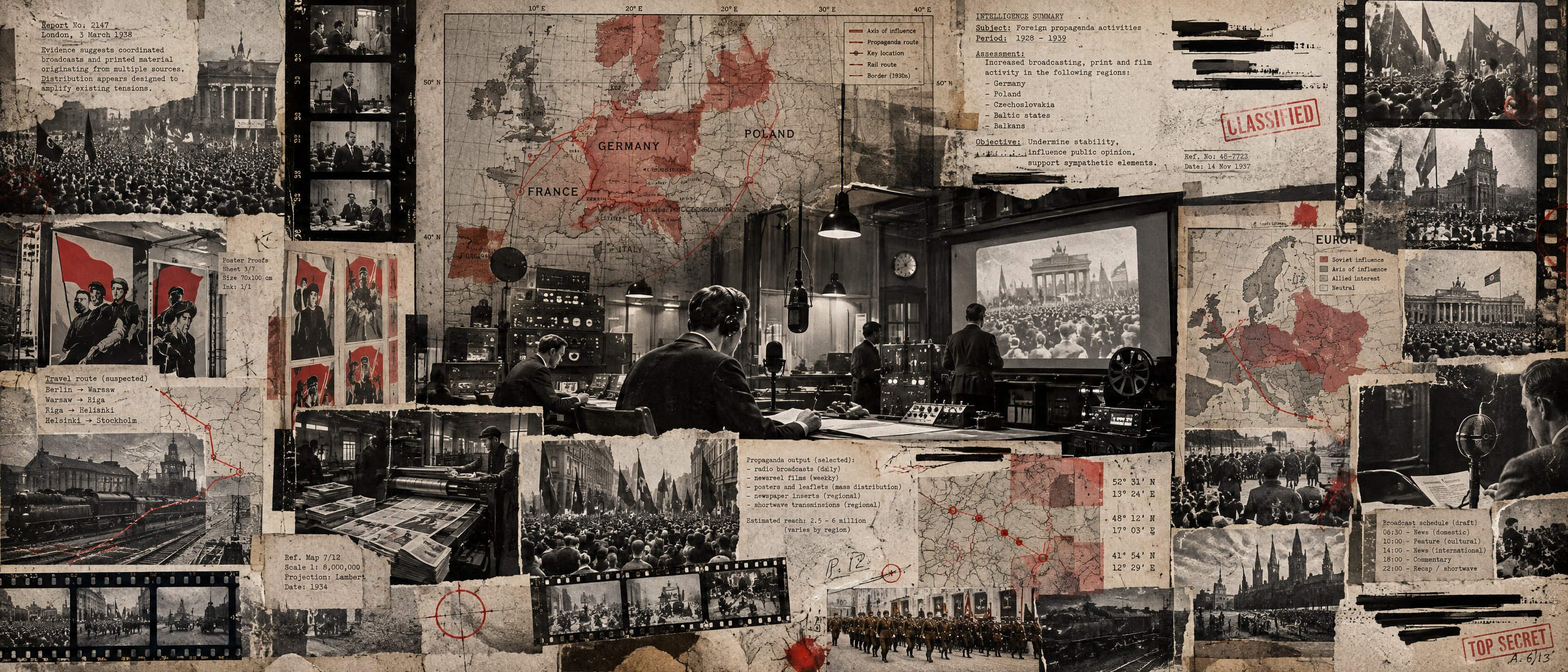
We have not waited for Lord Northcliffe’s procedure. On the spur of the moment we appreciated the great importance to enthuse public opinion for our more or less just cause. As early as three days after the outbreak of the war, Viviani promulgated a law which on the same day was passed by the House and the Senate, and which provided as the first instalment of a powerful propaganda the trifling amount of »79 twenty-five million francs in gold for the establishment of La Maison de la Presse, a gigantic building, Frangois Street 3, five stories high, without the basement, where the printing-presses are located, and the ground-floor with its large meeting hall. A busy, lively going and coming, as in a beehive; trucks arriving, elegant autos with pretentious-looking persons. The two hundred rooms contain the workshops, offices, parlours, and reception-rooms, where those war-mad heroes arc domiciled whose courage grows with the degree of distance from the trenches. From the basement up to the fifth story covered with a glass roof, all is the embodiment of concentrated propaganda. In the basement stood the machinery necessary for printing and reproduction, under the glass roof operated the photo-chemigraphic department. Its principal work consisted in making photographs and cuts of wooden figures with cut-off hands, torn-out tongues, gouged-out eyes, crushed skulls and brains laid bare. The pictures thus made were sent as unassailable evidence of German atrocities to all parts of the globe, where they did not fail to produce the desired effect. In the same rooms fictitious photographs were made of bombarded French and Belgian churches, violated graves and monuments and scenes of ruin and desolation. The staging and painting of these scenes were done by the best scene-painters of the Paris Grand Opera. . . . The Press House was the indefatigable geyser which belched forth incessantly false war reports and fictitious news from the rear and the front, the meanest and most brutal slanders of the opponents, the astonishing fictions of infamous acts attributed to them. The insidious but efficacious poison thus broadcast has misled and infected a host of well-meaning but unsophisticated people. . . . During the war the lie became a patriotic virtue. It was forced upon us by the Government and the censor, and through the peril of losing the war considered a necessity; besides, lying was profitable and often publicly honoured. It would be useless to deny the success of the lie, which used the Press as the best means of an extended and rapid circulation. The greatest efforts were made to stamp every word of the enemies as a lie and every lie of i8o FALSEHOOD IN WAR-TIME our own as absolute truth. Everything sailed under the flag of “ Propaganda.”
Children’s education was not neglected. In Le Matin, November 12, 1915, there was a paragraph headed, “ To Teachers.”
All French schools must possess a collection of the cards " German crimes,” in order to impress for ever upon the children the atrocities of the barbarians. It went on to say that an artist of note had created a dozen compositions relating to “ the most striking episodes among German crimes.” . . . “ Teachers, subscribe to-day and place these pictures in your schools.”
Press distortions were as common in France as in other countries. As early as July 25, 1914, M. Berthelot, M. Poincare’s permanent head of the Foreign Office, caused a gravely distorted account of the Pacific conversations between Bienvenu Martin and Baron Schoen to be published in the de Paris and Matin. Public opinion can be far more easily dragooned by Government and Press in France than it can be in this country. There was, therefore, less need for subtlety, more chance for concealment, and little fear of the crudest lies not being accepted, provided they had the hall-mark of some sort of authority. Moreover, in France there is less disposition to examine the stories and statements by which they were deceived and expose their falsity now that it is all over. Nevertheless, no people is more intelligently aware of the imbecile futility of war and its senseless barbarity than the common people of France.
(c) The United States.
There was no richer field for propaganda than the United States of America in the first years of the war.
i8i The Allied Powers and the Central Powers were both hard at work competing. The German method began by being too subtle. A wireless news agency, under German control, gave at first the best, most authentic, unbiased, and by far the cheapest war news, and thus attracted a large number of subscribers and fed the American Press. As the months passed, their news began to be ingeniously “ slanted ” in favour of the Central Powers. But they relied too much on argument. The cruder British methods were far more successful, and intensive work was done by the British War Mission, which (as Lord Northcliffe stated in Tbe November i6, 1917) comprised 500 officials with 10,000 assistants. Atrocities, Germany’s sole responsibility, the criminal Kaiser, and all the other fabrications started in Great Britain, were worked up by American liars with great effect. The Belgian baby without hands was a special favourite. There was hardly a household in which it was not discussed all over that vast continent, and even so ridiculous a scare as the concrete platforms for German guns was current in California. Spy stories abounded and effective films were produced by those who were pressing for America to come into the war. One particularly good one dealt with the pacific spirit which at first prevailed. Instead of deriding it, the pacifist hero was depicted as a fine, noble figure standing out against the excited agitation which surrounded him. The incursions of a foreign army were graphically and dramatically produced. Villages were burned, women carried off, and various cruelties perpetrated. The representative of a foreign Power, with an unmistakably German cast of countenance, was depicted as a hideous villain plotting and scheming with evil intent. There was a particularly fine “ closeup ” of him, rolling his eyes with Mephistophelian cunning, in the gallery of Congress. Finally the pacifist hero, carried away by his patriotic feelings, succumbs and supports the war with enthusiasm.
After America entered into the war a number of “ actual war picture ” films (prepared at Hollywood) were released. An immense army of speakers and pamphleteers were employed by the Committee on Public Information, and the country was flooded with literature describing the iniquities of the Hun.
The tragedy of the sinking of the Lusitania, which was of course the turning-point, was distorted to the utmost limit. Atrocity stories and faked films worked more especially on the feelings of the women, so that when neutrality was abandoned and “ Uncle Sam needs you ” was substituted, it took very few days to bring the whole country round. Once America was in the war, all the propaganda of the Allied nations was used and further exaggerated.
Among active patriots, John R. Rathom was conspicuous with his articles in the Providence Journal and with his numerous lectures. During 1917 and 1918 he led the campaign against any who could be suspected of having German sympathies. His spy stories were sensational, and he was said to be coached by the British Secret Service. In February 1918 he was issuing a series of articles on “ Germany’s Plot Exposed,” when the New York World discontinued them, as they were suspicious and believed that the articles were faked. In 1920 he was charged by Franklin D. Roosevelt for circulating false and defamatory libels, and in the course of examination he admitted “ drawing freely on his imagination.” He was finally utterly discredited, but not till after “ Rathomania ” had achieved considerable success during the time that it mattered.
Some lies which were little known here seem to have circulated successfully and been swallowed down in America, such as : poisoned sugar-candy dropped by German aeroplanes for children to eat; the outraging of nuns in Belgian convents ; the clipping of a chaplain’s ears by Uhlans ; and the German deification of Hindenburg by the hymn “ Hindenburg ist unser Gott ” (someone with insufficient knowledge of, or ear for, German having heard Luther’s hymn “ Ein feste Burg ist unser Gott ”). Persecution of Germans and everything German was undertaken with zeal; Wagner was unfavourably compared to Sousa, the danger of sauerkraut was emphasized and people rooted up “ bachelors’ buttons ” from their gardens, as being a German national flower. The frenzy with which the whole propaganda was conducted in America surpassed anything we experienced here. America being a land of extremes, colour and emphasis have to reach an exceptionally high pitch before anyone takes much notice.
In October 1918, some of the lies having become too absurdly preposterous. General Pershing and the War Department of the United States authorized the publication of the following cablegram :
A St. Louis (Missouri) paper recently received here states that a sergeant, one of fifty men sent back in connection with the Liberty Loan campaign, is making speeches in which he states: “ The Germans give poisoned candy to the children to eat and hand-grenades for them to play with. They show glee at the children’s dying writhings and laugh aloud when the grenades explode. I saw one American boy, about seventeen years old, who had been captured by the Germans, come back to our trenches. He had cotton in and about his cars. I asked someone what the cotton was for.
“ ‘ The Germans cut off his ears and sent him back to tell us they want to fight men,’ was the answer. ‘ They feed Americans on tuberculosis germs.’ ”
As there is no foundation whatever in fact for such statements, based on any experience we have had, I recommend that this sergeant, if the statements quoted above were made by him, be immediately returned for duty and that the statements be contradicted.
Pershing.
The American version of the crucifixion story • arose from the following statement of an American soldier :
It was on October 25, 1918, that out detachment, the Fifth Marines, Second Division, entered Suippes, situated north of Chalons and west of the Argonnes Forest, the village having just been evacuated by the Germans. There we found a naked girl nailed to a barn door. In addition about half of the coffins in the village churchyard had been torn from the graves and been opened, apparently with the idea of despoiling them.
When the soldier was pressed to give more precise details, he referred to the number of the Pittsburg Sunday Post of February 2, 1919, in which a description of the alleged incident, accompanied by drawings—not photographs—was given.
The matter having been referred to the German State Archives, it was stated, on September 27, 1924 :
During the year 1918 no Germans were in Suippes, situated on the Suippes and north-east of Chalons. The German front, especially in October 1918, ran north of Souain. That village was in possession of the French and the village of Suippes lies seven kilometres behind to the south.
' See page 91.
A Catholic clergyman in Suippcs, replying to an inquiry, dated February 18, 1925, answered:
Your American soldier could not have seen that a young girl had been crucified, for there is nothing whatever known here about this tale. That graves have been despoiled is possible, but not in the cemetery of Suippes.
In spite of the denial of the story by General March at Washington, it was introduced as the basis of a war propaganda drama which had the blessing of President Wilson.* Hideous cruelties, attributed to German submarine commanders, were also widely circulated. In April 1923 Admiral Sims stated, in the Neu> York Tribune :
There exists no authentic report of cruelties ever having been committed by the commander or the crew of a German submarine.
The Press reports about cruelties were only meant for propaganda purposes.
Traces of the deluge of falsehood still linger to-day among the more ignorant sections of the population. But far greater is the resentment of the disillusioned, who recognize now the quagmire of falsehood from which the whole war-fever emanated.
Mr. Kirby Page sums up the activities of the Committee of Public Information:
An examination of all this propaganda reveals the exaggerations and misrepresentations to which the American public was subjected. . . . Every Government systematically planned to deceive its own people, and a rigid censorship prevailed everywhere.
■ Duty to Civilisation, by Francis Nielson.
An interesting volume on the technique of propaganda has recently been published by Professor Lasswell, of Chicago,* from which the following passage may be quoted :
So great are the psychological resistances to war in modern nations, that every war must appear to be a war of defence against a menacing, murderous aggressor. There must be no ambiguity about whom the public is to hate. The war must not be due to a world system of conducting international affairs, nor to the stupidity or malevolence of all governing classes, but to the rapacity of the enemy. Guilt and guilelessness must be assessed geographically, and all the guilt must be on the other side of the frontier. If the propagandist is to mobilize the hate of the people, he must see to it that everything is circulated which establishes the sole responsibility of the enemy.
Mr. George Creel was, in the United States, the equivalent to Lord Northcliffe. His bureau was subsidized by public money, and in the book in which he relates the amazing activities undertaken, he gives some idea of the field covered when he says : “ The service cost the taxpayers $4,912,and earned $2,823,670.23 to be applied on expenses.” * (d) Italy.
Propaganda in Italy took rather a different form. The task of the Government was to formulate a policy which would justify Italy’s entry into the war and give the people expectation of definite gain. While, therefore, certain atrocity stories such as the Belgian baby without hands were circulated, it was not so much moral indignation which had to be stirred as political ambition which had to be satisfied.
■ Propagamla Ttehniqut in the World War, by Harold D. Lasswell * How We Adnertiied America, by George Creel.
The future of Dalmatia was the chief point of focus. Round this the Government and the Press worked up a great campaign of falsehood.
Mazzini once said, “ Istria is ours ; necessary to Italy just as the ports {porti) of Dalmatia are necessary to Southern Slavs.”
Mazzini’s name counted, and this saying was reproduced in Baron Sonino’s paper, the Giomale d’ltalia (March ii, 1918), : “Istria is ours; necessary to Italy just as the forts {forti) of Dalmatia are necessary to Southern Italy.”
When the falsity of this statement was pointed out in the Chamber, the reply given was that it was “ a fault of the printer.”
Nicolo Tomasso, a patriot of Dalmatian origin, who, till he died in 1873, was in favour of a Southern Slav confederation, was also declared, without a vestige of evidence, to be in favour of the annexation of Dalmatia by Italy.
An even more ridiculous fabrication was the publication in a Milanese newspaper of a long letter from no less a person than Abraham Lincoln, said to have been written in 1853, in which the American President assigned to Italy the entire Eastern coast of the Adriatic, as well as Corsica and Malta. Mazzini, who had been reduced to tears on reading it, had translated the letter with his own hand, and Carducci and de Amicis had expressed their admiration of it. It seemed curious that such an important document should never have been heard of before. But unfortunately Abraham Lincoln, in specifying the various territories which should be assigned to Italy, used the expressions “ Venezia Tridentina ” and “ Venezia Giulia,” designations which were used for the first time in 1866, and only came slowly into common use in subsequent years. The letter was subsequently condemned as a clumsy forgery."
In 1918 an article appeared in the Kasstgna Italiana in which a large number of famous Italians, from early Roman times onward, were quoted as being in favour of Dalmatia becoming an integral part of Italy. A painstaking research into the writings of every one of the notables mentioned produced the result that without a single exception they had all declared themselves in precisely the opposite sense.
On one occasion an impressive old man with a white beard was placed outside a meeting called in favour of the annexation of Dalmatia, who, with tears coursing down his cheeks, explained how he had been persecuted by the Dalmatians. As a matter of fact, he came from Rome.
On October 8, 1916, the Stampa of Turin produced a declaration from Lugano, said to have been issued by anti-Italian Yugo-Slavs, to the following effect:
The present war shows that the small States cannot have an independent life without facing great dangers to their national existence. Therefore the Yugo-Slavs recognize that it is impossible to form an independent Serbian kingdom which embraces all the Yugo-Slav territories. They desire that the unification of Slav territories should happen in triune form, namely, that the Slav countries should be included in the Austro-Hungarian monarchy, with the same rights and duties and in the same situation as Hungary.
The object of this was to incite anti-Yugo-Slav sentiment and to further Baron Sonino’s policy of the retention of Austro-Hungary as a federal State. The document was a forgery, but was reproduced throughout • Dal Patto di Londra alia Pace di Kama, Gaetano Salvemini.
Italy. UUnita invited the Stampa to state the source of its information, but no reply was ever given.* A series of telegrams was sent from the various districts of Dalmatia to the Prime Minister asking that Dalmatia might be annexed to Italy. These were all sent under the instructions of the Italian military authorities. The actual orders were subsequently discovered and published, urging that telegrams should be dispatched “ expressing the keen desire of the population for annexation to Italy.”
Slavophobe opinion was encouraged by every sort of device. Baron Sonino, for instance, in March 1918, declared, through his organs, that it was impossible to come to any accommodation with the Yugo-Slavs with regard to the Pact of London, because they insisted on claiming not only Dalmatia but also Pola, Trieste, and Udine. He had actually received specific assurances from M. Pashitch that these latter districts should remain in Italy’s possession.
A good instance of a volte-face on the part of the Press under Government pressure is afforded by two extracts from the Popolo d'ltalia, which show how the Press was used to guide public opinion and tell one people to hate or love another people.
Before Roumanian Declaration of War.
People must at last cease from describing the Roumanians as our sister nation. They are not Romans at all, however much they adorn themselves with this noble appellation. They are an intermixture between the barbarous Aborigines, who were subjugated by the Romans and Slavs, Chazars, Avars, Tartars, Mongols, Huns, and Turks, and so one can easily imagine what a gang of rascals has sprung from such an origin. The Roumanian is to-day still a barbarian and an ■ L.a Qutstione ieWAdriatico, by Mannelli and Salvemini.
individual of very inferior worth who, amid the universal ridicule of the French, apes the Parisian. He is glad enough to fish in muddy waters where none of those perils exist which he seeks to avoid as much as possible, as he has already shown in 1915.
The same newspaper wrote after the declaration of war :
The Roumanians have now proved in the most striking manner that they are worthy sons of the ancient Romans, from whom they, like ourselves, are descended. They arc thus our nearest brethren who now, with that courage and determination which are their special qualities, are taking part in the fight of the Latin and Slav races against the German race. . . . Nothing else indeed could be expected from a people which has the honour of belonging to that Latin race which once ruled the world.
Before Italian intervention, the Press in Italy was, as may well be imagined, a mass of contradictory reports from belligerents on both sides, charges, countercharges, atrocity accusations and denials, scares, spy stories, and every conceivable item of “ news ” which percolated through not only from Great Britain, France, Russia, and the Central Powers, but from the factories of more lurid and sensational reports in the Balkans.
Utterly unreliable and contradictory reports were published day by day with regard to the treatment of Cardinal Mercier. The papal authorities had to deny the existence of a radio-telegraphic station in the Vatican. Great excitement was caused by the reported existence of a secret bomb factory in an international school directed by Benedictines on the Aventine, which was proved by police investigation to be without foundation {Corriere della Sera, May ii, 1915). A Milan evening paper reported that German spies had been discovered and arrested by carabinieri while making maps on the railroad lines. These were found to be Milanese citizens testing a camera, and they were released at once.
Statements in the Press reporting that French willingness to treat with Germany had been prevented by British threats of reprisals (January 1915) had to be denied by the British and French Embassies in Rome.
A good instance of suppression producing falsehood can be found in a garbled report of a Parliamentary question in April 1915.
Mr. Chancellor asked the Under-Secretary for War :
Whether there was any official information showing that two hundred men belonging to one cavalry regiment became seriously ill with symptoms of blood-poisoning after inoculation against typhoid ; if so, will he say whether two or three of them died ; whether the two doctors who performed the inoculation were, on inquiry, found to be Austrians, tried by court martial and sentenced to penal servitude. . . .
Mr. Tennant replied :
There is no official information corresponding in any way to the statements in the first three parts of the question. No one has heard of the Austrian doctors who have been sentenced to penal servitude.
The question without the categorical official denial of the story was reproduced as a statement in the Corriire della Sera, April i8th, the object being, of course, to fan up anti-Austrian feeling.
Every report of Italy’s possible adherence to one side was authoritatively denied by the other side, and various suggested bribes of territory were constantly appearing. False reports of engagements and preparations in the Balkans and elsewhere helped to keep the minds of the unfortunate Italian people in utter confusion.
War lies from Russia, the Balkans and other parts of the world have unfortunately been beyond the reach of a collector. While some of them may have been more lurid and fantastic, they would, if recited, hardly serve by comparison to mitigate the foulness of the streams of falsehood which found their source in the great civilized Christian nations of the world.
Is further proof needed that international war is a monster born of hypocrisy, fed on falsehood, fattened on humbug, kept alive by superstition, directed to the death and torture of millions, succeeding in no high purpose, degrading to humanity, endangering civilization and bringing forth in its travail a hideous brood of strife, conflict and war, more war ? Yet statesmen still hesitate to draw the sword of their wits to destroy it.
7ijy the same author and published by George Allen (d Unwin Ltd
Falsehood in War-Time, Arthur Ponsonby. Published in the United Kingdom in 1928, more than 95 years ago, so in the public domain in the United States. Ponsonby died in 1946, so the text is also in the public domain in countries that count the author's life plus 70 years. Provenance and rights.