Albert Speer
Illustration, not an archive object
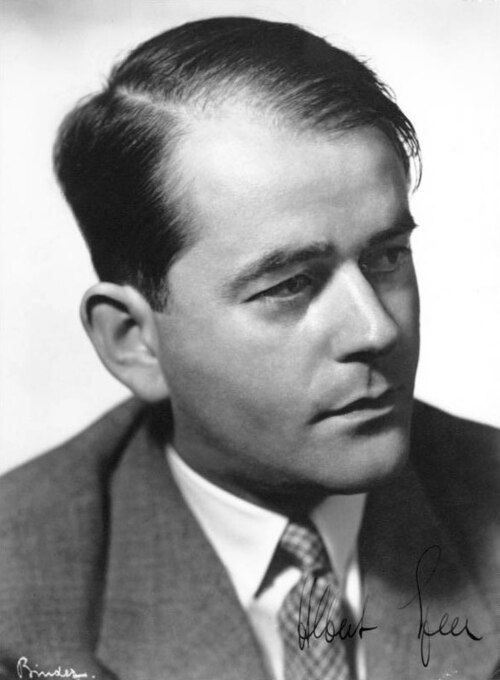

Armaments Minister · Germany
On the regime page: Nazi Germany
7 quotes, oldest first. Filter with other speakers.
Content note: Recommends sending workers to concentration-camp factories to deter absenteeism. The words are shown as they were said or written. Why
“We must also discuss the slackers. Ley has ascertained that the sick list decreases to one-fourth or one-fifth in factories where doctors are on the staff who examine the sick men. There is nothing to be said against SS and Police taking drastic steps and putting those known to be slackers into concentration camp factories. There is no alternative. Let it happen several times, and the news will soon get around.”
English: Nuremberg trial translation of the Central Planning Board minutes (as read into the IMT record). Original-language text not found.
Remark attributed to Speer in the minutes of the Central Planning Board, which allocated raw materials and labour. Justice Jackson read it in cross-examination on 21 June 1946; Speer answered "Correct" and described it as one of the remarks one can make in wartime when upset.
Cross-examination of Speer by Justice Jackson, in Trial of the Major War Criminals before the International Military Tribunal (Nuremberg: IMT, 1947), vol. 16, p. 515 (session of 21 June 1946) Source
“The enemy air force has concentrated further on traffic installations. Economic transportation has thereby been considerably reduced... In 4 to 8 weeks the final collapse of German economy must therefore be expected with certainty... After that collapse, the war cannot even be continued militarily... We at the head have the duty to help the nation in the difficult times which must be expected. In this connection we must soberly, and without regard for our fate, ask ourselves the question as to how this can be done even in the more remote future. If the opponent wishes to destroy the nation and the basis of its existence, then he must do the job himself. We must do everything to maintain, even if perhaps in a most primitive manner, a basis of existence for the nation to the last.”
English: Official IMT simultaneous translation of Speer's reading (document Speer-23). Original-language text not found.
Extract from a memorandum Speer sent to Hitler, read by Speer himself in court (exhibit Speer 23). In it he warned that the economy would collapse within weeks and asked that industry and transport not be destroyed during the retreat.
Testimony of Speer reading his memorandum to Hitler of 18 March 1945, in Trial of the Major War Criminals before the International Military Tribunal (Nuremberg: IMT, 1947), vol. 16, p. 496 (session of 20 June 1946) Source
Content note: Describes a plan to kill Hitler and his associates with poison gas. The words are shown as they were said or written. Why
“In those days Hitler, after the military situation conference, often had conversations in his shelter with Ley, Goebbels, and Bormann, who were particularly close to him then because they supported and co-operated in his radical course of action. [...] It would not be difficult to introduce the gas into the ventilator of the air-conditioning plant, which was in the garden of the Reich Chancellery. It was then bound to circulate through the entire shelter in a very short time. Thereupon, in the middle of February 1945, I sent for Stahl, the head of my main department "Munitions," with whom I had particularly close relations, since I had worked in close co-operation with him during the destructions. I frankly told him of my intention, as his testimony shows. I asked him to procure this new poison gas for me from the munitions production.”
English: Official IMT simultaneous translation. Original-language text not found.
Speer's testimony in his own defence about a plan he formed in February 1945 to kill Hitler and others in the Reich Chancellery bunker with poison gas. He says the plan failed for technical reasons.
Testimony of Speer, in Trial of the Major War Criminals before the International Military Tribunal (Nuremberg: IMT, 1947), vol. 16, p. 493 (session of 20 June 1946) Source
Content note: Concerns demands for labourers including foreigners working against their will. The words are shown as they were said or written. Why
“This voluntary statement is quite correct. During the war I was very grateful to Sauckel for every laborer whom I got through him. Many a time I held him responsible for the fact that through lack of manpower the armament industry did not achieve the results it might have, but I always emphasized the merits which accrued to him because of his activity on behalf of armaments.”
English: Official IMT simultaneous translation. Original-language text not found.
Examination by his counsel Dr. Flächsner about Speer's earlier statement of 18 October 1945 that he had demanded workers from Fritz Sauckel, the Plenipotentiary for Labour Mobilisation, knowing that foreigners among them were working in Germany against their will.
Testimony of Speer, in Trial of the Major War Criminals before the International Military Tribunal (Nuremberg: IMT, 1947), vol. 16, p. 446 (session of 20 June 1946) Source
“Hitler's dictatorship differed in one fundamental point from all its predecessors in history. His was the first dictatorship in the present period of modern technical development, a dictatorship which made complete use of all technical means in a perfect manner for the domination of its own nation. Through technical devices such as radio and loudspeaker 80 million people were deprived of independent thought. It was thereby possible to subject them to the will of one man.”
English: Official IMT simultaneous translation. Original-language text not found.
From Speer's final statement to the Tribunal before judgment, on the character of the Nazi state.
Final statement of the defendant Speer, in Trial of the Major War Criminals before the International Military Tribunal (Nuremberg: IMT, 1947), vol. 22, p. 404 (session of 31 August 1946) Source
“A new large-scale war will end with the destruction of human culture and civilization. Nothing can prevent unconfined engineering and science from completing the work of destroying human beings, which it has begun in so dreadful a way in this war.”
English: Official IMT simultaneous translation. Original-language text not found.
From Speer's final statement to the Tribunal before judgment, warning about future wars fought with the weapons developed in this one.
Final statement of the defendant Speer, in Trial of the Major War Criminals before the International Military Tribunal (Nuremberg: IMT, 1947), vol. 22, p. 406 (session of 31 August 1946) Source