Joachim von Ribbentrop
Illustration, not an archive object
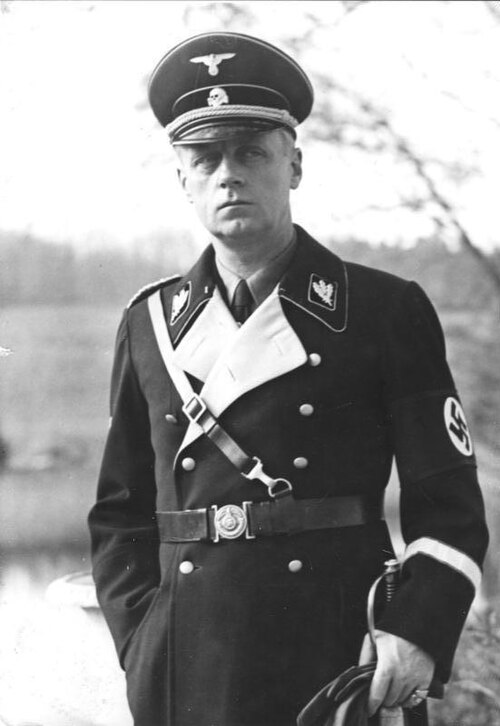

Reich Foreign Minister · Germany
On the regime page: Nazi Germany
8 quotes, oldest first. Filter with other speakers.
Content note: Attributed statement that Germany wanted war. The words are shown as they were said or written. Why
“"Well, Ribbentrop," I asked him while we were walking in the garden, "What do you want? The Corridor or Danzig?" "Not any longer" — and he fixed on me those cold Musee Grevin eyes of his — "We want war."”
English: Office of United States Chief of Counsel, translation of Nuremberg document 2987-PS (entries from the diary of Count Galeazzo Ciano). Original-language text not found.
Ciano's account of a conversation with Ribbentrop while walking in the garden at Ribbentrop's residence on the eve of the Salzburg talks with Hitler, three weeks before the invasion of Poland. Only the two replies "Not any longer" and "We want war" are attributed to Ribbentrop; the rest is Ciano's narration and question. Ribbentrop denied the remark under oath on 1 April 1946.
Introduction to the diary of Count Galeazzo Ciano (Italian Foreign Minister), account of his meeting with Ribbentrop at Fuschl, 11 August 1939, document 2987-PS, in Office of United States Chief of Counsel for Prosecution of Axis Criminality, Nazi Conspiracy and Aggression, vol. 5 (Washington: US Government Printing Office, 1946), p. 688 Source
Disputed: this is Ciano's record in his diary introduction, written afterwards, of what Ribbentrop said, not a verbatim record by Ribbentrop or a stenographic text. Ribbentrop testified that it was "absolutely untrue" (see ribbentrop-1946-04-01-denies-we-want-war). The Italian original of the diary was not checked.
Content note: States that Jews must be exterminated or put in concentration camps. The words are shown as they were said or written. Why
“To Horthy's counter-question as to what he should do with the Jews now that he had deprived them of almost all possibilities of livelihood, he could not kill them off — the Reich Foreign Minister declared that the Jews must either be exterminated or taken to concentration camps. There was no other possibility.”
English: Office of United States Chief of Counsel, translation of Nuremberg document D-736. Original-language text not found.
Hitler and the Hungarian Regent Admiral Horthy met at Klessheim; Ribbentrop was present. Horthy asked what he should do with the Jews of Hungary now that they had been deprived of nearly all means of livelihood and, he said, he could not kill them. The German record reports Ribbentrop's answer in indirect speech.
Office of United States Chief of Counsel for Prosecution of Axis Criminality, Nazi Conspiracy and Aggression, vol. 7 (Washington: US Government Printing Office, 1946), document D-736 (German record of the Hitler-Horthy conversation, Klessheim, 17 April 1943), p. 190 Source
Content note: Says the only possibilities for the Jews were killing or internment. The words are shown as they were said or written. Why
“Yes, there are only two possibilities -- either that, or to intern the Jews.”
English: Official IMT simultaneous translation of testimony. Original-language text not found.
Testimony of Paul Schmidt, the interpreter present at the Hitler-Horthy talks of 17 April 1943, recalling what Ribbentrop said after Horthy asked whether he should "beat the Jews to death". Schmidt testified on 28 March 1946, almost three years after the meeting.
Testimony of Paul Schmidt (interpreter) on Ribbentrop's remark at Klessheim, in Trial of the Major War Criminals before the International Military Tribunal (Nuremberg: IMT, 1947), vol. 10, p. 203 (session of 28 March 1946) Source
“Yes, that is absolutely untrue. I told Count Ciano at that time, this is on the same line, "the Fuehrer is determined to solve the Polish problem one way or another." This was what the Fuehrer had instructed me to say. That I am supposed to have said "we want war" is absurd for the simple reason that, it is clear to every diplomat, those things are just not said, not even to the very best and most trusted ally, but most certainly not to Count Ciano.”
English: Official IMT simultaneous translation. Original-language text not found.
Cross-examination by Sir David Maxwell-Fyfe, who put to Ribbentrop the account in Count Ciano's diary of their meeting before the August 1939 Salzburg talks, in which Ribbentrop is said to have answered "Not any more; we want war". Ribbentrop's reply.
Cross-examination of Ribbentrop by Sir David Maxwell-Fyfe, in Trial of the Major War Criminals before the International Military Tribunal (Nuremberg: IMT, 1947), vol. 10, p. 361 (session of 1 April 1946) Source
Content note: Admits knowing of the deportation of Jews and pressing other governments to act. The words are shown as they were said or written. Why
“I do not know the contents of the document in detail. I do not know what I myself said in detail. But at any rate I knew that the Fuehrer had ordered that the Jews of the occupied territories in Europe were to be transported to reservations in the East and resettled there. That I did know. The carrying out of these measures, however, was not my task as Minister for Foreign Affairs of the Foreign Office, but I did know that it was the Fuehrer's wish. In this connection, I remember that I received an order from him to discuss the matter with the Italian Government so that they too would introduce corresponding measures regarding the Jewish problem. That applied to other countries as well, where we had to send telegrams quite frequently, so that these countries should solve the Jewish question.”
English: Official IMT simultaneous translation. Original-language text not found.
Cross-examination by French prosecutor Faure on German policy toward Jews in occupied Europe. Ribbentrop describes what he knew of Hitler's order and of his own role in pressing allied governments.
Cross-examination of Ribbentrop by M. Faure, in Trial of the Major War Criminals before the International Military Tribunal (Nuremberg: IMT, 1947), vol. 10, p. 407 (session of 2 April 1946) Source
Content note: Refers to atrocities and compares them with Allied conduct. The words are shown as they were said or written. Why
“Fate made me one of the exponents of this revolution. I deplore the atrocious crimes which became known to me here and which besmirch this revolution. But I cannot measure all of them according to puritanical standards, and the less so since I have seen that even the enemy, in spite of their total victory, was neither able nor willing to prevent atrocities of the most extensive kind.”
English: Official IMT simultaneous translation. Original-language text not found.
From Ribbentrop's final statement to the Tribunal before judgment, on his role in the Nazi government and the crimes revealed at the trial.
Final statement of the defendant Ribbentrop, in Trial of the Major War Criminals before the International Military Tribunal (Nuremberg: IMT, 1947), vol. 22, p. 374 (session of 31 August 1946) Source
“When I look back upon my actions and my desires, then I can conclude only this: The only thing of which I consider myself guilty before my people--not before this Tribunal--is that my aspirations in foreign policy remained without success.”
English: Official IMT simultaneous translation. Original-language text not found.
Closing words of Ribbentrop's final statement to the Tribunal before judgment.
Final statement of the defendant Ribbentrop, in Trial of the Major War Criminals before the International Military Tribunal (Nuremberg: IMT, 1947), vol. 22, p. 374 (session of 31 August 1946) Source
“God protect Germany [...] My last wish is that Germany realize its entity and that an understanding be reached between the East and the West. I wish peace to the world.”
English: As rendered in the International News Service dispatch of Kingsbury Smith. Original-language text not found.
Ribbentrop's words on the scaffold, as reported by the sole US press witness to the executions. He spoke "God protect Germany" in German and was then asked whether he wished to say more.
Kingsbury Smith, "The Execution of Nazi War Criminals", International News Service dispatch from Nuremberg Gaol, 16 October 1946 Source