Karl Dönitz
Illustration, not an archive object
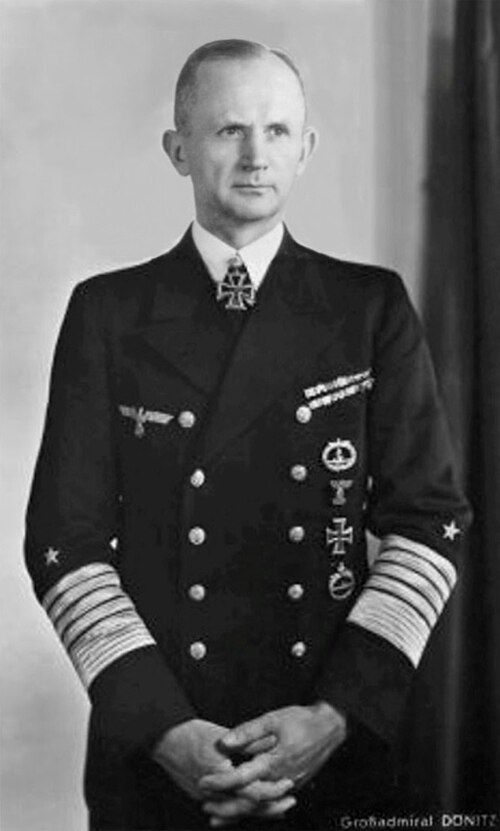

Navy commander; Reich President 1945 · Germany
On the regime page: Nazi Germany
6 quotes, oldest first. Filter with other speakers.
Content note: Order not to rescue survivors of sunk ships. The words are shown as they were said or written. Why
“1. No attempt of any kind must be made at rescuing members of ships sunk and this includes picking up persons in the water and putting them in lifeboats, righting capsized lifeboats and handing over food and water. Rescue runs counter to the rudimentary demands of warfare for the destruction of enemy ships and crews. 2. Orders for bringing in Captains and Chief Engineers still apply. 3. Rescue shipwrecked only if their statements will be of importance for your boat. 4. Be harsh, having in mind that the enemy takes no regard of women and children in his bombing attacks on German cities.”
English: Office of United States Chief of Counsel, translation of Nuremberg document D-630. Original-language text not found.
Signal sent by Dönitz, as Commander of Submarines, five days after the sinking of the liner Laconia, which carried Italian prisoners of war, and while rescue efforts for its survivors were under way. It was read into the record during Dönitz's examination on 9 May 1946 and was the subject of the charge of ordering the killing of shipwrecked crews.
Radio signal "Triton Null" to all U-boat commanding officers, 17 September 1942, from the war diary of the Commander of Submarines (B.d.U.), document D-630, in Office of United States Chief of Counsel for Prosecution of Axis Criminality, Nazi Conspiracy and Aggression, vol. 7 (Washington: US Government Printing Office, 1946), p. 99 Source
“From the very start the whole of the officers' corps must be so indoctrinated that it feels itself coresponsible for the National Socialist State in its entirety. The officer is the exponent of the State. The idle chatter that the officer is nonpolitical is sheer nonsense.”
English: Nuremberg trial translation of document D-640 (as read into the IMT record). Original-language text not found.
Passage from a directive of Dönitz, as Commander-in-Chief of the Navy, to naval officers on political indoctrination, read by Sir David Maxwell-Fyfe in cross-examination (document D-640, exhibit GB-186). Dönitz answered that he had said it and asked that the preceding lines on discipline and fighting strength be read too.
Cross-examination of Dönitz by Sir David Maxwell-Fyfe, reading document D-640, in Trial of the Major War Criminals before the International Military Tribunal (Nuremberg: IMT, 1947), vol. 13, p. 391 (session of 10 May 1946) Source
Content note: Describes Jews as a "spreading poison". The words are shown as they were said or written. Why
“What would have become of our country today if the Fuehrer had not united Us under National Socialism? Split parties, beset with the spreading poison of Jewry, and vulnerable to it because we lacked the defense of our present uncompromising ideology, we would long since have succumbed under the burden of this war and delivered ourselves up to the enemy who would have mercilessly destroyed us.”
English: Nuremberg trial translation of document 2878-PS (as read into the IMT record). Original-language text not found.
Passage from Dönitz's Heroes' Day (Heldengedenktag) address to the navy, read by Sir David Maxwell-Fyfe in cross-examination (document 2878-PS). Dönitz was then Commander-in-Chief of the Navy, with 600,000 to 700,000 men.
Cross-examination of Dönitz by Sir David Maxwell-Fyfe, reading document 2878-PS, in Trial of the Major War Criminals before the International Military Tribunal (Nuremberg: IMT, 1947), vol. 13, p. 391 (session of 10 May 1946) Source
Content note: Explains an antisemitic remark. The words are shown as they were said or written. Why
“It means that it might have had a disintegrating effect on the people's power of endurance, and in this life-and-death struggle of our country I, as a soldier, was especially anxious about this. SIR DAVID MAXWELL-FYFE: Well, now, that is what I want to know. You were the Supreme Commander and indoctrinated 600,000 or 700,000 men. Why were you conveying to them that Jews were a spreading poison in party politics? Why was that? What was it that you objected to in Jews that made you think that they had a bad effect on Germany? DOENITZ: That statement was made during my memorial speech on Heroes' Day. It shows that I was of the opinion that the endurance, the power to endure, of the people, as it was composed, could be better preserved than if there were Jewish elements in the nation.”
English: Official IMT simultaneous translation. Original-language text not found.
Dönitz's answer when Sir David Maxwell-Fyfe asked what he had meant by the phrase "spreading poison of Jewry" in his Heroes' Day speech of 12 March 1944.
Cross-examination of Dönitz by Sir David Maxwell-Fyfe, in Trial of the Major War Criminals before the International Military Tribunal (Nuremberg: IMT, 1947), vol. 13, p. 392 (session of 10 May 1946) Source
“Secondly, there has been much talk here about a conspiracy which is alleged to have existed among the defendants. I consider this allegation a political dogma. As such it cannot be proved, but can only be believed or rejected. Considerable portions of the German people will never believe, however, that such a conspiracy could have been the cause of their misfortune. Let politicians and jurists argue about it; they will only make it harder for the German people to draw a lesson from this Trial, which is of decisive importance for its attitude toward the past and the shaping of its future the acknowledgement that the Fuehrer principle as a political principle is wrong. In the military leadership of all armies in this world, the Fuehrer principle has proved itself in the best possible way. On the strength of this experience I considered it also right with regard to political leadership, particularly in the case of a nation in the hopeless position in which the German people found itself in 1932. The great successes of the new government and a feeling of happiness such as the entire nation had never known before seemed to prove it right. But if, in spite of all the idealism, all the decency, and all the devotion of the great majority of the German people, no other, result has been achieved through the Fuehrer principle, in the last analysis, than the misfortune of this people, then this principle as such must be wrong, wrong because apparently human nature is not in a position to use the power of this principle for good, without falling victim to the temptations of this power.”
English: Official IMT simultaneous translation. Original-language text not found.
Second of three points in Dönitz's final statement to the Tribunal before judgment, on the alleged conspiracy and the Führer principle.
Final statement of the defendant Dönitz, in Trial of the Major War Criminals before the International Military Tribunal (Nuremberg: IMT, 1947), vol. 22, p. 389 (session of 31 August 1946) Source
“Thirdly, my life was devoted to my profession and thereby to the service of the German people. As the last Commander-in-Chief of the German Navy and as the last Head of the State, I bear the responsibility towards the German people, for everything which I have done and left undone.”
English: Official IMT simultaneous translation. Original-language text not found.
Third point in Dönitz's final statement to the Tribunal before judgment. He had been named Hitler's successor as head of state and led the Reich government in May 1945.
Final statement of the defendant Dönitz, in Trial of the Major War Criminals before the International Military Tribunal (Nuremberg: IMT, 1947), vol. 22, p. 390 (session of 31 August 1946) Source