Andrei Zhdanov
Illustration, not an archive object
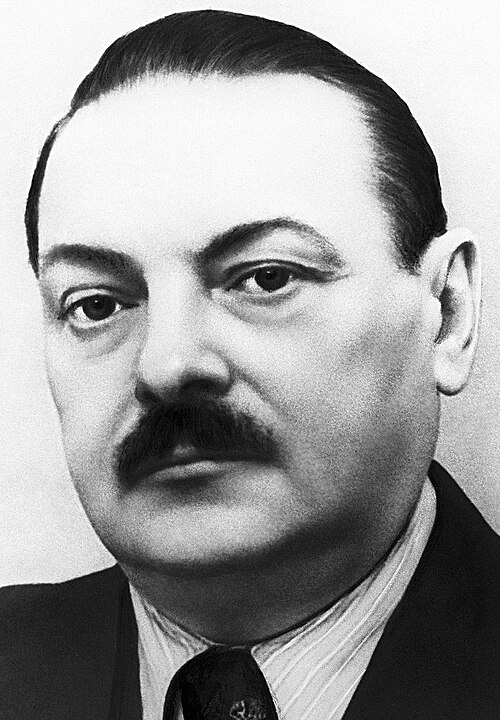

Secretary of the Central Committee and Politburo member; Leningrad party chief; head of postwar Soviet cultural and ideological policy · Soviet Union
On the regime page: Soviet Union under Stalin
7 quotes, oldest first. Filter with other speakers.
“In addition to this, the truthfulness and historical concreteness of the artistic portrayal should be combined with the ideological remolding and education of the toiling people in the spirit of socialism. This method in belles lettres and literary criticism is what we call the method of socialist realism.”
English: Soviet Writers' Congress 1934 (London: Lawrence & Wishart, 1977), translator not credited. Original-language text not found.
Zhdanov spoke for the Central Committee at the opening of the writers' congress that adopted socialist realism as the method of Soviet literature.
Speech at the First All-Union Congress of Soviet Writers, August 1934, in Soviet Writers' Congress 1934 (London: Lawrence & Wishart, 1977), pp. 15-26 Source
“To be an engineer of human souls means standing with both feet firmly planted on the basis of real life. And this in its turn denotes a rupture with romanticism of the old type, which depicted a non-existent life and non-existent heroes, leading the reader away from the antagonisms and oppression of real life into a world of the impossible, into a world of utopian dreams.”
English: Soviet Writers' Congress 1934 (London: Lawrence & Wishart, 1977), translator not credited. Original-language text not found.
Zhdanov explains the phrase "engineers of human souls", which he attributes to Stalin, to the assembled writers.
Speech at the First All-Union Congress of Soviet Writers, August 1934, in Soviet Writers' Congress 1934 (London: Lawrence & Wishart, 1977), pp. 15-26 Source
“We demand that our comrades, both practising writers and those in positions of literary leadership, should be guided by that without which the Soviet order cannot live, that is to say, by politics, so that our young people may be brought up not in the spirit of do-nothing and don’t-care, but in an optimistic revolutionary spirit.”
Original (Russian)
Мы требуем, чтобы наши товарищи, как руководители литературы, так и пишущие, руководствовались тем, без чего советский строй не может жить, т. е. политикой, чтобы нам воспитывать молодежь не в духе наплевизма и безидейности, а в духе бодрости и революционности.
English: Eleanor Fox, Stella Jackson and Harold C. Feldt, for the Society for Cultural Relations with the USSR (London: Lawrence & Wishart, 1950)
Zhdanov reported to Leningrad party and literary officials on the Central Committee decision of 14 August 1946 condemning the journals Zvezda and Leningrad. The report set the line for Soviet literary policy in the following years.
Report on the journals Zvezda and Leningrad (delivered 15-16 August 1946; published in Pravda, 21 September 1946, no. 225, pp. 2-3), in A. A. Zhdanov, On Literature, Music and Philosophy (London: Lawrence & Wishart, 1950), section "Leninism and Literature" Source
Content note: Calls a writer's work the product of the "scum of the literary world". The words are shown as they were said or written. Why
“The Leningraders in charge of Zvezda must indeed be lacking in vigilance if a ‘work’ of this sort is offered to the journal’s Soviet readers, if it is found possible to publish works steeped in the venom of bestial enmity towards the Soviet order. Only the scum of the literary world could write such ‘works’, and only the blind, the apolitical could allow them to appear.”
Original (Russian)
Если «произведения» такого сорта преподносятся советским читателям журналом «Звезда», то как слаба должна быть бдительность ленинградцев, руководящих журналом «Звезда», чтобы в нем можно было помещать произведения, отравленные ядом зоологической враждебности к советскому строю. Только подонки литературы могут создавать подобные «произведения», и только люди слепые и аполитичные могут давать им ход.
English: Eleanor Fox, Stella Jackson and Harold C. Feldt (Lawrence & Wishart, 1950)
Zhdanov refers to the satirist Mikhail Zoshchenko's story The Adventures of a Monkey, which Zvezda had published. Zoshchenko was expelled from the Union of Writers after the decree.
Report on the journals Zvezda and Leningrad (15-16 August 1946; Pravda, 21 September 1946, no. 225), in A. A. Zhdanov, On Literature, Music and Philosophy (London: Lawrence & Wishart, 1950) Source
Content note: Abusive and sexualised characterisation of a woman poet. The words are shown as they were said or written. Why
“Akhmatova’s subject-matter is individualistic to the core. The range of her poetry is sadly limited; it is the poetry of a spoilt woman-aristocrat, frenziedly vacillating between boudoir and chapel. Her main emphasis is on erotic love-themes interwoven with notes of sadness, longing, death, mysticism, fatality. A sense of fatality (quite comprehensible in a dying group), the dismal tones of a deathbed hopelessness, mystical experiences shot with eroticism, make up Akhmatova’s spiritual world; she is a left-over from the world of the old aristocracy now irrevocably past and gone, the world of ‘Catherine’s good old days’. It would be hard to say whether she is a nun or a fallen woman; better perhaps say she is a bit of each, her desires and her prayers intertwined.”
Original (Russian)
Тематика Ахматовой насквозь индивидуалистическая. До убожества ограничен диапазон ее поэзии,— поэзии взбесившейся барыньки, мечущейся между будуаром и моленной. Основное у нее — это любовно-эротические мотивы, переплетенные с мотивами грусти, тоски, смерти, мистики, обреченности. Чувство обреченности,— чувство, понятное для общественного сознания вымирающей группы,— мрачные тона предсмертной безнадежности, мистические переживания пополам с эротикой — таков духовный мир Ахматовой, одного из осколков безвозвратно канувшего в вечность мира старой дворянской культуры, «добрых старых екатерининских времен». Не то монахиня, не то блудница, а вернее блудница и монахиня, у которой блуд смешан с молитвой.
English: Eleanor Fox, Stella Jackson and Harold C. Feldt (Lawrence & Wishart, 1950)
Zhdanov's account of the poet Anna Akhmatova, whose work had appeared in Leningrad. She was expelled from the Union of Writers after the decree.
Report on the journals Zvezda and Leningrad (15-16 August 1946; Pravda, 21 September 1946, no. 225), in A. A. Zhdanov, On Literature, Music and Philosophy (London: Lawrence & Wishart, 1950) Source
“The fundamental changes caused by the war on the international scene and in the position of individual countries has entirely changed the political landscape of the world. A new alignment of political forces has arisen. The more the war recedes into the past, the more distinct becomes two major trends in postwar international policy, corresponding to the division of the political forces operating on the international arena into two major camps: the imperialist and anti-democratic camp, on the one hand, and the anti-imperialist and democratic camp, on the other. The principal driving force of the imperialist camp is the U.S.A. Allied with it are Great Britain and France.”
English: English text as reprinted in the Congressional Record, 80th Congress, vol. 94, part 9 (1948), p. A1288; translator not credited. Original-language text not found.
Zhdanov's report to the founding conference of the Cominform, delivered after the announcement of the Marshall Plan. It describes the world as divided into two camps.
Report on the International Situation to the Information Conference of Communist parties, September 1947, in Informatsionnoe soveshchanie predstavitelei nekotorykh kompartii v Polshe (Moscow: Gospolitizdat, 1948), pp. 30-35; English in the Congressional Record, 80th Congress, vol. 94, part 9, p. A1288 Source
“The formalist trend brings about the substitution of a music which is false, vulgar and often purely pathological, for natural, beautiful, human music. Furthermore, it is characteristic of this trend to avoid a frontal attack and to screen its revisionist activities by formally agreeing with the basic principles of socialist realism. This sort of underhand method is, of course, nothing new. History can show many instances of revisionism behind the label of sham agreement with a given teaching. This makes it all the more necessary to reveal the real essence of the formalist trend and the damage it has done to the development of Soviet music.”
English: Lawrence & Wishart, 1950 edition (Society for Cultural Relations with the USSR). Original-language text not found.
Zhdanov's concluding speech after criticism of the opera The Great Friendship by Vano Muradeli. It was followed by the Central Committee resolution of 10 February 1948 condemning "formalism" in the work of Shostakovich, Prokofiev and others.
Concluding speech at the Conference of Soviet Music Workers, January 1948, in A. A. Zhdanov, On Literature, Music and Philosophy (London: Lawrence & Wishart, 1950), "On Music" Source