Georgy Zhukov
Illustration, not an archive object
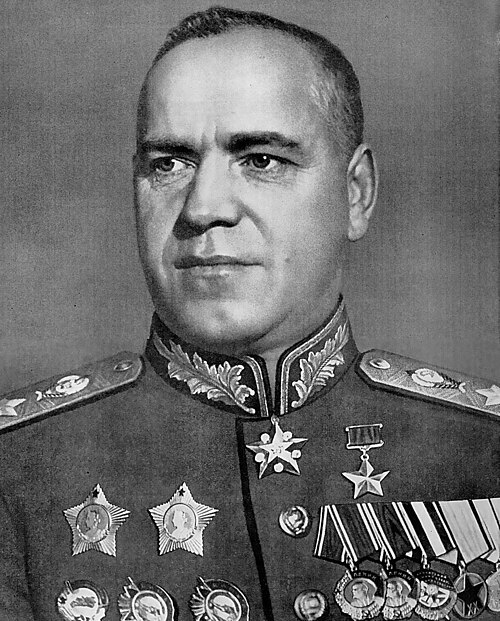

Marshal of the Soviet Union; Deputy Supreme Commander-in-Chief; Commander of the 1st Belorussian Front; Minister of Defence, 1955-1957 · Soviet Union
On the regime page: Soviet Union under Stalin
4 quotes, oldest first. Filter with other speakers.
“We’ll definitely hold Moscow. But we’ll need at least two more armies and another two hundred tanks.”
English: Progress Publishers translation (Moscow, 1985); chapters 14-23 translated by N. Burova, R. Daglish, P. Garb, G. Kozlov, S. Sossinsky and M. Sydney. Original-language text not found.
Zhukov, commanding the Western Front, recalls Stalin telephoning to ask whether Moscow could be held, after a German breakthrough on the Kalinin Front. Stalin's question, as Zhukov gives it, was: "Are you sure we’ll be able to hold Moscow? It hurts me to ask you this. Answer me truthfully, as a Communist."
Zhukov's reply to Stalin's telephone question, mid-November 1941, in G. K. Zhukov, Reminiscences and Reflections, vol. 2 (Moscow: Progress Publishers, 1985; translated from Vospominaniya i razmyshleniya, Moscow: APN, 1974), ch. 15, p. 35 Source
“We, representatives of the Supreme Command of the Soviet Armed Forces and the Supreme Command of the Allied Forces, have been authorized by the governments of the anti-Hitler coalition to accept the unconditional surrender of Germany from the German Military Command. Bring in the representatives of the German High Command.”
English: Progress Publishers translation (Moscow, 1985); chapters 14-23 translated by N. Burova, R. Daglish, P. Garb, G. Kozlov, S. Sossinsky and M. Sydney. Original-language text not found.
Zhukov presided for the Soviet side at the signing of the German act of unconditional surrender, with Tedder, Spaatz and de Lattre de Tassigny present for the Western Allies and Field Marshal Keitel, Stumpff and Friedeburg for Germany.
Opening of the surrender ceremony, 24:00 on 8/9 May 1945, as recalled in G. K. Zhukov, Reminiscences and Reflections, vol. 2 (Moscow: Progress Publishers, 1985; translated from Vospominaniya i razmyshleniya, Moscow: APN, 1974), ch. 23, pp. 399-400 Source
Content note: Describes sending infantry across minefields. The words are shown as they were said or written. Why
“There are two kinds of mines; one is the personnel mine and the other is the the vehicular mine. When we come to a mine field our infantry attacks exactly as if it were not there. The losses we get from personnel mines we consider only equal to those we would have got from machine guns and artillery if the Germans had chosen to defend that particular area with strong bodies of troops instead of with mine fields. The attacking infantry does not set off the vehicular mines, so after they have penetrated to the far side of the field they form a bridgehead, after which the engineers come up and dig out channels through which our vehicles can go.”
English: Dwight D. Eisenhower's own English rendering of an interpreted conversation, in Crusade in Europe (London: William Heinemann, 1948). Original-language text not found.
Eisenhower introduces the words with "Marshal Zhukov gave me a matter-of-fact statement of his practice, which was, roughly:". The conversation took place on the return flight from Leningrad to Berlin after Eisenhower's August 1945 visit to the Soviet Union.
Quoted by Dwight D. Eisenhower, Crusade in Europe (London: William Heinemann, 1948), pp. 510-511 Source
“No one can deny that the main brunt of the fight against the fascist armed forces was borne by the Soviet Union. It was the most bitter, bloody and difficult of all the wars that our people had ever fought. Suffice it to say that more than 20 million Soviet people died in that war.”
English: Progress Publishers translation (Moscow, 1985); chapters 14-23 translated by N. Burova, R. Daglish, P. Garb, G. Kozlov, S. Sossinsky and M. Sydney. Original-language text not found.
Zhukov's closing reflections on the war in his memoirs, which first appeared in Russian in 1969. This edition is the 1974 Russian text, translated in 1985.
G. K. Zhukov, Reminiscences and Reflections, vol. 2 (Moscow: Progress Publishers, 1985; translated from Vospominaniya i razmyshleniya, Moscow: APN, 1974), ch. 23, p. 413 Source
Often attributed, not verified
These words circulate under Georgy Zhukov’s name but could not be traced to a source. They are listed so readers can check them, not as Georgy Zhukov’s words.
“Women will bear more soldiers.”
Not found in the English text of Zhukov's Reminiscences and Reflections, vol. 2 (OCR searched for related phrases), nor in Eisenhower's Crusade in Europe, where Zhukov's minefield remark is recorded. No contemporary source was located.