Joseph Stalin
Illustration, not an archive object
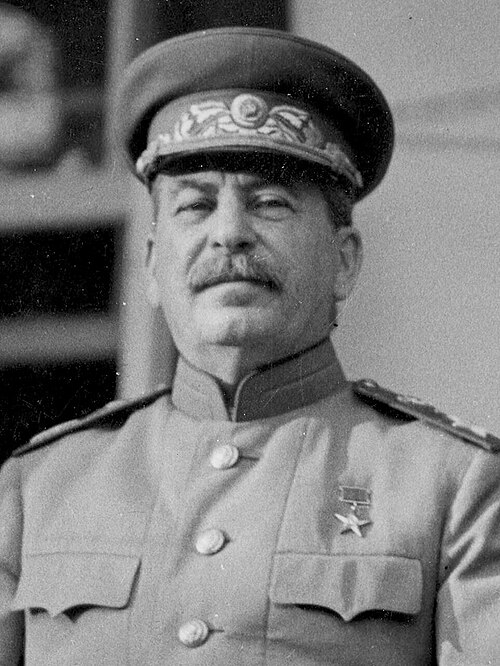

General Secretary; from 1941 also Chairman of the Council of People's Commissars · Soviet Union
On the regime page: Soviet Union under Stalin
25 quotes, oldest first. Filter with other speakers.
“The press must grow day in and day out—it is our Party's sharpest and most powerful weapon.”
Original (Russian)
Печать должна расти не по дням, а по часам, – это самое острое и самое сильное оружие нашей партии.
English: Foreign Languages Publishing House, Moscow, official English edition (J. V. Stalin, Works), translator not credited
Stalin proposed four amendments to the Central Committee's proposals at the end of the congress debate on the organisational report. The fourth concerned the Party press.
Reply to the discussion on the Central Committee's organisational report, Twelfth Congress of the R.C.P.(B.), 19 April 1923, in J. V. Stalin, Works, vol. 5 (Moscow: Foreign Languages Publishing House, 1954); Russian: Sochineniya, vol. 5 (Moscow: OGIZ-Gospolitizdat, 1947) Source
Content note: Announces the elimination of a social class (dekulakisation). The words are shown as they were said or written. Why
“What does this mean? It means that we have passed from the policy of restricting the exploiting tendencies of the kulaks to the policy of eliminating the kulaks as a class. It means that we have carried out, and are continuing to carry out, one of the decisive turns in our whole policy.”
Original (Russian)
Что это значит? Это значит, что от политики ограничения эксплуататорских тенденций кулачества мы перешли к политике ликвидации кулачества, как класса. Это значит, что мы проделали и продолжаем проделывать один из решающих поворотов во всей нашей политике.
English: Foreign Languages Publishing House, Moscow, official English edition (J. V. Stalin, Works), translator not credited
Stalin addressed a conference of Marxist agrarian scholars during the first phase of mass collectivisation. He described the change in Party policy towards better-off peasants (kulaks).
Speech at a Conference of Marxist Students of Agrarian Questions, 27 December 1929, 'Concerning Questions of Agrarian Policy in the U.S.S.R.', in J. V. Stalin, Works, vol. 12 (Moscow: Foreign Languages Publishing House, 1954), pp. 147-178; Russian: Sochineniya, vol. 12 (Moscow: Gospolitizdat, 1949), pp. 141-172 Source
Content note: Dismissive remark about the dispossession of peasant households. The words are shown as they were said or written. Why
“Now we are able to carry on a determined offensive against the kulaks, break their resistance, eliminate them as a class and replace their output by the output of the collective farms and state farms. Now, dekulakisation is being carried out by the masses of poor and middle peasants themselves, who are putting complete collectivisation into practice. Now, dekulakisation in the areas of complete collectivisation is no longer just an administrative measure. Now, it is an integral part of the formation and development of the collective farms. Consequently it is now ridiculous and foolish to discourse at length on dekulakisation. When the head is off, one does not mourn for the hair.”
Original (Russian)
Теперь мы имеем возможность повести решительное наступление на кулачество, сломить его сопротивление, ликвидировать его, как класс, и заменить его производство производством колхозов и совхозов. Теперь раскулачивание производится самими бедняцко-середняцкими массами, осуществляющими сплошную коллективизацию. Теперь раскулачивание в районах сплошной коллективизации не есть уже простая административная мера. Теперь раскулачивание представляет там составную часть образования и развития колхозов. Поэтому смешно и несерьезно распространяться теперь о раскулачивании. Снявши голову, по волосам не плачут.
English: Foreign Languages Publishing House, Moscow, official English edition (J. V. Stalin, Works), translator not credited
In the same speech, Stalin answered the question whether dekulakisation (expropriation and removal of kulak households) could be permitted in areas of complete collectivisation.
Speech at a Conference of Marxist Students of Agrarian Questions, 27 December 1929, 'Concerning Questions of Agrarian Policy in the U.S.S.R.', in J. V. Stalin, Works, vol. 12 (Moscow: Foreign Languages Publishing House, 1954), pp. 147-178; Russian: Sochineniya, vol. 12 (Moscow: Gospolitizdat, 1949), pp. 141-172 Source
“Collective farms must not be established by force. That would be foolish and reactionary.”
Original (Russian)
Нельзя насаждать колхозы силой. Это было бы глупо и реакционно.
English: Foreign Languages Publishing House, Moscow, 1955 (J. V. Stalin, Works, vol. 12), translator not credited
The article states that by 20 February 1930 half of the peasant farms of the U.S.S.R. had been collectivised, and criticises local officials who, it says, violate the voluntary principle.
'Dizzy with Success: Concerning Questions of the Collective-Farm Movement', Pravda, no. 60, 2 March 1930, in J. V. Stalin, Works, vol. 12 (Moscow: Foreign Languages Publishing House, 1955), pp. 197-205; Russian: Sochineniya, vol. 12 (Moscow: Gospolitizdat, 1949), pp. 191-199 Source
“We are fifty or a hundred years behind the advanced countries. We must make good this distance in ten years. Either we do it, or we shall go under.”
Original (Russian)
Мы отстали от передовых стран на 50–100 лет. Мы должны пробежать это расстояние в десять лет. Либо мы сделаем это, либо нас сомнут.
English: Foreign Languages Publishing House, Moscow, official English edition (J. V. Stalin, Works), translator not credited
Stalin spoke during the first Five-Year Plan, in answer to the question whether the pace of industrialisation could be reduced.
'The Tasks of Business Executives', speech at the First All-Union Conference of Leading Personnel of Socialist Industry, 4 February 1931, in J. V. Stalin, Works, vol. 13 (Moscow: Foreign Languages Publishing House, 1954), pp. 29-42; Russian: Sochineniya, vol. 13 (Moscow: Gospolitizdat, 1951), pp. 29-42 Source
“A Bolshevik's word is his bond. Bolsheviks are in the habit of fulfilling promises made by them.”
Original (Russian)
Слово большевика – серьезное слово. Большевики привыкли выполнять обещания, которые они дают.
English: Foreign Languages Publishing House, Moscow, official English edition (J. V. Stalin, Works, vol. 13, 1954), translator not credited
Opening of the passage in which Stalin asks industrial managers whether the pledge to meet the 1931 control figures, an increase in industrial output of 45 percent, will be kept. He goes on to say that the 1930 pledge was not fulfilled in full.
Speech 'The Tasks of Business Executives', 4 February 1931, in J. V. Stalin, Works, vol. 13 (Moscow: Foreign Languages Publishing House, 1954) Source
“If we do not correct the situation in Ukraine immediately, we could lose Ukraine…. Also keep in mind that within the Communist Party of Ukraine (500,000 members, ha, ha) there is no lack (yes, no lack!) of rotten elements, active and latent Petliurites and direct agents of [Józef] Piłsudski.”
Original (Russian)
Если не возьмемся теперь же за выправление положения на Украине, Украину можем потерять. [...] Имейте также в виду, что в Украинской компартии (500 тысяч членов, хе-хе) обретается немало (да, немало!) гнилых элементов, сознательных и бессознательных петлюровцев, наконец – прямых агентов Пилсудского.
English: English version in 'Holodomor Documents' (Holodomor Research and Education Consortium, holodomor.ca), from Holodomor of 1932-33 in Ukraine: Documents and Materials (Kyiv, 2008), pp. 47-49; translator not credited for this item
Stalin wrote to Kaganovich during the 1932 grain-procurement campaign. The letter proposed replacing the leaders of the Communist Party of Ukraine and of the Ukrainian GPU.
Letter from Stalin to L. M. Kaganovich, 11 August 1932, in J. V. Stalin, Sochineniya, vol. 17 (Tver: Severnaya Korona, 2004), pp. 571-573; English excerpt in Holodomor of 1932-33 in Ukraine: Documents and Materials (Kyiv, 2008), pp. 47-49, as reproduced in 'Holodomor Documents' (Holodomor Research and Education Consortium) Source
“The abolition of classes is not achieved by the extinction of the class struggle, but by its intensification. The state will wither away, not as a result of weakening the state power, but as a result of strengthening it to the utmost, which is necessary for finally crushing the remnants of the dying classes and for organising defence against the capitalist encirclement that is far from having been done away with as yet, and will not soon be done away with.”
Original (Russian)
Уничтожение классов достигается не путем потухания классовой борьбы, а путем ее усиления. Отмирание государства придет не через ослабление государственной власти, а через ее максимальное усиление, необходимое для того, чтобы добить остатки умирающих классов и организовать оборону против капиталистического окружения, которое далеко еще не уничтожено и не скоро еще будет уничтожено.
English: Foreign Languages Publishing House, Moscow, official English edition (J. V. Stalin, Works), translator not credited
Stalin reported that the first Five-Year Plan had been completed in four years, and addressed the view that class struggle would fade as classes were abolished.
'The Results of the First Five-Year Plan', report to the Joint Plenum of the C.C. and C.C.C., C.P.S.U.(B.), 7 January 1933, in J. V. Stalin, Works, vol. 13 (Moscow: Foreign Languages Publishing House, 1954); Russian: Sochineniya, vol. 13 (Moscow: Gospolitizdat, 1951), pp. 161-215 Source
“Education is a weapon the effect of which is determined by the hands which wield it, by who is to be struck down.”
Original (Russian)
образование– это оружие, эффект которого зависит от того, кто его держит в своих руках, кого этим оружием хотят ударить.
English: Red Star Press, London, 1978 reprint of the official English edition (J. V. Stalin, Works, vol. 14), translator not credited
Stalin was replying to H. G. Wells's reference to 'educated people' and the part they play in social change.
Interview with H. G. Wells, 23 July 1934, in J. V. Stalin, Works, vol. 14 (London: Red Star Press, 1978); Russian: Sochineniya, vol. 14 (Moscow: Pisatel', 1997), pp. 24-39 Source
“It is time to realise that of all the valuable capital the world possesses, the most valuable and most decisive is people, cadres. It must be realised that under our present conditions "cadres decide everything."”
Original (Russian)
Надо, наконец, понять, что из всех ценных капиталов, имеющихся в мире, самым ценным и самым решающим капиталом являются люди, кадры. Надо понять, что при наших нынешних условиях “кадры решают все”.
English: Red Star Press, London, 1978 reprint of the official English edition (J. V. Stalin, Works, vol. 14), translator not credited
Stalin addressed military-academy graduates on the shift of emphasis from equipment ('technique decides everything') to trained personnel.
Address to the Graduates from the Red Army Academies, Kremlin, 4 May 1935, in J. V. Stalin, Works, vol. 14 (London: Red Star Press, 1978); Russian: Sochineniya, vol. 14 (Moscow: Pisatel', 1997), pp. 58-63 Source
“Life has improved, comrades. Life has become more joyous. And when life is joyous, work goes well. Hence the high rates of output. Hence the heroes and heroines of labour.”
Original (Russian)
Жить стало лучше, товарищи. Жить стало веселее. А когда весело живется, работа спорится. Отсюда высокие нормы выработки. Отсюда герои и героини труда.
English: Red Star Press, London, 1978 reprint of the official English edition (J. V. Stalin, Works, vol. 14), translator not credited
Stalin spoke to delegates of the Stakhanovite movement, a Party-promoted campaign to raise output norms, and gave his reasons for its growth.
Speech at the First All-Union Conference of Stakhanovites, 17 November 1935, in J. V. Stalin, Works, vol. 14 (London: Red Star Press, 1978); Russian: Sochineniya, vol. 14 (Moscow: Pisatel', 1997), pp. 79-92 Source
“You see, we Marxists believe that a revolution will also take place in other countries. But it will take place only when the revolutionaries in those countries think it possible, or necessary. The export of revolution is nonsense. Every country will make its own revolution if it wants to, and if it does not want to, there will be no revolution. For example, our country wanted to make a revolution and made it, and now we are building a new, classless society.”
Original (Russian)
Видите ли, мы, марксисты, считаем, что революция произойдет и в других странах. Но произойдет она только тогда, когда это найдут возможным или нужным революционеры этих стран. Экспорт революции – это чепуха. Каждая страна, если она этого захочет, сама произведет свою революцию, а ежели не захочет, то революции не будет. Вот, например, наша страна захотела произвести революцию и произвела ее, и теперь мы строим новое, бесклассовое общество.
English: Red Star Press, London, 1978 reprint of the official English edition (J. V. Stalin, Works, vol. 14), translator not credited
Roy Howard, president of the Scripps-Howard newspapers, asked whether the Soviet Union had abandoned plans for world revolution.
Interview between J. Stalin and Roy Howard, 1 March 1936, in J. V. Stalin, Works, vol. 14 (London: Red Star Press, 1978); Russian: Sochineniya, vol. 14 (Moscow: Pisatel', 1997), pp. 103-112 Source
Content note: Denounces political opponents as spies and killers. The words are shown as they were said or written. Why
“Contemporary Trotskyism is not a political trend within the working class, but an unprincipled and intellectually devoid band of wreckers, diversionists, intelligence agents, spies, and killers; a band of sworn enemies of the working class in the hire of the intelligence service organs of foreign states.”
Original (Russian)
Современный троцкизм есть не политическое течение в рабочем классе, а беспринципная и безыдейная банда вредителей, диверсантов, разведчиков, шпионов, убийц, банда заклятых врагов рабочего класса, действующих по найму у разведывательных органов иностранных государств.
English: Cooperative Publishing Society of Foreign Workers in the USSR, Moscow, 1937 (pamphlet translation), translator not credited
Stalin's report to the February-March 1937 plenum came after the January 1937 trial of Pyatakov, Radek and others, and before the mass arrests and executions of 1937-38.
'Defects in Party Work and Measures for Liquidating Trotskyite and Other Double Dealers', report to the Plenum of the Central Committee of the RKP(b), 3 March 1937 (Moscow: Cooperative Publishing Society of Foreign Workers in the USSR, 1937); Russian: Sochineniya, vol. 14 (Moscow: Pisatel', 1997), pp. 151-173 Source
“To be cautious and not allow our country to be drawn into conflicts by warmongers who are accustomed to have others pull the chestnuts out of the fire for them;”
Original (Russian)
Соблюдать осторожность и не давать втянуть в конфликты нашу страну провокаторам войны, привыкшим загребать жар чужими руками;
English: Red Star Press, London, 1978 reprint of the official English edition (J. V. Stalin, Works, vol. 14), translator not credited
Stalin's report to the congress surveyed international relations since 1934 and then set out the Party's tasks in foreign policy.
Report on the Work of the Central Committee to the Eighteenth Congress of the C.P.S.U.(B.), 10 March 1939, in J. V. Stalin, Works, vol. 14 (London: Red Star Press, 1978); Russian: Sochineniya, vol. 14 (Moscow: Pisatel', 1997), pp. 290-341 Source
Content note: Toast to the health of Adolf Hitler. The words are shown as they were said or written. Why
“I know how much the German nation loves its Führer; I should therefore like to drink to his health.”
English: U.S. Department of State, translation of the German Foreign Ministry record, in Nazi-Soviet Relations 1939-1941: Documents from the Archives of the German Foreign Office, ed. Raymond J. Sontag and James S. Beddie (Washington, 1948). Original-language text not found.
Late on the night of the signing of the German-Soviet Non-aggression Pact, Stalin proposed a toast during the conversation with Reich Foreign Minister Ribbentrop. The record is a German memorandum.
Memorandum of a Conversation Held on the Night of August 23d to 24th, Between the Reich Foreign Minister, on the One Hand, and Herr Stalin and the Chairman of the Council of People's Commissars Molotov, on the Other Hand, item 8 (toasts), in Nazi-Soviet Relations 1939-1941 (Washington: Department of State, 1948) Source
“What did we gain by concluding the non-aggression pact with Germany? We secured our country peace for a year and a half and the opportunity of preparing our forces to repulse fascist Germany should she risk an attack on our country despite the pact. This was a definite advantage for us and a disadvantage for fascist Germany.”
Original (Russian)
Что выиграли мы, заключив с Германией пакт о ненападении? Мы обеспечили нашей стране мир в течение полутора годов и возможность подготовки своих сил для отпора, если фашистская Германия рискнула бы напасть на нашу страну вопреки пакту. Это определенный выигрыш для нас и проигрыш для фашистской Германии.
English: Soviet English text of the speech hosted by Marxists Internet Archive; translator and print edition are not named on that page
Stalin's first public address after the German invasion of 22 June 1941. He explained why the Soviet Government had concluded the 1939 non-aggression pact with Germany.
Radio broadcast, 3 July 1941; Russian: Sochineniya, vol. 15 (Moscow: Pisatel', 1997), pp. 56-61 Source
“Comrades, citizens, brothers and sisters, men of our Army and Navy! My words are addressed to you, dear friends!”
Original (Russian)
Товарищи! Граждане! Братья и сестры! Бойцы нашей армии и флота! К вам обращаюсь я, друзья мои!
English: Soviet English text of the speech hosted by Marxists Internet Archive; translator and print edition are not named on that page
Stalin's first public address after the German invasion of 22 June 1941, broadcast to the Soviet population. Later in the same speech he orders that, in a forced retreat, nothing be left for the enemy.
Radio broadcast, 3 July 1941; Russian: Sochineniya, vol. 15 (Moscow: Pisatel', 1997), pp. 56-61 Source
Content note: Calls for killing every German soldier on Soviet territory. The words are shown as they were said or written. Why
“The German invaders want a war of extermination with the peoples of the U.S.S.R. Well, if the Germans want to have a war of extermination, they will get it. (Loud and prolonged applause.) From now on our task, the task of the peoples of the U.S.S.R., the task of the fighters, commanders and the political workers of our Army and our Navy will be to exterminate every single German who has set his invading foot on the territory of our Fatherland.”
Original (Russian)
Немецкие захватчики хотят иметь истребительную войну с народами СССР. Что же, если немцы хотят иметь истребительную войну, они ее получат Отныне наша задача, задача народов СССР, задача бойцов, командиров и политработников нашей армии и нашего флота будет состоять в том, чтобы истребить всех немцев до единого, пробравшихся на территорию нашей Родины в качестве ее оккупантов.
English: Soviet English text of the speech hosted by Marxists Internet Archive; translator and print edition are not named on that page
Stalin spoke while German forces were advancing on Moscow, shortly after quoting passages he attributed to Hitler and the German command calling for the killing of Soviet people.
Speech at the Celebration Meeting of the Moscow Soviet of Working People's Deputies and Moscow Party and Public Organizations, 6 November 1941; Russian: Sochineniya, vol. 15 (Moscow: Pisatel', 1997), pp. 71-83 Source
“The Red Army has not and cannot have such idiotic aims. The Red Army’s aim is to drive the German occupants from our country and liberate Soviet soil from the German-fascist invaders. It is very likely that the war for the liberation of Soviet soil will lead to the exile or destruction of Hitler’s clique. We would welcome such an outcome. But it would be ludicrous to identify Hitler’s clique with the German people, with the German state. The experience of history indicates that Hitlers come and go, but the German people and the German state remain.”
Original (Russian)
У Красной Армии нет и не может быть таких идиотских целей. Красная Армия имеет своей целью изгнать немецких оккупантов из нашей страны и освободить Советскую землю от немецко-фашистских захватчиков. Очень вероятно, что война за освобождение Советской земли приведет к изгнанию или уничтожению клики Гитлера. Мы приветствовали бы подобный исход. Но было бы смешно отождествлять клику Гитлера с германским народом, с германским государством. Опыт истории говорит, что гитлеры приходят и уходят, а народ германский, а государство германское остается.
English: Soviet English text of the speech hosted by Marxists Internet Archive; translator and print edition are not named on that page
Order marking the 24th anniversary of the Red Army. It answered foreign press reports that the Red Army aimed to destroy the German people and state.
Order of the Day No. 55, People's Commissar for Defence of the U.S.S.R., 23 February 1942; Russian: Sochineniya, vol. 15 (Moscow: Pisatel', 1997), pp. 93-98 Source
Content note: Order to kill soldiers who panic or retreat. The words are shown as they were said or written. Why
“The panic-mongers and cowards should be exterminated in place.”
Original (Russian)
Паникеры и трусы должны истребляться на месте.
English: English translation on Wikisource ('Order No. 227 by the People's Commissar of Defence of the USSR'), credited there to 'Frank' of www.stalingrad-info.com; a web translation, not a published edition
The order, issued as German forces advanced towards Stalingrad and the Caucasus, is known by its slogan 'Not one step back'.
Order of the People's Commissar of Defence of the U.S.S.R. No. 227, 28 July 1942; Russian: J. V. Stalin, Sochineniya, vol. 15 (Moscow: Pisatel', 1997), pp. 110-114 Source
Content note: Order to shoot soldiers on the spot. The words are shown as they were said or written. Why
“b) Form within the limits of each army 3 to 5 well-armed defensive squads (up to 200 persons in each), and put them directly behind unstable divisions and require them in case of panic and scattered withdrawals of elements of the divisions to shoot in place panic-mongers and cowards and thus help the honest soldiers of the division execute their duty to the Motherland;”
Original (Russian)
б) сформировать в пределах армии 3–5 хорошо вооруженных заградительных отрядов (по 200 человек в каждом), поставить их в непосредственном тылу неустойчивых дивизий и обязать их в случае паники и беспорядочного отхода частей дивизии расстреливать на месте паникеров и трусов и тем помочь честным бойцам дивизий выполнить свой долг перед Родиной;
English: English translation on Wikisource ('Order No. 227 by the People's Commissar of Defence of the USSR'), credited there to 'Frank' of www.stalingrad-info.com; a web translation, not a published edition
Paragraph (b) of the operative section of Order No. 227, addressed to army commanders and military councils.
Order of the People's Commissar of Defence of the U.S.S.R. No. 227, 28 July 1942; Russian: J. V. Stalin, Sochineniya, vol. 15 (Moscow: Pisatel', 1997), pp. 110-114 Source
Content note: Proposal to execute tens of thousands of German officers. The words are shown as they were said or written. Why
“At least 50,000 and perhaps 100,000 of the German Commanding Staff must be physically liquidated.”
English: Charles E. Bohlen, English-language minutes (Bohlen Minutes), in Foreign Relations of the United States: The Conferences at Cairo and Tehran, 1943 (Washington: Government Printing Office, 1961), document 368. Original-language text not found.
At a dinner of Stalin, Roosevelt and Churchill, Stalin set out two conditions for preventing a renewed German threat, of which this was the first. The minute records that Roosevelt then said, jokingly, that the number should be 49,000 or more, and that Churchill objected strongly to executing soldiers 'for political purposes'.
Bohlen Minutes, tripartite dinner meeting, 29 November 1943, 8:30 p.m., in Foreign Relations of the United States: The Conferences at Cairo and Tehran, 1943 (Washington, 1961), document 368, pp. 553-554 Source
“I drink in the first place to the health of the Russian people because it is the most outstanding nation of all the nations forming the Soviet Union. I propose a toast to the health of the Russian people because it has won in this war universal recognition as the leading force of the Soviet Union among all the peoples of our country. I propose a toast to the health of the Russian people not only because it is the leading people, but also because it possesses a clear mind, a staunch character, and patience.”
Original (Russian)
Я пью прежде всего за здоровье русского народа потому, что он является наиболее выдающейся нацией из всех наций, входящих в состав Советского Союза. Я поднимаю тост за здоровье русского народа потому, что он заслужил в этой войне общее признание как руководящей силы Советского Союза среди всех народов нашей страны. Я поднимаю тост за здоровье русского народа не только потому, что он руководящий народ, но и потому, что у него имеется ясный ум, стойкий характер и терпение.
English: Soviet English text of the speech hosted by Marxists Internet Archive; translator and print edition are not named on that page
Stalin proposed a final toast at a reception after the German surrender, naming the Russian people first among the peoples of the Soviet Union.
Toast to the Russian people at a reception in honour of Red Army commanders given by the Soviet Government in the Kremlin, 24 May 1945; Russian: Sochineniya, vol. 15 (Moscow: Pisatel', 1997), pp. 228-229 Source
“Our Government made not a few errors, we experienced at moments a desperate situation in 1941-1942, when our Army was retreating, abandoning our own villages and towns of the Ukraine, Byelorussia, Moldavia, the Leningrad Region, the Baltic area and the Karelo-Finnish Republic, abandoning them because there was no other way out. A different people could have said to the Government: “You have failed to justify our expectations. Go away. We shall install another government which will conclude peace with Germany and assure us a quiet life.” The Russian people, however, did not take this path because it trusted the correctness of the policy of its Government, and it made sacrifices to ensure the rout of Germany. This confidence of the Russian people in the Soviet Government proved to be that decisive force which ensured the historic victory over the enemy of humanity—over fascism.”
Original (Russian)
У нашего правительства было немало ошибок, были у нас моменты отчаянного положения в 1941–1942 годах, когда наша армия отступала, покидала родные нам села и города Украины, Белоруссии, Молдавии, Ленинградской области, Прибалтики, Карело-Финской республики, покидала, потому что не было другого выхода. Иной народ мог бы сказать правительству: вы не оправдали наших ожиданий, уходите прочь, мы поставим другое правительство, которое заключит мир с Германией и обеспечит нам покой. Но русский народ не пошел на это, ибо он верил в правильность политики своего правительства, и пошел на жертвы, чтобы обеспечить разгром Германии. И это доверие русского народа Советскому правительству оказалось той решающей силой, которая обеспечила историческую победу над врагом человечества – над фашизмом.
English: Soviet English text of the speech hosted by Marxists Internet Archive; translator and print edition are not named on that page
In the same toast, Stalin referred to the army's retreats of 1941-1942.
Toast to the Russian people at a reception in honour of Red Army commanders given by the Soviet Government in the Kremlin, 24 May 1945; Russian: Sochineniya, vol. 15 (Moscow: Pisatel', 1997), pp. 228-229 Source
“In substance, Mr. Churchill now stands in the position of a firebrand of war. And Mr. Churchill is not alone here. He has friends not only in England but also in the United States of America. In this respect, one is reminded remarkably of Hitler and his friends. Hitler began to set war loose by announcing his racial theory, declaring that only people speaking the German language represent a fully valuable nation. Mr. Churchill begins to set war loose, also by a racial theory, maintaining that only nations speaking the English language are fully valuable nations, called upon to decide the destinies of the entire world.”
Original (Russian)
По сути дела господин Черчилль стоит теперь на позиции поджигателей войны. И господин Черчилль здесь не одинок, – у него имеются друзья не только в Англии, но и в Соединенных Штатах Америки. Следует отметить, что господин Черчилль и его друзья поразительно напоминают в этом отношении Гитлера и его друзей. Гитлер начал дело развязывания войны с того, что провозгласил расовую теорию, объявив, что только люди, говорящие на немецком языке, представляют полноценную нацию. Господин Черчилль начинает дело развязывания войны тоже с расовой теории, утверждая, что только нации, говорящие на английском языке, являются полноценными нациями, призванными вершить судьбы всего мира.
English: English text as printed in The New York Times, 14 March 1946, p. 4, reproduced in the Modern History Sourcebook (Fordham University); translator not credited
Stalin answered questions about Winston Churchill's speech at Fulton, Missouri, of 5 March 1946.
'Stalin's Reply to Churchill', interview with a Pravda correspondent, 14 March 1946, Pravda; Russian: J. V. Stalin, Sochineniya, vol. 16 (Moscow: Pisatel', 1997), pp. 25-30; English: The New York Times, 14 March 1946, p. 4 Source
Often attributed, not verified
These words circulate under Joseph Stalin’s name but could not be traced to a source. They are listed so readers can check them, not as Joseph Stalin’s words.
“A single death is a tragedy; a million deaths is a statistic.”
No citation to a Stalin speech, letter, interview or contemporaneous record was located. The attribution appears only in later secondary and popular sources. Not published as Stalin's words.
“Death solves all problems. No man, no problem.”
No Stalin source was located. Reference works trace the line to a character's speech in Anatoly Rybakov's novel Children of the Arbat (1987); the novel was not checked in this pass. Not published as Stalin's words.
“The Pope? How many divisions has he got?”
The remark is reported second-hand (Churchill's account of what Laval told him). No Soviet or contemporaneous record of the exchange was located and Churchill's text was not checked in this pass. Not published as Stalin's words.
“It doesn't matter who votes, but who counts the votes.”
The line is attributed to Stalin only in a defector's memoir of the 1920s; no stenogram or other contemporaneous record was located and the memoir was not checked in this pass. Not published as Stalin's words.
“Stalin's speech to the Politburo of 19 August 1939 ('The question of peace or war enters a critical phase for us ...').”
No stenographic record or draft appears in Soviet archives opened since 1991, and a Stalin statement in Pravda in November 1939 called the Havas report a lie. Secondary literature, including work by Tatyana Bushuyeva (1994), treats the text as a fabrication; these secondary works were not read in full for this file. Not published as Stalin's words.