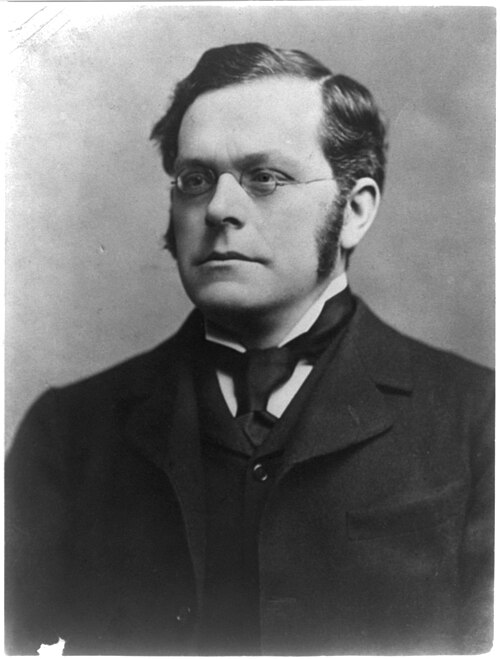
Augustine Birrell
Illustration, not an archive object

Chief Secretary for Ireland · United Kingdom
On the regime page: Asquith government
4 quotes, oldest first. Filter with other speakers.
“We are at this moment considering what immediate steps should be taken to secure the suppression of documents and statements of this character. Although I do not myself regard them as a danger I am sure they are an insult to the sentiment of the vast majority of the Irish people.”
Asked in the House about seditious publications in circulation, particularly in England, Birrell said that the Government was considering steps to suppress them.
Augustine Birrell, Chief Secretary for Ireland, reply to a question in the House of Commons on the seditious press in Ireland, 25 November 1914, Hansard, HC Deb vol. 68, col. 1120 Source
“I have no reason whatever to believe that these papers have poisoned anybody's mind except the minds of the people who have written the articles.”
The day after his statement on suppression, Birrell was pressed by Members who said that the Irish Volunteer and the Gaelic American had been poisoning Nationalists' minds for six weeks.
Augustine Birrell, Chief Secretary for Ireland, answer to supplementary questions in the House of Commons on the seditious press in Ireland, 26 November 1914, Hansard, HC Deb vol. 68, col. 1290 Source
“I therefore, speaking for myself alone, say sorrowfully that I made an untrue estimate of this Sinn Fein movement—not indeed of its character or of the probable numbers of persons engaged in it or belonging to the association, nor of the localities where it is most to be found, nor of its frequent and obvious disloyalty, nor indeed of some of the dangers resulting from it. All this I knew and was able, if not fully, at all events with no great measures of incompleteness to appreciate, but not the possibility of a disturbance of the kind that has occurred in Dublin, of the mode of the warfare, if such an expression can be used in regard to it, which has been pursued—it was not street fighting, for there was no street fighting but of house and roof occupation—and of the desperate folly displayed by the leaders and by their dupes, which has resulted in the deaths of officers and soldiers who never enlisted for such purposes as these, and whose hopes, therefore, although their duty none the less has been well performed, were disappointed, and also in the deaths of equally brave inspectors, sergeants, and constables of the Royal Irish Constabulary.”
Birrell, Chief Secretary for Ireland since 1907, made a personal statement on his resignation after the Easter Rising in Dublin was put down, and gave his own account of how he had judged the Sinn Fein movement.
Augustine Birrell, personal statement on his resignation, House of Commons, 3 May 1916, Hansard, HC Deb vol. 82, col. 33 Source
“The unanimity of Ireland has, as I say, even yet been preserved. This is no Irish rebellion. I hope that, although put down, as it is being put down, as it must be put down, it will be so put down, with such success and with such courage, and yet at the same time humanity, displayed towards the dupes, the rank and file, led astray by their leaders, that this insurrection in Ireland will never, even in the minds and memories of that people, be associated with their past rebellions, or become an historical landmark in their history.”
Later in the same statement Birrell described the Rising as an insurrection led by a small group rather than an Irish rebellion, and referred to the treatment of those who followed them.
Augustine Birrell, personal statement on his resignation, House of Commons, 3 May 1916, Hansard, HC Deb vol. 82, col. 35 Source