David Lloyd George
Illustration, not an archive object
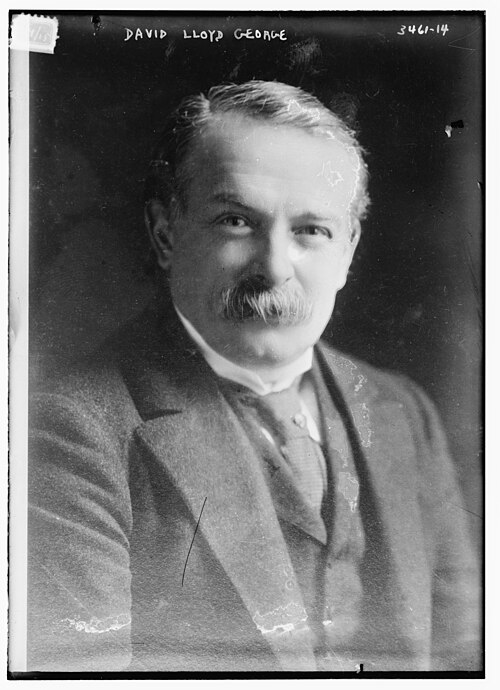

Chancellor of the Exchequer; Minister of Munitions; Prime Minister 1916 to 1922 · United Kingdom
On the regime page: Asquith government
17 quotes, oldest first. Filter with other speakers.
“This, Mr. Emmott, is a War Budget. It is for raising money to wage implacable warfare against poverty and squalidness. I cannot help hoping and believing that before this generation has passed away we shall have advanced a great step towards that good time when poverty and wretchedness and human degradation which always follow in its camp will be as remote to the people of this country as the wolves which once infested its forests.”
The closing passage of Lloyd George's Budget speech introducing the 1909 Budget, which raised taxation to fund naval building and new social spending.
Budget statement by the Chancellor of the Exchequer, House of Commons, 29 April 1909, HC Deb vol. 4, c. 548 Source
“Because a fully-equipped duke costs as much to keep up as two "Dreadnoughts," and they are just as great a terror, and they last longer.”
Speaking during the controversy over the 1909 Budget and its land taxes, Lloyd George referred to recent speeches by dukes and to the cost of the naval programme.
Speech at Newcastle, 9 October 1909, "The Landlords' Tariff on Industry", in David Lloyd George, Better Times: Speeches (London: Hodder & Stoughton, 1910), p. 159 Source
“The question will be asked whether five hundred men, ordinary men chosen accidentally from among the unemployed, should override the judgment — the deliberate judgment — of millions of people who are engaged in the industry which makes the wealth of the country.”
Lloyd George was speaking about the House of Lords, which had not yet rejected the 1909 Budget, and about the questions he expected the country to ask if it did.
Speech at Newcastle, 9 October 1909, "The Landlords' Tariff on Industry", in David Lloyd George, Better Times: Speeches (London: Hodder & Stoughton, 1910), p. 174 Source
“I would make great sacrifices to preserve peace. I conceive that nothing would justify a disturbance of international good will except questions of the greatest national moment. But if a situation were to be forced upon us in which peace could only be preserved by the surrender of the great and beneficent position Britain has won by centuries of heroism and achievement, by allowing Britain to be treated where her interests were vitally affected as if she were of no account in the Cabinet of nations, then I say emphatically that peace at that price would be a humiliation in tolerable for a great country like ours to endure.”
Delivered during the Agadir crisis between France and Germany over Morocco, at an annual dinner of bankers, after consultation with Asquith and Grey. It was understood at the time as a warning to Germany.
Speech at the Bankers' Dinner, Mansion House, London, 21 July 1911, as reproduced in the World War I Document Archive (Brigham Young University Library) from the press report Source
“But ah ! the world owes much to the little five-foot-five nations. The greatest art in the world was the work of little nations ; the most enduring literature of the world came from little nations ; the greatest literature of England came when she was a nation of the size of Belgium fighting a great Empire. The heroic deeds that thrill humanity through generations were the deeds of little nations fighting for their freedom. Yes, and the salvation of mankind came through a little nation. God has chosen little nations as the vessels by which He carries His choicest wines to the lips of humanity, to rejoice their hearts, to exalt their vision, to stimulate and strengthen their faith ; and if we had stood by when two little nations were being crushed and broken by the brutal hands of barbarism, our shame would have rung down the everlasting ages.”
A recruiting and war-aims speech to a London audience six weeks after Britain entered the war, arguing for support of Belgium and Serbia.
Speech on the War, Queen's Hall, London, 19 September 1914, in David Lloyd George, Through Terror to Triumph: Speeches and Pronouncements (London: Hodder & Stoughton, 1915), p. 9 Source
Content note: Calls a head of state lunatic. The words are shown as they were said or written. Why
“Lunacy is always distressing, but sometimes it is dangerous ; and when you get it manifested in the head of the State, and it has become the policy of a great Empire, it is about time that it should be ruthlessly put away.”
Lloyd George had just read a speech attributed to the German Emperor, quoted from the British Weekly, to his audience.
Speech on the War, Queen's Hall, London, 19 September 1914, in David Lloyd George, Through Terror to Triumph (London: Hodder & Stoughton, 1915), p. 11 Source
Content note: Insult aimed at a social class and a state. The words are shown as they were said or written. Why
“The Prussian Junker is the road-hog of Europe. Small nationalities in his way are hurled to the roadside, bleeding and broken. Women and children are crushed under the wheels of his cruel car, and Britain is ordered out of his road. All I can say is this : if the old British spirit is alive in British hearts, that bully will be torn from his seat.”
A passage in the same recruiting speech describing German policy toward Belgium and Britain through a motoring comparison.
Speech on the War, Queen's Hall, London, 19 September 1914, in David Lloyd George, Through Terror to Triumph (London: Hodder & Stoughton, 1915), p. 12 Source
Content note: Describes the German army as a beast. The words are shown as they were said or written. Why
“France ! The German army, like a wild beast, has fastened its claws deep into her soil, and every effort to drag them out rends and tears the living flesh of that beautiful land.”
Delivered on a Sunday at Bangor while Lloyd George was urging greater effort on munitions production and national seriousness about the war.
Speech at Bangor, 28 February 1915, in David Lloyd George, Through Terror to Triumph (London: Hodder & Stoughton, 1915), p. 76 Source
“Drink is doing us more damage in the war than all the German submarines put together.”
Part of a passage about workmen who lost time from munitions work, which Lloyd George attributed mostly to drink. The speech preceded the Government's liquor-control measures of 1915.
Speech at Bangor, 28 February 1915, in David Lloyd George, Through Terror to Triumph (London: Hodder & Stoughton, 1915), p. 84 Source
“Germany elected to make it a finish fight with England. Now we intend to see that Germany has her way. The fight must be to the finish - to a knockout."”
Lloyd George was Secretary of State for War. The interview, given to an American news agency, addressed talk of neutral mediation and was widely reprinted.
Interview with Roy W. Howard of the United Press, London, 28 September 1916, as printed in the UPI Archives (dispatch of 28-29 September 1916) Source
“There has been some talk about proposals of peace. What are the proposals? There are none. To enter at the invitation of Germany, proclaiming herself victorious, without any knowledge of the proposals she proposes to make, into a conference, is to put our heads into a noose with the rope end in the hands of Germany.”
Lloyd George's first statement to the Commons as Prime Minister, days after the German Chancellor's peace note of 12 December and the American note that followed it.
Statement by the Prime Minister, House of Commons, 19 December 1916, HC Deb vol. 88, c. 1334 Source
“I said that the fighting strength of the Army had increased. General Maurice says that it had diminished, as compared with the previous year. The figures that I gave were taken from the official records of the War Office, for which I sent before I made the statement. If they were incorrect, General Maurice was as responsible as anyone else. But they were not inaccurate.”
Major-General Sir Frederick Maurice had published a letter alleging that statements by Lloyd George and Bonar Law on army strength in France were incorrect, and Asquith moved for a select committee. Lloyd George answered in the debate.
Prime Minister's reply to Asquith's motion, House of Commons, 9 May 1918, HC Deb vol. 105, c. 2359 Source
“You may strip Germany of her colonies, reduce her armaments to a mere police force and her navy to that of a fifth rate power; all the same in the end if she feels that she has been unjustly treated in the peace of 1919 she will find means of exacting retribution from her conquerors.”
Written over a weekend at Fontainebleau and circulated to Wilson and Clemenceau while the terms of the German treaty were being drafted. It argued for moderation toward Germany.
"Some Considerations for the Peace Conference Before They Finally Draft Their Terms", memorandum by Lloyd George (the Fontainebleau Memorandum), 25 March 1919 Source
Content note: Concerns the Irish conflict and reprisal policy. The words are shown as they were said or written. Why
“There [Ireland] we have witnessed a spectacle of organised assassination of the most cowardly character [...] But, at last, unless I am mistaken by the steps we have taken we have murder by the throat.”
Delivered during the Irish War of Independence, twelve days before Bloody Sunday, as the Government was reinforcing the Royal Irish Constabulary with the Black and Tans and Auxiliaries.
Speech at the Lord Mayor's Banquet, Guildhall, London, 9 November 1920, as quoted in the Irish Times, "We have murder by the throat" (Bloody Sunday, 21 November 1920) Source
Content note: Praise of Adolf Hitler. The words are shown as they were said or written. Why
“Chancellor Adolf Hitler is one of the greatest of the many great men I have ever met”
Reported by the Jewish Telegraphic Agency a few days after Lloyd George's visit to Germany. The agency summarises the interview and quotes this sentence.
Interview with the News Chronicle (London), September 1936, as reported by the Jewish Telegraphic Agency, 23 September 1936 Source
Content note: Praise of Adolf Hitler. The words are shown as they were said or written. Why
“One man has accomplished this miracle. He is a born leader of men. A magnetic, dynamic personality with a single-minded purpose, a resolute will and a dauntless heart.”
Lloyd George wrote after a visit to Germany in September 1936, during which he met Hitler at Berchtesgaden. He was then a backbench MP and former Prime Minister.
David Lloyd George, "I Talked to Hitler", Daily Express (London), 17 September 1936, reproduced in German History in Documents and Images Source
“It is not a question of who are the Prime Minister's friends. It is a far bigger issue. The Prime Minister must remember that he has met this formidable foe of ours in peace and in war. He has always been worsted. He is not in a position to appeal on the ground of friendship. He has appealed for sacrifice. The nation is prepared for every sacrifice so long as it has leadership, so long as the Government show clearly what they are aiming at and so long as the nation is confident that those who are leading it are doing their best. I say solemnly that the Prime Minister should give an example of sacrifice, because there is nothing which can contribute more to victory in this war than that he should sacrifice the seals of office.”
Lloyd George, then 77 and a backbencher, spoke on the second day of the debate that preceded Neville Chamberlain's resignation, answering Chamberlain's appeal to his friends.
Speech in the Norway debate on the conduct of the war, House of Commons, 8 May 1940, HC Deb vol. 360, c. 1283 Source
Often attributed, not verified
These words circulate under David Lloyd George’s name but could not be traced to a source. They are listed so readers can check them, not as David Lloyd George’s words.
“A fully-equipped duke costs as much to keep up as two Dreadnoughts, and they last longer.”
The words are in the Newcastle speech of 9 October 1909 (Better Times, 1910, p. 159), not the Limehouse speech of 30 July 1909 as often stated. Included in verified form above.
“We are fighting Germany, Austria and drink; and as far as I can see the greatest of these deadly foes is drink.”
Not found in the printed Through Terror to Triumph (1915), the Bangor speech of 28 February 1915 or War Memoirs. The sentiment appears in the verified Bangor passage on drink above; the exact sentence was not seen in a primary text.
“What is our task? To make Britain a fit country for heroes to live in.”
Reported in the press (the Times of 25 November 1918) and widely quoted; the exact wording could not be read in a primary text during this check, and sources differ on the date (23 or 24 November).
“If the people really knew, the war would be stopped tomorrow. But of course they don't know, and can't know.”
Attributed to Lloyd George on the strength of Scott's private diary, as published in Trevor Wilson (ed.), The Political Diaries of C. P. Scott 1911-1928 (1970). The diary text was not seen; the words are Scott's record of a private conversation.
“We will squeeze the German lemon until the pips squeak.”
The phrase is associated with Sir Eric Geddes, First Lord of the Admiralty, speaking at Cambridge on 10 December 1918, not with Lloyd George, who spoke in more general terms on reparations. This attribution was recalled from the secondary literature and not re-checked against a primary text.