Deng Xiaoping
Illustration, not an archive object
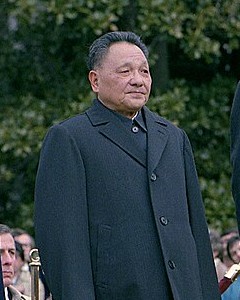

General Secretary of the CCP Secretariat · China
On the regime page: People's Republic of China under Mao Zedong
7 quotes, oldest first. Filter with other speakers.
“The most extensive uses of writing are in publishing articles in the newspapers, issuing pamphlets and broadcasting them over the radio. Moreover, if the work of the press and broadcasting is closely integrated with practical and central tasks, it will be more effective on a broader scale than other means and will play a greater role in the carrying out of the leaders’ intentions.”
English: English text in Deng Xiaoping Works (translator not named), as transcribed by the Marxists Internet Archive. Original-language text not found.
Report by Deng, then the leading Party official in Southwest China, to a conference of newspaper and broadcasting staff on how the press should serve Party policy.
Report Delivered at a Conference on the Press in Southwest China, published 16 May 1950, in Deng Xiaoping Works (English translation as transcribed on marxists.org) Source
“The Party and Party members should be subject to supervision, a point which was emphasized at the Party’s Eighth National Congress. Recently Chairman Mao stressed in particular that a set of rules and regulations should be formulated for the convenience of supervision. He said that we should allow others to challenge us with opposing views, because this is better than acting alone. Our Party is the ruling party and enjoys high prestige. A good many of our cadres hold leading posts. In China who is in a vulnerable position to make big mistakes? None other than the Chinese Communist Party. When it makes such mistakes, the effects are most widespread, so the Party should be particularly careful. The Party’s leadership position is stipulated in the Constitution. If the Party wants to exercise good leadership, it should constantly overcome subjectivism, bureaucratism and sectarianism, accept supervision and expand democracy within the Party and the state. If we do not accept supervision or work to expand democracy within the Party and the state, we shall surely cut ourselves off from the masses and make big mistakes.”
English: English text in Deng Xiaoping Works (translator not named), as transcribed by the Marxists Internet Archive. Original-language text not found.
Remarks on the Party's rectification movement during the Hundred Flowers period, two months before the Anti-Rightist Campaign began.
The Communist Party Must Accept Supervision, published 8 April 1957, in Deng Xiaoping Works (English translation as transcribed on marxists.org) Source
“When talking about fighting battles, Comrade Liu Bocheng often quotes a Sichuan proverb — “It does not matter if it is a yellow cat or a black cat, as long as it catches mice.””
English: English text in Deng Xiaoping Works (translator not named), as transcribed by the Marxists Internet Archive. Original-language text not found.
Talk on recovering farm output after the Great Leap Forward, in which Deng cites a proverb that Liu Bocheng used about fighting battles and applies it to the choice of rural production arrangements.
Restore Agricultural Production, 7 July 1962, in Deng Xiaoping Works (English translation as transcribed on marxists.org) Source
“If one day China should change her colour and turn into a superpower, if she too should play the tyrant in the world, and everywhere subject others to her bullying, aggression and exploitation, the people of the world should identify her as social-imperialism, expose it, oppose it and work together with the Chinese people to overthrow it.”
English: Foreign Languages Press, Peking, 1974. Original-language text not found.
Speech by the head of China's delegation at the sixth special session of the UN General Assembly, setting out the 'three worlds' theory and China's position on superpowers.
Speech by Chairman of the Delegation of the People's Republic of China, Teng Hsiao-ping, at the Special Session of the U.N. General Assembly, 10 April 1974 (Peking: Foreign Languages Press, 1974) Source
“A few days ago, when two leading comrades of the General Office of the Central Committee of the Party came to see me, I told them that the “two whatevers” are unacceptable. If this principle were correct, there could be no justification for my rehabilitation, nor could there be any for the statement that the activities of the masses at Tiananmen Square in 1976 were reasonable.”
English: English text in Deng Xiaoping Works (translator not named), as transcribed by the Marxists Internet Archive. Original-language text not found.
Deng recounts telling two leading officials of the General Office of the Central Committee that the line that the Party should uphold 'whatever' Mao decided or instructed was unacceptable.
The 'Two Whatevers' Do Not Accord With Marxism, 24 May 1977, in Deng Xiaoping Works (English translation as transcribed on marxists.org) Source
“Science and technology are part of the productive forces. Mental workers who serve socialism are part of the working people. A correct understanding of these two facts is essential to the rapid development of our scientific enterprises.”
English: English text in Deng Xiaoping Works (translator not named), as transcribed by the Marxists Internet Archive. Original-language text not found.
Speech opening the National Conference on Science, which restored the status of scientists and intellectuals after the Cultural Revolution.
Speech at the Opening Ceremony of the National Conference on Science, 18 March 1978, in Deng Xiaoping Works (English translation) Source
“When views diverge on scholarly questions, we must follow the policy of “letting a hundred schools of thought contend” and encourage free discussion.”
English: English text in Deng Xiaoping Works (translator not named), as transcribed by the Marxists Internet Archive. Original-language text not found.
Same speech, on how disagreements in scholarship were to be handled.
Speech at the Opening Ceremony of the National Conference on Science, 18 March 1978, in Deng Xiaoping Works (English translation) Source
Often attributed, not verified
These words circulate under Deng Xiaoping’s name but could not be traced to a source. They are listed so readers can check them, not as Deng Xiaoping’s words.
“It doesn't matter whether a cat is black or white, so long as it catches mice.”
In the earliest text found (Restore Agricultural Production, 7 July 1962, Deng Xiaoping Works) Deng says Comrade Liu Bocheng 'often quotes a Sichuan proverb' about a yellow cat or a black cat catching mice; it is a proverb he cites, not his coinage, and the wording is 'yellow cat or black cat'. The 1962 passage is published above as his citation of the proverb.