Hua Guofeng
Illustration, not an archive object
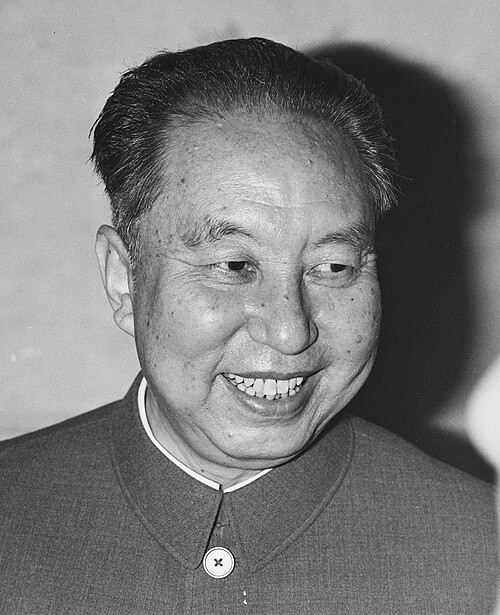

Premier; First Vice-Chairman of the CCP · China
On the regime page: People's Republic of China under Mao Zedong
4 quotes, oldest first. Filter with other speakers.
“Under Chairman Mao’s leadership, our Party defeated the opportunist lines perused by Chen Tu-hsiu, Chu Chiu-pai, Li Li-san, Lo Chang-lung, Wang Ming, Chang Kuo-tao, Kao Kang - Jao Shu-Shih and Peng Teh-huai and again, during the Great Proletarian Cultural Revolution, triumphed over the counter-revolutionary revisionist line of Liu Shao-chi, Lin Piao and Teng Hsiao-ping.”
English: Foreign Languages Press, Peking, 1976. Original-language text not found.
Memorial address delivered at Tiananmen Square nine days after Mao's death, by Hua as First Vice-Chairman of the Central Committee and Premier of the State Council.
Memorial speech at the Mass Memorial Meeting for Chairman Mao Tsetung, 18 September 1976 (pamphlet; Peking: Foreign Languages Press, 1976) Source
“Internally, we must conscientiously study Marxism-Leninism-Mao Tsetung Thought, take class struggle as the key link [...] deepen the struggle it criticize Teng Hsiao-ping and repulse the right deviationist attempt to reverse correct verdicts”
English: Foreign Languages Press, Peking, 1976. Original-language text not found.
From the closing programme of the memorial address: tasks the Central Committee set for the Party after Mao's death, at a time when Deng Xiaoping had been dismissed from his posts earlier in 1976.
Memorial speech at the Mass Memorial Meeting for Chairman Mao Tsetung, 18 September 1976 (pamphlet; Peking: Foreign Languages Press, 1976) Source
“The Party Central Committee took prompt and effective measures to help the people in the stricken areas restore production and rebuild their homes and to lead the masses in the heroic struggle to overcome the difficulties caused by the earth quakes. It was at this time that the "gang of four, " the Wang-Chang-Chiang-Yao anti-Party clique, perversely exploited the grave difficulty confronting the Party and the people and tried to usurp the supreme Party and state leadership, which was their long-cherished ambition. Before Chairman Mao’s death, they went against a series of directives issued by Chairman Mao and the Party Central Committee, sang another tune in the criticism of Teng Hsiao-ping and thus caused great ideological and political confusion and enormous economic losses. After Chairman Mao’s death, thinking their chance had come, they quickened their pace to usurp the supreme Party and state leadership and mounted unprecedentedly wild attacks in an attempt to knock down the Party and the people.”
English: Foreign Languages Press, Peking, 1977. Original-language text not found.
Speech to the national agriculture conference about ten weeks after the arrest of Wang Hongwen, Zhang Chunqiao, Jiang Qing and Yao Wenyuan, giving the Central Committee's account of their actions. The quoted passage begins with the Central Committee's response to the 1976 earthquakes.
Speech at the Second National Conference on Learning from Tachai in Agriculture, 25 December 1976 (Peking: Foreign Languages Press, 1977) Source
“Our Party carried out Chairman Mao's behest and crushed the criminal scheme of the Wang-Chang-Chiang-Yao "gang of four" to usurp the supreme leadership of the Party and the state.”
English: Peking Review, vol. 20, no. 45 (4 November 1977). Original-language text not found.
Speech proposing that the Fifth National People's Congress be convened early, giving the leadership's account of the events of 1976.
Speech at the Fourth Session of the Standing Committee of the Fourth National People's Congress, 23 October 1977, Peking Review, vol. 20, no. 45 (4 November 1977) Source
Often attributed, not verified
These words circulate under Hua Guofeng’s name but could not be traced to a source. They are listed so readers can check them, not as Hua Guofeng’s words.
“We will resolutely uphold whatever policy decisions Chairman Mao made, and unswervingly follow whatever instructions Chairman Mao gave.”
Reported in secondary sources as the formula of the unsigned joint editorial 'Study the Documents Well and Grasp the Key Link' (People's Daily, Red Flag and Liberation Army Daily, 7 February 1977), not as a speech by Hua. The editorial text was not located (it is not in Peking Review nos. 7-9, 1977). Deng Xiaoping's remarks of 24 May 1977 reject the 'two whatevers' without naming an author.