Duff Cooper
Illustration, not an archive object
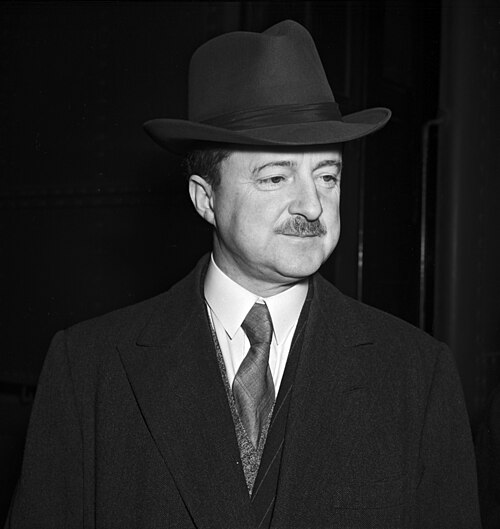

Minister of Information (May 1940 to July 1941) · United Kingdom
On the regime page: Churchill wartime government
6 quotes, oldest first. Filter with other speakers.
“As this war becomes more intensified, as it does become from hour to hour, so are the duties of the Ministry of Information evermore important, because our duties are not only to present the news but also to guide as well as to inform opinion both at home and abroad.”
Duff Cooper had been Minister of Information since 12 May 1940 and was presenting the Ministry's estimates to the Commons for the first time.
Speech on the Civil Estimates (Ministry of Information), House of Commons, 28 May 1940 (HC Deb vol. 361, c. 451) Source
“Of course, the Press are free to publish what they like, subject to the censorship which is under the control of the Ministry of Information. We are keeping in the closest touch with the Press, who are most anxious to collaborate and to give us all the assistance they can.”
In the same speech Duff Cooper described the relation between the Ministry, which controlled the censorship, and the newspapers.
Speech on the Civil Estimates (Ministry of Information), House of Commons, 28 May 1940 (HC Deb vol. 361, c. 454) Source
“The answers to the first two parts of the Question are in the affirmative. As regards the last part, I understand that a number of United States citizens of Italian origin have already voiced their criticism of the action of the Italian Government, but I do not think it would be desirable to enlist the services of United States citizens in the manner suggested.”
Nine days after Italy entered the war, a Member asked whether the Ministry had enlisted Italian anti-Fascists in exile to carry out propaganda among the Italian people, and whether it would use Italian-American citizens.
Oral answer on anti-Fascist propaganda, House of Commons, 19 June 1940 (HC Deb vol. 362, c. 166) Source
Content note: Explains the withholding of news of a ship sinking. The words are shown as they were said or written. Why
“The reasons for holding the news of the bombing and sinking of the steamship "Lancastria" were the following. This ship was engaged on a military operation, and it was evident from the German wireless announcement that the enemy were totally unaware of the identity of the ship which had been sunk. Further, it is contrary to the general policy of His Majesty's Government to announce the loss of individual merchant ships. The number and the total tonnage of merchant ships lost is given in a weekly statement. The tonnage of the steamship "Lancastria" was included in the statement issued on 2nd July. This policy is well known, and I cannot, therefore, understand why on this occasion bewilderment should have been caused in Liverpool and shipping circles.”
The troopship Lancastria was bombed and sunk off St Nazaire on 17 June 1940. Members asked why the news was not published in Britain until after it appeared in the American press, about five weeks later.
Oral answer on the sinking of the Lancastria, House of Commons, 31 July 1940 (HC Deb vol. 363, c. 1219) Source
“This is not spying. This is a method which newspapers and commercial firms have been following in this country for the last 30 years in order to ascertain public opinion. There is nothing new about it, nor is it underhand or in any way connected with spying.”
Members asked why Ministry-funded interviewers were canvassing householders, a practice the press called spying. Duff Cooper replied that the Ministry used the opinion-survey methods of newspapers and commercial firms.
Oral answer on the War-time Social Survey, House of Commons, 31 July 1940 (HC Deb vol. 363, c. 1216) Source
“No, Sir. To broadcast the addresses in question in the manner proposed by my hon. Friend would suggest to listeners abroad that they possessed an official character. This, as explained by the Prime Minister on 28th January, is not the case.”
A Member asked whether the six addresses broadcast by Sir Robert Vansittart, the Foreign Office's chief diplomatic adviser, would be translated and broadcast in other languages. The question was headed "Black Record", the title of Vansittart's book.
Oral answer on Sir Robert Vansittart's broadcasts, House of Commons, 5 February 1941 (HC Deb vol. 368, c. 923) Source
Often attributed, not verified
These words circulate under Duff Cooper’s name but could not be traced to a source. They are listed so readers can check them, not as Duff Cooper’s words.
“The Silent Column”
Hansard (HL Deb 1 August 1940 vol. 117 cc. 91-2) records the Ministry's spokesman in the Lords saying the phrase was used in advertisements and then dropped. No text spoken or written by Duff Cooper himself introducing the phrase was found.