Franklin D. Roosevelt
Illustration, not an archive object
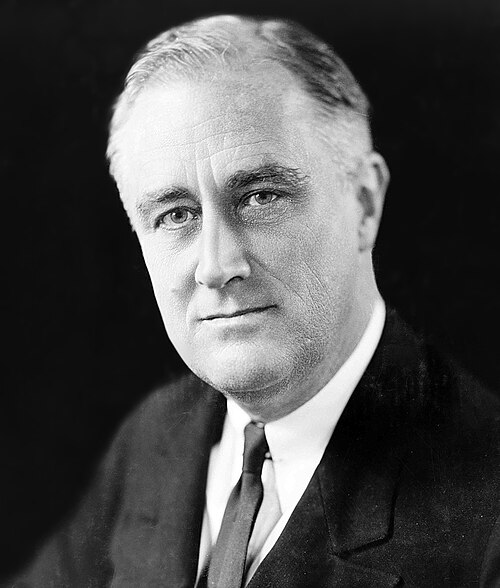

President of the United States · United States
On the regime page: Roosevelt administration
28 quotes, oldest first. Filter with other speakers.
“So, first of all, let me assert my firm belief that the only thing we have to fear is fear itself—nameless, unreasoning, unjustified terror which paralyzes needed efforts to convert retreat into advance.”
Delivered at the start of his first term, during the banking crisis of the Great Depression, and broadcast on radio.
First Inaugural Address, 4 March 1933, text in the American Presidency Project (UC Santa Barbara) Source
“Plenty is at our doorstep, but a generous use of it languishes in the very sight of the supply.”
Said early in his first inaugural address, delivered during the banking crisis of the Great Depression.
First Inaugural Address, 4 March 1933, text in the American Presidency Project (UC Santa Barbara) Source
“This is preeminently the time to speak the truth, the whole truth, frankly and boldly. Nor need we shrink from honestly facing conditions in our country today.”
Said in the opening passage of his first inaugural address, delivered during the banking crisis of the Great Depression.
First Inaugural Address, 4 March 1933, text in the American Presidency Project (UC Santa Barbara) Source
“I have seen war. I have seen war on land and sea. I have seen blood running from the wounded. I have seen men coughing out their gassed lungs. I have seen the dead in the mud. I have seen cities destroyed. I have seen two hundred limping, exhausted men come out of line—the survivors of a regiment of one thousand that went forward forty-eight hours before. I have seen children starving. I have seen the agony of mothers and wives. I hate war.”
Delivered in the run-up to the 1936 election, on his policy toward the wars in Europe and Africa; Congress had passed neutrality acts in 1935 and 1936.
Address at Chautauqua, N.Y., 14 August 1936, text in the American Presidency Project (UC Santa Barbara) Source
“Never before in all our history have these forces been so united against one candidate as they stand today. They are unanimous in their hate for me—and I welcome their hatred.”
Final major speech of the 1936 re-election campaign, delivered the Saturday before election day. "These forces" refers to groups he had just listed, which he listed as business and financial monopoly, speculation, reckless banking, class antagonism, sectionalism and war profiteering.
Campaign Address at Madison Square Garden, New York City, 31 October 1936, text in the American Presidency Project (UC Santa Barbara) Source
“It seems to be unfortunately true that the epidemic of world lawlessness is spreading. When an epidemic of physical disease starts to spread, the community approves and joins in a quarantine of the patients in order to protect the health of the community against the spread of the disease.”
Delivered in Chicago at the dedication of a civic improvement project, after Japan's invasion of China and while the Spanish Civil War continued. Congress had passed neutrality legislation in 1935 and 1937.
Address at Chicago (the "Quarantine" speech), 5 October 1937, text in the American Presidency Project (UC Santa Barbara) Source
“The news of the past few days from Germany has deeply shocked public opinion in the United States. Such news from any part of the world would inevitably produce a similar profound reaction among American people in every part of the nation. "I myself could scarcely believe that such things could occur in a twentieth century civilization. "With a view to gaining a first-hand picture of the current situation in Germany I asked the Secretary of State to order our Ambassador in Berlin to return at once for report and consultation.”
Read to reporters five days after the Kristallnacht pogrom in Germany and Austria; Roosevelt recalled Ambassador Hugh Wilson from Berlin for consultation.
Statement read at the 500th Press Conference, 15 November 1938, text in the American Presidency Project (UC Santa Barbara) Source
“That is not in contemplation; we have the quota system.”
Asked at the same conference whether he would recommend relaxing immigration restrictions so that Jewish refugees could be received in the United States. Three days later (18 November 1938) he said he had told the Secretary of Labor that 12,000 to 15,000 German and Austrian visitors in the country should receive six-month extensions of stay.
Answer to a reporter at the 500th Press Conference, 15 November 1938, text in the American Presidency Project (UC Santa Barbara) Source
“The Act was passed by Democratic votes but it was over the opposition of the Republican leaders. And just to name a few, the following Republican leaders, among many others, voted against the Act: Senators McNary, Vandenberg, Nye and Johnson; now wait, a perfectly beautiful rhythm—Congressmen Martin, Barton and Fish.”
Campaign speech against Republican leaders in Congress on the repeal of the arms embargo in 1939.
Campaign Address at Madison Square Garden, New York City, 28 October 1940, text in the American Presidency Project (UC Santa Barbara) Source
“I have said this before, but I shall say it again and again and again: Your boys are not going to be sent into any foreign wars.”
Speech in the closing week of the 1940 campaign for a third term, in which he was running against Wendell Willkie. The Selective Training and Service Act had been enacted in September 1940. The United States entered the war after the Japanese attack of 7 December 1941.
Campaign Address at Boston, Massachusetts, 30 October 1940, text in the American Presidency Project (UC Santa Barbara) Source
“Suppose my neighbor's home catches fire, and I have a length of garden hose four or five hundred feet away. If he can take my garden hose and connect it up with his hydrant, I may help him to put out his fire. Now, what do I do? I don't say to him before that operation, "Neighbor, my garden hose cost me $15; you have to pay me $15 for it." What is the transaction that goes on? I don't want $15—I want my garden hose back after the fire is over. All right. If it goes through the fire all right, intact, without any damage to it, he gives it back to me and thanks me very much for the use of it. But suppose it gets smashed up—holes in it—during the fire; we don't have to have too much formality about it, but I say to him, "I was glad to lend you that hose; I see I can't use it any more, it's all smashed up." He says, "How many feet of it were there?" I tell him, "There were 150 feet of it."”
Roosevelt explained to reporters the idea behind what became the Lend-Lease Act (March 1941), at a time when British dollar reserves were running low and the Johnson Act and Neutrality Act restricted loans and cash sales.
Press Conference, 17 December 1940, text in the American Presidency Project (UC Santa Barbara) Source
“We must be the great arsenal of democracy. For us this is an emergency as serious as war itself. We must apply ourselves to our task with the same resolution, the same sense of urgency, the same spirit of patriotism and sacrifice as we would show were we at war.”
Radio address to the nation on aid to Britain and defense production, delivered while the United States was formally neutral.
Fireside Chat on National Security ("Arsenal of Democracy"), 29 December 1940, text in the American Presidency Project (UC Santa Barbara) Source
“In the future days, which we seek to make secure, we look forward to a world founded upon four essential human freedoms. The first is freedom of speech and expression—everywhere in the world. The second is freedom of every person to worship God in his own way—everywhere in the world. The third is freedom from want—which, translated into world terms, means economic understandings which will secure to every nation a healthy peacetime life for its inhabitants-everywhere in the world. The fourth is freedom from fear—which, translated into world terms, means a world-wide reduction of armaments to such a point and in such a thorough fashion that no nation will be in a position to commit an act of physical aggression against any neighbor—anywhere in the world.”
Delivered to a joint session of Congress, months before the Lend-Lease Act, as the war in Europe continued and the United States remained out of it.
Annual Message to Congress on the State of the Union (the "Four Freedoms" speech), 6 January 1941, text in the American Presidency Project (UC Santa Barbara) Source
“I do hereby reaffirm the policy of the United States that there shall be no discrimination in the employment of workers in defense industries or government because of race, creed, color, or national origin, and I do hereby declare that it is the duty of employers and of labor organizations, in furtherance of said policy and of this Order, to provide for the full and equitable participation of all workers in defense industries, without discrimination because of race, creed, color, or national origin;”
Signed days before a planned march on Washington by Black labour leaders, including A. Philip Randolph, protesting exclusion from defense jobs. It created the Committee on Fair Employment Practice. The armed forces remained racially segregated throughout the war.
Executive Order 8802, 25 June 1941, operative paragraph, text in the American Presidency Project (UC Santa Barbara) Source
“She was then and there attacked by a submarine. Germany admits that it was a German submarine. The submarine deliberately fired a torpedo at the Greer, followed later by another torpedo attack. In spite of what Hitler's propaganda bureau has invented, and in spite of what any American obstructionist organization may prefer to believe, I tell you the blunt fact that the German submarine fired first upon this American destroyer without warning, and with deliberate design to sink her.”
Radio address a week after a German submarine fired torpedoes at the USS Greer in the North Atlantic; in it he announced that American ships and aircraft would act against Axis vessels in waters vital to American defense.
Fireside Chat on the Greer incident, 11 September 1941, text in the American Presidency Project (UC Santa Barbara) Source
Content note: Compares enemy forces to snakes. The words are shown as they were said or written. Why
“But when you see a rattlesnake poised to strike, you do not wait until he has struck before you crush him. These Nazi submarines and raiders are the rattlesnakes of the Atlantic.”
From the same address: Roosevelt compared German submarines and raiders to rattlesnakes in explaining the policy that American naval forces would no longer wait to be attacked first in defended waters.
Fireside Chat on the Greer incident, 11 September 1941, text in the American Presidency Project (UC Santa Barbara) Source
“For example, I have in my possession a secret map made in Germany by Hitler's Government—by the planners of the new world order. It is a map of South America and a part of Central America, as Hitler proposes to reorganize it. Today in this area there are fourteen separate countries. But the geographical experts of Berlin have ruthlessly obliterated all existing boundary lines; they have divided South America into five vassal states, bringing the whole continent under their domination. And they have also so arranged it that the territory of one of these new puppet states includes the Republic of Panama and our great life line—the Panama Canal. That is his plan. It will never go into effect. This map, my friends, makes clear the Nazi design not only against South America but against the United States as well.”
Broadcast address delivered after the attack on the USS Kearny and weeks before the United States entered the war.
Address for Navy and Total Defense Day, 27 October 1941, text in the American Presidency Project (UC Santa Barbara) Source
“Yesterday, December 7, 1941—a date which will live in infamy—the United States of America was suddenly and deliberately attacked by naval and air forces of the Empire of Japan.”
Delivered to a joint session the day after the attack on Pearl Harbor; Congress declared war on Japan the same day.
Address to Congress Requesting a Declaration of War with Japan, 8 December 1941, text in the American Presidency Project (UC Santa Barbara) Source
“I ask that the Congress declare that since the unprovoked and dastardly attack by Japan on Sunday, December 7, 1941, a state of war has existed between the United States and the Japanese Empire.”
The operative request that closes the 8 December 1941 address, delivered the day after the attack on Pearl Harbor. Congress declared war on Japan the same day.
Address to a joint session of Congress, 8 December 1941, transcript of the reading copy (SEN 77A-H1, Records of the United States Senate, RG 46), National Archives milestone document Source
“No matter how long it may take us to overcome this premeditated invasion, the American people in their righteous might will win through to absolute victory.”
Said in the 8 December 1941 address to Congress, the day after the attack on Pearl Harbor and before the declaration of war.
Address to a joint session of Congress, 8 December 1941, transcript of the reading copy (SEN 77A-H1, Records of the United States Senate, RG 46), National Archives milestone document Source
“If you feel that your Government is not disclosing enough of the truth, you have every right to say so. But—in the absence of all the facts, as revealed by official sources—you have no right in the ethics of patriotism to deal out unconfirmed reports in such a way as to make people believe that they are gospel truth.”
Radio address the day after the declaration of war on Japan, in which he asked press and radio to report only confirmed information from official sources.
Fireside Chat on the war with Japan, 9 December 1941 (passage addressed to newspapers and radio stations), text in the American Presidency Project (UC Santa Barbara) Source
“All Americans abhor censorship, just as they abhor war. But the experience of this and of all other Nations has demonstrated that some degree of censorship is essential in wartime, and we are at war.”
Issued when he created the Office of Censorship under Byron Price, twelve days after the attack on Pearl Harbor and the entry of the United States into the war.
Statement on the Executive Order Establishing the Office of Censorship, 19 December 1941, text in the American Presidency Project (UC Santa Barbara) Source
Content note: Order authorising mass exclusion and, in practice, incarceration of Japanese Americans. The words are shown as they were said or written. Why
“I hereby authorize and direct the Secretary of War, and the Military Commanders whom he may from time to time designate, whenever he or any designated Commander deems such actions necessary or desirable, to prescribe military areas in such places and of such extent as he or the appropriate Military Commanders may determine, from which any or all persons may be excluded, and with such respect to which, the right of any person to enter, remain in, or leave shall be subject to whatever restrictions the Secretary of War or the appropriate Military Commander may impose in his discretion.”
Signed about ten weeks after Pearl Harbor. The order does not name any group of people; it was carried out through military exclusion orders on the West Coast under which about 120,000 people of Japanese ancestry, most of them United States citizens, were removed and held in camps.
Executive Order 9066, 19 February 1942 (7 Fed. Reg. 1407), operative paragraph, text in the American Presidency Project (UC Santa Barbara) Source
Content note: Order creating the agency that ran the Japanese American incarceration camps. The words are shown as they were said or written. Why
“2. The Director of the War Relocation Authority is authorized and directed to formulate and effectuate a program for the removal, from the areas designated from time to time by the Secretary of War or appropriate military commander under the authority of Executive Order No. 9066 of February 19, 1942, of the persons or classes of persons designated under such Executive Order, and for their relocation, maintenance, and supervision.”
Signed a month after Executive Order 9066, creating the War Relocation Authority to carry out removal and relocation of the people designated under that order. The Authority ran the ten camps in which Japanese Americans were held.
Executive Order 9102, 18 March 1942, section 2, text in the American Presidency Project (UC Santa Barbara) Source
“Another point. I think we have all had it in our hearts and our heads before, but I don't think that it has ever been put down on paper by the Prime Minister and myself, and that is the determination that peace can come to the world only by the total elimination of German and Japanese war power. Some of you Britishers know the old story—we had a General called U.S. Grant. His name was Ulysses Simpson Grant, but in my, and the Prime Minister's, early days he was called "Unconditional Surrender" Grant. The elimination of German, Japanese, and Italian war power means the unconditional surrender by Germany, Italy, and Japan. That means a reasonable assurance of future world peace. It does not mean the destruction of the population of Germany, Italy, or Japan, but it does mean the destruction of the philosophies in those countries which are based on conquest and the subjugation of other people.”
Statement to reporters at the close of the Casablanca Conference. It set unconditional surrender by Germany, Italy and Japan as the Allied war aim.
Joint Press Conference with Prime Minister Churchill at Casablanca, 24 January 1943, text in the American Presidency Project (UC Santa Barbara) Source
“No loyal citizen of the United States should be denied the democratic right to exercise the responsibilities of his citizenship, regardless of his ancestry. The principle on which this country was founded and by which it has always been governed is that Americanism is a matter of the mind and heart; Americanism is not, and never was, a matter of race or ancestry. A good American is one who is loyal to this country and to our creed of liberty and democracy. Every loyal American citizen should be given the opportunity to serve this country wherever his skills will make the greatest contribution — whether it be in the ranks of our armed forces, war production, agriculture, government service, or other work essential to the war effort.”
Approved the War Department proposal to form a combat team of Japanese American citizens, about a year after Executive Order 9066. It became the 442nd Regimental Combat Team. Most Japanese Americans on the West Coast were still held in the camps.
Letter, President Roosevelt to Secretary of War Stimson, 1 February 1943, as released in War Department Bureau of Public Relations press release of 3 February 1943 (National Archives RG 107, Box 51, Folder 4, Item 8) Source
Content note: Joking remark about executing German officers. The words are shown as they were said or written. Why
“The President jokingly said that he would put the figure of the German Commanding Staff which should be executed at 49,000 or more.”
Reply to Stalin's statement at dinner that at least 50,000 and perhaps 100,000 of the German commanding staff must be physically liquidated. Churchill objected to the execution of soldiers for political purposes. The record is a third-person minute by interpreter Charles Bohlen.
Bohlen Minutes, tripartite dinner, Tehran, 29 November 1943, 8:30 p.m., in Foreign Relations of the United States: Diplomatic Papers, The Conferences at Cairo and Tehran, 1943, document 368, p. 554 Source
“He added that there were in the United States from six to seven million Americans of Polish extraction, and as a practical man, he did not wish to lose their vote.”
Roosevelt asked to speak with Stalin privately about the Polish frontier question and American domestic politics before the 1944 election. The record is a third-person minute taken by interpreter Charles Bohlen, not a stenographic transcript.
Bohlen Minutes, Roosevelt-Stalin meeting, Tehran, 1 December 1943, 3:20 p.m., in Foreign Relations of the United States: Diplomatic Papers, The Conferences at Cairo and Tehran, 1943, document 378 Source
Often attributed, not verified
These words circulate under Franklin D. Roosevelt’s name but could not be traced to a source. They are listed so readers can check them, not as Franklin D. Roosevelt’s words.
“He may be a son of a bitch, but he's our son of a bitch.”
Quote Investigator (quoteinvestigator.com/2021/02/24/rascal/) traces earlier political-boss anecdotes with different wording (a 'scoundrel' or 'rascal' who 'is our' man) and finds no contemporary record of Roosevelt saying it; the attribution to him is not supported by a primary text. Not published as his words.
“In politics, nothing happens by accident. If it happens, you can bet it was planned that way.”
No speech, press conference or letter containing this wording was located in the American Presidency Project searches made for this file. Quotation aggregators give no source. A search summary suggested it may be a recasting of Roosevelt's Citadel address (23 October 1935), which says the recovery was 'planning it that way'; that speech was not read in full by this checker. Not published as his words.