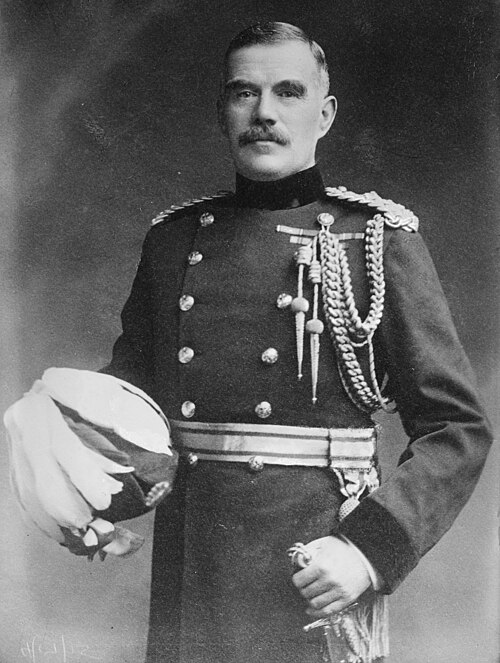
William Robertson
Illustration, not an archive object
.jpg)
Chief of the Imperial General Staff (December 1915 to February 1918) · United Kingdom
On the regime page: Asquith government
6 quotes, oldest first. Filter with other speakers.
“Not being able to go back on the Prime Minister's pledge to call up the single men before the married, certain Ministers are trying to render compulsion useless by making out that although we may have power to take the men we cannot pay for them, and that they cannot be spared from their trades and at the same time admit of keeping up the necessary exports and so provide the money we need with which to subsidize our Allies.”
Robertson had become Chief of the Imperial General Staff the previous month. He wrote to the Commander-in-Chief in France about the Cabinet's divisions over compulsory military service and the number of divisions the country could afford.
Sir William Robertson, letter to Sir Douglas Haig, 4 January 1916, as printed in Sir William Robertson, Soldiers and Statesmen, 1914-1918, vol. 1 (London: Cassell, 1926), pp. 293-294 Source
“The arguments I advanced were that we need every man we can get, and that it is for the Government to say how many they can pay for and how many they can find. The idea of some of the politicians is to abolish some if not all of the second line Territorial divisions now at home, thirteen in number, which are preparing to go out later. But I do not think this will be done.”
From the same letter. Robertson describes the argument he made in the Cabinet about the number of troops and a proposal to disband second-line Territorial divisions.
Sir William Robertson, letter to Sir Douglas Haig, 4 January 1916, as printed in Sir William Robertson, Soldiers and Statesmen, 1914-1918, vol. 1 (London: Cassell, 1926), p. 294 Source
“If I have to depend almost entirely upon Press communiqués my opinion is not much more valuable than that of anyone else.”
Writing to Haig during the Somme offensive, Robertson, who had to defend the offensive's casualties to Ministers, asked him to keep him informed beyond what the official communiqués said.
Sir William Robertson, letter to Sir Douglas Haig, August 1916 (after the Cabinet meeting of 1 August), as printed in Sir William Robertson, Soldiers and Statesmen, 1914-1918, vol. 1 (London: Cassell, 1926), p. 270 Source
“I said that we were now engaged in quite a new kind of warfare and that decisive results could not be expected in twenty-four hours nor in twenty-four days, and that relentless pressure on all fronts was the proper course to pursue and was promising good results by the winter.”
Robertson reports to Haig what he told the Cabinet when Ministers were uneasy about the length of the Somme casualty lists.
Sir William Robertson, letter to Sir Douglas Haig reporting his statement to the Cabinet of 1 August 1916, as printed in Sir William Robertson, Soldiers and Statesmen, 1914-1918, vol. 1 (London: Cassell, 1926), p. 270 Source
“Most indiscreet references to our intentions had appeared in the Press, and, in general, the longer the military attack was delayed the more formidable would the defences be found if it was eventually decided to make the attack.”
In his 1926 account of the planning of the Dardanelles campaign in early 1915, Robertson comments on what the press had published about the intended operation.
Sir William Robertson, Soldiers and Statesmen, 1914-1918, vol. 1 (London: Cassell, 1926), p. 112 (chapter 'The Dardanelles Expedition') Source
“Ministers, too, may become impatient with the small progress made in existing theatres, be alarmed at the long casualty lists and their possible effect on public opinion, and begin to search for a "way round" to victory in preference to the direct method of fighting and defeating the enemy's principal armies.”
Robertson, writing after the war, sets out his view of the effect of casualty lists and public opinion on Ministers' choice of strategy.
Sir William Robertson, Soldiers and Statesmen, 1914-1918, vol. 1 (London: Cassell, 1926), p. 74 (chapter 'The Dardanelles Expedition') Source