Reginald McKenna
Illustration, not an archive object
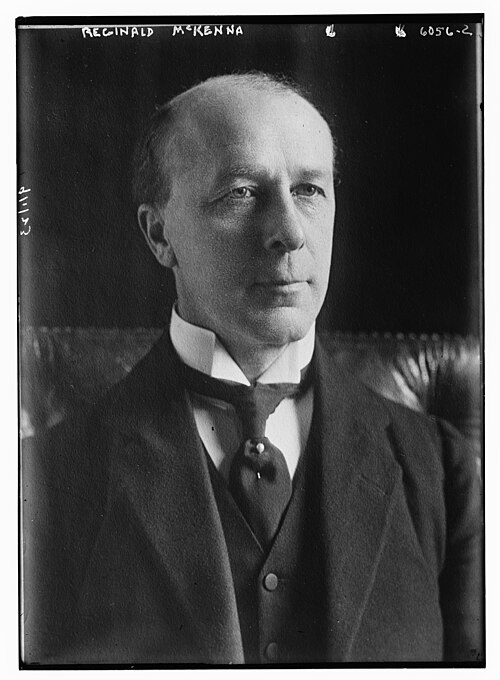

Home Secretary 1911 to 1915; Chancellor of the Exchequer 1915 to 1916 · United Kingdom
On the regime page: Asquith government
4 quotes, oldest first. Filter with other speakers.
Content note: Dismisses accounts of forcible feeding of imprisoned women. The words are shown as they were said or written. Why
“I mention this perhaps only by the way in order to warn hon. Members against attaching too much credence to the accounts which are being given as to the terrible tortures which are endured in prison under the system of forcible feeding. Those prisoners have declared war on society, and part of their campaign is to carry on war against the Government, be they Liberal or Conservative, not this or that Government, but against all Governments which are responsible to a House of Commons elected by men. It is part of their propaganda to enrage public opinion against the officers of the law, and in executing their purpose they seem to be as neglectful of accuracy of statement as they are disregardful of civil order in their acts.”
The Home Secretary introduced the bill, later known as the "Cat and Mouse" Act, which allowed hunger-striking suffragette prisoners to be released and re-arrested. He was describing the hunger strikes and the accounts of forcible feeding then circulating.
Second reading of the Prisoners (Temporary Discharge for Ill-Health) Bill, House of Commons, 2 April 1913, HC Deb vol. 51, cc. 405-406 Source
Content note: Concerns forcible feeding of imprisoned women. The words are shown as they were said or written. Why
“But it is undeniably true that forcible feeding, whether for those who suffer it or those who administer it, is a most objectionable practice, and means ought to be sought to enable those who are responsible for the administration of the law to take up some alternative methods which would not and could not have the same objections raised against them.”
The same speech, a few sentences later, as the Home Secretary explained why the bill proposed an alternative to forcible feeding.
Second reading of the Prisoners (Temporary Discharge for Ill-Health) Bill, House of Commons, 2 April 1913, HC Deb vol. 51, c. 406 Source
“It has fallen to my lot to introduce a third Budget, in which I must ask the House to assent to additional and unprecedented burdens, which, heavy as they are, I feel confident, if the taxes are approved, will be accepted by the country.”
McKenna had become Chancellor in the coalition formed in May 1915. His budget raised income tax and super-tax and introduced an excess profits duty.
Budget statement by the Chancellor of the Exchequer, House of Commons, 21 September 1915, HC Deb vol. 74, c. 347 Source
“On each of these articles I propose an ad valorem duty of 33⅓ per cent., or its equivalent, in the form of a specific rate, that is to say, on weight instead of on price. I anticipate a total revenue from the duty on these articles in a full year of £1,950,000, of which motor-cars account for £1,150,000, and cinema films for £400,000. These estimates of Revenue, however, are given under great reserve, as we have no experience what the effect of so high a rate of duty will be upon importation.”
McKenna announced customs duties on motor cars, cinema films, clocks, watches, musical instruments, plate glass and hats to curb imports and protect the exchanges. They became known as the McKenna duties.
Budget statement by the Chancellor of the Exchequer, House of Commons, 21 September 1915, HC Deb vol. 74, c. 361 Source