Hiroshi Shimomura
Illustration, not an archive object
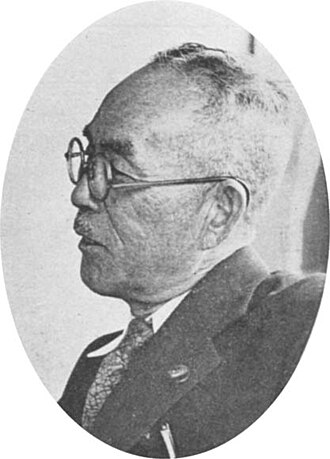

Minister of State and President of the Cabinet Information Board (1945) · Japan
On the regime page: Empire of Japan, 1937 to 1945
3 quotes, oldest first. Filter with other speakers.
“Following the Prime Minister’s explanation, both of the Chiefs and the Army Minister, standing up one by one, made an impassioned plea in tears, insisting that we should qualify our acceptance out of fear that the plan as it is now might endanger our goal of preserving our national polity. Here I do not bother to detail it. Hearing this sort of opinion, I remembered the words “Koudou” (The Emperor’s Way) and “Shindou” (The Loyalists’ Way) which Prime Minister Suzuki always mentioned. “The loyalists deserve death should their Highness be disgraced,” according to an ancient saying. No other words can express more correctly the feeling of the generals today than this word. Surely they deserve death. They have already dedicated themselves to His Majesty. But as the situation goes, His Majesty will be disgraced. Our national polity might be put in danger. Although I sympathized with their willingness out of their pride as military officers to search for a faint hope in another battle, I cannot but wonder if there would be any way out of the situation even without atomic bombs or the Soviet entry. Nowadays our problem gets much worse than simply seeing our Emperor disgraced. It is much and much worse than that. We are leading our homeland, our people, and even Japan itself to total destruction. In this time of losing everything, we should weigh the Emperor’s Way caring for Japan and its 80 million people more than the Loyalists’ Way.”
English: Toshihiro Higuchi (National Security Archive translation). Original-language text not found.
Shimomura, then Minister of State and President of the Cabinet Information Board, describes the generals' objections at the Imperial Conference of 14 August 1945 and his own view. The conference ended with Hirohito's decision to accept the Allied terms.
Hiroshi Shimomura, 'The Second Sacred Judgment', from Shusenki [Account of the End of the War] (Tokyo: Kamakura Bunko, 1948), pp. 148-152, translated by Toshihiro Higuchi, in The Atomic Bomb and the End of World War II (National Security Archive Electronic Briefing Book 162), Document 89 Source
“While listening to his holy words, from every corner of the room the sound of sobs prevailed. Every single word he uttered was impressive. As he pronounced his determination to save the nation even at the expense of his own life and loudly wondered how we can honor the spirits of our ancestors if our homeland is burned to ashes and our people are lost in the blazing fire of war, the sound of our sobs became louder. Furthermore, when he said he would do anything and stand in front of the microphone if necessary, I could not suppress my sobs and tears, loudly crying despite being in a public place.”
English: Toshihiro Higuchi (National Security Archive translation). Original-language text not found.
Shimomura's description of the room as Hirohito spoke at the Imperial Conference of 14 August 1945, including Hirohito's offer to speak into a microphone, which led to the recorded broadcast of 15 August.
Hiroshi Shimomura, 'The Second Sacred Judgment', from Shusenki [Account of the End of the War] (Tokyo: Kamakura Bunko, 1948), pp. 148-152, translated by Toshihiro Higuchi, in The Atomic Bomb and the End of World War II (National Security Archive Electronic Briefing Book 162), Document 89 Source
“Now against the peace talk sprouted all sorts of argument, throwing all the corners of the nation into chaos. Some hardliners, in collaboration with right-wingers, ultra-nationalists and middle-ranking military officers, were beginning to stir about restlessly.”
English: Toshihiro Higuchi (National Security Archive translation). Original-language text not found.
Shimomura's account of the morning of 14 August 1945 in the Prime Minister's residence, before the Cabinet was summoned to the Palace.
Hiroshi Shimomura, 'The Second Sacred Judgment', from Shusenki [Account of the End of the War] (Tokyo: Kamakura Bunko, 1948), pp. 148-152, translated by Toshihiro Higuchi, in The Atomic Bomb and the End of World War II (National Security Archive Electronic Briefing Book 162), Document 89 Source