Otto Dietrich
Illustration, not an archive object
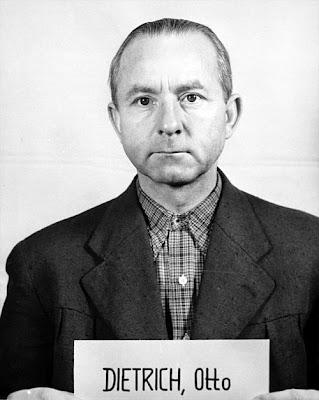

Reich Press Chief · Germany
On the regime page: Nazi Germany
8 quotes, oldest first. Filter with other speakers.
“Whenever one thinks of the Führer, a deep love surfaces that is sufficient to justify the sentence: “Hitler is Germany — Germany is Hitler!” Never have the hearts of a people been nearer to a man than to him, who began from nothing. He came not from outside our nation, but was born a member of our nation. He sensed its need and lived among it, and if today someone asks for the name of the unknown German front soldier, the whole German nation would answer: Adolf Hitler! He was the conscience of the nation. He expressed the sorrow and the resistance of an enslaved people, and in him the life will of all Germany, in the midst of its deepest need, found its expression. Adolf Hitler never said anything but what the people itself felt in the depths of its soul. He never did anything but what the entirety of the people wanted to do. He was not, is not, and never will be a dictator who forces the people to accept his personal wishes. He is a Führer, and that is the highest thing that can be said of any human being.”
English: Randall Bytwerk, German Propaganda Archive, Calvin University. Original-language text not found.
Essay by Dietrich, then Party Press Chief, in an illustrated book of photographs of Hitler distributed with cigarette-card albums. It describes the relationship between Hitler and the German people.
Otto Dietrich, "Der Führer und das deutsche Volk", in Adolf Hitler. Bilder aus dem Leben des Führers (Hamburg: Cigaretten-Bilderdienst, 1936), pp. 19-26; English translation by Randall Bytwerk Source
“Dietrich: I need the telegram urgently. Keppler: Tell the General Field Marshal that Seyss-Inquart agrees. Dietrich: This is marvelous. Thank you. Keppler : Listen to the radio. News will be given. Dietrich: Where? Keppler: From Vienna. Dietrich: So Seyss-Inquart agrees? Keppler : Jawohl !”
English: Office of United States Chief of Counsel, translation of Nuremberg document 2949-PS. Original-language text not found.
Telephone call on the evening of 11 March 1938, the day before German troops entered Austria. Dietrich, then Reich Press Chief, asks Keppler in Vienna for a telegram, and is told that Seyss-Inquart agrees. The same document records Göring's earlier calls asking that such a telegram be sent.
Transcript of telephone conversation between Wilhelm Keppler (Vienna) and Otto Dietrich (Berlin), 11 March 1938, 21:54, document 2949-PS (transcripts of telephone calls on the evening of the Anschluss), in Office of United States Chief of Counsel for Prosecution of Axis Criminality, Nazi Conspiracy and Aggression, vol. 5 (Washington: US Government Printing Office, 1946), p. 640 Source
“If we all make a passionate effort on behalf of peace and write in favor of peace out of a sense of the deepest human responsibility, if the newspaper and press services which you represent publish your appeal, and if you can manage to become the advocate of the peaceful interests of humanity with the same passion, then no government in the world will be able to act against this phalanx of public opinion. I do not know whether you will succeed in getting your newspapers to do this. In any case I should never like to reproach myself with not having called your attention to this matter at a moment of decisive importance for world peace.”
English: Official translation in the Nuremberg Military Tribunal record. Original-language text not found.
Dietrich quoted his own 1939 address to foreign journalists in Berlin in the final statement at his trial in the Ministries case. He cited it as evidence of peaceful intentions, and recalled that President Roosevelt dismissed it at a press conference.
Appeal to representatives of the world press, 6 February 1939, as quoted by Dietrich in his final statement to Military Tribunal IV, 18 November 1948, in Trials of War Criminals before the Nuernberg Military Tribunals under Control Council Law No. 10, vol. XIV (Washington: US Government Printing Office, 1952), pp. 283-284 Source
Content note: Press instruction to portray Jews as harmful and justify the yellow star. The words are shown as they were said or written. Why
“With reference to the marking of Jewry, the opportunity is offered to handle this theme in the most varied ways, in order to make clear to the German people the necessity for these measures, and especially to indicate the noxiousness of the Jews. From tomorrow on the special delivery service will provide material to be used as proof of the injuries which Jewry has inflicted upon Germany, and the destiny it has envisaged for her, past and present. This material is recommended.”
English: Official translation in the Nuremberg Military Tribunal record (document NG-4701). Original-language text not found.
Daily instruction to the German press issued from the Reich Press Chief's office, shortly after Jews in Germany were ordered to wear the yellow star. The Tribunal treated the Tagesparole as Dietrich's directive.
Secret information in the Tagesparole (daily press directive) of the Reich Press Chief, 26 September 1941, document NG-4701, Prosecution Exhibit 1261, as quoted in the judgment of Military Tribunal IV (Ministries case), in Trials of War Criminals before the Nuernberg Military Tribunals under Control Council Law No. 10, vol. XIV (Washington: US Government Printing Office, 1952), p. 571 Source
“In connection with the material already on hand on this subject-among other things a new congratulatory message of Churchill's for the Anglo-American terror fliers has been published-it must be established that the war criminal Churchill will one day receive his punishment for his historical guilt. In commenting, it must furthermore be -observed that nothing must be mentioned on the subject of reprisals on our part, or of retaliation.”
English: Official translation in the Nuremberg Military Tribunal record (document NG-3327). Original-language text not found.
Daily press instruction on reporting the Allied air war. The prosecution relied on it as an order to withhold news of the lynching of Allied airmen; the Tribunal found the evidence insufficient on that count and acquitted Dietrich of it.
Tagesparole of the Reich Press Chief, 28 December 1943, document NG-3327, Prosecution Exhibit 1225, as quoted in the judgment of Military Tribunal IV (Ministries case), in Trials of War Criminals before the Nuernberg Military Tribunals under Control Council Law No. 10, vol. XIV (Washington: US Government Printing Office, 1952), pp. 435-436 Source
Content note: Press instruction to intensify antisemitic propaganda. The words are shown as they were said or written. Why
“The anti-Semitic campaign must be emphasized still more than up till now as an important propagandistic factor in the world struggle. Therefore, at all possible occasions world Judaism has to be stigmatized as the one whose cunning machinations are even opposed to the interests of its hostess nations. On top of all that these voices are to be recorded which show clearly the real Jewish intentions of destruction and to make them the subject of convincing exposure. In this respect German journalism has to aim at keeping awake in the German people the feeling that Judaism constitutes a world danger on the one hand, and on the other, above all, to carry the discussions abroad.”
English: Official translation in the Nuremberg Military Tribunal record (document NG-3410). Original-language text not found.
Daily press instruction issued in the sixth year of the war while the deportation and killing of Jews was in progress. The Tribunal quoted a series of such directives.
Tagesparole of the Reich Press Chief, 2 March 1944, document NG-3410, Prosecution Exhibit 1277, as quoted in the judgment of Military Tribunal IV (Ministries case), in Trials of War Criminals before the Nuernberg Military Tribunals under Control Council Law No. 10, vol. XIV (Washington: US Government Printing Office, 1952), p. 572 Source
Content note: Press instruction on presenting measures against Jews in Hungary. The words are shown as they were said or written. Why
“One of the fundamental topics of the German press will remain the anti-Semitic campaign. In this respect very useful material has come to hand from Hungary. When utilizing the reports on the measures taken there against the Jews it has to be kept in mind that they will not be reproduced without extensive statements on the crimes committed by the Jews, which caused these measures.”
English: Official translation in the Nuremberg Military Tribunal record (document NG-3412). Original-language text not found.
Daily press instruction issued a month after German forces occupied Hungary and as deportations of Hungarian Jews began. It tells editors how to present reports of measures taken against Jews in Hungary.
Tagesparole of the Reich Press Chief, 27 April 1944, document NG-3412, Prosecution Exhibit 1279, as quoted in the judgment of Military Tribunal IV (Ministries case), in Trials of War Criminals before the Nuernberg Military Tribunals under Control Council Law No. 10, vol. XIV (Washington: US Government Printing Office, 1952), p. 572 Source
“When my country was at war I supported its war effort by my publicity work, as was my duty. But I never used my pen to call for inhuman actions; I never called for the violation of the laws of war. In no field of publicity did I violate the internationally recognized principles of political and military ethics. I never participated in persecutions of or actions against the Jews, or uttered a word in favor of inhumanity.”
English: Official translation in the Nuremberg Military Tribunal record. Original-language text not found.
Dietrich's closing words to the Tribunal in the Ministries case, in which he was charged as Reich Press Chief with incitement to war and to persecution of Jews.
Final statement of the defendant Dietrich to Military Tribunal IV (Ministries case), 18 November 1948, in Trials of War Criminals before the Nuernberg Military Tribunals under Control Council Law No. 10, vol. XIV (Washington: US Government Printing Office, 1952), p. 284 Source