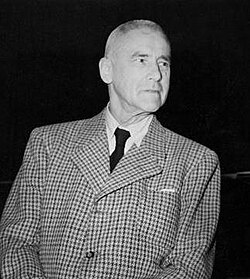
Wilhelm Frick
Illustration, not an archive object

Reich Minister of the Interior · Germany
On the regime page: Nazi Germany
5 quotes, oldest first. Filter with other speakers.
“There is no National Socialist and no racialist who expects any kind of manly German deed from that gossip club on the Koenigsplatz and who is not convinced of the necessity for direct action by the unbroken will of the 4 German people to bring about their spiritual and physical liberation. But there is a long road ahead. After the failure of November 1923, there was no choice but to begin all over again and to strive to bring about a change in the spirit and determination of the most valuable of our racial comrades as the indispensable prerequisite for the success of the coming fight for freedom. Our activities in parliament must be evaluated as merely part of this propaganda work. Our participation in the parliament does not indicate a support, but rather an undermining of the parliamentarian system. It does not indicate that we renounce our antiparliamentarian attitude, but that we are fighting the enemy with his own weapons and that we are fighting for our National Socialist goal from the parliamentary platform.”
English: Office of United States Chief of Counsel, translation of Nuremberg document 2742-PS. Original-language text not found.
Written by Frick, then a Nazi member of the Reichstag, for the party yearbook. It explains why the party took part in parliamentary elections and sat in the Reichstag while rejecting the parliamentary system.
Passage written by Frick, Nationalsozialistisches Jahrbuch 1927, p. 124, document 2742-PS, in Office of United States Chief of Counsel for Prosecution of Axis Criminality, Nazi Conspiracy and Aggression, vol. 5 (Washington: US Government Printing Office, 1946), p. 382 Source
“The planned preparation of the administration for the possibility of a war has already been carried out during peacetime. For this purpose the Fuehrer appointed a Plenipotentiary General for the Reich Administration and a Plenipotentiary General for War Economy.”
English: Nuremberg trial translation of document 2608-PS (as read into the IMT record). Original-language text not found.
Speech by Frick, as Reich Minister of the Interior and General Plenipotentiary for the Reich Administration, at the University of Freiburg in the winter after the invasion of Poland. Read into the record by the US prosecution as document 2608-PS, exhibit USA-714.
Prosecution reading of document 2608-PS, in Trial of the Major War Criminals before the International Military Tribunal (Nuremberg: IMT, 1947), vol. 5, p. 360 (session of 16 January 1946) Source
Content note: Describes killings carried out without legal proceedings. The words are shown as they were said or written. Why
“Heinrich Himmler, in June of 1934, was able to convince Hitler that Roehm wanted to start a putsch. The Fuehrer ordered Himmler to suppress the putsch, which was supposed to take place at the Tegernsee, where all of the SA leaders were coming to gather. For Northern Germany, the Fuehrer gave the order to suppress the putsch to Goering. On account of this order, many, many people were arrested, and as was heard in the course of time, little by little, something like a hundred, even more, who were accused of high treason, were killed. All of this was done without resort to legal proceedings. They were just killed on the spot. Many people were killed — I don't know how many — who actually did not have anything to do with the putsch. People who just weren't liked very well, as for instance, Schleicher, the former Reich Chancellor, were killed. Schleicher's wife was also killed as was Gregor Strasser, who had been the Reich organization leader and second man in the Party after Hitler. Strasser, at the time he was murdered, was not active in political affairs anymore. However, he had separated himself from the Fuehrer in November or December of 1932. The SS was used by Himmler for the execution of these orders to suppress the putsch. This was the first illegal act by the Party since the accession to power. This state of affairs, which is today still partly under discussion, and which I consider correct, was never stated officially, but became known in the course of the years, little by little.”
English: Office of United States Chief of Counsel, translation of Nuremberg document 2950-PS. Original-language text not found.
Sworn statement given by Frick in custody before the trial, describing the killings of 30 June to 2 July 1934 (the Röhm purge), which the Reichstag had retroactively declared lawful.
Affidavit of Wilhelm Frick sworn before Major Seymour M. Peyser, 19 November 1945, document 2950-PS, in Office of United States Chief of Counsel for Prosecution of Axis Criminality, Nazi Conspiracy and Aggression, vol. 5 (Washington: US Government Printing Office, 1946), pp. 653-654 Source
“Since, as soon as the war started, everything had to be done speedily and there would have been no time for planning, such measures and decrees were prepared in advance in case of war. All one then still had to do was to pull out of the drawer the war orders that had been prepared. Later on, after the outbreak of the war, these decrees were enacted by the Ministerial Council for the defense of the Reich.”
English: Office of United States Chief of Counsel, translation of Nuremberg document 2986-PS. Original-language text not found.
Sworn pre-trial statement by Frick as to his office of General Plenipotentiary for the Reich Administration, which he held until 20 August 1943, and the preparation of wartime decrees before the outbreak of war.
Affidavit of Wilhelm Frick sworn before Major Warren F. Farr, 19 November 1945, document 2986-PS, in Office of United States Chief of Counsel for Prosecution of Axis Criminality, Nazi Conspiracy and Aggression, vol. 5 (Washington: US Government Printing Office, 1946), p. 688 Source
“I have a clear conscience with respect to the Indictment. My entire life was spent in the service of my people and my fatherland. To them I have devoted the best of my strength in the loyal fulfilment of my duty. I am convinced that no patriotic American or citizen of any other country would have acted differently in my place, if his country had been in the same position. For to have acted any differently would have been a breach of my oath of allegiance, and high treason.”
English: Official IMT simultaneous translation. Original-language text not found.
Frick's final statement to the Tribunal before judgment. Frick did not testify in his own defence.
Final statement of the defendant Frick, in Trial of the Major War Criminals before the International Military Tribunal (Nuremberg: IMT, 1947), vol. 22, p. 384 (session of 31 August 1946) Source