Rodolfo Graziani
Illustration, not an archive object
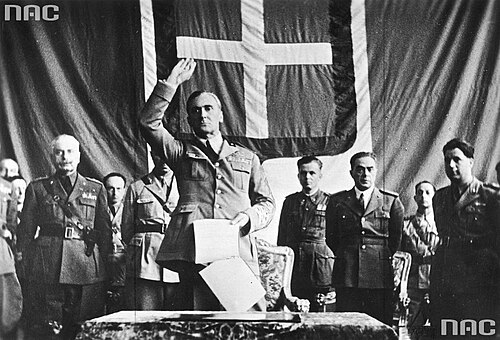

Marshal of Italy; Governor of Cyrenaica (1930 to 1934), Viceroy of Italian East Africa (1936 to 1937), Minister of Defence of the Italian Social Republic (1943 to 1945) · Italy
On the regime page: Fascist Italy under Mussolini
4 quotes, oldest first. Filter with other speakers.
Content note: Order to eliminate those who refuse to disarm; call for no mercy. The words are shown as they were said or written. Why
“‘[Your work] must conclude with the total submission of Shewa and the elimination of all who refuse to disarm, even if every last house must be razed to the soil’ … ‘Remember that every false pity is a crime when dealing with people decidedly against our dominion’ … ‘Conquest is conquest … and its only law is that of an eye for an eye and a tooth for a tooth.’”
English: Ian L. Campbell (translation based on the quotation in Nicola Labanca, 2008, p. 33, as cited in his note 10). Original-language text not found.
Campbell summarises the Viceroy's instructions to his field commanders in 1937, during the occupation of Ethiopia and in the months after the attempt on Graziani's life of 19 February 1937. The three quotations are printed in the book as separate fragments joined by ellipses.
Ian L. Campbell, The Addis Ababa Massacre: Italy's National Shame (C. Hurst & Co., London; Oxford University Press, New York, 2017), ch. 7 "Reprisals Should Cease", p. 191 and note 10 (Graziani to Lessona, 13 May 1937, telegram no. 24923, in Stato Maggiore del Governo Generale, Il secondo anno dell'impero, Addis Ababa, 1937-38, pp. 58-9, cited in G. Rochat, 1988, p. 214) Source
Content note: Report of executions of prisoners. The words are shown as they were said or written. Why
“45 men have been executed on the morning of the 26th and none of them raised his voice in protest against the destiny that awaited them.”
English: Ian L. Campbell, quoting Giorgio Rochat (the book prints it as Rochat's quotation of a Graziani telegram). Original-language text not found.
After the attempt on his life on 19 February 1937, Graziani reported to Rome on the summary trials and shootings of Ethiopians in Addis Ababa. Campbell cites this line from a telegram as quoted by the military historian Giorgio Rochat.
Ian L. Campbell, The Addis Ababa Massacre: Italy's National Shame (C. Hurst & Co., London; Oxford University Press, New York, 2017), ch. 9 "Roman Justice", p. 259, quoting G. Rochat, 1988 (note 53) Source
““for a man who knows Africa means that he must suffer from softening of the brain, or, what is worse, from bad faith.” “The water supply is entirely insufficient. We move toward a defeat which, in the desert, must inevitably develop into a rapid and total disaster.””
Original (Italian)
“per un uomo che conosce l'Africa, vuol dire essere rammollito o peggio ancora in mala fede”. “I rifornimenti idrici sono del tutto insufficienti. Si va incontro ad un insuccesso che nel deserto si trasformerà inevitabilmente e presto in un disastro totale”.
English: Hugh Gibson (ed.), The Ciano Diaries 1939-1943 (Doubleday, 1946; Simon Publications reprint, 2001)
Graziani, commander of the Italian forces in Libya, told Ciano that the planned offensive against Egypt was badly prepared and criticised Badoglio for not restraining Mussolini. Ciano passed the remarks to Mussolini the same day. The words are Graziani's as reported by Ciano.
Galeazzo Ciano, diary entry of 8 August 1940, recording a conversation with Graziani, in Hugh Gibson (ed.), The Ciano Diaries 1939-1943 (Doubleday, 1946; Simon Publications reprint, 2001); Italian original: Galeazzo Ciano, Diario 1937-1943 (Italian text; 2020 FS digital reprint) Source
“in order to keep the flag flying on that fortress at least”
Original (Italian)
per tenere almeno alta la bandiera su quel Castello
English: Hugh Gibson (ed.), The Ciano Diaries 1939-1943 (Doubleday, 1946; Simon Publications reprint, 2001)
After the British offensive in Egypt and Cyrenaica (Operation Compass), Graziani telegraphed Mussolini from Libya that he was thinking of withdrawing to Tripoli. Ciano quotes two fragments of the telegram in his diary entry.
Galeazzo Ciano, diary entry of 13 December 1940 (the Gibson edition places it under 12 December), quoting a telegram from Graziani to Mussolini, in Hugh Gibson (ed.), The Ciano Diaries 1939-1943 (Doubleday, 1946; Simon Publications reprint, 2001); Italian original: Galeazzo Ciano, Diario 1937-1943 (Italian text; 2020 FS digital reprint) Source