In one line: From Urban II's address at the Council of Clermont in November 1095 to the fall of Acre in May 1291, the popes issued the indulgences, bulls and instructions, and commissioned the preachers, that called Latin Christians to armed expeditions in the eastern Mediterranean; this page covers that messaging by the same standard used for any state, and the Muslim, Byzantine and Jewish records appear as sources in their own right.
The leader and the people under the leader
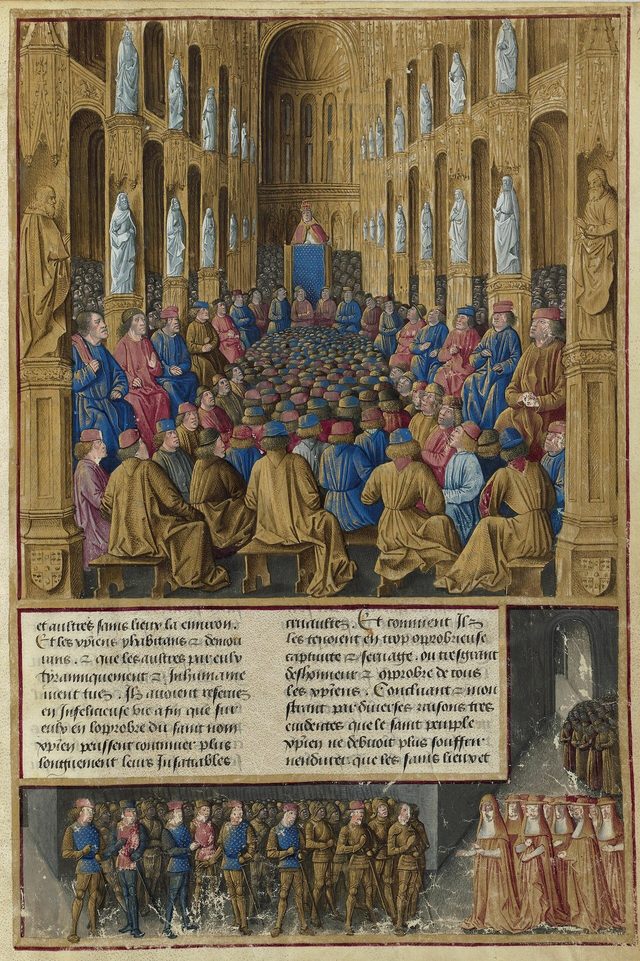
UINo contemporary portrait is known, so none is hosted. Nearest: source, public domain, a 15th-century imagined scene and not a likeness.
Urban II
Pope · 1088 to 1099
Urban II: Read more
Addressed the Council of Clermont in November 1095, an address known only through chroniclers written after the First Crusade; his own letter of December 1095 names Adhemar of Le Puy as leader of the expedition in his stead and describes the undertaking as 'a preparation for the remission of all their sins'.
In their words
“We solemnly enjoined upon them at the council of Auvergne (the accomplishment of) such an undertaking, as a preparation for the remission of all their sins.”
“And we have constituted our most beloved son, Adhemar, Bishop of Puy, leader of this expedition and undertaking in our stead”
“All who die by the way, whether by land or by sea, or in battle against the pagans, shall have immediate remission of sins. This I grant them through the power of God with which I am invested.”
Popes
EINo contemporary portrait is known, so none is hosted; later manuscript scenes show the office rather than a likeness.
Eugenius III
Pope · 1145 to 1153
Eugenius III: Read more
Issued the bull Quantum praedecessores, dated 1 December (1145 by the usual reckoning), after the fall of Edessa; it renews the remission of sins 'which our aforesaid predecessor pope Urban did institute' and puts crusaders' families and goods under the protection of the Church.
In their words
“that remission of sins which our aforesaid predecessor pope Urban did institute; and do decree that their wives and sons, their goods also and possessions shall remain under the protection of our selves and of the archbishops, bishops and other prelates of the church of God.”
“those who war for the Lord should by no means prepare themselves with precious garments, nor with provision for their personal appearance, nor with dogs or hawks”
GVNo contemporary portrait is known, so none is hosted; later manuscript scenes show the office rather than a likeness.
Gregory VIII
Pope · 1187
Gregory VIII: Read more
Pope in the last months of 1187; issued the encyclical Audita tremendi, dated 29 October 1187 in reference works, after the defeat at Hattin (4 July 1187), which presents the loss as a consequence of Christian sins and calls for penance as well as expedition.
IINo contemporary portrait is known, so none is hosted; later manuscript scenes show the office rather than a likeness.
Innocent III
Pope · 1198 to 1216
Innocent III: Read more
Called the Fourth Crusade (1198 onward), forbade the attack on Zara and condemned the sack of Constantinople in a letter of 12 July 1204, authorised the Albigensian Crusade in 1208, and issued the encyclical Quia maior in April 1213; Smith calls the last 'one of the most important calls to crusade ever issued by the medieval papacy'.
In their words
“grant to all those submitting to this labour personally or at their own expense full forgiveness of their sins”
“a son of perdition has arisen, the false prophet Muhammad, who has seduced many men from the truth by worldly enticements and the pleasures of the flesh”
“whose swords, which they were supposed to use against the pagans, are now dripping with Christian blood”
IINo contemporary portrait is known, so none is hosted; later manuscript scenes show the office rather than a likeness.
Innocent IV
Pope · 1243 to 1254
Innocent IV: Read more
Pope whose lead bullae (inscribed INNOCENTIVS PP IIII, with the heads of Saints Peter and Paul on the reverse) are, with those of Gregory IX, the most commonly recorded papal seals in the English finds database (Portable Antiquities Scheme).
Legates and preachers
AONo contemporary portrait is known, so none is hosted.
Adhemar of Le Puy
Bishop of Le Puy and papal representative on the First Crusade · 1095 to 1098
Adhemar of Le Puy: Read more
Named by Urban II's letter of December 1095 as leader of the expedition 'in our stead', with the instruction that those who joined should 'comply with his commands, as if they were our own'.
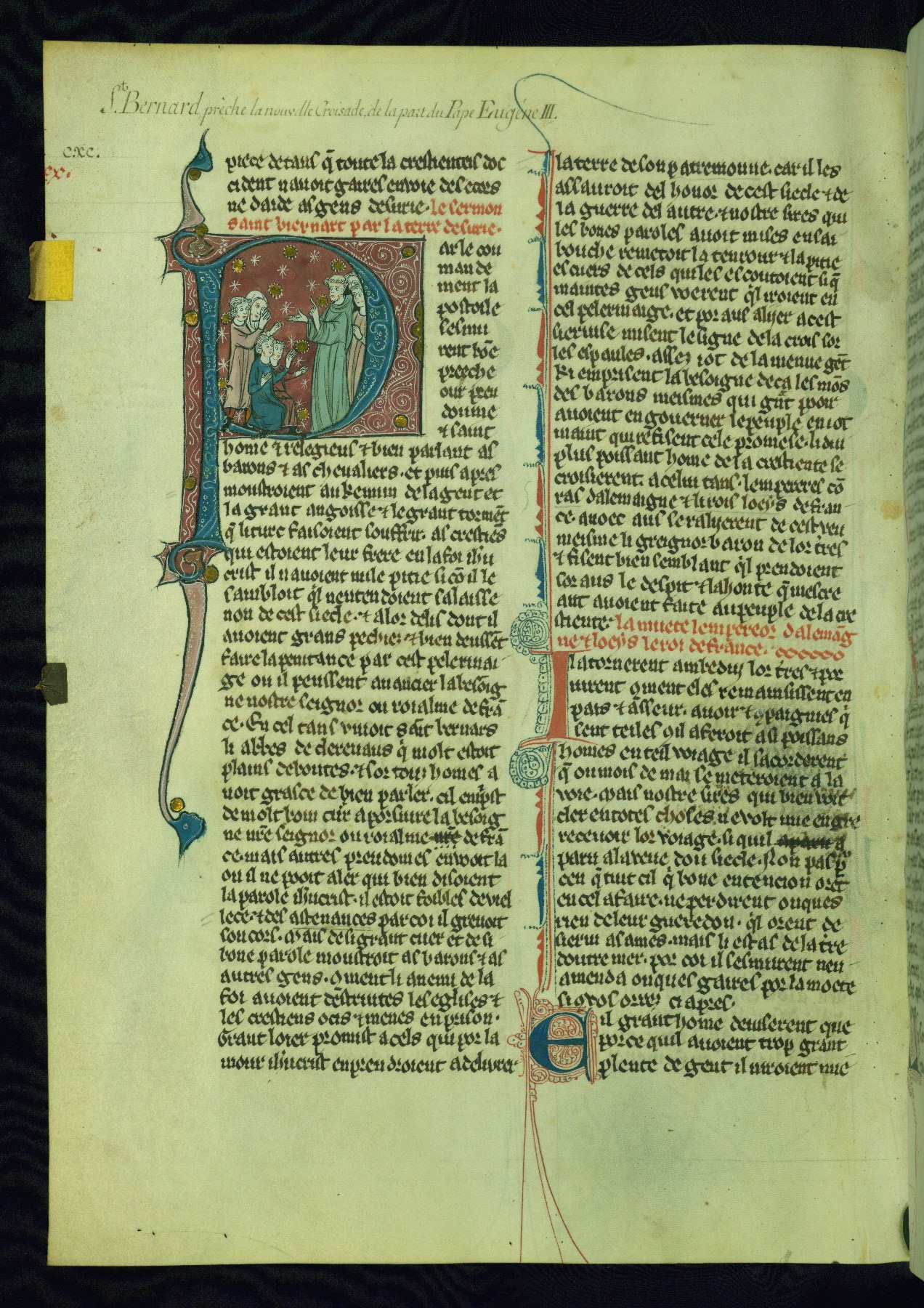
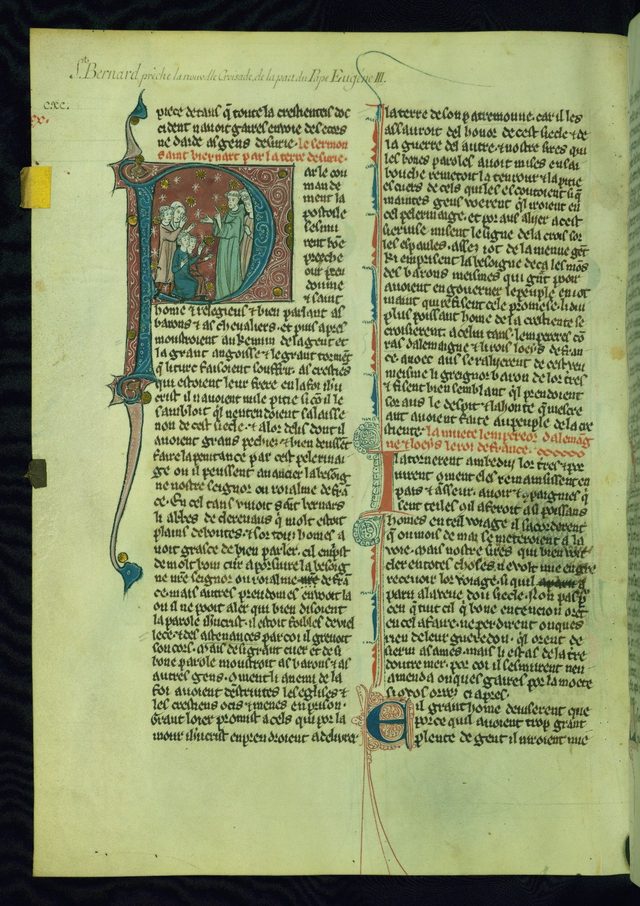
BONo contemporary portrait is known, so none is hosted. Nearest: a late-13th-century manuscript initial of Bernard preaching, shown on this page as a collection object.
Bernard of Clairvaux
Abbot of Clairvaux; preacher of the Second Crusade for Eugenius III · 1146 to 1147
Bernard of Clairvaux: Read more
Cistercian abbot who preached the cross in France and the Rhineland in 1146; his letter to Eastern France and Bavaria offers 'pardon for every sin that you confess with a contrite heart' and also says that 'the Jews must not be persecuted, slaughtered, nor even driven out'.
In their words
“Take the sign of the cross and you shall gain pardon for every sin that you confess with a contrite heart.”
“now, O brave knight, now, O warlike hero, here is a battle you may fight without danger, where it is glory to conquer and gain to die.”
“The Jews must not be persecuted, slaughtered, nor even driven out.”
PTNo contemporary portrait is known, so none is hosted.
Peter the Hermit
Popular preacher of the First Crusade (not a papal office-holder) · 1095 to 1096
Peter the Hermit: Read more
Named by the Byzantine historian Anna Komnene as the man who set out for Jerusalem, returned and 'promoted the expedition', and whose host was the first to cross to Constantinople; she reports that the Emperor urged him to wait for the other counts and that part of his army was cut down by the Turks.
PCNo contemporary portrait is known, so none is hosted.
Peter Capuano
Cardinal-priest of San Marcello and papal legate to the Fourth Crusade · 1202 to 1204
Peter Capuano: Read more
Legate whom Innocent III rebuked on 12 July 1204 for sailing to Constantinople with the pilgrims and for absolving the crusaders who stayed to defend the city from their vows.
Background and rise to power
The papacy was not a state in the sense of the other regime pages, and this page does not treat it as one. It was a religious institution with courts, councils, legates and a chancery, and its crusade messaging is the part of its activity examined here. The question this page asks is what the institution did and said, with citations, and not whether the expeditions were justified.
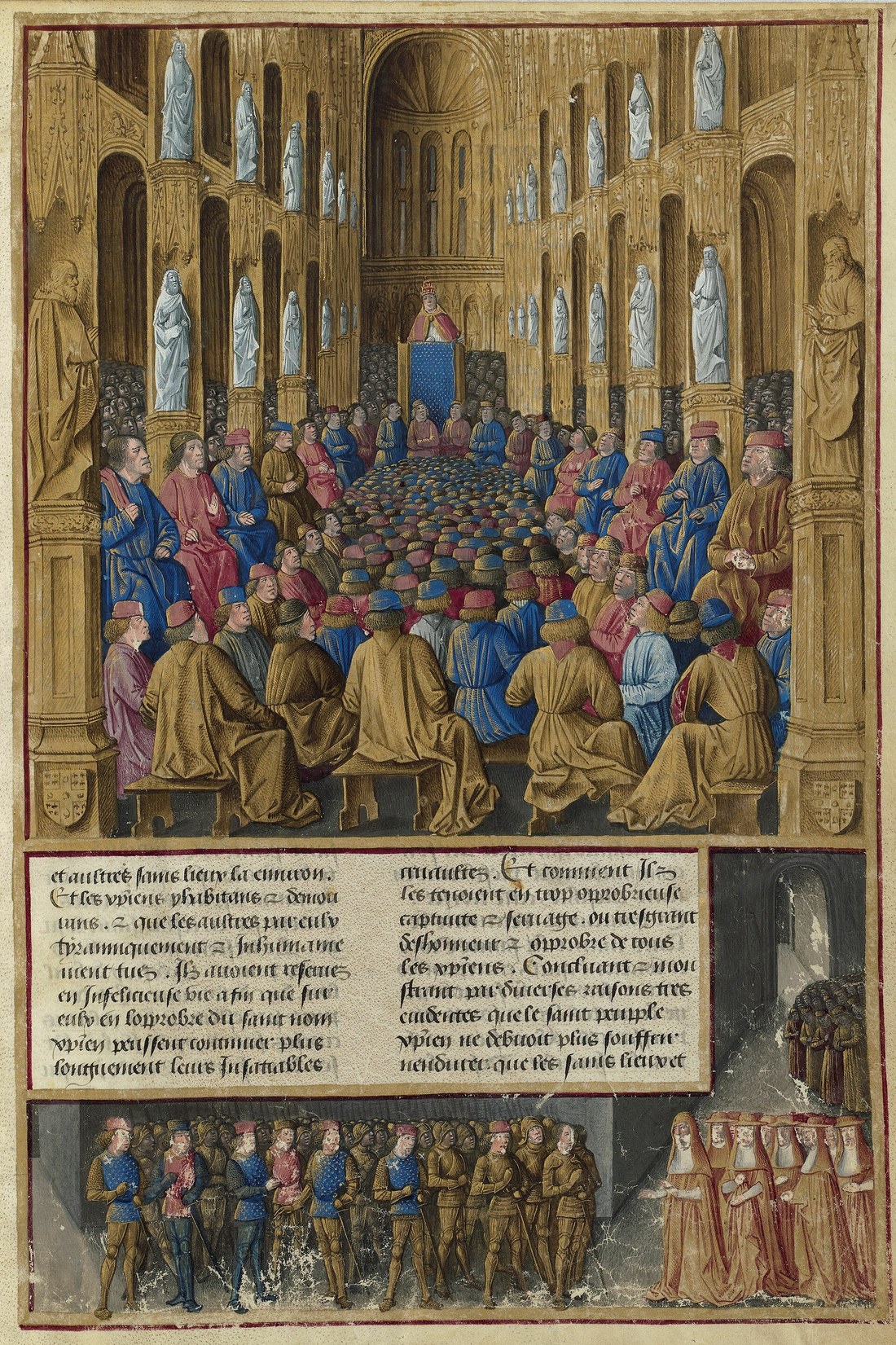
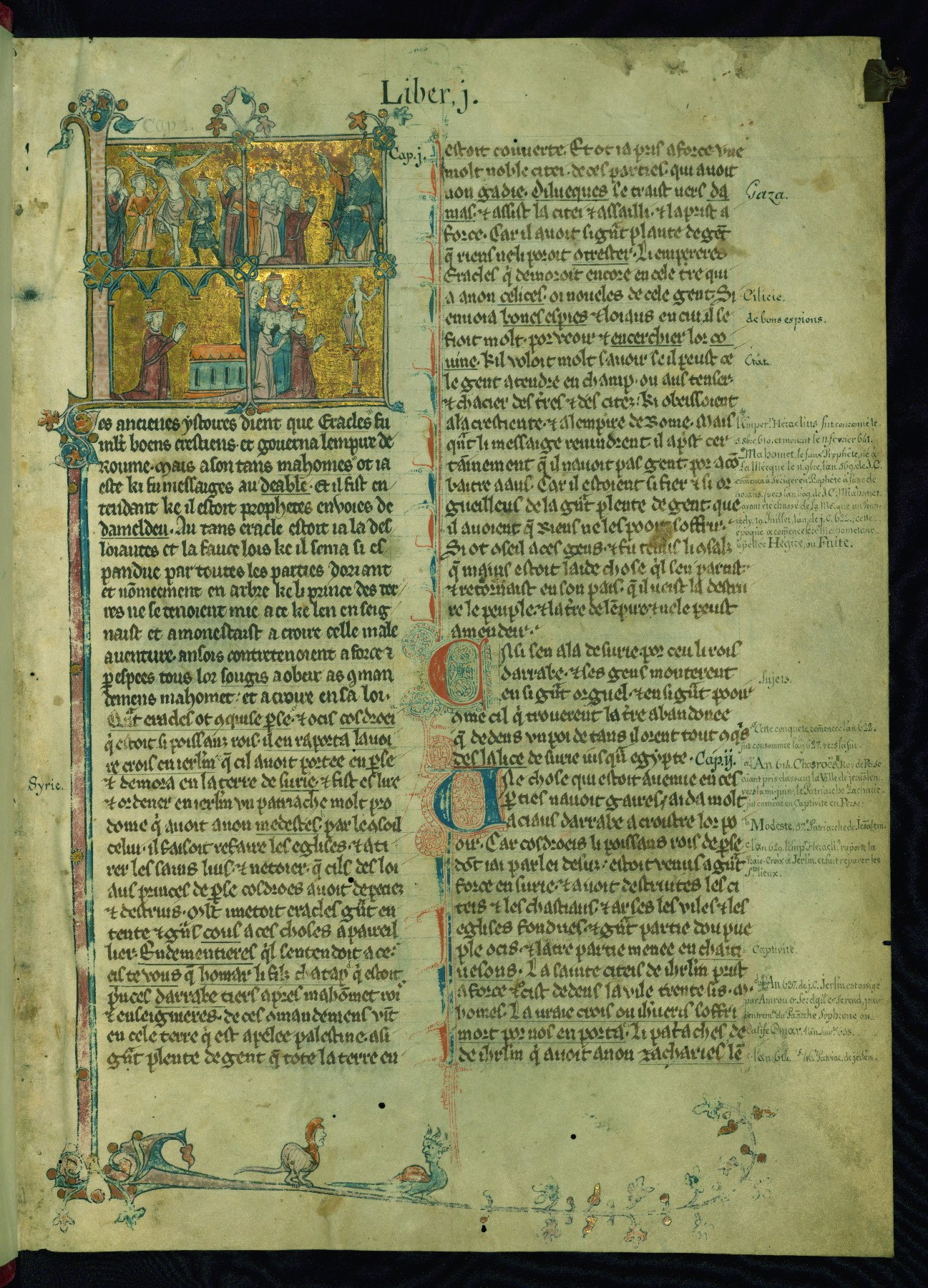
Content note: Medieval religious imagery and a French text describing alleged killings and captivity of eastern Christians, as used to argue for the First Crusade; the text is shown as written. This object is shown as it was published. Why
In the eleventh century the "reform papacy" had already used war and oratory in its own conflicts. Georg Strack notes that Gregory VII's register records a synod of November 1083 in the Lateran at which, with King Henry IV besieging Rome, the pope addressed his remaining supporters in a speech with elements of a classical battle address (Strack 2012). Carl Erdmann's Die Entstehung des Kreuzzugsgedankens (1935; English translation 1977 or 1978, by Baldwin and Goffart) stresses, in the Princeton University Press description, the role of the church reformers and of Gregory VII in the idea of crusade.
Urban II's appeal followed a request for help from the Byzantine emperor Alexios I Komnenos, who in 1094 or 1095 asked the pope for aid against the Seljuq Turks, who had taken most of Asia Minor (editor's introduction to the Fordham collection of Clermont texts). Urban addressed the Council of Clermont in November 1095. The council's own acts do not survive, and what follows is built on chronicles written afterwards. Urban's letter of December 1095 to the faithful "waiting in Flanders" is a contemporary papal document: it says the pope "solemnly enjoined" the undertaking at the council "as a preparation for the remission of all their sins" and names Adhemar, Bishop of Le Puy, as leader in his stead (Krey 1921, pp. 42-43). On 15 July 1099 the crusaders took Jerusalem (Ibn al-Athir, in Richards 2010).
The message was reissued when the situation changed. After the fall of Edessa, Eugenius III's bull Quantum praedecessores was addressed to Louis VII of France and the faithful of Gaul. After the defeat at Hattin (4 July 1187), Gregory VIII issued Audita tremendi (dated 29 October 1187 in reference works; it circulated in several revised versions). Innocent III's letters of 1198 to 1213 shaped the Fourth and Fifth Crusades.
How power was organized
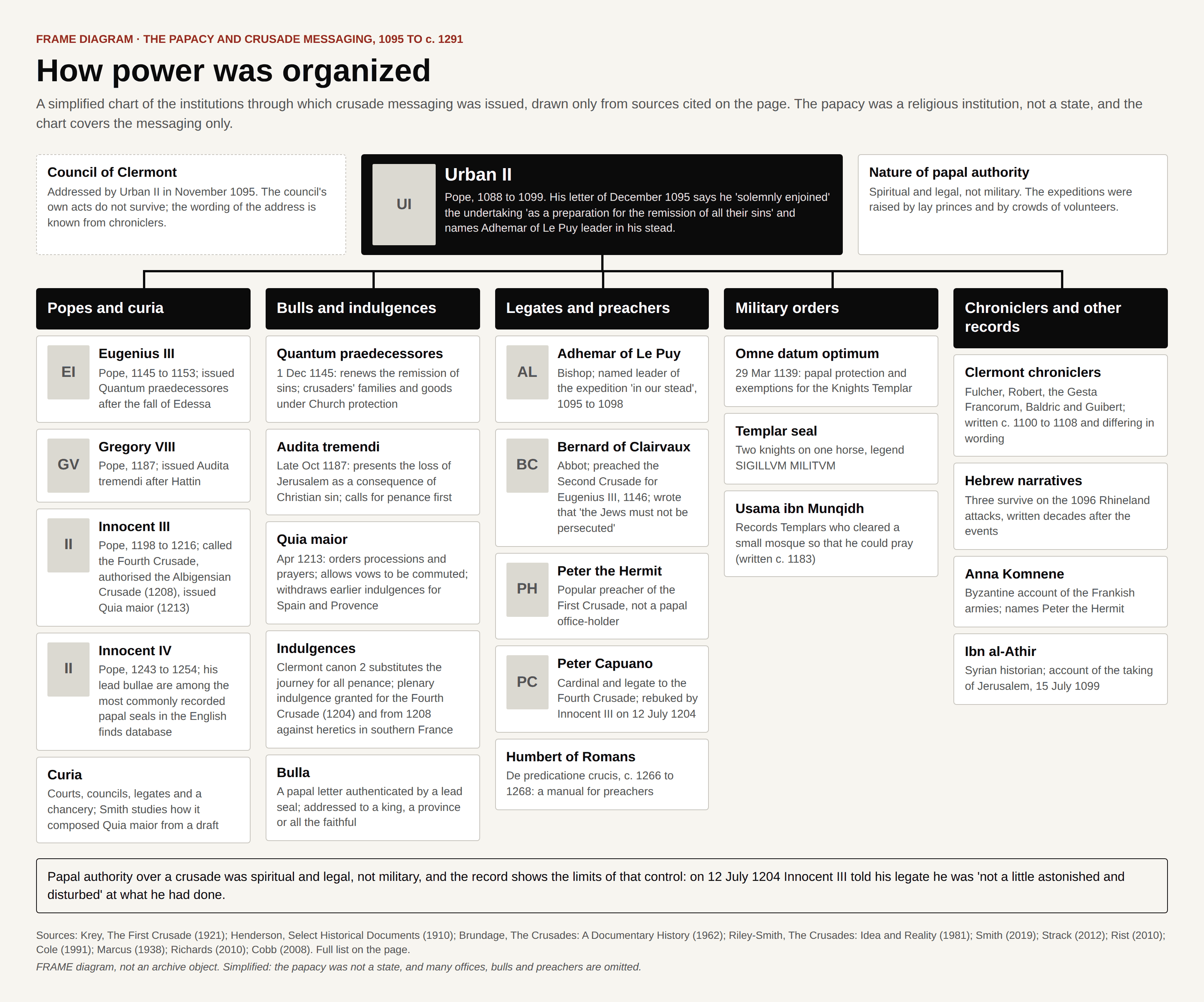
Papal authority over a crusade was spiritual and legal, not military. The documents show four instruments.
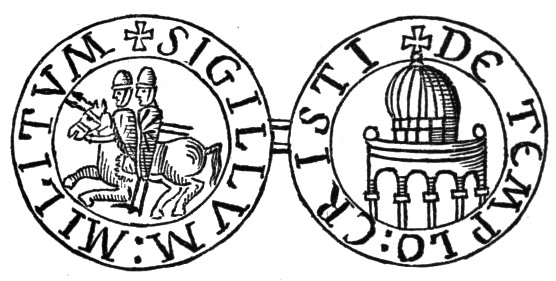
A Templar seal as engraved in 1894. The order was given papal protection by the bull Omne datum optimum of 29 March 1139. Source: Archer and Kingsford, The Crusades (London, 1894), p. 176, via Wikimedia Commons, Public domain (Commons: PD-old; 1894 book illustration).
The institutions behind papal crusade messaging, 1095 to c. 1291, simplified from the sources cited on this page. Source: FRAME diagram, drawn from the sources listed on this page, CC BY 4.0 (FRAME archive content).
Bulls and encyclicals. A bull is a papal letter authenticated by a lead seal (a bulla); crusade bulls are addressed to a king, a province or all the faithful. Quantum praedecessores promised that crusaders' "wives and sons, their goods also and possessions shall remain under the protection of ourselves and of the archbishops, bishops and other prelates", forbade lawsuits over property held in peace until news of their return or death, released debtors from interest, and allowed them to pledge land to churches (Henderson 1910, pp. 333-36).
Indulgences. The remission of sins offered to crusaders is the central device. Canon 2 of Clermont, as reported by Lambert of Arras, who was present, reads: "Whoever for devotion alone, not to gain honour or money, goes to Jerusalem to liberate the Church of God can substitute this journey for all penance." Later bulls repeat and extend it. Rebecca Rist defines a plenary indulgence as the remission of all the temporal punishment owed for sin, and records that Innocent III granted it for the Fourth Crusade in 1204 and from 1208 for the campaign against heretics in southern France (Rist 2010).
Legates. Popes sent representatives who spoke for them: Adhemar of Le Puy in 1095 to 1098, Cardinal Peter Capuano with the Fourth Crusade. The record also shows the limits of that control. Innocent III's letter of 12 July 1204 tells Peter that he was "not a little astonished and disturbed" that he had gone to Constantinople, and that he could not give the absolution he had given (Brundage 1962, pp. 208-09).
Orders. The order was given papal protection and exemptions by Omne datum optimum of 29 March 1139 (text as presented by the Knights Templar Vault site, which gives the date and Innocent II as issuer). The orders had their own seals; the Templar seal, of two knights on one horse with the legend SIGILLVM MILITVM, is shown below as an image.
The expeditions themselves were raised by lay princes and by crowds of volunteers. Christopher Tyerman argues in God's War (2006) that "preaching tours were meticulously planned and orchestrated, and response to such calls, far from being entirely spontaneous, was cultivated and fostered beforehand" (quoted in Chrissis's 2010 review).
Illustration, not an archive object
The propaganda apparatus
Where the word "propaganda" is used, and where it is disputed. The word is modern and is applied to this material by scholars and not by the medieval sources. Christoph Maier uses it in the title of his edition and study of model sermons for preaching the cross (Crusade Propaganda and Ideology: Model Sermons for the Preaching of the Cross, Cambridge, 2000). Penny Cole's standard study is titled instead The Preaching of the Crusades to the Holy Land, 1095-1270 (Medieval Academy, 1991), and Thomas Smith writes of how the papal curia "crafted" a crusade call (Smith 2019). The medieval texts speak of preaching the cross (Humbert of Romans's manual is titled De predicatione crucis); this page uses "propaganda" only in the neutral sense of organised persuasion by an institution and applies the same technique definitions as on every other regime page. A second dispute concerns the nature of the thing preached. Erdmann's book, in the publisher's description, traces a long evolution of the idea of Christian knighthood and holy war, with weight on the church reformers and Gregory VII; Jonathan Riley-Smith (The First Crusade and the Idea of Crusading, 1986) wrote on the same question from the crusaders' own motives. Whether the call is best called a holy war, a pilgrimage or both is disputed between them and others; this page has not re-checked their arguments beyond those descriptions, follows the sources and takes no side.
The speech at Clermont, as five chroniclers recorded it. The actual wording of Urban's address is unrecoverable. The Fordham collection groups five versions (Fulcher of Chartres; Robert the Monk; the anonymous Gesta Francorum; Baldric of Dol; Guibert of Nogent) from Thatcher and McNeal (1905), Munro (1895) and Krey (1921). Strack's article gives the dates and the problem: the anonymous Gesta (c. 1100) has no word-for-word speech; Fulcher gives the first full rendition (c. 1100 to 1105); Robert completed his history in 1107 and Baldric about 1108, and both were revising the Gesta in the orbit of the French court, writing "more than ten years after the synod" (Strack 2012). Strack concludes that only Fulcher's version fits the papal oratory of the eleventh century. Dana Munro's 1906 article, Robert Somerville's studies of the council, Penny Cole, Jonathan Riley-Smith, Marcus Bull, H. E. J. Cowdrey, Jean Flori and Jay Rubenstein have each reconstructed what Urban said and meant, and they differ. What the versions share and where they differ can be shown without choosing one. In Fulcher's version Urban says "All who die by the way, whether by land or by sea, or in battle against the pagans, shall have immediate remission of sins" and calls the opponents "a despised and base race, which worships demons". Robert's version has the pope say "Jerusalem is the navel of the world" and includes a long account of atrocities against eastern Christians, and the crowd's cry "It is the will of God!" The text beneath the 15th-century miniature of the council in this archive speaks of the Christians of the East held in "captivity and servitude" (our translation of the French) to the shame of all Christians.
Bulls as texts.Audita tremendi presents the loss of Jerusalem as a consequence of Christian sin and calls for penance first. Quia maior describes Muhammad as "a son of perdition" whose "treachery has prevailed up to the present day", orders processions and prayers at every mass, allows vows to be commuted or redeemed, and withdraws the indulgences earlier given for Spain and for Provence, giving as its reason that conditions there had changed (translation of Louise and Jonathan Riley-Smith, 1981). Smith compares the final text with a draft, Quoniam maior, preserved in Burchard of Ursberg's chronicle, to reconstruct how the curia composed it (Smith 2019).
Preaching. Bernard of Clairvaux's letter of 1146 to Eastern France and Bavaria is a surviving sermon-letter. It calls the moment "a very jubilee", tells knights "now, O brave knight, now, O warlike hero, here is a battle you may fight without danger, where it is glory to conquer and gain to die", and urges the "prudent merchant" to take "some great bargains" in the cross. In the same letter he writes that "the Jews must not be persecuted, slaughtered, nor even driven out" (letter reproduced by the Council of Centers on Jewish-Christian Relations). Peter the Hermit's preaching is known mostly through others; Anna Komnene says he "promoted the expedition" (Alexiad 10.5, Krey 1921, pp. 70-71). A published review describes Cole's book as an account of the crusade sermons, of the preachers who gave them and of the shifts in papal crusade policy that the sermons reflect, from Urban II's preaching to Louis IX's crusade to Tunis. Humbert of Romans's De predicatione crucis (c. 1266 to 1268) is a manual of arguments, scriptural examples and replies to objections for preachers (Bird 2019).
The Rhineland massacres of 1096 and the Jewish chronicles. Bands of crusaders attacked Jewish communities in the Rhineland in the spring of 1096. The Hebrew account attributed to Solomon bar Samson puts the attack on Mainz on 3 Sivan, 27 May 1096, led by Emicho, and describes the community's resistance, the Archbishop's palace where the Jews had taken refuge, and the deaths and suicides of many Jews (Marcus 1938, pp. 115-20). Three Hebrew narratives survive (the Mainz Anonymous, Solomon bar Samson, and Eliezer bar Nathan). Marcus's introduction on the Fordham page says Solomon bar Samson "wrote about 1140", and summaries of Robert Chazan's work (European Jewry and the First Crusade, 1987) place the Solomon bar Simson compilation about 1140 to the mid-1140s and Eliezer bar Nathan after the Second Crusade (not checked against Chazan's text); on those datings they were written decades after the events, and their relation to what happened is itself a subject of study (Chazan 2000). None of the papal texts quoted on this page mentions the Jews. The record of Bernard in 1146 above is the one such papal-side text here.
The Fourth Crusade and Constantinople (1204). Innocent III had forbidden the attack on Zara, a Christian city, and in November 1202 the crusaders took it. After the sack of Constantinople he wrote to his legate that the crusaders' "swords, which they were supposed to use against the pagans, are now dripping with Christian blood" and asked how the Greek Church could return to union with Rome when it "sees in the Latins only an example of perdition" (Brundage 1962). The Fordham editor adds that Innocent later accepted the new order in Constantinople.
The Albigensian Crusade (briefly). In 1208, after the murder of his legate Peter of Castelnau, Innocent III authorised a crusade against Cathar heretics in southern France, with the indulgence earlier reserved for eastern expeditions (Rist 2010). Rist notes that in 1213 Innocent could declare the Holy Land crusade more meritorious than the crusade against heretics.
The Muslim and Byzantine records. These are sources and not replies. Anna Komnene's Alexiad, written by the emperor's daughter, describes the arrival of "innumerable Frankish armies" and says the emperor "feared the incursions of these people" (Krey 1921). The Syrian historian Ibn al-Athir (1160 to 1233) writes under 15 July 1099 that the Franks "continued to slaughter the Muslims" for a week, that more than 70,000 were killed in the Aqsa Mosque (his figure), and that in Ramadan 1099 refugees from Syria came to Baghdad and "recounted in the Diwan a narrative which brought tears to the eye" (Richards 2010). Usama ibn Munqidh's Book of Contemplation (written around 1183) records both the roughness of "newly arrived Franks" and Templars who cleared a small mosque so that he could pray, with whom he says he was on friendly terms (Cobb 2008, pp. 144-54). Each writer had his own audience and purposes.
Timeline
1088 to 1099: Urban II is pope.
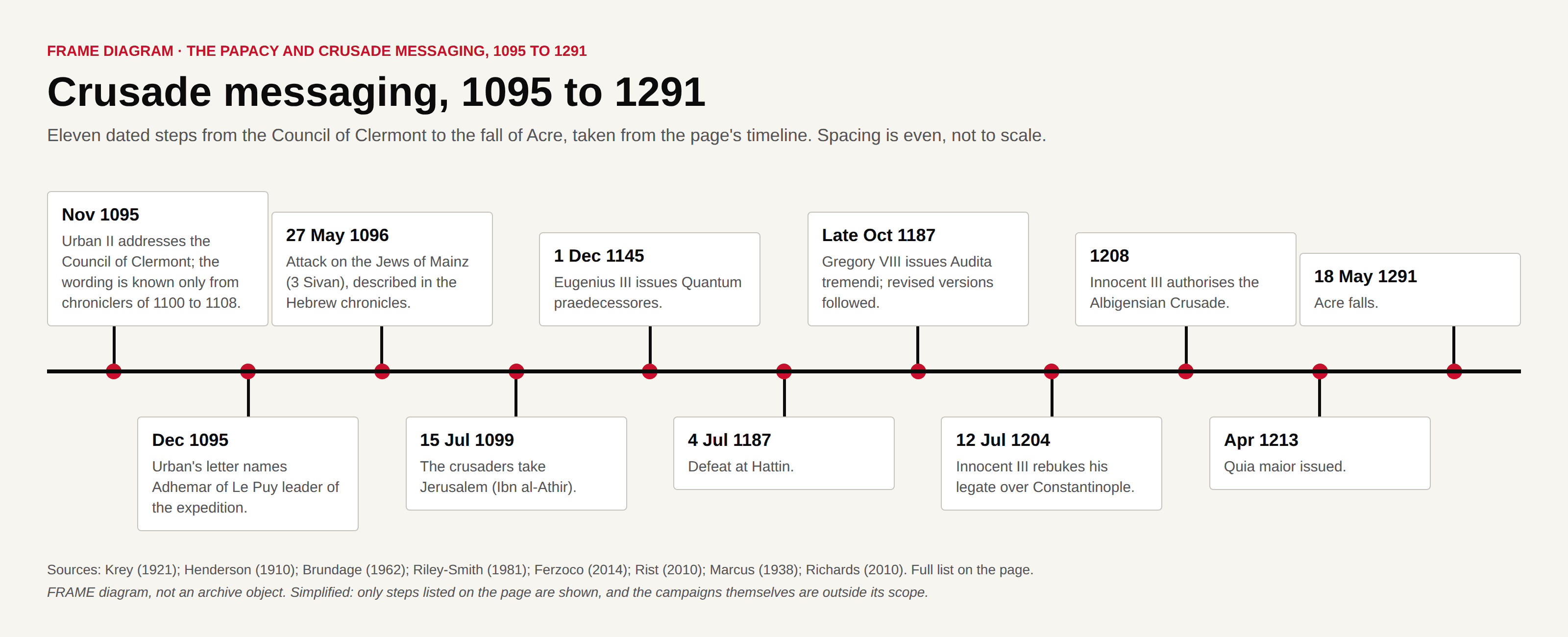
Nov 1095: Urban II addresses the Council of Clermont; the wording is known only from chroniclers of 1100 to 1108.
Dec 1095: Urban's letter names Adhemar of Le Puy leader of the expedition.
27 May 1096: attack on the Jews of Mainz (3 Sivan), described in the Hebrew chronicles.
15 Jul 1099: the crusaders take Jerusalem (Ibn al-Athir).
29 Mar 1139: Omne datum optimum gives the Templars papal protection.
1 Dec 1145: Quantum praedecessores issued by Eugenius III (reissued 1 March 1146, per Ferzoco).
1146: Bernard of Clairvaux preaches the Second Crusade and writes to Eastern France and Bavaria.
4 Jul 1187: defeat at Hattin.
Late Oct 1187: Audita tremendi issued by Gregory VIII (dated 29 October in reference works; revised versions followed).
Nov 1202: crusaders take Zara despite Innocent III's prohibition.
Apr 1204: sack of Constantinople.
12 Jul 1204: Innocent III's rebuke to his legate.
1208: Innocent III authorises the Albigensian Crusade.
Apr 1213: Quia maior issued.
c. 1266 to 1268: Humbert of Romans writes a preachers' manual.
18 May 1291: Acre falls.
Eleven dated steps in papal crusade messaging, 1095 to 1291, simplified from the sources cited on this page. Source: FRAME diagram, drawn from the sources listed on this page, CC BY 4.0 (FRAME archive content).
How it ended
Illustration, not an archive object
The siege of Acre ran from early April (4 April in some accounts, 6 April in others) to 18 May 1291 and ended with its capture by the Mamluk sultan al-Ashraf Khalil, the last Christian stronghold in the Holy Land (dates as given in standard secondary accounts; for full treatments see Runciman 1954 and Folda 2005). Papal crusade calls did not stop in 1291, and this page stops there by scope.
Same-standard note
The same technique definitions are applied here as to every state: fear-appeal (the staged atrocity account in Robert's version and the sins-and-defeat framing of Audita tremendi), transfer (the cross, the authority of Peter and Paul and of Christ) and testimonial (papal and legatine authority as the voucher) describe devices, not verdicts, and the same tags are applied to other regimes. The differences from the state pages are stated, not smoothed: the papacy raised no armies of its own, its main instruments were spiritual grants and legal protections, and its texts were addressed to a Latin Christian audience, so scale, intent and context differ from, for example, a ministry of propaganda; the record includes papal statements limiting the violence (Bernard on the Jews; Innocent III on Zara and Constantinople) and papal grants of indulgence for campaigns in the course of which massacres occurred. Nothing here implies an equivalence with any other regime on this site. The page does not judge the theology.
Sources
Fordham Internet Medieval Sourcebook, "Urban II: Speech at Council of Clermont, 1095 (six versions)": Fulcher after Thatcher and McNeal, A Source Book for Medieval History (1905), pp. 513-17; Robert the Monk after Munro (1895), pp. 5-8; Krey, The First Crusade (1921), pp. 23-43 (Urban's letter of December 1095, pp. 42-43). https://sourcebooks.fordham.edu/source/urban2-5vers.asp
Henderson, Select Historical Documents of the Middle Ages (1910), pp. 333-36, for Quantum praedecessores; the Fordham heading misdates it 1154 ("Dec 1, 1154", seen). The date 1 December 1145 and the reissue of 1 March 1146 are given by G. Ferzoco, "The Origin of the Second Crusade", De Re Militari, https://deremilitari.org/2014/03/the-origin-of-the-second-crusade/ https://sourcebooks.fordham.edu/source/eugene3-2cde.asp
Brundage, The Crusades: A Documentary History (1962), pp. 208-09 (Innocent III to Peter, 12 July 1204). https://sourcebooks.fordham.edu/source/1204innocent.asp
Louise and Jonathan Riley-Smith, The Crusades: Idea and Reality, 1095-1274 (1981), for Quia maior (text as reproduced at https://franciscanum.wordpress.com/2014/08/25/pope-innocent-iii-quia-maior/).
Smith, T. W., "How to craft a crusade call: Pope Innocent III and Quia maior (1213)", Historical Research 92 (2019). https://eprints.whiterose.ac.uk/id/eprint/124634/
Strack, G., "The Sermon of Urban II in Clermont and the Tradition of Papal Oratory", Medieval Sermon Studies 56 (2012). https://www.mag.geschichte.uni-muenchen.de/downloads/strack_urban.pdf
Rist, R., "Salvation and the Albigensian Crusade", Reading Medieval Studies 36 (2010). https://centaur.reading.ac.uk/17023/
Bird, J., Peters, E., and Powell, J. M., eds., Crusade and Christendom: Annotated Documents in Translation from Innocent III to the Fall of Acre, 1187-1291 (University of Pennsylvania Press, 2013), pp. 4-23, for Audita tremendi.
Bird, J., review of Humbert of Romans, De predicatione crucis, The Medieval Review (2019). https://scholarworks.iu.edu/journals/index.php/tmr/article/download/26754/32279
Chrissis, N., review of Tyerman, God's War, The Medieval Review (2010). https://scholarworks.iu.edu/journals/index.php/tmr/article/view/16938/23056
Cole, P. J., The Preaching of the Crusades to the Holy Land, 1095-1270 (Medieval Academy of America, 1991); Maier, C. T., Crusade Propaganda and Ideology: Model Sermons for the Preaching of the Cross (Cambridge University Press, 2000); Erdmann, C., The Origin of the Idea of Crusade, trans. Baldwin and Goffart (Princeton, 1977); Riley-Smith, J., The First Crusade and the Idea of Crusading (1986); Munro, D. C., "The Speech of Pope Urban II at Clermont, 1095", American Historical Review 11 (1906); Somerville, R., "The Council of Clermont and the First Crusade", Studia Gratiana 20 (1976); Cowdrey, H. E. J., "Pope Urban II's Preaching of the First Crusade", History 55 (1970); Flori, J., Urbain II et la première croisade (2001); Rubenstein, J., Armies of Heaven (2011); Bull, M., ed., The First Crusade literature (cited for the dispute, not quoted).
Bernard of Clairvaux, letter to Eastern France and Bavaria (1146), text reproduced by the Council of Centers on Jewish-Christian Relations. https://www.ccjr.us/dialogika-resources/primary-texts-from-the-history-of-the-relationship/bernard-of-clairvaux
Marcus, J. R., The Jew in the Medieval World (1938), pp. 115-20 (Solomon bar Samson, Mainz). https://sourcebooks.fordham.edu/source/1096jews-mainz.asp; Chazan, R., European Jewry and the First Crusade (1987) and God, Humanity, and History: The Hebrew First Crusade Narratives (2000).
Anna Komnene, Alexiad 10.5-6, in Krey (1921), pp. 70-71. https://sourcebooks.web.fordham.edu/source/comnena-cde.asp
Ibn al-Athir, al-Kamil fi'l-ta'rikh, trans. D. S. Richards, The Chronicle of Ibn al-Athir for the Crusading Period, Part 1 (Ashgate, 2006; reprint 2010).
Usama ibn Munqidh, The Book of Contemplation, trans. P. M. Cobb (Penguin, 2008), pp. 144-54.
Runciman, S., A History of the Crusades, vol. 3 (1954); Folda, J., Crusader Art in the Holy Land, from the Third Crusade to the Fall of Acre (2005).