In one line: twice in forty years, a one-party state answered a deadly new disease by spreading the claim that it came out of the same U.S. Army laboratory, Fort Detrick in Maryland.
The shared technique: Narrative laundering. The archive's definition: "Pass a state or factional message through a more legitimate-looking surface so origin is hard to see." Both campaigns also have a Scapegoating element: a disease with a natural or still-disputed origin is placed on a rival state.
| Then | Now | |
|---|---|---|
| The item | An anonymous letter, then a series of articles and a pseudo-scientific report, claiming AIDS was made at Fort Detrick | A spokesman's tweets, then a state newspaper's petition, suggesting COVID-19 came from the U.S. Army or Fort Detrick |
| When | July 1983 to about 1987 | 12 March 2020; petition July–August 2021 |
| Who issued it | The Soviet KGB, later with East Germany's Stasi | China's Foreign Ministry spokesman Zhao Lijian; the state-run Global Times |
| Leader at the time | Yuri Andropov, then Konstantin Chernenko and Mikhail Gorbachev | Xi Jinping |
| Disguise | Covert: planted in a foreign newspaper under an anonymous "American scientist" byline | Mostly overt: an official spokesman under his own name, and a "public" petition hosted by a state newspaper |
| What was going on | The early AIDS epidemic and the late Cold War | The first months of COVID-19, first identified in Wuhan, and rising U.S.–China tension |

Where the two claims sit. Drawn by FRAME from Natural Earth's public-domain outlines; it takes no position on borders. The pins mark where each story was published or said, not where any outbreak began, except Wuhan, where COVID-19 was first identified.
Then: Operation INFEKTION (USSR, 1983–87)
Image gap: no openly licensed copy of the 1983 Patriot letter or the 1985 Literaturnaya Gazeta article was found.
In July 1983 the Indian newspaper Patriot, which the KGB is documented as using to place stories, printed an anonymous letter from a "well-known American scientist and anthropologist". It claimed the Pentagon had created AIDS at Fort Detrick. The story lay dormant until the Soviet weekly Literaturnaya Gazeta cited it on 30 October 1985. It was then repeated in a report by the East German biophysicist Jakob Segal and picked up by newspapers in dozens of countries.
What was going on. AIDS had been identified in 1981 and was spreading with no treatment. The Cold War was at a tense stage. The United States had its own record of biological-weapons research before 1969, which made the claim easier to believe.
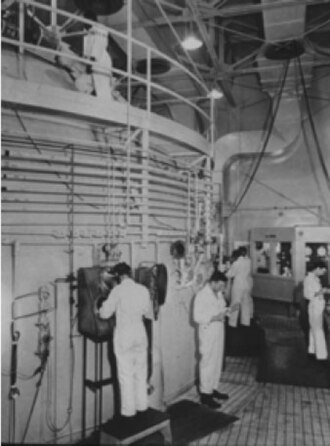
Workers beside the One-Million-Liter Test Sphere ("the 8-Ball") at Fort Detrick, Maryland, built to test how biological agents disperse as aerosols. U.S. Army Fort Detrick Public Affairs Office photograph, undated (Wikimedia Commons gives c. 1968), from the U.S. Army's Medical Aspects of Chemical and Biological Warfare. Public domain (U.S. government work). It documents the pre-1969 programme mentioned above; it has nothing to do with AIDS, which no evidence links to Fort Detrick.
A germ-warfare charge in the other direction. Accusations that a state had used disease as a weapon were also made against the United States in 1952, when China, North Korea and the USSR charged it with germ warfare in the Korean War and the United States denied it. The gallery holds the U.S. reply.
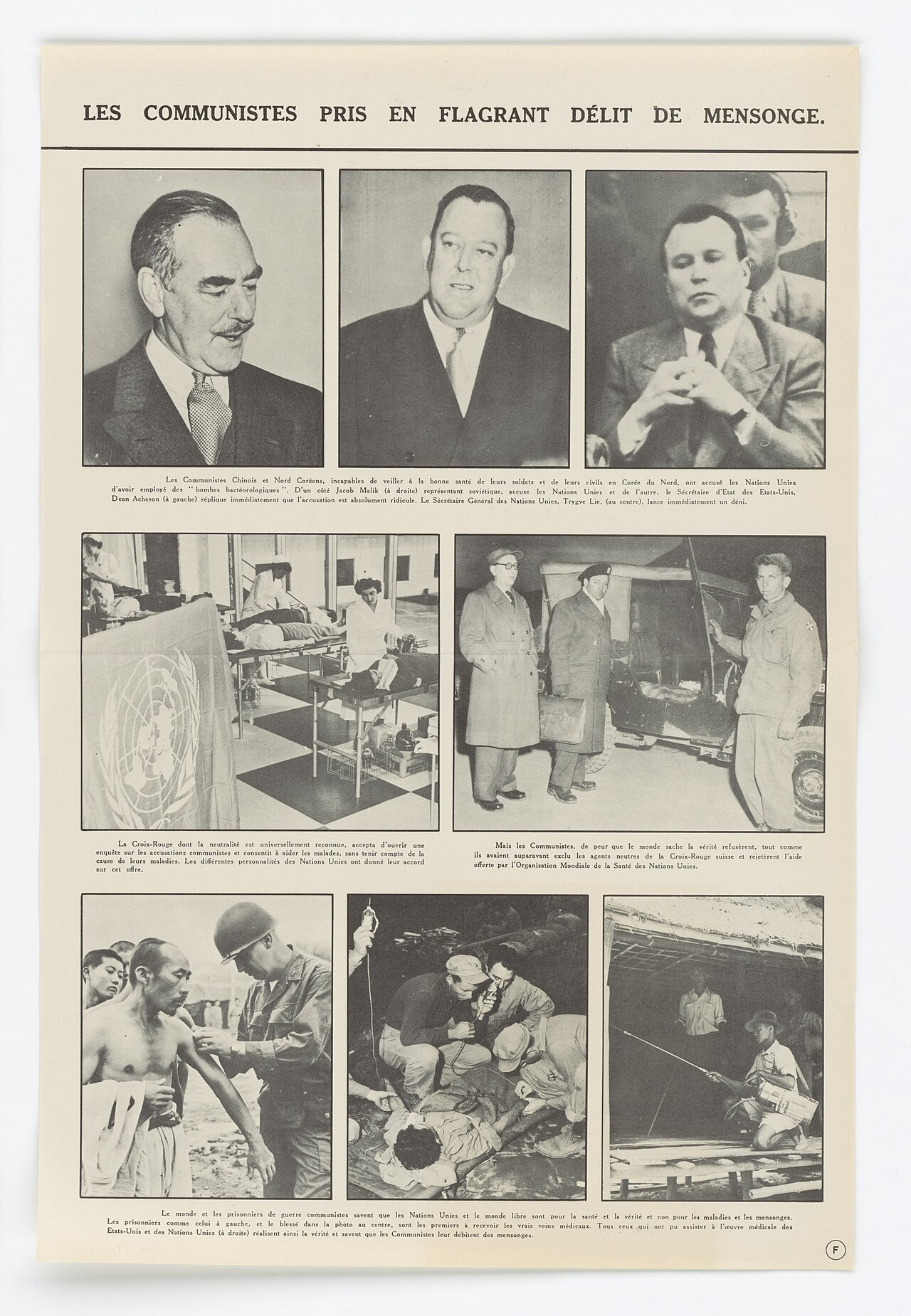
Les communistes pris en flagrant délit de mensonge (The Communists Caught in the Act of Lying). U.S. State Department poster, 1952, printed in French and other languages, answering the germ-warfare charges. Public domain (U.S. government work). The archive's case study, The Korean War germ-warfare charges: commissions, confessions and the 1953 recall, covers both sides of that exchange.
How the technique shows. A state message was passed through a foreign newspaper, an anonymous "scientist" and a "research" report, so readers would not see where it came from. In 1992, Yevgeny Primakov, head of Russia's foreign intelligence service, acknowledged that the KGB had been behind the articles.
Now: the Fort Detrick COVID-19 claim (China, 2020–21)
Image gap: the tweets and the Global Times pages are copyrighted. They are linked instead. The two photographs below show the Wuhan event the tweet pointed to, not the tweets.
On 12 March 2020, Foreign Ministry spokesman Zhao Lijian tweeted: "It might be US army who brought the epidemic to Wuhan. Be transparent! Make public your data! US owe us an explanation!" The claim pointed to the U.S. team at the Military World Games in Wuhan in October 2019. The next day he shared an article from Global Research, a Canadian website known for conspiracy content. In July and August 2021, the state-run Global Times hosted a petition asking the World Health Organization to investigate Fort Detrick, and reported more than 25 million signatures.

The U.S. Armed Forces men's basketball team playing China at the Military World Games in Wuhan, 20 October 2019. Photograph: Mass Communication Specialist 1st Class Ian Carver, U.S. Navy (VIRIN 191020-N-XK513-296), via Wikimedia Commons. Public domain (U.S. government work). The event the 12 March 2020 tweet pointed to; the photograph shows a match and bears on neither the claim nor the origin of the virus.
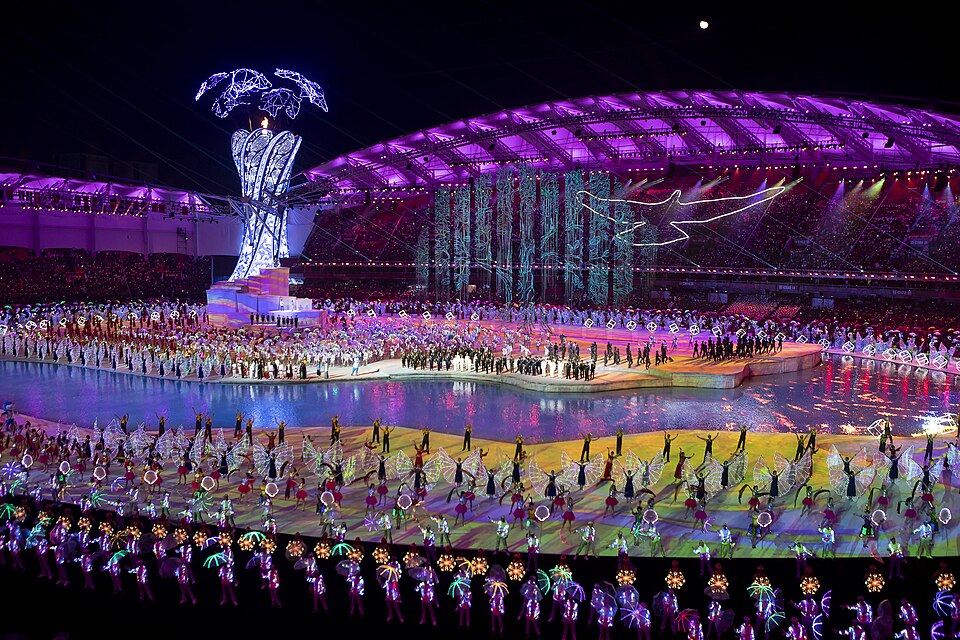
Opening ceremony of the Military World Games, Wuhan, 18 October 2019. Photograph: Gerben van Es, Netherlands Ministry of Defence, via Wikimedia Commons, CC BY-SA 4.0 (scaled by Wikimedia to 960 px wide).
What was going on. The virus was first identified in Wuhan, and China faced international criticism over its early handling. U.S. officials, including the President, were calling it the "Chinese virus" (see Then and now: national and ethnic labels for an enemy or a disease (US 1942, US 2020)). In 2021 the U.S. government was pressing for an inquiry into a possible laboratory leak in Wuhan, and the petition was presented as a response.
How the technique shows. An official claim was reinforced by citing a foreign website and by a petition framed as the voice of ordinary citizens, but run through a state newspaper.
Where they are alike
- Both blame a deadly new disease on the same U.S. Army laboratory.
- Both come from one-party states in a period of rivalry with the United States.
- Both borrow a more independent-looking voice: a foreign paper and an anonymous scientist then; a foreign website and a citizens' petition now.
Where they differ
- Covert or open. INFEKTION hid its origin, which is laundering in its full form. The 2020 claim was made openly by a named official; the laundering was partial.
- What was known. Later research traced HIV to a natural crossover from chimpanzees in Central Africa, decades before the 1980s. The origin of SARS-CoV-2 is still disputed between natural spillover and a laboratory accident in Wuhan. No evidence has linked it to Fort Detrick.
- Admission. Russia's intelligence chief acknowledged the Soviet campaign in 1992. China has not withdrawn the 2020 claims.
Positions on the record
- The Chinese government has said the petition reflected public opinion and that the United States should open its laboratories to the same scrutiny it asks of China. Global Times reported cyberattacks on the petition from U.S. addresses.
- The U.S. government summoned China's ambassador in March 2020 over the tweets and described them as disinformation.
- Much of the Western reporting on both campaigns relies partly on U.S. government sources. Academic and non-U.S. sources are cited below as well.
Same-method test
A U.S. or allied campaign that planted a disease-origin story about a rival through anonymous "scientists", front outlets or state-run "citizen" petitions would be scored the same way here.
How to spot it
- Trace the claim back to its first appearance. Who published it first, and who funds that outlet?
- Be wary of anonymous experts and of petitions hosted by the party that benefits.
- Check whether the claim appeared just as the speaker was under criticism for the same harm.
Sources
- Wilson Center, Operation "Denver": KGB and Stasi Disinformation regarding AIDS.
- Boghardt, T., "Operation INFEKTION: Soviet Bloc Intelligence and Its AIDS Disinformation Campaign", Studies in Intelligence 53(4), 2009 (a CIA journal).
- Selvage, D. and Nehring, C., Disinformation squared: Was the HIV-from-Fort-Detrick myth a Stasi success?, Politics and the Life Sciences (a scholarly debate on the Stasi's role).
- South China Morning Post, Chinese foreign ministry spokesman tweets claim US military brought coronavirus to Wuhan, 13 March 2020.
- ABC News, False claims about sources of coronavirus cause spat between the US, China.
- Global Times, Ft. Detrick probe petition concludes with 25m signatures, August 2021 (primary source).
- CNN, report on China's Fort Detrick messaging, 6 August 2021.
Images
| Image | Source | Licence |
|---|---|---|
| Where the two claims sit (map) | Drawn for FRAME (make_lab_origin_map.py) from Natural Earth |
CC BY 4.0, FRAME; basemap public domain |
| One-Million-Liter Test Sphere, Fort Detrick (c. 1968) | Wikimedia Commons, U.S. Army Fort Detrick Public Affairs Office | Public domain (U.S. government work) |
| Les communistes pris en flagrant délit de mensonge (1952) | FRAME gallery, from NARA via Wikimedia Commons | Public domain (U.S. government work) |
| U.S. Armed Forces v China basketball, Wuhan, 20 Oct 2019 | Wikimedia Commons, U.S. Navy (MC1 Ian Carver) | Public domain (U.S. government work) |
| Military World Games opening ceremony, Wuhan, 18 Oct 2019 | Wikimedia Commons, Gerben van Es / Netherlands Ministry of Defence | CC BY-SA 4.0 |


Image gaps
- The 1983 Patriot letter and the 1985 Literaturnaya Gazeta article. No openly licensed copy found.
- Zhao Lijian's tweets and the Global Times petition page. Copyrighted. Linked instead.
- A larger historical photograph of Fort Detrick. The U.S. Army photographs of the site found on Wikimedia Commons (the test sphere; Building 470, 1953) are only about 300 to 340 pixels wide, so just the sphere is used.