Content note. Two of the pages below use the ethnic slur "Jap" and "Japs" in their banner headlines, as American newspapers of the period did. It is shown as printed, as evidence of the method.
In one line: on 6 August 1945 a U.S. aircraft dropped an atomic bomb on Hiroshima. Within two days three newspapers in three places printed it in three very different ways: a Washington daily built its front page around it, a Black-owned Atlanta daily gave it one column under a story about Black soldiers on Okinawa, and an Indian-nationalist paper printed in Japanese-occupied Singapore carried a two-sentence Japanese military communique on page 2. This page sets them side by side and applies the archive's technique definitions to each in the same way.
What was going on. At 8:15 a.m. local time on 6 August 1945 the bomb exploded over Hiroshima. President Truman announced it from the White House the same day (Washington time), describing the city as an important Japanese Army base. Estimates of the dead in Hiroshima by the end of 1945 range from about 90,000 to 166,000 (Radiation Effects Research Foundation). Nagasaki was bombed on 9 August, and Japan announced its surrender on 15 August. Japan's own first public statement was a short communique from Imperial General Headquarters, relayed by the Domei news agency.
| Evening Star | Atlanta Daily World | Azad Hind (English edition) | |
|---|---|---|---|
| Where | Washington, D.C. | Atlanta, Georgia | Syonan (Singapore), under Japanese occupation |
| Date | Tuesday 7 August 1945 | Tuesday 7 August 1945 | Wednesday 8 August 1945 |
| Issuer | A daily newspaper, "An Associated Press Newspaper" | A Black-owned daily newspaper | Organ of the Indian Independence League |
| Government | Truman administration | Truman administration | Japanese military administration; the League backed the Provisional Government of Free India (Bose) |
| Where the bomb sits | Banner headline and most of the page | One column, upper centre-right | Two sentences, lower centre of page 2 |
| Source named | AP; a Japanese Domei dispatch; Truman's remarks | SNS wire; the White House statement | Domei; Imperial General Headquarters |
| Casualty figure | None printed | None printed | None printed |
The Evening Star, Washington, 7 August
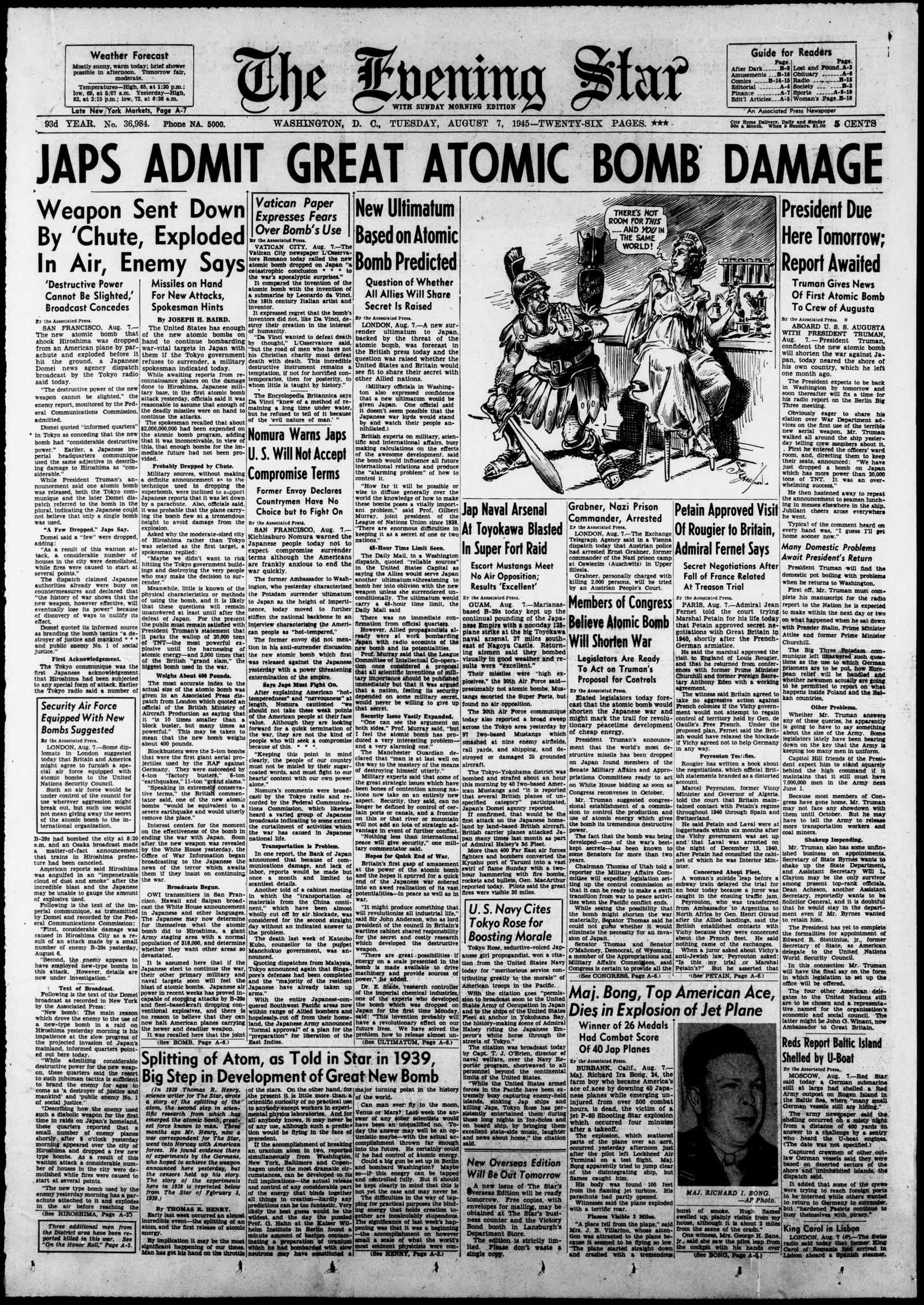
The Evening Star (Washington, D.C.), front page, 7 August 1945. The Evening Star (Washington, D.C.), 7 August 1945, p. A-1. Library of Congress, Chronicling America. Public domain / no known copyright restrictions (Library of Congress statement).
The banner reads "JAPS ADMIT GREAT ATOMIC BOMB DAMAGE". The first story is headed "Weapon Sent Down By 'Chute, Exploded In Air, Enemy Says" and opens: "SAN FRANCISCO, Aug. 7.—The new atomic bomb that shook Hiroshima was dropped from an American plane by parachute and exploded before it hit the ground, a Japanese Domei news agency dispatch broadcast by the Tokyo radio said today." Around it are a Vatican paper's "fears over bomb's use", a predicted "new ultimatum", "Members of Congress Believe Atomic Bomb Will Shorten War", and a 1939 Star article on splitting the atom. The only figure about the city is an Office of War Information remark, in a story on the broadcasts to Japan, that it had a normal population of 318,000. The page prints no count of the dead.
Technique definitions applied.
- Name-calling: "Attach a loaded label so the audience rejects the target without checking the claim." The banner and two other headlines use "Japs" for the Japanese government and people.
- Card stacking: "Select, omit, or order facts so the remaining pile can only be read one way." The page leads with the enemy's own admission of damage, followed by reports of expected pressure on Japan to surrender and of Congress backing the weapon. What happened to people in the city is absent from the page.
The Atlanta Daily World, 7 August
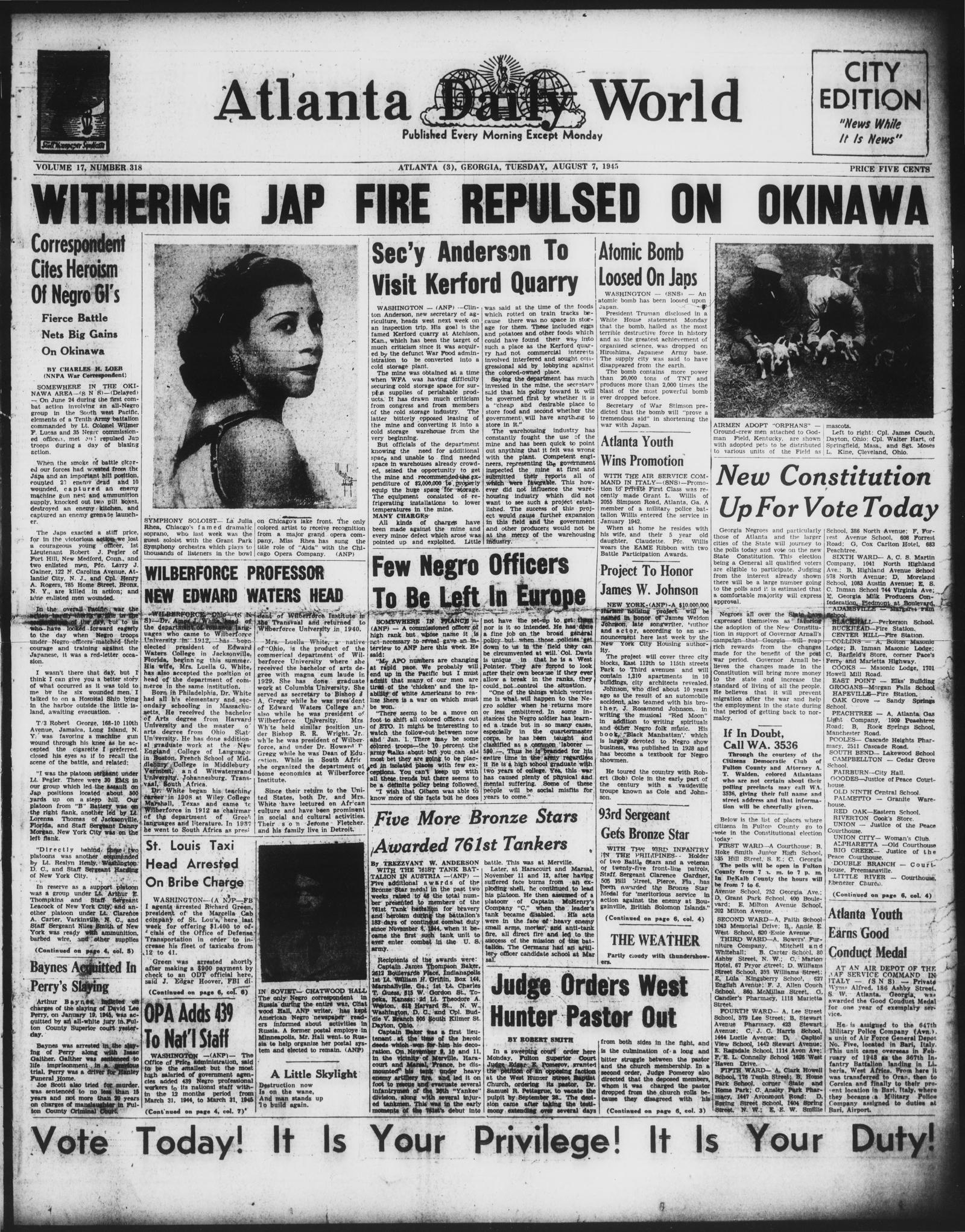
Atlanta Daily World, front page, 7 August 1945. Atlanta Daily World, 7 August 1945 (City Edition), p. 1. Digital Library of Georgia / Library of Congress, Chronicling America. Public domain / no known copyright restrictions (Library of Congress statement).
The banner is "WITHERING JAP FIRE REPULSED ON OKINAWA", over "Correspondent Cites Heroism Of Negro GI's". The bomb is a single column headed "Atomic Bomb Loosed On Japs": "WASHINGTON — (SNS) — An atomic bomb has been loosed upon Japan. President Truman disclosed in a White House statement Monday that the bomb ... was dropped on Hiroshima, Japanese Army base. The supply city was said to have disappeared from the earth." It adds the TNT comparison and Secretary of War Stimson's prediction that the bomb would "prove a tremendous aid" in shortening the war. Elsewhere on the page are a story that few Black officers will remain in Europe and a "Vote Today!" banner for a Georgia vote on a new state constitution.
Technique definitions applied.
- Name-calling: same definition. The banner and the bomb headline use "Jap" and "Japs".
- Card stacking: same definition. The page orders its news by what the paper's readers are doing in the war and at the ballot box, and gives the bomb the White House's wording. As on the Washington page, the item has no description of the city's people.
A difference between the two U.S. pages is placement and editorial focus, not wording of the slur: the Washington paper made the bomb its page, and the Atlanta paper made Black soldiers' combat its page.
Azad Hind, Singapore, 8 August
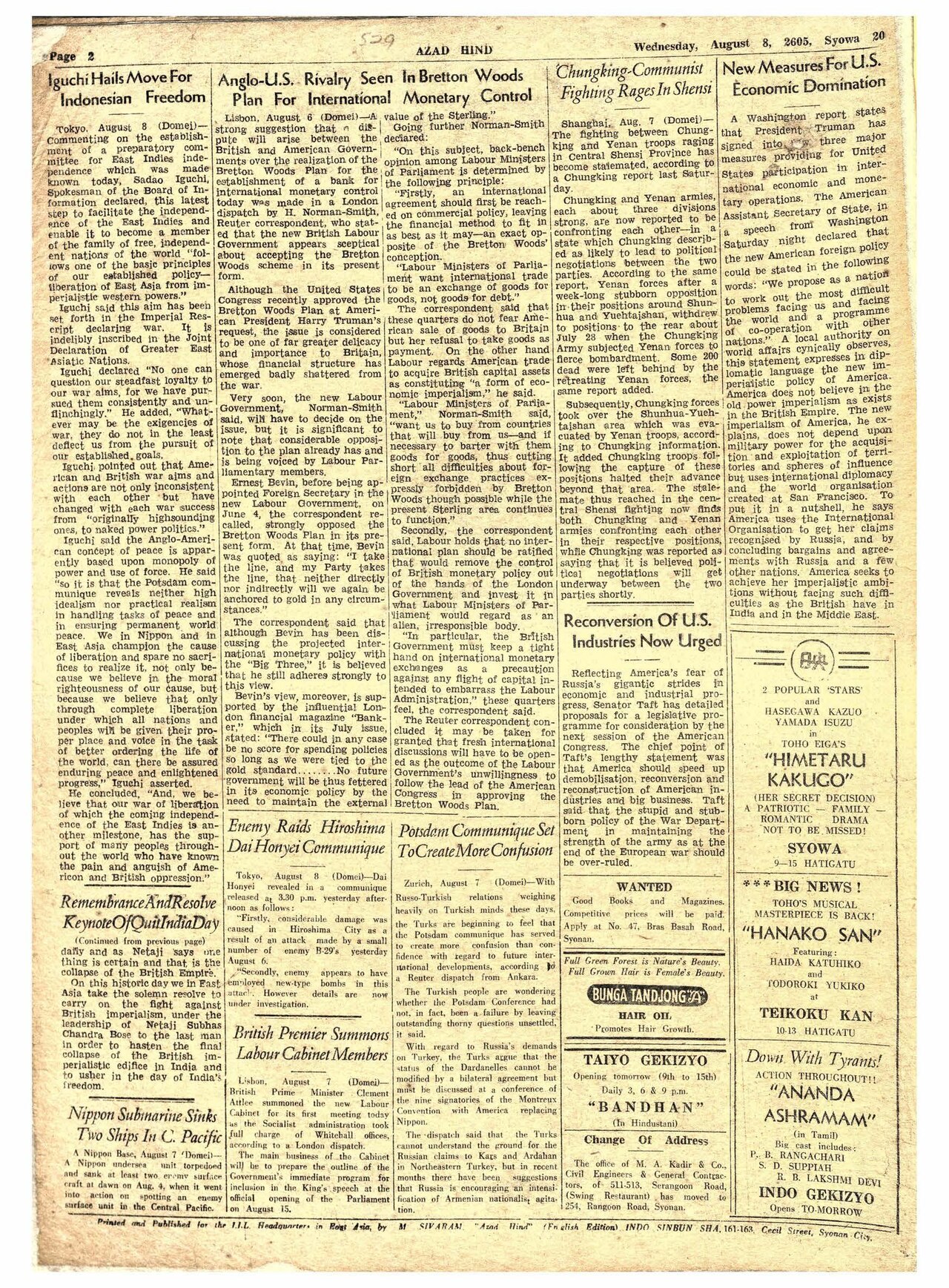
Azad Hind, English edition, page 2 (Syonan/Singapore, 8 August 1945). Azad Hind (English edition), Vol. 2 No. 186, 8 August 1945, p. 2; via Wikimedia Commons. Public domain per the Commons file page (tags PD-Azad Hind, PD-SG-edition, PD-Japan; FRAME did not independently verify them).
The English edition of Azad Hind was the organ of the Indian Independence League, printed in Japanese-occupied Singapore, with war news from the Japanese Domei agency. Its page 1 for 8 August (not hosted) does not mention Hiroshima; the headlines are about Indonesian independence and "Quit India Day". On page 2, under "Enemy Raids Hiroshima / Dai Honyei Communique", it prints: "Firstly, considerable damage was caused in Hiroshima City as a result of an attack made by a small number of enemy B-29's yesterday August 6. Secondly, enemy appears to have employed new-type bombs in this attack. However details are now under investigation." The same page carries the headline "Iguchi Hails Move For Indonesian Freedom", in which a Japanese Board of Information spokesman describes Japan's policy as "liberation of East Asia from imperialist western powers", and "Anglo-U.S. Rivalry Seen In Bretton Woods Plan".
Technique definitions applied.
- Card stacking: same definition. The communique is the only account of the bomb in the hosted pages, it names no weapon beyond "new-type bombs", and it is placed below the Indonesian-independence story.
- Semantic hijacking: "Capture a high-prestige or high-stigma word and stretch it until it covers the speaker's preferred set." The page applies "liberation" and "independence" to the Japanese war aims; the Indonesian "independence" in the item is a preparatory committee working under the Japanese military administration, as the same page says.
Where they are alike
- All three give the wire-service or official source, and none prints a casualty count or describes the people of Hiroshima.
- All three were produced in wartime for a readership at war: the two American papers for an American public, and the Singapore paper for Indians in a Japanese-held region.
- Each page gives the bomb the weight its own editors chose, set against the other news of that morning.
Where they differ
- Sourcing. The Washington page quotes the enemy's broadcast to carry its story; the Atlanta page uses the White House statement; the Singapore page prints only the Japanese communique.
- Size. The bomb is the whole page in Washington, one column in Atlanta and two sentences on page 2 in Singapore.
- Constraint. The Singapore paper printed Japanese official news under wartime Japanese control of the press in occupied territory. The American papers printed an official statement and agency copy under wartime conditions that included secrecy about the weapon until the announcement.
- Labels. The two U.S. pages use a slur for the enemy. The Singapore page's labels are of a different kind: "enemy", "Anglo-American", "imperialist". It calls the weapon only "new-type bombs", as the Japanese military statement did.
- What came next. The Singapore page was printed two days before Japan's conditional offer to accept the Potsdam terms (10 August) and a week before the surrender announcement. The Washington page appeared before Nagasaki.
Image gaps
No Japanese-language newspaper from 6-8 August 1945 could be licence-verified, so none is hosted. The Asahi Shimbun extra of 15 August 1945 on Wikimedia Commons is outside this week. A page of the Japan-aligned Azad Hind is the nearest hostable view of the Japanese side's own announcement.
Sources
- Library of Congress, Chronicling America: Evening Star, 7 August 1945; Atlanta Daily World, 7 August 1945.
- Wikimedia Commons: Azad Hind, English, Vol. 2 No. 186, 8 August 1945.
- Radiation Effects Research Foundation, Frequently asked questions (Hiroshima death estimates).