In one line: a French sociologist's argument that propaganda is not an occasional weapon of bad governments but a permanent feature of every modern technological society, democracies included, with a vocabulary (political and sociological, agitation and integration, vertical and horizontal, pre-propaganda) that still organises much of the field.
The source
- Work: Jacques Ellul, Propagandes (Paris: Armand Colin, 1962). English translation by Konrad Kellen and Jean Lerner: Propaganda: The Formation of Men's Attitudes (New York: Alfred A. Knopf, 1965; Vintage paperback reprint, 1973), with an introduction by Kellen.
- Author: Jacques Ellul (1912-1994), professor at the University of Bordeaux, legal historian, sociologist and Protestant lay theologian.
- Language: French original; quotations here are from the English translation.
- Rights on this archive: in copyright. Summarised in this archive's own words, with short quotations only.
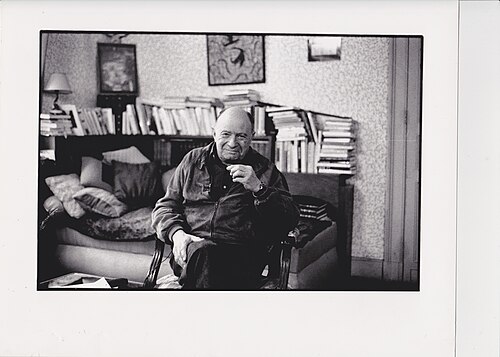
Jacques Ellul at his home in Pessac, France, 12 December 1990. Photo by Jan van Boeckel, ReRun Productions, taken during filming of the documentary The Betrayal by Technology. Wikimedia Commons, CC BY-SA 4.0.
Context
Ellul wrote Propagandes as part of a larger body of work on what he called "technique", the drive toward efficient method in every field of modern life, set out in La Technique ou l'enjeu du siècle (1954; English, The Technological Society, 1964). Propaganda, in his account, is technique applied to human opinion and behaviour.
The book appeared in 1962, the final year of the Algerian War, during the Cold War. Ellul draws his examples from the Soviet Union under Lenin and Stalin, Nazi Germany, the People's Republic of China, France and the United States, and treats them under the same headings.
What it says
A definition centred on participation, not belief. Ellul defines propaganda as "a set of methods employed by an organized group that wants to bring about the active or passive participation in its actions of a mass of individuals, psychologically unified through psychological manipulations and incorporated in an organization" (p. 61). The goal is action or acquiescence, not changing an opinion on a single question.
Political and sociological propaganda. Political propaganda is run deliberately by a government, party or pressure group with defined aims. Sociological propaganda is diffuse: a society's economic, political and cultural structures spread a way of life through advertising, film, education and magazines, often without a central author. Ellul gives the "American way of life" as his main example of sociological propaganda and says the audience comes to treat its own way of life as the measure of what is good.
Agitation and integration. Agitation propaganda stirs people to break with the existing order or to make a sudden effort, and is typical of revolutionary movements and of governments launching campaigns. Integration propaganda aims at long-term conformity and stability. Ellul argues that integration propaganda is the more important and more typical form in developed societies.
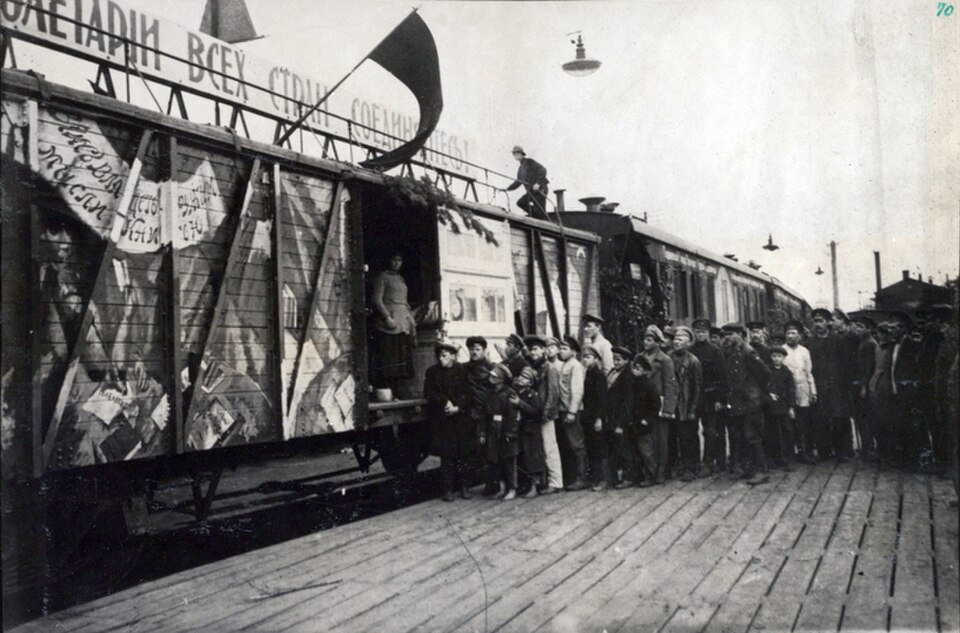
Painted wagons of the "Lenin" literature-and-propaganda train at a station, 1923, with a crowd at the door. Photographer unknown. New York Public Library Digital Collections, via Wikimedia Commons. Public domain.
Vertical and horizontal. Vertical propaganda comes from a leader or apparatus above the mass. Horizontal propaganda works inside small groups whose members reach the expected conclusion in discussion, so that it feels like their own. Ellul uses Chinese Communist small-group practice as his main example of the horizontal form and also discusses American "human relations" and group-dynamics methods under the same heading.
Pre-propaganda. Before a campaign can work, an audience must already hold the images, myths and conditioned responses it will draw on. Ellul calls this preparation pre-propaganda (or sub-propaganda) and counts mass education among its channels, since literacy and a steady supply of information are what make a population reachable.
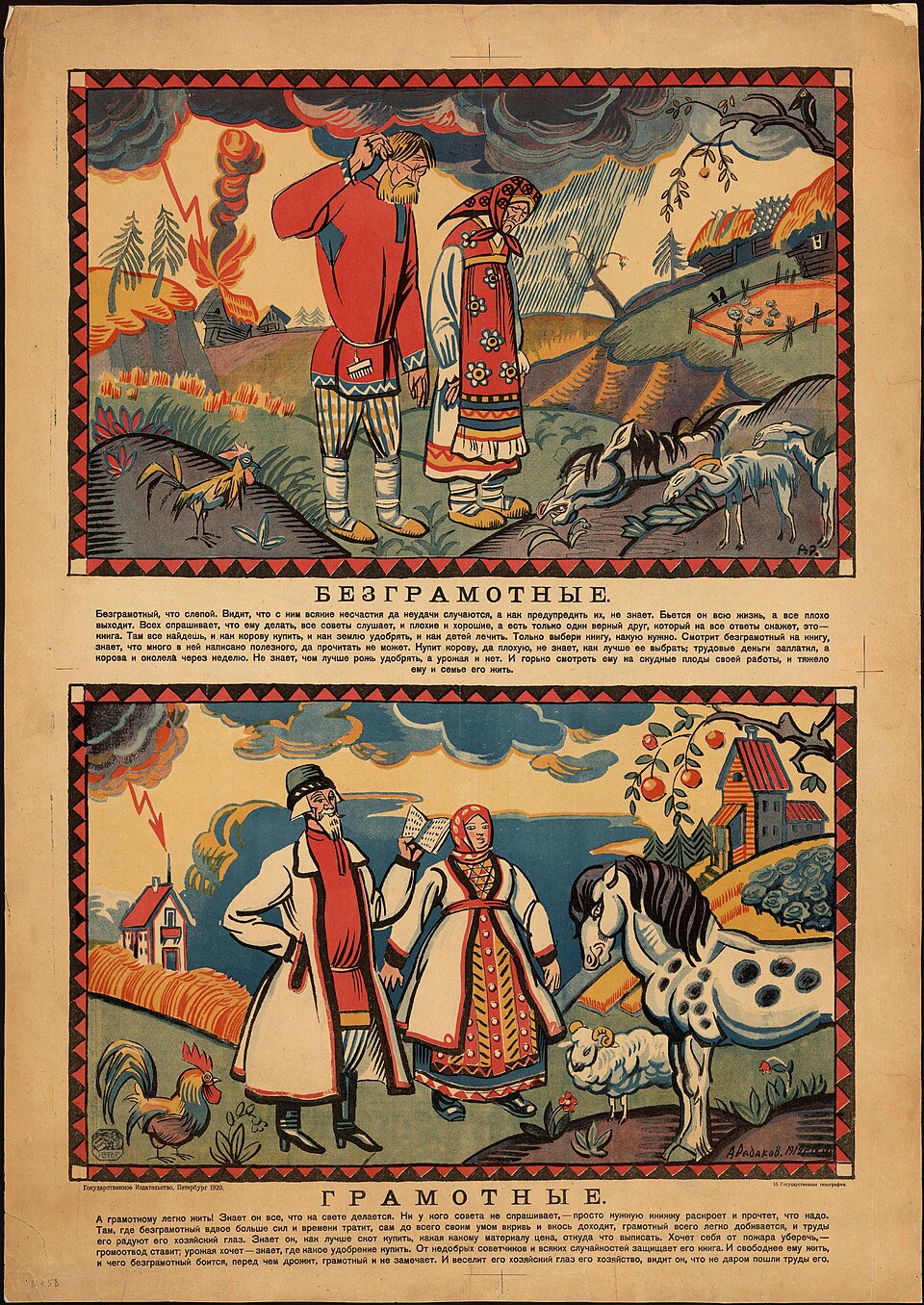
"The Illiterate / The Literate" (Bezgramotnye / Gramotnye), literacy-campaign poster by Aleksei Radakov, Gosizdat, Petrograd, 1920. Russian State Library, via Wikimedia Commons. Public domain.
The educated are especially susceptible. Reversing the view that education protects against propaganda, Ellul argues that intellectuals are among the most vulnerable, because they take in the largest amount of secondhand information they cannot check, feel they must hold an opinion on every major question, and believe themselves capable of "judging for themselves".
Propaganda must be total and continuous. Ellul argues that effective modern propaganda uses every medium at once and never stops: "Propaganda must be continuous and lasting—continuous in that it must not leave any gaps, but must fill the citizen's whole day and all his days; lasting in that it must function over a very long period of time."
Facts are used, interpretation is shaped. Modern propaganda, in Ellul's account, relies more on accurate facts than on outright lies, and works on meaning: "no proof can be furnished where motivations or intentions are concerned or interpretation of a fact is involved."
Democracies and dictatorships alike. Ellul argues that a democratic government in a mass society also needs propaganda, both to govern and to compete with rivals, and that people also seek it out because it gives them ready-made explanations. He argues that democracies adopting propaganda move toward the methods they oppose. He presents this as a description of modern conditions, not as a recommendation.
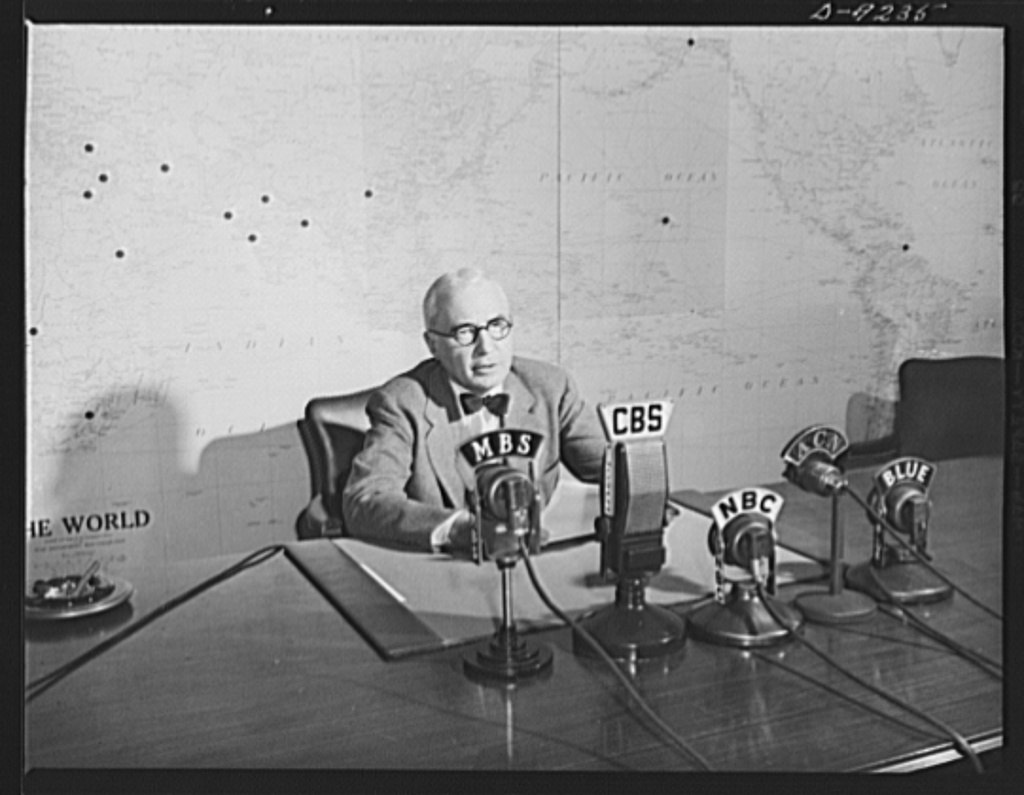
Elmer Davis, director of the U.S. Office of War Information, at his weekly Friday-evening broadcast to the nation, facing the microphones of the major radio networks, c. 1943. Office of War Information photograph, Library of Congress (LC-USE6-D-009235). Public domain (U.S. government work).
How it worked in practice
Ellul's book is analysis, not a manual, and no government adopted it as doctrine. Its documented uses are in scholarship and teaching:
- Media ethics and journalism studies. Clifford G. Christians' Jacques Ellul and Democracy's "Vital Information" Premise (Journalism Monographs no. 45, 1976) applied Ellul's argument to the assumption that more news makes better citizens. Randal Marlin's Propaganda and the Ethics of Persuasion (Broadview, 2002; 2nd ed. 2013) builds its framework partly on Ellul, including pre-propaganda.
- Military and security education. The US Army War College's online journal War Room presented the book, in its "Dusty Shelves" series, as an overlooked classic for understanding information operations and disinformation.
- Readers across the political spectrum. The text is hosted by anarchist online libraries, and the argument was taken up in 2013 by the blogger Curtis Yarvin (writing as Mencius Moldbug) for Ellul's argument that audiences seek propaganda.
- This archive. The integration-propaganda concept is listed in the lineage of Identity fusion, and Doctrine (working definition) names Ellul among the texts its watcher should know.
Techniques in this archive's taxonomy
- Identity fusion: integration propaganda binds the individual to the group so that questioning the group's view feels like leaving it. The taxonomy entry cites Ellul's integration propaganda as lineage.
- Flooding the zone: Ellul's requirement that propaganda be total and continuous, filling "the citizen's whole day", describes saturating attention across every channel so that no gap is left.
- Manufactured consensus: horizontal propaganda produces a conclusion that group members experience as reached by themselves; Ellul's Chinese small-group example is the clearest case in the book.
- Card stacking: Ellul's account of propaganda that uses accurate facts while controlling their interpretation matches selection and framing of a true evidence pile.
Reception and criticism
- Admirers credit the book with moving attention from lies and posters to the everyday channels of education, advertising and news. Marlin, Christians and the War Room essay each draw on it and argue for its continued relevance.
- Method. Kellen's introduction to the English edition notes that Ellul relies on observation and reasoning, not statistics or experiments, and that he rejects small-group laboratory studies as unable to reproduce the total environment in which propaganda works. Researchers in the experimental and survey tradition of communication research regard this as the book's main weakness: a claim that propaganda works through the whole social environment is hard to test or to disprove.
- Breadth. If advertising, schooling, entertainment and group discussion all count as propaganda, critics argue, the word loses its boundary and cannot separate propaganda from ordinary social life. This archive's Doctrine (working definition) states the same worry in its own terms ("If everything is propaganda, the word is a glittering generality") and draws a narrower line.
- Pessimism. Some readers find the book fatalistic about resisting propaganda. Kellen's introduction notes that Ellul reaches neither a pessimistic nor an optimistic conclusion about the future.
Same-standard note
Ellul applies the same categories to the United States and France as to the Soviet Union, Nazi Germany and China, and this archive does the same. His two leading examples show both the similarity and the difference: Chinese Communist small-group discussion (see Mao Zedong and the Chinese Communist Party, thought work and the mass line (1942-present)) and the American way of life are both, in his terms, integration propaganda. The first was organised by a single ruling party with control of the press and penalties for dissent; the second, as Ellul describes it, spreads through commercial, civic and educational channels with no single director and alongside competing messages. Ellul treats that difference as real while arguing that both shape attitudes.
Sources
- Jacques Ellul, Propagandes (Paris: Armand Colin, 1962).
- Jacques Ellul, Propaganda: The Formation of Men's Attitudes, trans. Konrad Kellen and Jean Lerner (New York: Alfred A. Knopf, 1965; Vintage, 1973), including Kellen's introduction.
- Jacques Ellul, The Technological Society, trans. John Wilkinson (New York: Alfred A. Knopf, 1964).
- Clifford G. Christians, Jacques Ellul and Democracy's "Vital Information" Premise, Journalism Monographs no. 45 (August 1976).
- Randal Marlin, Propaganda and the Ethics of Persuasion (Peterborough, Ont.: Broadview Press, 2002; 2nd ed. 2013).
- "Ellul's 'Propaganda': Over Fifty Years' Warning, But Are We Listening?", War Room, US Army War College, Dusty Shelves series: https://warroom.armywarcollege.edu/articles/elluls-propaganda/
- Mencius Moldbug (Curtis Yarvin), "Jacques Ellul on the demand for propaganda", Unqualified Reservations (2013): https://www.unqualified-reservations.org/2013/03/jacques-ellul-on-demand-for-propaganda/