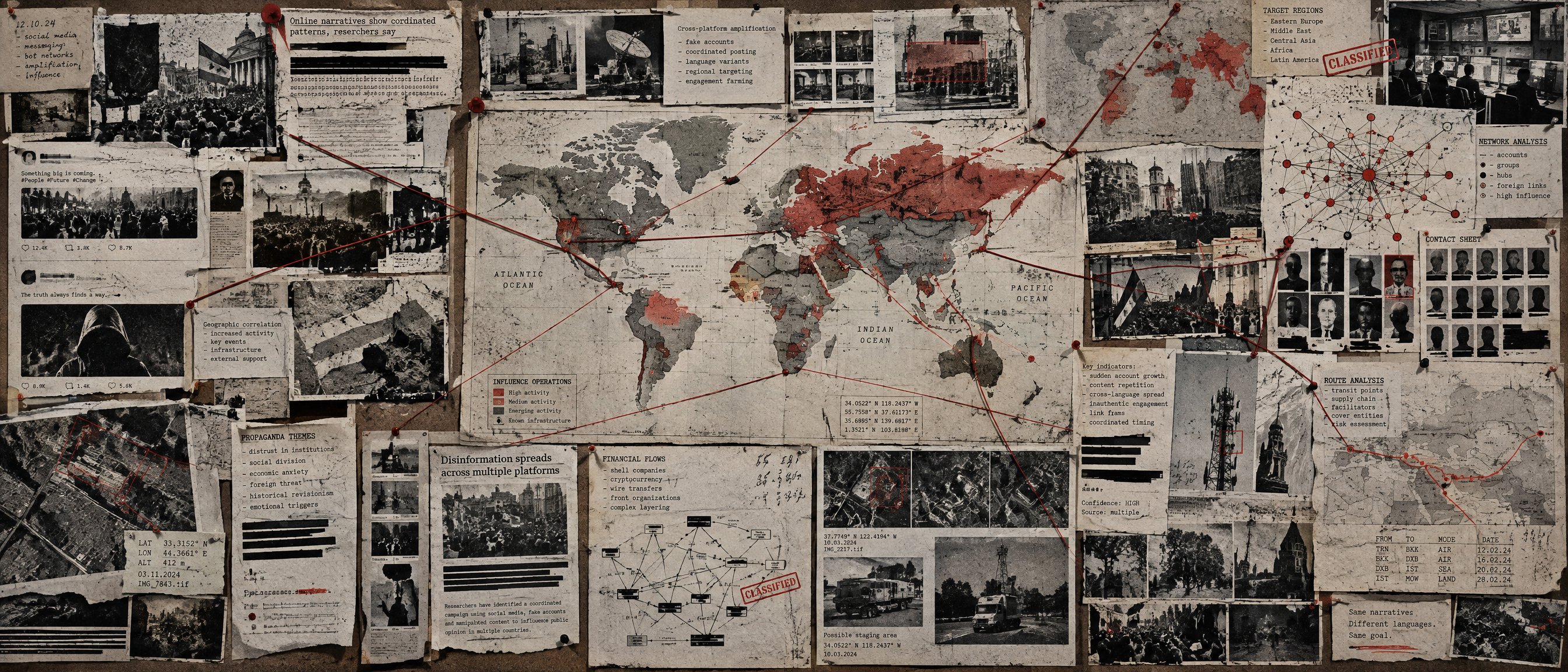
Also called Flood the zone, Attention saturation
Saturate the available attention so a preferred frame, or chaos itself, crowds out slower checking.
The tell
Many items, one window; the checker cannot finish one before the next arrives.
Not this
A single well-sourced dump of primary documents.
History and effect
Popularized by a 2018 remark attributed to Steve Bannon; related to but distinct from firehosing, since the goal here is occupying attention rather than necessarily lying.
It leaves no window of calm attention in which a single claim can be checked before the next one arrives.
Lineage: Bannon coinage; related to firehosing but about occupying attention, not necessarily falsehood
How it works
Flooding the zone works on the audience's time rather than on any single claim. An actor produces or amplifies many items (statements, controversies, posts, announcements, rival versions of an event) inside a short window, so journalists, fact-checkers and readers are always behind. The items need not be false. What matters is the ratio: new material arrives faster than any one piece can be examined, and each unexamined piece is displaced by the next. The preferred frame survives because it is repeated most, or because nothing else holds attention long enough to form a competing picture.
Three variants recur in the research record. The first is distraction. Margaret Roberts (2018) names "flooding" as one of three mechanisms of modern censorship, alongside fear and friction: instead of removing information, a government coordinates the production of other information that competes with it. The second is swamping a shared channel, such as a protest hashtag, with repetitive or unrelated posts until it stops working as a place to coordinate. The third is agenda saturation by one prominent actor, a steady stream of statements that keeps newsrooms reacting to the latest item. A related, older pattern exploits a flood rather than creating one: unwelcome material is released when attention is already saturated, or many items are released together so none gets full coverage.
The technique needs volume and coordination, so it is often paired with Astroturfing (many voices that are really one) and Outrage bait (items built to draw reaction). It differs from Firehosing, which RAND's Christopher Paul and Miriam Matthews (2016) define partly by a lack of commitment to objective reality and consistency. Flooding the zone can be done entirely with true but trivial or diversionary material; its defining feature is occupying attention.
Why it works
Attention is finite, and checking costs more than asserting. Herbert Simon wrote in 1971 that "a wealth of information creates a poverty of attention." Brandolini's law (Alberto Brandolini, 2013) states the second half: refuting a misleading claim takes far more effort than producing it. Agenda-setting research (McCombs and Shaw, 1972) found that what news media emphasise shapes what audiences consider important, so whoever controls the flow of new items influences which issues are discussed at all.
Under heavy load people also process less carefully. In Petty and Cacioppo's elaboration likelihood model (1986), low ability or motivation to scrutinise shifts judgement toward peripheral cues such as volume and familiarity, and repetition raises perceived truth (illusory truth effect, Hasher, Goldstein and Toppino 1977). Roberts adds friction: small extra costs in finding information deflect most people, so a channel need not be blocked to be buried. The legal scholar Tim Wu (2017) argued that when speech is cheap and attention scarce, flooding can silence more effectively than removal. See Illusory truth effect in the Learn library.
Examples across eras and sides
- Four Minute Men (1917-1918, United States, Committee on Public Information). The federal committee chaired by George Creel recruited tens of thousands of volunteer speakers to give short, centrally supplied talks in cinemas and halls, alongside posters, pamphlets and a daily Official Bulletin, while also issuing voluntary guidelines to the press. The flooding element is saturation of every available channel with one government frame for the war. Unlike later cases, the material was openly attributed and aimed at mobilisation rather than distraction (George Creel, How We Advertised America, 1920).
- The "Gish gallop" (1970s-1990s, United States, creationist debaters). Duane Gish of the Institute for Creation Research raised many separate claims in quick succession in timed debates with scientists. Eugenie Scott of the National Center for Science Education named the style "the Gish gallop", noting that each claim took seconds to state and far longer to rebut. This is the technique at the scale of one debate, used by a non-state actor (Eugenie C. Scott, National Center for Science Education, 1990s).
- "A very good day to bury" (2001, United Kingdom, Labour government adviser). On 11 September 2001 Jo Moore, a special adviser at the Department for Transport, Local Government and the Regions, emailed colleagues that it was "a very good day to get out anything we want to bury." The email became public, she apologised, and she left the post in 2002. This is the timing variant: using existing saturation rather than creating it (BBC News and The Guardian reporting, 2001-2002).
- Fabricated posts for distraction (2013-2014 data, China, local propaganda offices). From a leaked archive of a Jiangxi district internet propaganda office's emails, Gary King, Jennifer Pan and Margaret Roberts estimated that the Chinese government fabricates about 448 million social media posts a year, mostly written by government employees. The posts rarely engaged critics; they emphasised cheerleading and positive topics and clustered around sensitive dates and events, which the authors read as strategic distraction (King, Pan and Roberts, American Political Science Review, 2017).
- #YaMeCansé (2014-2015, Mexico, automated accounts). After 43 students from the Ayotzinapa teacher-training college disappeared in September 2014, Attorney General Jesús Murillo Karam's remark "Ya me cansé" ("I've had enough") at a November press conference became a protest hashtag. Researchers documented large numbers of automated accounts posting to it and related tags, which activists said made the channel hard to use for organising; the operators were not publicly identified (Suárez-Serrato, Roberts, Davis and Menczer, SocInfo, 2016).
- The name as stated strategy (2018, United States, former White House chief strategist). Michael Lewis reported that Steve Bannon told him: "The Democrats don't matter. The real opposition is the media. And the way to deal with them is to flood the zone with shit." This is a statement of intent from an interview, not a measured campaign. The phrase comes from American football, where a "flood" sends several receivers into one area to overwhelm its defenders (Michael Lewis, Bloomberg Opinion, February 2018).
- The Gyirong flood toll (2026, Tibet, China's Ministry of Public Security and platforms). After a deadly mudslide at Gyirong Port, official coverage centred on the rescue while police punished "rumours" of higher tolls and platforms removed such posts. The Guardian, quoting China Media Project director David Bandurski, presents continuous deletion and routine guidance as everyday practice that kept the space filled with the official account (The Guardian, 8 September 2026; see The Gyirong flood and the official death toll).
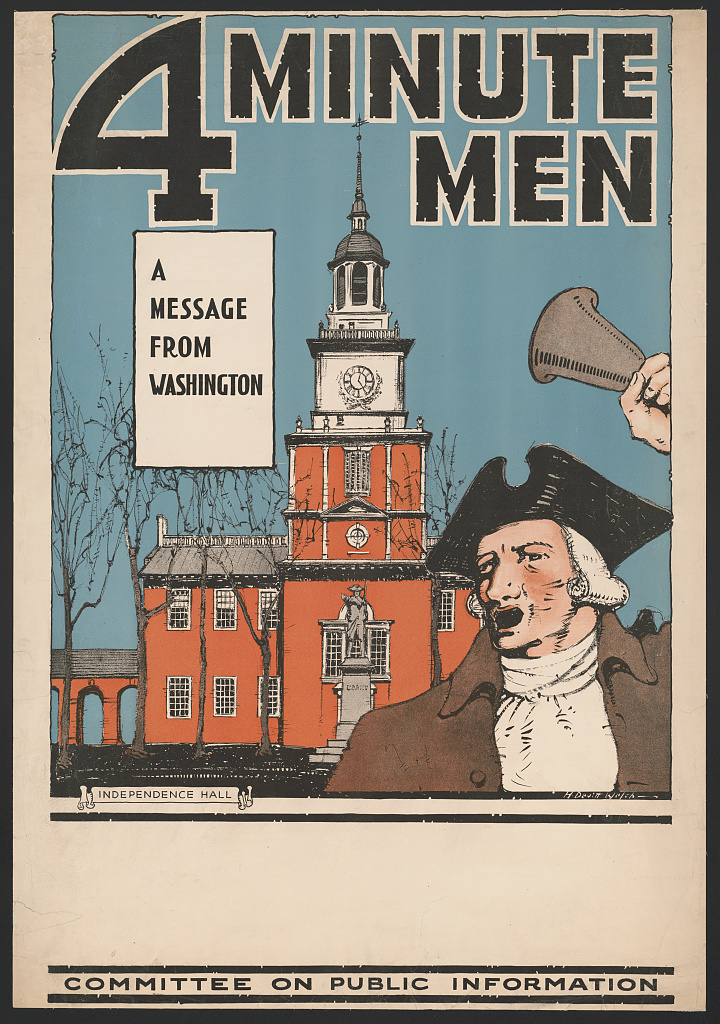
"4 Minute Men: A Message from Washington", Committee on Public Information poster, 1917, from the gallery entry 4 Minute Men: A Message from Washington. The volunteer-speaker network was one openly attributed channel among posters, pamphlets and a daily bulletin.
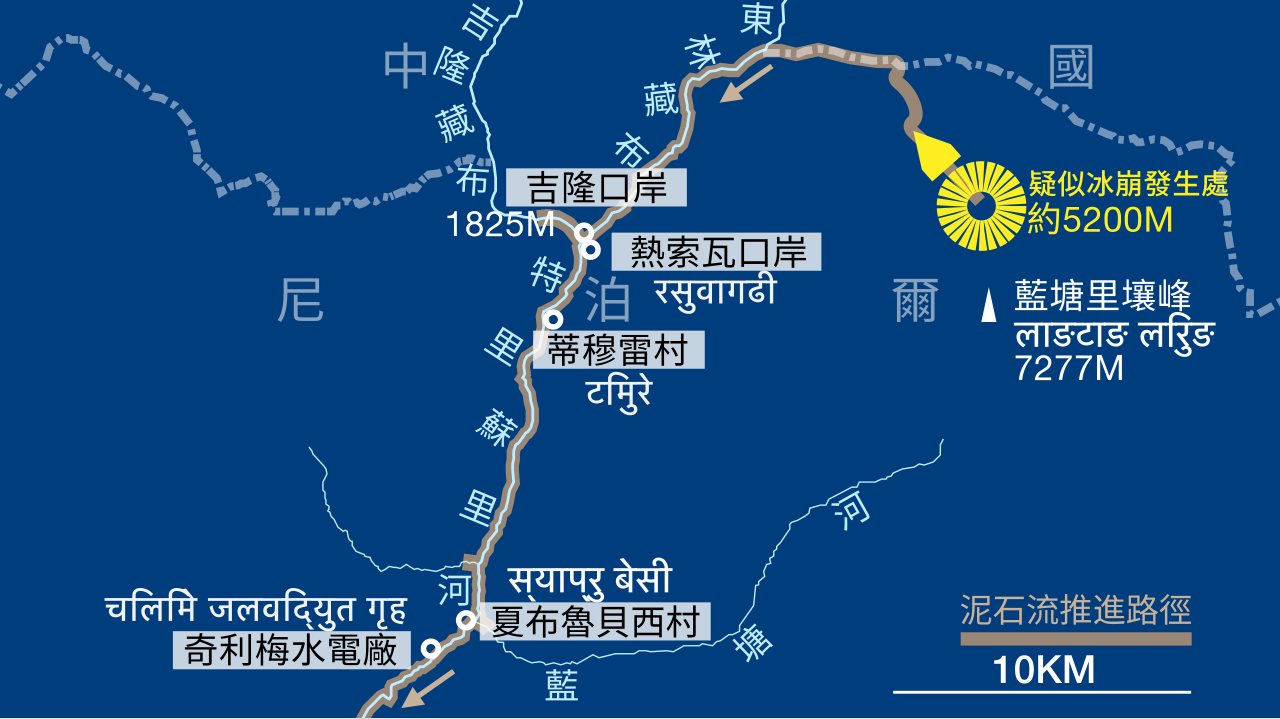
Map of the mudslide's path from a suspected ice collapse, past Gyirong Port and Rasuwagadhi, into Nepal (2026), from The Gyirong flood and the official death toll. Chinese and Nepali labels. By Wikimedia user 王桁霽, CC BY-SA 4.0.

Steve Bannon speaking at the Conservative Political Action Conference, National Harbor, Maryland, 23 February 2017. Michael Lewis reported in 2018 that Bannon described his strategy toward the press as flooding the zone (quoted above). Photo: Gage Skidmore, CC BY-SA 3.0.
How to spot it
- How many new items arrived in this window, and was any earlier one checked or corrected before the next appeared?
- Does this item add to the topic at hand, or change the subject just as that topic was gaining attention?
- Are many similar posts arriving at once from accounts with little history, or accounts that post only on this subject?
- Was this released when attention was elsewhere (late on a Friday, before a holiday, during a major breaking story), or bundled with many other releases?
- Setting the volume aside, what is the one claim that matters most, and has anyone checked it?
- Is a shared channel (a hashtag, a comment section, a hearing's time limit) still usable for its purpose, or is it mostly noise?
Where it ends: edge cases and legitimate persuasion
- Firehosing. When the volume is also false and self-contradicting, the case moves toward Firehosing; the Russian Defence Ministry's shifting accounts of the MH17 shoot-down are tagged there because inconsistency is the documented feature (Russian Defence Ministry satellite image, MH17 briefing). Many cases combine both.
- Fake volume. When the flood is made to look like many independent people, it also involves Astroturfing and often Manufactured consensus. One openly identified speaker issuing many statements is flooding but not astroturf.
- Removal plus flooding. Deletion alone is censorship, not flooding. The two often run together, as in the Gyirong case, where deletion sat beside a partial official account (Limited hangout).
- Legitimate volume. A newsroom putting many reporters on one story (a journalistic sense of "flood the zone" associated with New York Times editor Howell Raines), a campaign publishing many policy papers, or a large release of primary documents is not this technique. Honest volume is attributed, lets each item be checked on its own, and is not timed or arranged to prevent checking.
- Busy days and debates. Organisations sometimes must release material on crowded days, and debaters legitimately raise several points. The line is crossed with evidence of intent to bury, a consistent pattern of timing, or points chosen for number rather than weight and abandoned once rebutted.
Sources
- Creel, George. How We Advertised America. Harper and Brothers, 1920.
- Hasher, Lynn, David Goldstein, and Thomas Toppino. "Frequency and the Conference of Referential Validity." Journal of Verbal Learning and Verbal Behavior, 1977.
- King, Gary, Jennifer Pan, and Margaret E. Roberts. "How the Chinese Government Fabricates Social Media Posts for Strategic Distraction, Not Engaged Argument." American Political Science Review, 2017.
- Lewis, Michael. Column on the Trump administration, Bloomberg Opinion, February 2018.
- McCombs, Maxwell E., and Donald L. Shaw. "The Agenda-Setting Function of Mass Media." Public Opinion Quarterly, 1972.
- Paul, Christopher, and Miriam Matthews. The Russian "Firehose of Falsehood" Propaganda Model. RAND Corporation, 2016.
- Petty, Richard E., and John T. Cacioppo. Communication and Persuasion: Central and Peripheral Routes to Attitude Change. Springer, 1986.
- Roberts, Margaret E. Censored: Distraction and Diversion Inside China's Great Firewall. Princeton University Press, 2018.
- Scott, Eugenie C. Writings for the National Center for Science Education on creation-evolution debates, 1990s.
- Simon, Herbert A. "Designing Organizations for an Information-Rich World." In Computers, Communications, and the Public Interest, ed. Martin Greenberger. Johns Hopkins Press, 1971.
- Suárez-Serrato, Pablo, Margaret E. Roberts, Clayton Davis, and Filippo Menczer. "On the Influence of Social Bots in Online Protests: Preliminary Findings of a Mexican Case Study." Social Informatics (SocInfo), 2016.
- The Guardian. Reporting on the Nepal-Tibet flood and China's Clean Internet campaign, 8 September 2026.
- Wu, Tim. "Is the First Amendment Obsolete?" Knight First Amendment Institute, Columbia University, 2017.
Case studies
- The Gyirong flood and the official death toll — The Gyirong flood and the official death toll
- The Alar campaign: an advocacy report, a TV exclusive and a planned echo — The Alar campaign: an advocacy report, a TV exclusive and a planned echo
- Brazil 2018 and 2022: WhatsApp blasts, removal orders against both campaigns, and the electoral court's new powers — Brazil 2018 and 2022: WhatsApp blasts, removal orders against both campaigns, and the electoral court's new powers
- The Agitprop Department: the Communist Party's standing propaganda apparatus, 1920-1991 — The Agitprop Department: the Communist Party's standing propaganda apparatus, 1920-1991
- Zhongxuanbu: the Central Propaganda Department as the ruling party's standing ministry of message, 1949-2026 — Zhongxuanbu: the Central Propaganda Department as the ruling party's standing ministry of message, 1949-2026
Images
| Image | Source | Licence |
|---|---|---|
| "4 Minute Men" poster, 1917 | Gallery entry 4 Minute Men: A Message from Washington | See the gallery entry |
| Map of the 2026 Gyirong mudslide | Wikimedia Commons (via The Gyirong flood and the official death toll) | CC BY-SA 4.0 |
| Steve Bannon at CPAC, 2017 | Wikimedia Commons | CC BY-SA 3.0 |


Image gaps
- The 1917-18 Official Bulletin, the Jo Moore email of 11 September 2001, the Jiangxi leaked archive and the #YaMeCansé bot traffic: no image with a verified free licence found; the studies and reports are cited in Sources.
- Duane Gish debating (the "Gish gallop"): no debate photograph with a verified free licence found.