Content note: this page quotes protest signs that call abortion murder, describes films and placards showing aborted fetuses, and refers to the 1993 murder of a doctor who performed abortions.
In one line: both movements in the US abortion debate chose names built on a single virtue word ("life", "choice"), both used vivid images of harm, and each has at least one documented case of a false or disputed claim; most of what both sides did was open, signed advocacy.
What happened
The anti-abortion movement
- 1968 to 1973. The National Right to Life Committee (NRLC) begins under the Catholic bishops' conference and becomes an independent organisation in 1973, after Roe v. Wade.
- May 1971. Jack and Barbara Willke publish the Handbook on Abortion, with a section of photographs of aborted fetuses. It sells about 1.5 million copies, and the Willkes turn the photos into handout brochures.
- 22 January 1974. Nellie Gray leads the first March for Life on the anniversary of Roe; organisers claim 20,000 marchers. It becomes an annual event.
- 1984 to 1985. The Silent Scream, narrated by Bernard Nathanson, shows an ultrasound of a 12-week abortion. Nathanson says the fetus opens its mouth in a "silent scream". Crusade for Life sends videocassettes to every member of Congress and to the Supreme Court justices.
- 1989 to 1993. Anti-abortion demonstrations at a Washington, D.C. clinic end in arrests, and clinic protests reach the Supreme Court in Bray v. Alexandria Women's Health Clinic (1992). On 10 March 1993, anti-abortion activist Michael F. Griffin murders Dr David Gunn in Pensacola, Florida. In June 1993 a Senate committee takes up a clinic-access bill.
- 1995. The term "partial-birth abortion" is developed in a meeting of Rep. Charles Canady, Keri Folmar, the lawyer who drafted the bill's language, and NRLC lobbyist Douglas Johnson. President George W. Bush signs a ban on 5 November 2003. The Supreme Court upholds it 5 to 4 in Gonzales v. Carhart (2007).
- 2013 to 2015. Center for Medical Progress (CMP) staff pose as buyers from a fake tissue company, "BioMax", and secretly record Planned Parenthood staff, then release the videos in 2015. In 2019 a federal jury finds CMP and David Daleiden liable for fraud, trespass, breach of contract and illegal recording, with damages of up to about $2.2 million. Daleiden says he will appeal.
- 1 August 2022. Before the Kansas vote on the "Value Them Both" amendment, voters get unsigned texts saying women are "losing their choice on reproductive rights" and that a yes vote would "protect women's health". A yes vote would have removed the state's constitutional abortion right. The Kansas Reflector links the texts to former Rep. Tim Huelskamp's Do Right PAC; Huelskamp later denies sending them. The Value Them Both Coalition says it was not involved.
The abortion-rights movement
- 1969. Bernard Nathanson and others found NARAL, the National Association for the Repeal of Abortion Laws. It becomes the National Abortion Rights Action League in 1973, NARAL Pro-Choice America in 2003, and Reproductive Freedom for All in 2023.
- By 1970. "My body, my choice" is a regular rally chant.
- 1972. Jimmye Kimmey of the Association for the Study of Abortion writes a memo seeking a counter to "Right to Life": "Right to Choose would seem to do the job." The Women's National Abortion Action Coalition calls an Abortion Action Week.
- 1979 onward. Nathanson, now an opponent of abortion, says in Aborting America (1979) and later that NARAL routinely cited 5,000 to 10,000 deaths a year from illegal abortion and that he knew the figures were false. The CDC counted 39 deaths from illegal abortion in 1972. Historians such as Leslie Reagan say official counts missed deaths, and estimates range widely.
- 1985. NOW president Judith Goldsmith calls The Silent Scream "fraudulent" and "emotionally exploitative". Planned Parenthood answers with The Facts Speak Louder than The Silent Scream, saying a 12-week fetus cannot feel pain or make purposeful movements.
- 1991 to 1996. Bill Clinton says abortion should be "safe, legal and rare".
- 17 July 2006. A report prepared for Rep. Henry Waxman, then the senior Democrat on the House Government Reform Committee, by his committee staff, says 20 of 23 federally funded pregnancy centres contacted gave false or misleading health information, such as a link between abortion and breast cancer. In 2018 the Supreme Court, 5 to 4 in NIFLA v. Becerra, holds that California's 2015 rule requiring such centres to post notices about state abortion services likely violates the First Amendment.
- 19 September 2015. After a House vote to suspend Planned Parenthood funding, Amelia Bonow and Lindy West start #ShoutYourAbortion, asking women to tell their own abortion stories.
- 21 January 2017. The Women's March removes the anti-abortion group New Wave Feminists from its partner list, saying "The Women's March platform is pro-choice and that has been our stance from day one."
Violence connected to the debate
These acts are crimes, not persuasion. They are listed because the campaigns above were argued over in their shadow.
- Anti-abortion side. Besides the 1993 Gunn murder, abortion provider Dr Barnett Slepian was shot dead at his home in Amherst, New York, in 1998; James Kopp was convicted of his murder in 2003. On 31 May 2009 Scott Roeder shot Dr George Tiller dead in the foyer of Tiller's church in Wichita, and a Kansas jury convicted him of first-degree murder in January 2010. The National Abortion Federation, an abortion-providers' association, counts 11 murders, 42 bombings and 200 arsons against providers since 1977.
- Abortion-rights side. After the draft Dobbs opinion leaked in May 2022, pregnancy centres and anti-abortion offices were vandalised and set on fire, and messages signed "Jane's Revenge" claimed some of the attacks. In Florida, Caleb Freestone, Amber Smith-Stewart and Annarella Rivera pleaded guilty in 2024 to a federal civil-rights conspiracy for spray-painting pregnancy centres with messages such as "if abortions aren't safe then neither are you" and "Jane's Revenge"; Freestone was sentenced to a year and a day. No killing connected to the abortion-rights side was found in the sources for this page.
- 24 June 2022 onward. Dobbs overturns Roe. The coat hanger returns on signs; some doctors and abortion-rights advocates ask for it to be retired. In Kansas, Kansans for Constitutional Freedom run ads calling the amendment a "government mandate", some without using the word abortion. The amendment fails, 59 to 41 per cent.
How it works
- Glittering generalities: "pro-life", "right to life", "pro-choice", "right to choose", "Value Them Both" and "Reproductive Freedom" each put a virtue word where a policy would go. None says what law, at which week, with which exceptions. The Associated Press tells reporters to use "anti-abortion" and "abortion-rights" and to avoid "pro-life" and "pro-choice" except in quotes or names. Each side also labels the other ("pro-abortion", "anti-choice").
- Semantic hijacking: "partial-birth abortion" is a legal term, not a medical one. Doctors describe the procedure as intact dilation and evacuation, and the statutory definition does not track the medical category exactly. The Kansas texts take the other side's key word, "choice", and attach it to a vote that would have removed that choice.
- Fear appeal: the coat hanger stands for death by self-induced abortion, with legal abortion as the remedy. Pregnancy centres, per the Waxman report, gave callers false or misleading claims that abortion raised risks of breast cancer, infertility and mental illness, with carrying to term as the remedy.
- Card stacking: by Nathanson's own later account, NARAL's death figures were chosen to persuade, not counted. His critics say The Silent Scream read a scream and flight into ultrasound movements that 12-week neurology does not support.
- Euphemism / doublespeak: in Kansas in 2022 both campaigns left out the operational word. The amendment was named "Value Them Both"; some "No" ads called it a "government mandate". Neither phrase says abortion. NARAL's 2003 and 2023 names also drop the word.
- Transfer: the Center for Bio-Ethical Reform's Genocide Awareness Project sets photos of aborted fetuses beside images of the Holocaust and of lynchings, borrowing their stigma. No abortion-rights campaign of similar reach using this device was sourced for this page.
Open persuasion. Marches, petitions, lobbying, court cases, ballot campaigns, films and books signed by their makers, and #ShoutYourAbortion's first-person stories are ordinary open advocacy, not techniques in the taxonomy. The CMP recording was deception in gathering material that a jury found unlawful; the videos went out under CMP's own name.
Then and now
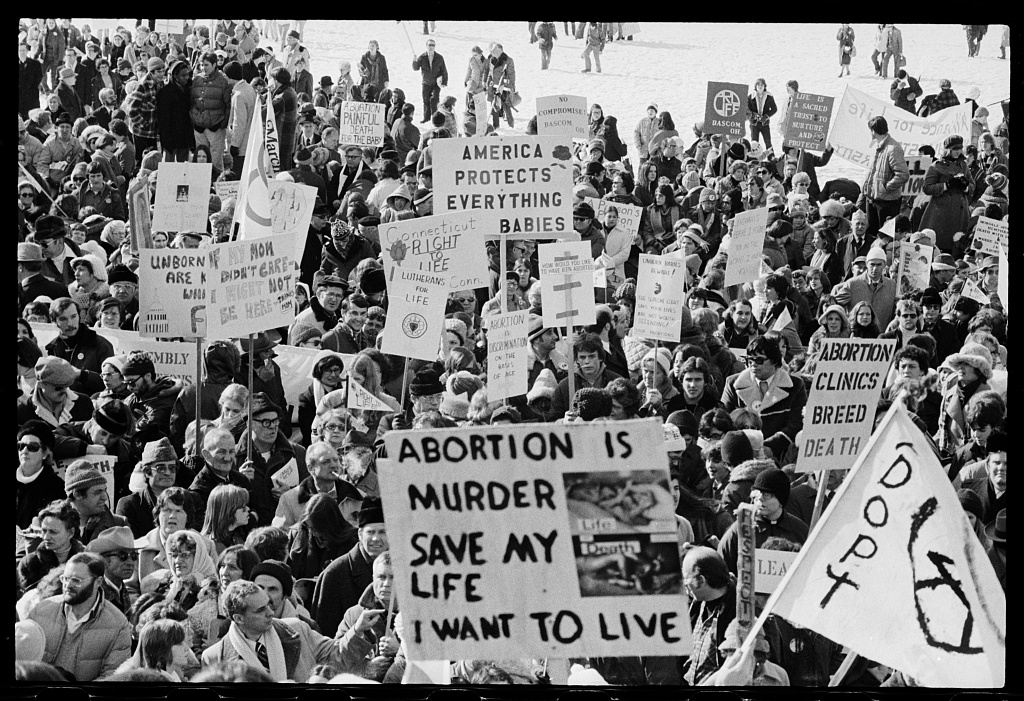
"Right to Life" demonstration, at White House and Capitol, anti-abortion demonstrators, 1978. Public domain.
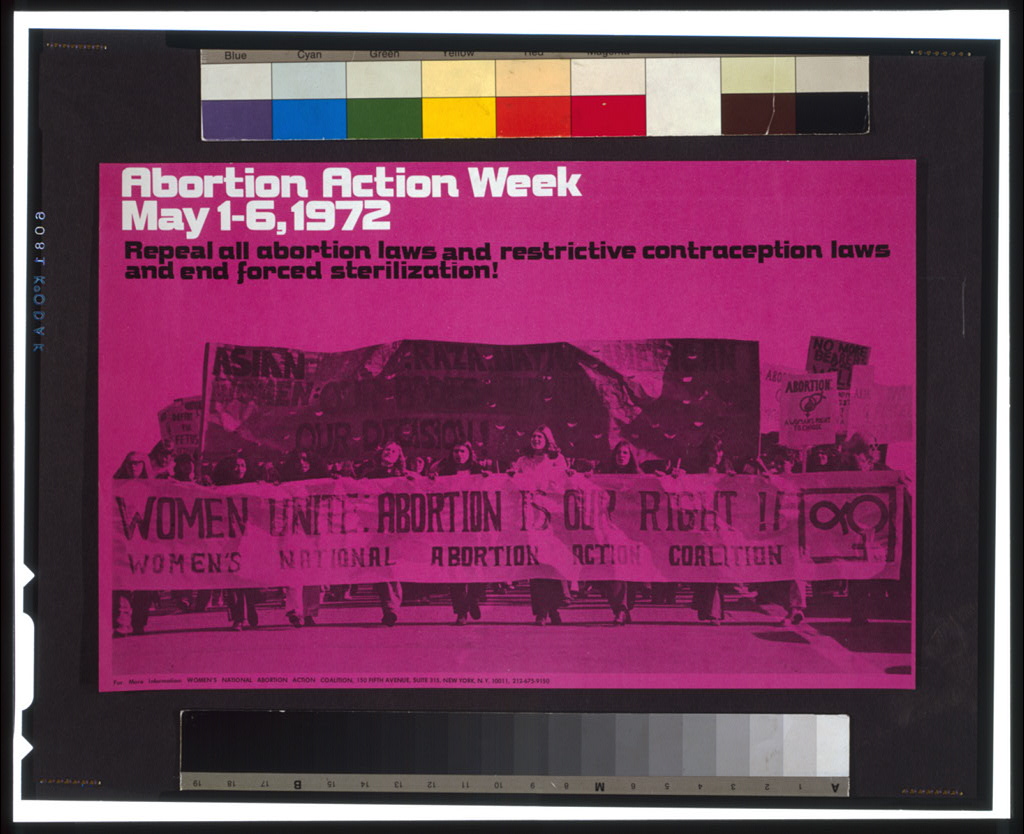
Abortion Action Week, May 1-6, 1972, Women's National Abortion Action Coalition, 1972. Public domain.
The 1978 signs speak for the fetus in the first person; the 1972 banner speaks for women as a right. Both frames were set by the mid-1970s and were still in use at Dobbs in 2022, when a "Love them both" sign, an echo of the "life" frame, stood in the crowds outside the Court.
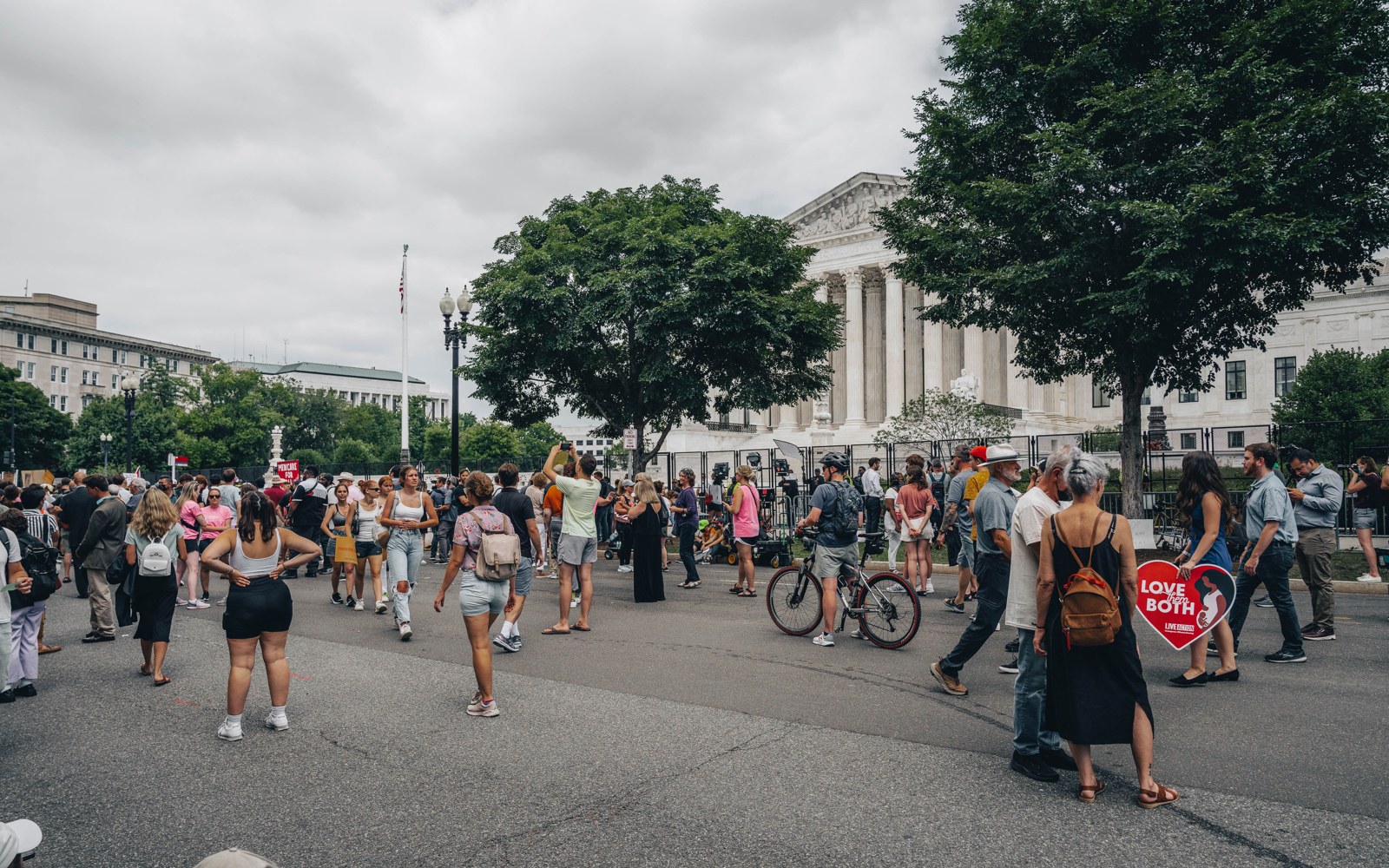
Protests in front of SCOTUS after Dobbs, demonstrators outside the Supreme Court, 2022. Photo by John Brighenti, CC BY 2.0.
The record differs by side. The killings of Dr Gunn, Dr Slepian and Dr Tiller by anti-abortion attackers were violence, not persuasion, and the record sourced here has no killing on the other side; the 2022 attacks on pregnancy centres were vandalism, arson and threats. The clinic protests of 1989 ended in arrests. The unsigned Kansas texts and the CMP cover company hid who was speaking or recording; no unattributed campaign on the abortion-rights side was sourced for this page.
Positions on the record
- Anti-abortion groups say abortion ends a human life, that images and ultrasound show the public what abortion is, and that pregnancy centres offer women help and alternatives. NIFLA says the California law forced its members to promote a message they oppose. Daleiden's lawyers describe CMP's staff as investigators exposing wrongdoing.
- Abortion-rights groups say the decision belongs to the pregnant woman, that bans push women towards unsafe abortion, and that some pregnancy centres mislead. Planned Parenthood calls CMP a "discredited" group, citing the 2019 verdict finding it liable for fraud.
- This archive's reading: documented are the labels, the films, the Waxman findings, the 2019 verdict, the Kansas texts and Nathanson's later account. Not shown: exactly how many women died from illegal abortion before Roe (the records are disputed), who wrote the Kansas texts beyond the PAC link, or whether any single slogan changed votes. This page covers persuasion; the violence listed above is recorded as crime connected to the debate, not as a technique of either movement.
Same-method test
Swap the sides and the tags stay. A virtue-word name is scored the same whether the word is "life" or "choice". A death figure its own author calls false is card-stacking whichever cause it serves. An unsigned text that borrows the other camp's key word would be scored the same if an abortion-rights PAC had sent it.
How to spot it
- Replace the label with the policy: which law, which week, which exceptions?
- Ask whether a term appears in medical texts or only in bills and ads.
- For any death or harm figure, find who counted it, how, and whether the author has since withdrawn it.
- Check who is speaking. An unsigned message, or a clinic name that does not say what it offers, is a reason to look further.
Images
| Image | Source | Licence |
|---|---|---|
| March for Life signs, 1978 | Library of Congress, U.S. News & World Report collection | Public domain (no known restrictions) |
| Abortion Action Week, 1972 | Library of Congress, Yanker poster collection | Public domain (published without notice) |
| Supreme Court on Dobbs day, 2022 | Wikimedia Commons, John Brighenti | CC BY 2.0 |

Image gaps
- The Silent Scream stills and the Willke fetal photographs. Copyrighted; not hosted.
- Planned Parenthood's The Facts Speak Louder booklet, NARAL materials and the Shout Your Abortion logo. Copyrighted; not hosted.
- The 2022 Kansas texts and campaign ads. Screenshots in news reports are copyrighted.
- Herblock's "We're doing God's work" (1993) and Ann Telnaes's cartoon of the 2003 ban signing. Held by the Library of Congress with publication restrictions.
- CQ Roll Call photos of 1989 clinic blockades and of both sides at the Supreme Court. The Library of Congress clears only staff photographers' work; photographer status could not be confirmed.
- A 2019 March for Life photo released to the public domain on Commons. Rate limits blocked a rights check.
Sources
- CBS News, 2003: Kopp convicted of murder
- CNN, 28 January 2010: Roeder convicted of Tiller's murder
- National Abortion Federation: violence and disruption statistics
- U.S. Department of Justice: Florida man sentenced for civil rights conspiracy targeting pregnancy resource centers
- Florida Attorney General: case against members of Jane's Revenge
- March for Life: history of the march
- Karrer, "The National Right to Life Committee: Its Founding, Its History"
- NRLC, 21 February 2011: on the death of Bernard Nathanson
- Slate, June 2022: the Willkes' Handbook on Abortion
- Christian Science Monitor, 14 February 1985: The Silent Scream
- Embryo Project, Arizona State University: The Silent Scream
- Washington Post, 2011: Nathanson obituary
- Guttmacher Institute, 2003: Lessons from Before Roe
- History News Network: historian Leslie Reagan
- Reproductive Freedom for All (formerly NARAL): history
- Greenhouse and Siegel, Before Roe v. Wade (Yale Law School)
- KFF Health News: "My body, my choice"
- CBC News, 2022: the coat hanger symbol
- Barry Popik: "safe, legal and rare"
- NPR via KUNC, 2006: "Partial-Birth Abortion": Separating Fact From Spin
- Library of Congress: Telnaes cartoon record, 2003 ban signing
- Gonzales v. Carhart, 550 U.S. 124 (2007)
- Library of Congress: Herblock, "We're doing God's work" (record on the Gunn murder)
- Library of Congress: 1989 clinic demonstration and arrests
- Library of Congress: 1993 Senate hearing on the clinic-access bill
- Washington Post, 17 July 2006: pregnancy centres and the Waxman report
- NIFLA v. Becerra (2018), Supreme Court opinion
- NIFLA: NIFLA v. Becerra
- San Francisco Chronicle, 2019: verdict against CMP
- Planned Parenthood on the 2019 verdict
- Live Action: Daleiden's attorney on the case
- Detroit Catholic: Daleiden to appeal
- Commonwealth Times, 2012: the Genocide Awareness Project
- Seattle magazine: "Ten Years Loud" (Shout Your Abortion)
- Slate, January 2017: New Wave Feminists removed from Women's March partners
- Daily Signal, 2022: AP Stylebook guidance on abortion terms
- Kansas Reflector, 2 August 2022: Huelskamp linked to false text
- Kansas Reflector, 10 September 2022: Huelskamp denies sending texts
- Washington Monthly, 2022: the Kansas "No" ads
- Kansas Public Radio, 3 August 2022: amendment rejected