Content note. This case quotes wartime labels ("Jiffs", "traitors", "demonic beasts") and gives death tolls for massacres, forced labour, famine and military sexual slavery. The labels are quoted as evidence of the method. No atrocity photographs are shown.
In one line: from 1932 to 1945 Imperial Japan sold its expansion as Asia's liberation from Western rule, in words ("co-prosperity", "harmony of the five races", "independence") that its secret plans and occupation record did not match; allied nationalist movements used the same vocabulary for their own ends, and British India answered with labels of its own.
What happened
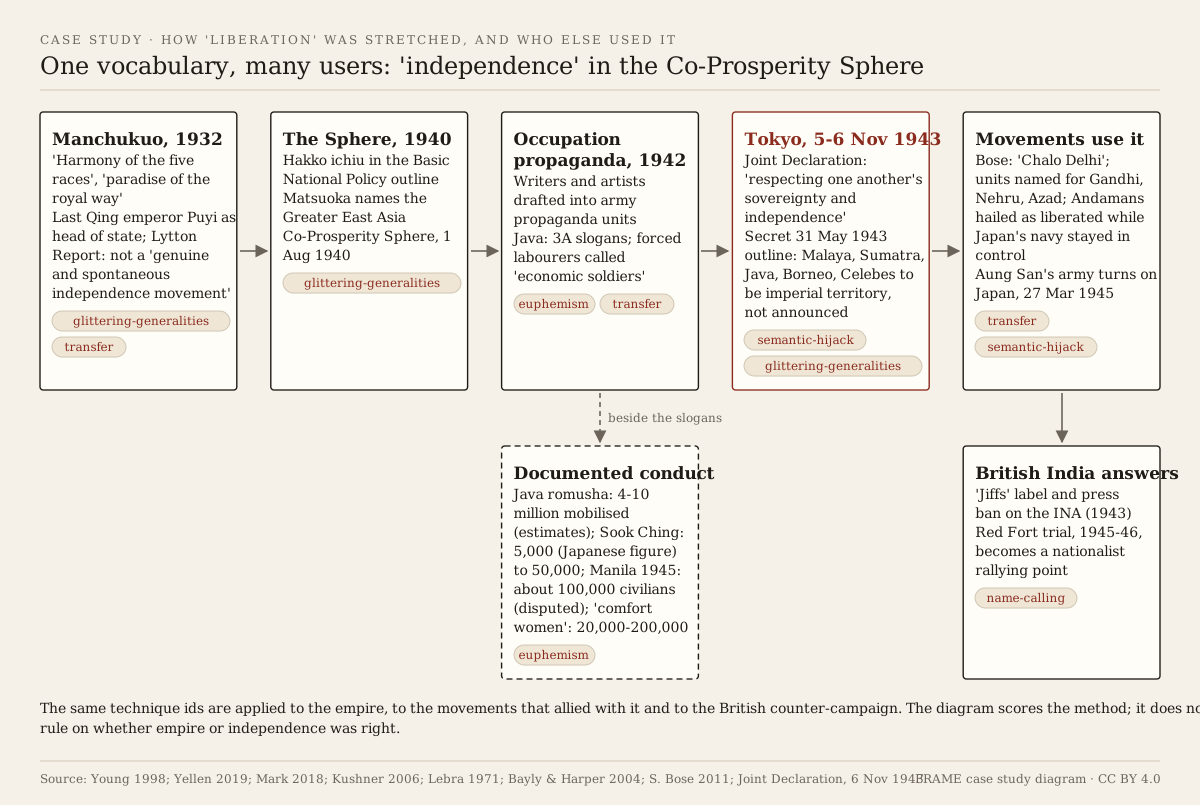
- 1 March 1932. After the Kwantung Army's seizure of Manchuria, Manchukuo is proclaimed, with the last Qing emperor, Puyi, as head of state. Its slogans are gozoku kyōwa ("harmony of the five races": Japanese, Han, Manchu, Mongol, Korean) and ōdō rakudo ("paradise of the royal way"). In October 1932 the League of Nations' Lytton Report finds that the new regime did not come from "a genuine and spontaneous independence movement" (Young 1998).
- July-August 1940. The Konoe cabinet's Basic National Policy outline invokes hakkō ichiu ("the eight corners of the world under one roof"). On 1 August Foreign Minister Matsuoka Yōsuke announces a "Greater East Asia Co-Prosperity Sphere" (Daitōa Kyōeiken) at a press conference (Yellen 2019).
- Late 1941 to 1942. The army drafts writers, painters and journalists into propaganda units that follow the invasion: Ibuse Masuji to Malaya, Takeda Rintarō and Ōya Sōichi to Java, Hino Ashihei to the Philippines (Terami-Wada 1990; Mark 2018). "Asia for the Asiatics" is a stock line of their output.
- 17 February 1942. At Farrer Park, Singapore, Major Fujiwara Iwaichi takes over about 45,000 Indian prisoners of war from the British surrender. Captain Mohan Singh raises the first Indian National Army (INA) from among them (Lebra 1971).
- 18 February to early March 1942. In the Sook Ching ("purge through cleansing") screenings the Japanese army kills Chinese men in Singapore it classes as anti-Japanese: about 5,000 by the Japanese figure, up to 50,000 by Chinese community estimates. A British court in 1947 sentenced two officers to death and five to life.
- April 1942. In Java the army propaganda department (Sendenbu), under Shimizu Hitoshi, launches the 3A Movement: "Nippon Cahaya Asia, Nippon Pelindung Asia, Nippon Pemimpin Asia" ("Japan the light of Asia, Japan the protector of Asia, Japan the leader of Asia"). It is dissolved at the end of 1942 and replaced in March 1943 by Putera, led by Sukarno and Mohammad Hatta (Mark 2018).
- 31 May 1943. An Imperial Conference adopts the Daitōa seiryaku shidō taikō (Outline for the Political Guidance of Greater East Asia). Burma and the Philippines are to be made "independent". Malaya, Sumatra, Java, Borneo and Celebes are decided as imperial territory, and the decision is not to be announced for the time being (JACAR B02032973300; Yellen 2019).
- June 1943 onward. The British Indian Army starts a campaign calling INA men "JIFs", for "Japanese-inspired fifth columnists". The Indian press is barred from reporting on the INA until after the war (Fay 1993).
- 1 August and 14 October 1943. Ba Maw's State of Burma declares independence and, the same day, war on Britain and the United States. José Laurel's Philippine Republic follows in October.
- 4-5 July and 21 October 1943. Subhas Chandra Bose takes command of the INA in Singapore with the call "Chalo Delhi" ("On to Delhi") and proclaims the Provisional Government of Free India (Azad Hind), which declares war on Britain and the United States (S. Bose 2011).
- 5-6 November 1943. The Greater East Asia Conference meets in Tokyo. Its Joint Declaration accuses the United States and the British Empire of "insatiable aggression and exploitation" and of seeking to enslave "the entire region". It pledges "respecting one another's sovereignty and independence" and to "work for the abolition of racial discrimination". Tōjō announces that the Andaman and Nicobar Islands will pass to Azad Hind. Bose raises the flag at Port Blair on 29 December, but the Japanese navy stays in effective control (Bayly & Harper 2004). On 30 January 1944 the Japanese shoot 44 Indian civilians accused of spying at Homfreyganj, many of them members of the Indian Independence League (Dasgupta 2002).
- 4 and 6 July 1944. At a rally in Burma Bose says "Tum mujhe khoon do, main tumhe azadi dunga" ("Give me blood and I will give you freedom"). Two days later, on Azad Hind Radio, he calls Gandhi "Father of our Nation" and asks for his blessings for the INA's war (Gandhi Sangrahalaya, Mani Bhavan).
- 1942 to 1945: occupation conduct. Estimates of Javanese forced labourers (romusha) mobilised run from 4 to 10 million, most working inside Java (Library of Congress country study). Satō (1994) estimates about 270,000 were sent outside Java. Survivor estimates range from about 70,000 (Ricklefs) to 135,000 repatriated (Satō). Van der Eng (2024) estimates 1.8 million excess deaths in Java's 1944-45 famine. Women held in the military "comfort station" system are estimated at 20,000 to 200,000; the 1993 Kōno Statement acknowledged the military was "directly or indirectly" involved. In Manila in February-March 1945 about 100,000 civilians died (the most-cited, disputed figure), most in Japanese killings and part by U.S. artillery (Connaughton et al. 1995; Meixsel).
- 27 March 1945. Aung San's Burma National Army, founded as the Burma Independence Army with Japanese help in Bangkok in December 1941, turns against Japan.
- 17 August 1945. Sukarno and Hatta proclaim Indonesian independence. In his 1965 autobiography, as widely quoted, Sukarno said of the romusha he had helped recruit, "I shipped them to their deaths."
- 5 November 1945 to January 1946. The British court-martial of three INA officers, Shah Nawaz Khan, Prem Sahgal and Gurbaksh Singh Dhillon, opens at the Red Fort, Delhi. The slogan "Lal Qile se aayi awaz: Sahgal, Dhillon, Shah Nawaz" spreads and police fire on protesters in Calcutta. Convicted of waging war against the King, the three are sentenced to transportation for life; Auchinleck remits the sentences (Sundaram).
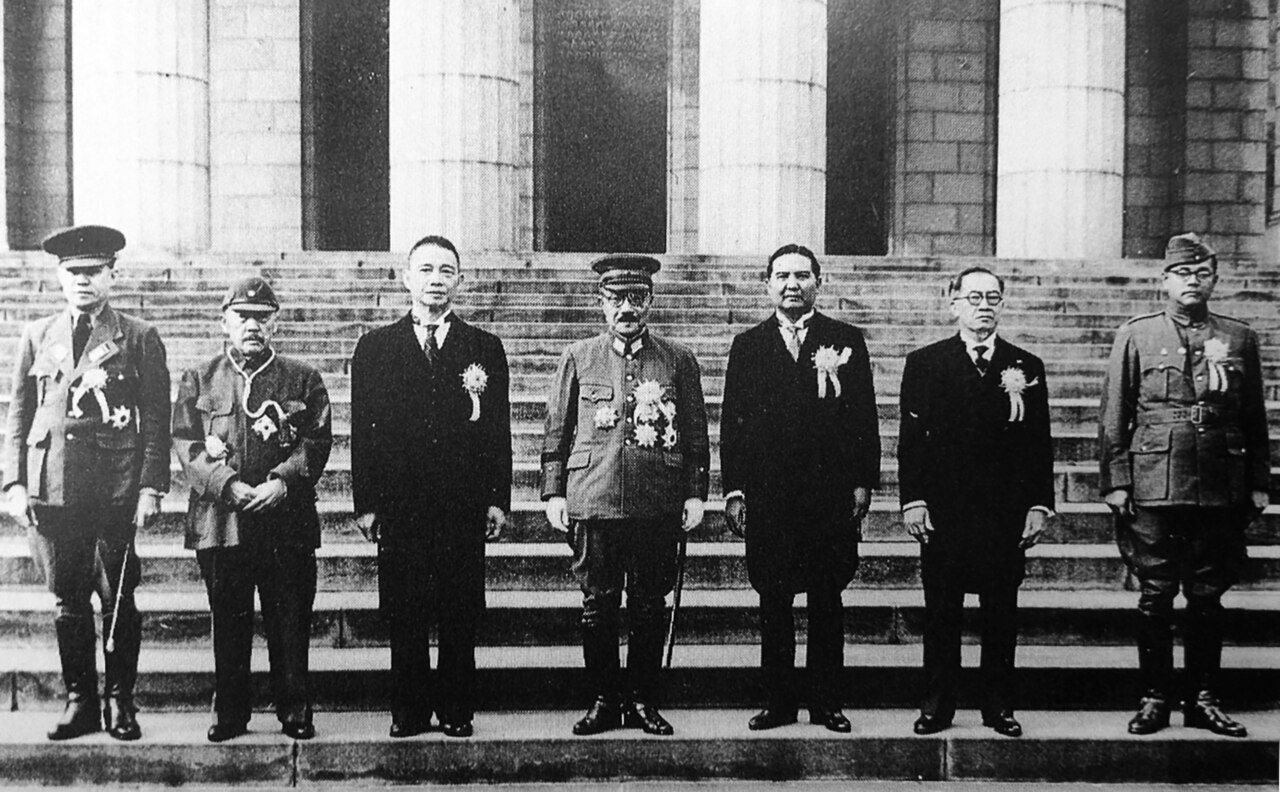
Tokyo, 5 November 1943. From left: Ba Maw, Zhang Jinghui, Wang Jingwei, Hideki Tōjō, Wan Waithayakon, José Laurel, Subhas Chandra Bose (observer). Public domain.
How it works
- Semantic hijacking: "independence" was stretched over Manchukuo, set up under Japanese troops, and Burma, bound by alliance with Japan's army still present. Six months before Tokyo pledged respect for "sovereignty and independence", a secret decision had made Malaya and the Indonesian islands Japanese territory. Azad Hind stretched the word too, calling the Andamans liberated Indian territory while the Japanese navy ran them.
- Glittering generalities: "co-prosperity", "harmony of the five races", "paradise of the royal way", hakkō ichiu, "Asia for the Asiatics". None named a border, a wage, a vote or a withdrawal date.
- Euphemism / doublespeak: forced labourers were romusha ("labourers"), hailed in Java as "economic soldiers" and "labour heroes". Sites of military sexual slavery were "comfort stations". A mass killing was a "purge through cleansing".
- Transfer: Japan put the last Qing emperor at Manchukuo's head and had Indonesian nationalist leaders front its mass organisations and labour drafts. Bose's INA named units after Gandhi, Nehru and Maulana Azad, although Congress's Quit India resolution (8 August 1942) said a free India would resist Japanese aggression; his "Father of our Nation" broadcast lent Gandhi's standing to an armed campaign Gandhi had not endorsed.
- Name-calling: Japanese home-front propaganda called the Allies kichiku Bei-Ei ("demonic beasts, America and Britain") (Dower 1986). The British answer to the INA was the label "JIFs", backed by a news ban, and soldiers heard the label rather than the INA's case. The later trial charge, waging war against the King, was the formal charge in a British court; its legitimacy was the point in dispute at the Red Fort, and it is not scored here as a label.
Then and now
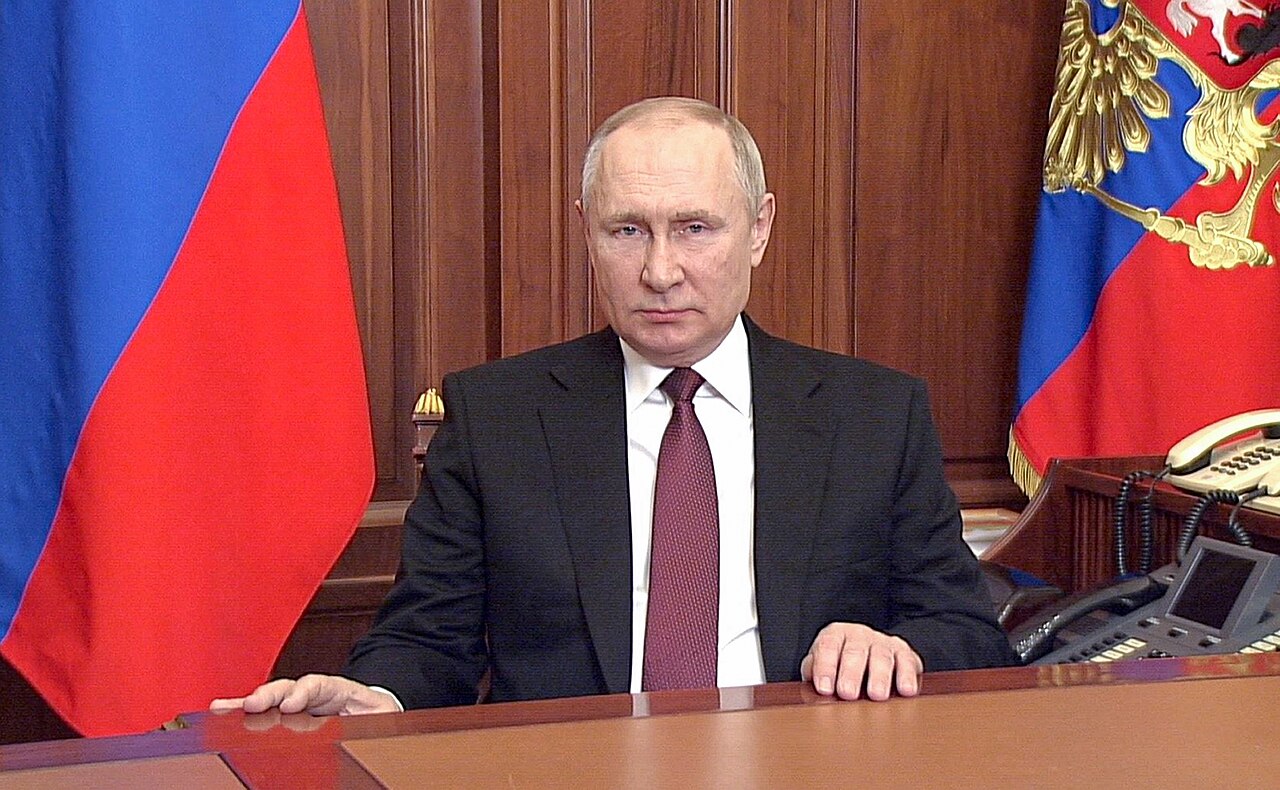
Address announcing a 'special military operation', Presidential Executive Office of Russia, 2022. CC BY 4.0.
In 2022 Russia's president described a full-scale invasion of a neighbouring state as a "special military operation" for its "denazification". In 1943 the Tokyo declaration described military occupation as the liberation of Asia from Anglo-American rule. Both borrow a word with real moral weight (anti-Nazism; anti-colonialism) and stretch it over the speaker's own military control. The differences: the 1943 language pointed to existing colonial rule, since most of Southeast Asia and India were Western colonies, and several leaders who used Japan's offer went on to lead independent states; the 2022 address targeted an existing, recognised state.
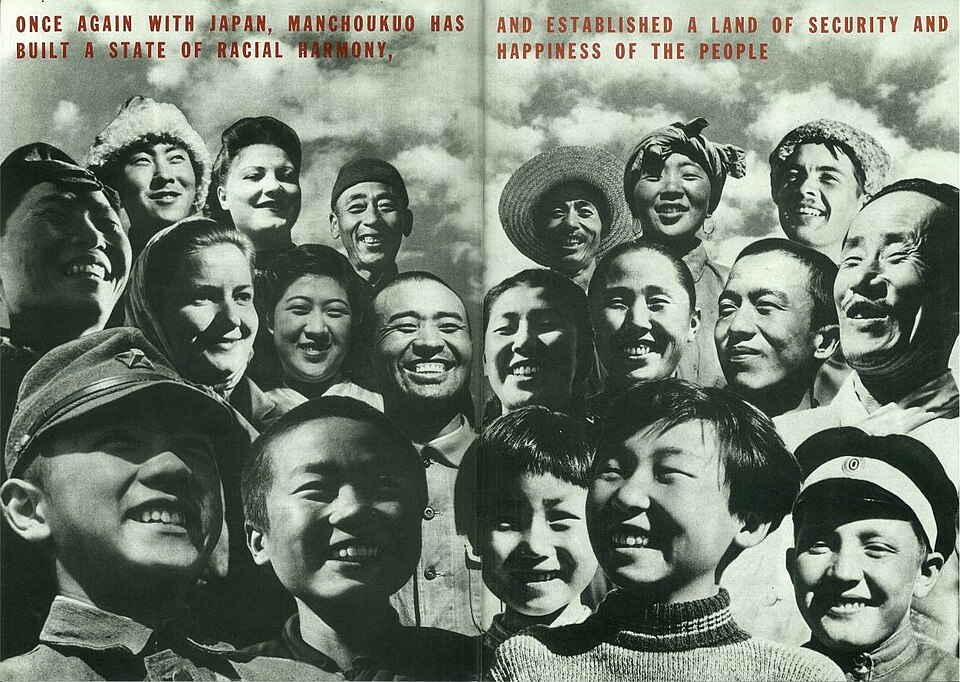
English-language Manchukuo photomontage, 1930s-1945, rendering gozoku kyōwa and ōdō rakudo for foreign readers. Public domain.
Positions on the record
- Japan's stated position: the war was for the liberation of Asia from Western colonialism and for racial equality. Japan had proposed a racial-equality clause at Paris in 1919 (Shimazu 1998), and the 1943 declaration repeated the aim.
- Allied movements' positions: Bose argued that India should take help from Britain's enemies to win its freedom. Ba Maw's memoir (1968) records bitterness at both Japanese military conduct and Allied self-determination that stopped at colonial borders. Sukarno defended cooperation as a route to independence while acknowledging his part in romusha recruitment.
- British position: INA men were soldiers who had broken their oath to the King. After the war the British graded them "white", "grey" or "black" by commitment to Bose, to decide who went back into the army and who went to trial (Fay 1993).
- What is documented: the slogans, the declaration text, the May 1943 outline, the tolls above with their ranges, the Red Fort trial and its outcome.
- What is not shown here: how far propaganda, rather than camp conditions, pay, coercion or conviction (all documented by Lebra and Bayly & Harper), moved individual INA recruits. This page makes no finding on whether empire or independence was right.
Same-method test
When the United States took the Philippines from Spain, President McKinley's proclamation of 21 December 1898 promised "benevolent assimilation" and said Americans came "not as invaders or conquerors, but as friends". The Philippine-American War followed (Miller 1982). In 1941 the Atlantic Charter promised peoples the right to choose their government. On 9 September 1941 Churchill told the Commons that it was aimed primarily at the nations of Europe under Nazi rule and did not qualify British policy on India or Burma. A liberation word stretched to cover the speaker's own rule is scored as Semantic hijacking whichever flag flies over it.
How to spot it
- Put the public declaration next to the internal planning document from the same months, as with 6 November 1943 against 31 May 1943.
- Ask of each virtue word what it would commit the speaker to: a border, a withdrawal date, a wage, an election.
- Check who holds the guns in a "liberated" territory, whoever is liberating it, and whether a leader whose name is borrowed agreed.
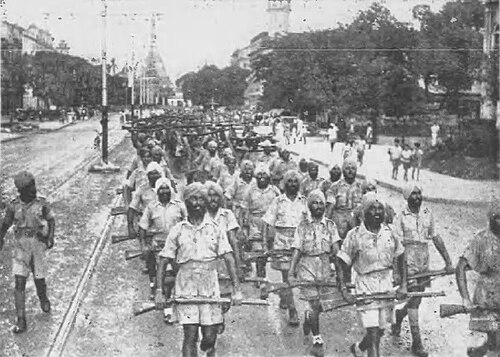
INA troops in Rangoon, 1944, in Shashin Shūhō, the Japanese Cabinet Information Bureau's picture weekly. Public domain.
Images
| Image | Source | Licence |
|---|---|---|
| Mechanism diagram (above) | Drawn for FRAME from the page's sourced facts (make_diagrams.py) |
CC BY 4.0, FRAME |
| Greater East Asia Conference, 5 Nov 1943 | Wikimedia Commons, from Shōwa-shi vol. 11 (Mainichi Shimbun) | Public domain (PD-Japan-oldphoto; PD in the U.S., not restored under URAA) |
| Manchukuo "racial harmony" photomontage | Wikimedia Commons | Public domain (PD-Japan-oldphoto; PD in the U.S., not restored under URAA) |
| INA in Rangoon, 1944 | Wikimedia Commons, Shashin Shūhō, National Archives of Japan | Public domain (PD-Japan-oldphoto) |
| Special military operation address (2022) | FRAME gallery | CC BY 4.0 (kremlin.ru) |


Image gaps
- 3A Movement and Sendenbu posters from Java. Examples survive in Dutch and Indonesian collections (NIOD, KITLV), but none on Commons has a clear licence. Fillable if a holding archive states public-domain status.
- British "JIFs" leaflets and Indian government posters against the INA. These were British Indian government works, and their Crown copyright has expired. None could be found on Commons, and the IWM and British Library could not be reached from this environment. Fillable.
- U.S. Office of War Information leaflets to Burma and the Philippines. These are U.S. government works, public domain, held at NARA and the Hoover Institution. Those archives could not be reached. Fillable.
- Photographs of the Red Fort trial and of Bose's 1944 rallies. Indian photographs from 1944-46 were still in copyright in India on 1 January 1996, so their U.S. copyright was restored. Not included unless a clear public-domain release turns up.
- Occupation atrocities. Not shown by choice. The tolls are given in text with their sources.
Sources
- Louise Young, Japan's Total Empire: Manchuria and the Culture of Wartime Imperialism (University of California Press, 1998). UC Press
- Jeremy A. Yellen, The Greater East Asia Co-Prosperity Sphere: When Total Empire Met Total War (Cornell University Press, 2019). JSTOR
- Ethan Mark, Japan's Occupation of Java in the Second World War: A Transnational History (Bloomsbury Academic, 2018). Bloomsbury Collections
- Barak Kushner, The Thought War: Japanese Imperial Propaganda (University of Hawai'i Press, 2006).
- Joyce C. Lebra, Jungle Alliance: Japan and the Indian National Army (Singapore: Donald Moore for Asia Pacific Press, 1971); reissued as The Indian National Army and Japan (ISEAS, 2008).
- Christopher Bayly and Tim Harper, Forgotten Armies: The Fall of British Asia, 1941-1945 (Allen Lane, 2004).
- Sugata Bose, His Majesty's Opponent: Subhas Chandra Bose and India's Struggle against Empire (Harvard University Press, 2011).
- Peter Ward Fay, The Forgotten Army: India's Armed Struggle for Independence, 1942-1945 (University of Michigan Press, 1993).
- Mark R. Peattie, "Nanshin: The 'Southward Advance,' 1931-1941, as a Prelude to the Japanese Occupation of Southeast Asia", in Peter Duus, Ramon Myers and Mark Peattie (eds), The Japanese Wartime Empire, 1931-1945 (Princeton University Press, 1996).
- John W. Dower, War Without Mercy: Race and Power in the Pacific War (Pantheon, 1986).
- Naoko Shimazu, Japan, Race and Equality: The Racial Equality Proposal of 1919 (Routledge, 1998).
- Indian National Congress, "Quit India" resolution, All India Congress Committee, Bombay, 8 August 1942.
- Joint Declaration of the Greater East Asia Conference, 6 November 1943 (Wikisource); IMTFE defence document no. 77, National Diet Library scan on Commons.
- Daitōa seiryaku shidō taikō, Liaison Conference 29 May and Imperial Conference 31 May 1943, JACAR B02032973300
- League of Nations, Appeal by the Chinese Government: Report of the Commission of Enquiry (Lytton Report), C.663.M.320.1932.VII (Geneva, 1 October 1932).
- Motoe Terami-Wada, "The Japanese Propaganda Corps in the Philippines", Philippine Studies 38 (1990).
- Shigeru Satō, War, Nationalism and Peasants: Java under the Japanese Occupation, 1942-1945 (M.E. Sharpe, 1994).
- William H. Frederick and Robert L. Worden (eds), Indonesia: A Country Study (Library of Congress, 1993): romusha estimate of 4-10 million.
- Pierre van der Eng, "Mortality from the 1944-1945 famine in Java, Indonesia", Asia-Pacific Economic History Review (2024).
- Statement by Chief Cabinet Secretary Yōhei Kōno, 4 August 1993 (MOFA); Imperial War Museums, "Sexual slavery in Japan".
- Richard Connaughton, John Pimlott and Duncan Anderson, The Battle for Manila (Bloomsbury, 1995); Richard Meixsel, "Did 100,000 civilians die in the Battle of Manila in 1945?"
- National Library Board Singapore, "Operation Sook Ching"; Hayashi Hirofumi, "The Battle of Singapore, the Massacre of Chinese and Understanding of the Issue in Postwar Japan", Asia-Pacific Journal: Japan Focus 7:28 (2009).
- Jayant Dasgupta, Japanese in Andaman and Nicobar Islands: Red Sun over Black Water (Manas, 2002).
- Gandhi Sangrahalaya, Mani Bhavan: "Father of the Nation"
- Chandar S. Sundaram, "Trial at the Red Fort 1945-1946: The Indian National Army and the End of the British Raj in India", Education About Asia (Association for Asian Studies).
- Ba Maw, Breakthrough in Burma: Memoirs of a Revolution, 1939-1946 (Yale University Press, 1968).
- Sukarno, Sukarno: An Autobiography as Told to Cindy Adams (Bobbs-Merrill, 1965).
- Stuart Creighton Miller, "Benevolent Assimilation": The American Conquest of the Philippines, 1899-1903 (Yale University Press, 1982); Winston Churchill, House of Commons, 9 September 1941 (Hansard, "War Situation").