Content note. This page names wartime atrocities as the textbooks and courts discuss them: the Nanjing massacre and its death tolls, human experiments by the Imperial Japanese Army's Unit 731, and the military "comfort women" system, which the cited VOA report calls sexual slavery. It quotes labels used against textbook authors and critics.
In one line: Japan's privately written, state-screened history textbooks have been contested for seven decades over what screening changed or removed; the governments that protest them, the People's Republic of China (PRC) and South Korea, have written or tried to write their own, as North Korea does; this page holds all of them to the same definitions.
What happened
The systems differ. Japan's textbooks are written by private publishers, screened by the Ministry of Education (kentei), and chosen for public schools by local boards (Nippon.com). The PRC's and North Korea's are written by the state. South Korea had state-authored history textbooks from 1974, phased them out from 2002, and by 2011 used only privately written, screened ones (Korea Herald, 2016).
Japan
- August 1955. The Japan Democratic Party's pamphlet Ureubeki kyōkasho no mondai ("The problem of deplorable textbooks") links the Japan Teachers' Union to the Communist Party and calls union-aligned textbooks slanted. The next year publishers withdraw most of the books it attacked (Foreign Affairs, 1957).
- 1965-1997. Historian Saburō Ienaga sues the state three times over screening opinions on his high-school text. On 29 August 1997 the Supreme Court rules the screening system constitutional, but finds that the ministry abused its discretion in ordering him to delete a reference to Unit 731's human experiments in northern China. It orders the state to pay him 400,000 yen (Japan Times, 1997; CNN, 1997).
- 26 June 1982. Japanese media report that screening changed "aggression" (shinryaku) into northern China to "advance" (shinshutsu). China and South Korea protest. Later checks found the change had not been made in that year's screening; the same replacement had been made in screenings in the 1960s and 1970s (Nozaki and Selden, 2009; Hatano, 2018).
- 26 August 1982. Chief Cabinet Secretary Kiichi Miyazawa states that the government will take note of the criticism and correct the texts on its own responsibility. In November the ministry adds the "Neighbouring Countries Clause" (kinrin shokoku jōkō) to its screening criteria, asking for consideration of international understanding in treating modern history involving Asian neighbours (Hatano, 2018; World and Japan database).
- 4 August 1993. Chief Cabinet Secretary Yōhei Kōno states that the military was "directly or indirectly, involved in the establishment and management of the comfort stations", apologises, and states the government's "firm determination never to repeat the same mistake by forever engraving such issues in our memories through the study and teaching of history" (MOFA).
- 15 August 1995. Prime Minister Tomiichi Murayama states that Japan, "through its colonial rule and aggression, caused tremendous damage and suffering", and offers his "heartfelt apology" (MOFA).
- 1997-2001. The Japanese Society for History Textbook Reform (Tsukurukai), founded by Nishio Kanji, Fujioka Nobukatsu and others, calls the existing textbooks "masochistic" (jigyaku) (Nozaki and Selden, 2009; Bukh, 2007). Its New History Textbook passes screening in 2001. A survey by the Children and Textbook Japan Network 21 puts its first-round adoption at 0.039 percent, about 11 schools (Romeu, Japan Studies Review).
- 17 January 2014. Revised screening standards require textbooks to state where no settled view exists on figures such as casualty counts, and to reflect a "unified opinion of government" or a Supreme Court ruling where one exists (Tawara, 2015).
- 2021. After an April cabinet decision called terms such as "military comfort women" and "forcibly taken away" inappropriate, saying "military comfort women" could mislead, the ministry on 8 September approves requests from five publishers to change the wording. In 29 textbooks "military comfort women" becomes "comfort women", "so-called comfort women" or is removed, and "capture by force" or "carry off by force" becomes "forced mobilisation" or "conscription". South Korea's foreign ministry calls the changes "regrettable" (VOA).
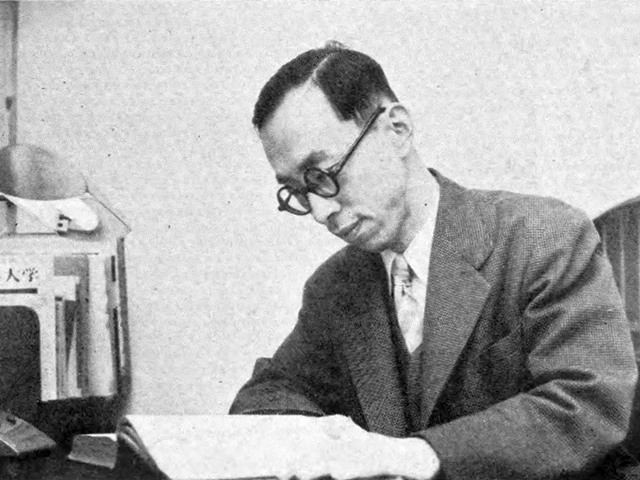
Saburō Ienaga in 1953, lecturing on Japanese history for NHK radio. From the NHK Yearbook 1954. Public domain (Japanese photograph published before 1957, public domain in Japan by 1996).
The critics: the PRC and the two Koreas
- 1994. The Communist Party Central Committee issues its "Outline on Implementing Patriotic Education". Zheng Wang describes a shift in textbooks and memorial sites from a victor narrative to a victim narrative centred on "national humiliation". Of the first 100 national patriotic-education demonstration bases named in 1997, 40 commemorate conflicts with foreign countries, half of them the war against Japan (Wang, 2008; Wang, 2012).
- Korean War in textbooks. A comparison of U.S., South Korean, Japanese and Chinese textbooks found that the first three say the war began with North Korea's invasion of the South, while the Chinese books say South Korean troops invaded the North and describe China's entry as defence of its borders (Lin et al., 2009).
- 24 January 2006. The Communist Youth League suspends Freezing Point (Bingdian), the weekly of China Youth Daily, after it runs historian Yuan Weishi's essay criticising how middle-school textbooks treat the Boxer Uprising and the Opium Wars. The League's decision says the essay "severely contradicted historical facts" and "severely harmed the national sentiments of the Chinese people" (CECC, 2006). The weekly reopened in March after its two senior editors were replaced.
- Nanjing. The memorial hall in Nanjing displays one figure, 300,000 victims, in Chinese, English and Japanese. The figure comes from the 1947 Nanjing war crimes tribunal. The Tokyo tribunal gave more than 200,000. Japanese historian Hata Ikuhiko estimates about 40,000; Kasahara Tokushi puts the toll well over 100,000, perhaps around 200,000 or more (Yoshida, 2006; Kasahara). Japan's foreign ministry says the killing of non-combatants and looting "cannot be denied", but that the number is difficult to determine (MOFA).
- 13 October 2015. South Korea's government announces a single state-written "Correct History Textbook" (올바른 역사교과서) for middle and high schools from 2017. President Park Geun-hye and the ruling Saenuri Party say existing books contain errors and pro-North Korean bias; historians' groups oppose the plan and many refuse to write for it (Al Jazeera, 2015; VOA, 2015; Inquirer, 2015). The draft of November 2016 calls 15 August 1948 the "foundation of the Republic of Korea", taking one side in a dispute over whether the state dates from 1948 or the 1919 Provisional Government (Korea Herald, 2016). One school adopts it (OWP, 2017). President Moon Jae-in scraps it in May 2017, saying history education should not be politicised (AP via Inquirer, 2017).
- North Korea. Textbooks are written under the Workers' Party. Human-rights researchers describe them as centring the anti-Japanese struggle on Kim Il-sung (HRNK Insider, 2021). This page did not examine North Korean textbooks directly.
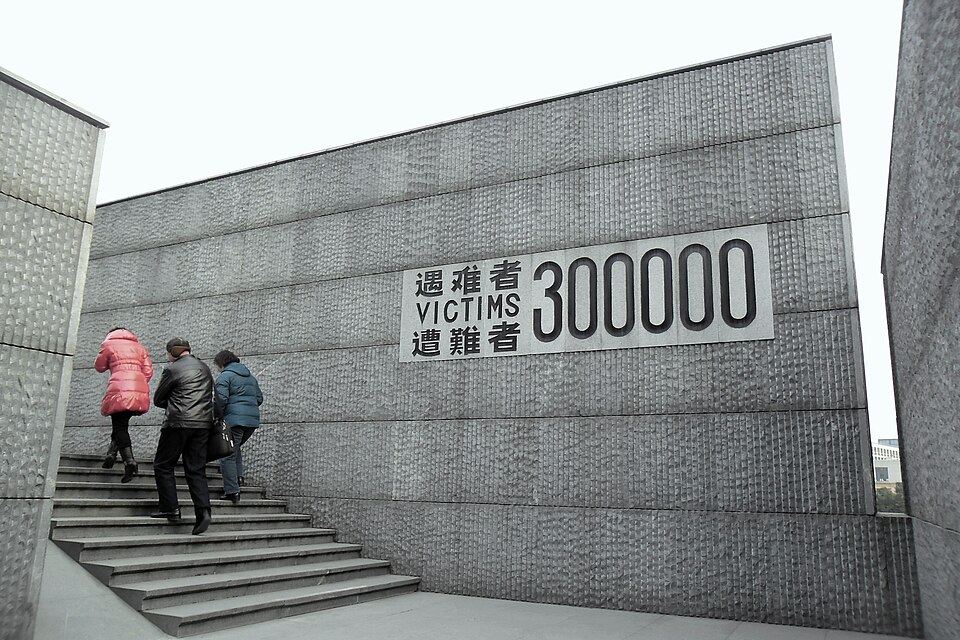
The entrance wall of the Memorial Hall of the Victims in Nanjing Massacre by Japanese Invaders, reading 遇难者 / VICTIMS / 遭難者 300000. Photo by Wikimedia user 董辰兴, 2012, CC BY-SA 4.0 (outdoor work, covered by the PRC's freedom of panorama). Shown because the wall carries one figure where scholarly estimates vary.
How it works
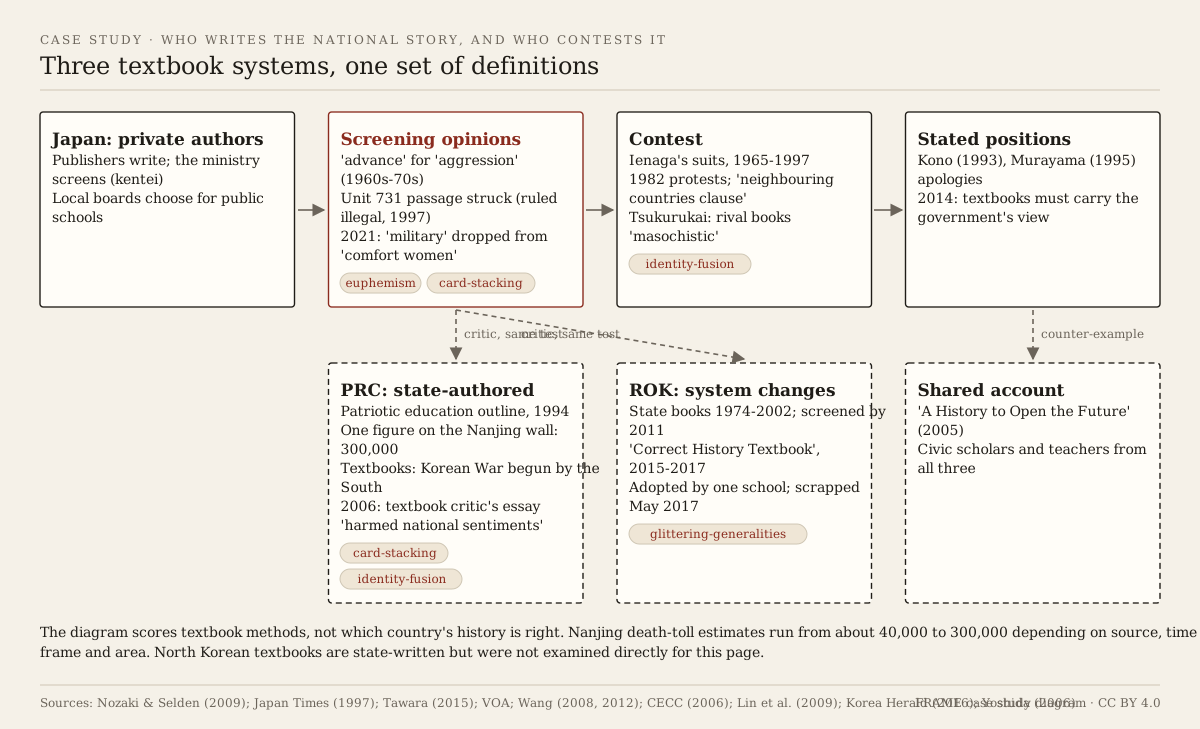
- Euphemism / doublespeak: in Japan's screenings of the 1960s and 1970s, "aggression" became "advance" (Nozaki and Selden, 2009). In 2021 "military comfort women" became "comfort women" or "so-called comfort women", dropping the military link that the Kono statement itself acknowledged. This page found no sourced instance of the same move in the critics' textbooks and claims none.
- Card stacking: a screening opinion removed Unit 731's human experiments from Ienaga's book; the Supreme Court found that order illegal. On the critics' side, Chinese textbooks, as analysed by Lin et al., give a cause of the Korean War that the U.S., Japanese and South Korean books contradict, and describe China's entry as border defence. The Nanjing wall states the official figure, the top of the estimates cited here, without the range. Yuan Weishi's 2006 essay argued that Chinese textbooks left out facts about the Boxers; that is his argument, not a finding here.
- Identity fusion: Tsukurukai called textbooks that dwell on Japan's wartime conduct "masochistic", a label that frames the passages as a matter of national self-respect; its founders also disputed specific passages (see Positions on the record). The Youth League's 2006 decision treated a historian's critique of Chinese textbooks as harm to "the national sentiments of the Chinese people". The scale differs: the first was a private group's label in an open debate, and its book was adopted by 0.039 percent of schools; the second suspended a national newspaper supplement.
- Glittering generalities: "Correct History Textbook" put a virtue word where a testable claim belonged. Which facts the old books got wrong was the question in dispute; the title answered it by name.
Then and now
Each system has changed course. Japan's screening has moved with the government of the day, from the 1982 clause and the 1993 and 1995 apologies to the 2014 standards and the 2021 wording. South Korea went from state books to screened ones and back, twice.
The PRC adopted a Patriotic Education Law in October 2023, in force from January 2024 (Nippon.com). Its state media have answered Japanese screening rounds: China Daily ran "Tokyo up to its tricks again revising history textbooks" (September 2021), and Xinhua ran "Why Japan's textbook revisions warrant caution" (April 2026).
A counter-example: A History to Open the Future (2005), written over four years by scholars, teachers and citizens from China, Japan and South Korea and published in all three languages (YaleGlobal, 2005; EuroClio). It was a civic project, not a government one, and did not replace any national textbook.
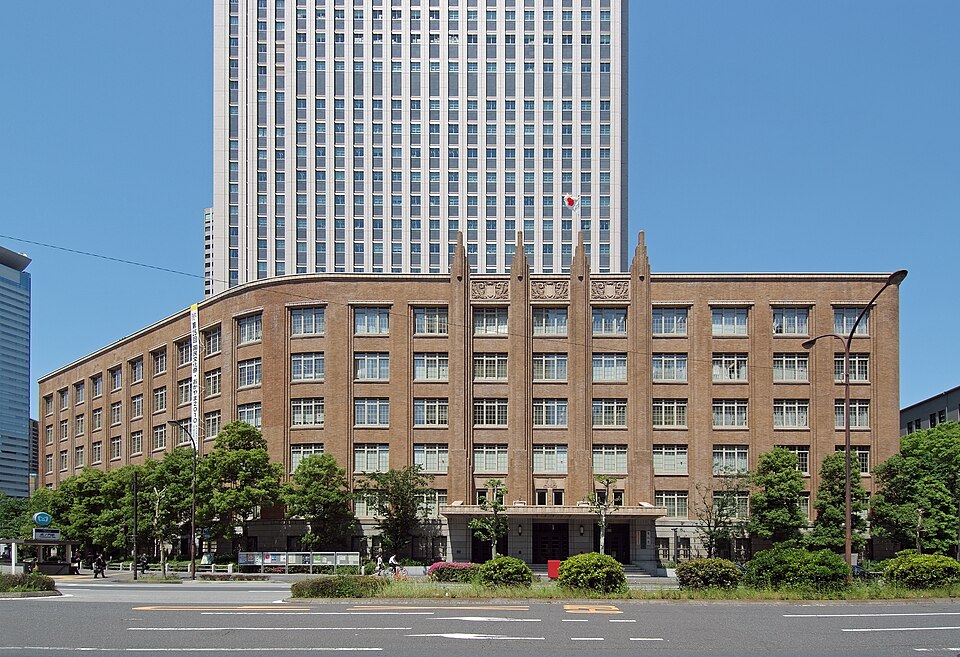
The former Ministry of Education (Monbushō) building in Kasumigaseki, Tokyo, where the ministry that screens textbooks is based, 2010. Photo by Wikimedia user Wiiii, CC BY-SA 3.0.
Positions on the record
- Government of Japan: screening is lawful and not censorship (upheld by the Supreme Court in 1997); the Kono and Murayama statements stand as its apologies; on Nanjing, killings occurred but the number cannot be fixed; wording such as "military comfort women" is inappropriate (2021 cabinet decision).
- Ienaga and Japanese critics of screening: screening opinions removed documented wartime acts; courts agreed on some items, including Unit 731.
- Tsukurukai: existing textbooks were "masochistic" and needed a national narrative. Its founders argued in particular that the 1997 junior-high textbooks' accounts of forcible recruitment of comfort women by the military were not supported by evidence (Nozaki and Selden, 2009).
- PRC government and state media: Japan's revisions distort history; the Nanjing toll is 300,000.
- South Korean governments: Park's government said the private books were biased; Moon's said a state book politicised history; Seoul's foreign ministry called the 2021 changes "regrettable".
- What is documented: the 1997 ruling; the 1982 statement and clause; the Kono and Murayama texts; the 2014 and 2021 changes; the 1994 outline; the 2006 suspension; South Korea's 2015-2017 textbook; the 2005 joint textbook.
- What is not shown / disputed: the Nanjing toll, with estimates from about 40,000 (Hata) through over 200,000 (Tokyo tribunal) to 300,000 (Nanjing tribunal, PRC). Whether "advance" replaced "aggression" in 1982: not in that screening, but in earlier ones. North Korean and current Chinese textbook texts were not read directly for this page. How far any textbook shaped students' views is not measured here.
Same-method test
The finding does not depend on the flag. Any government that screens or writes history textbooks, a U.S. state board or a European ministry included, would be tagged the same way if it struck a documented atrocity from a book, softened the words for it, titled its own book "correct", or treated a textbook critic as an offence against the nation. The differences stand: Japan's books are privately written and were contested in open court; the PRC's and North Korea's are state-written; South Korea's state book lasted two years.
How to spot it
- Ask who wrote the textbook and who approved it. A private author under screening, a ministry author and a party author are different things.
- When a word changes between editions ("aggression" to "advance", "military comfort women" to "comfort women"), ask what the new word leaves out.
- When a monument, textbook or statement gives one death toll, look for the range and who gives each figure.
Images
| Image | Source | Licence |
|---|---|---|
| Mechanism diagram (above) | Drawn for FRAME from the sources below (make_diagrams.py) |
CC BY 4.0, FRAME |
| Saburō Ienaga, 1953 | Wikimedia Commons, NHK Yearbook 1954 | Public domain (PD-Japan-oldphoto) |
| "Victims 300000" wall, Nanjing | Wikimedia Commons, 董辰兴 | CC BY-SA 4.0 |
| Former Monbushō building, 2010 | Wikimedia Commons, Wiiii | CC BY-SA 3.0 |


Image gaps
- Pages from Japanese textbooks (Ienaga's, Tsukurukai's, the 2021 editions). Not included: in copyright, and Japan's freedom of panorama covers buildings only. Not fillable without publishers' permission.
- Chinese, South Korean and North Korean textbook pages, and the 2015 "Correct History Textbook". Not included: in copyright or not safely public domain in the U.S. A Korean government work released under KOGL Type 1 could fill the South Korean gap. Possibly fillable.
- The 1955 pamphlet. A 1955 Japanese party publication may be public domain in Japan; no scan was found. Possibly fillable.
- The joint textbook's cover. In copyright. Not fillable.
Sources
- Nippon.com: Japan's history textbook system: creation, screening and selection
- Nippon.com: The East Asian textbook issue
- Marius B. Jansen, "Education, Values and Politics in Japan", Foreign Affairs, July 1957
- The Japan Times, 29 August 1997: Supreme Court backs Ienaga in textbook suit
- CNN, 29 August 1997: Japan court rules against atrocity cover-up
- Yoshiko Nozaki and Mark Selden, "Japanese Textbook Controversies, Nationalism, and Historical Memory: Intra- and Inter-national Conflicts", The Asia-Pacific Journal: Japan Focus, 2009
- Hatano Sumio, "History and the State in Postwar Japan", The Asia-Pacific Journal: Japan Focus, 2018
- "Statement by Chief Cabinet Secretary Kiichi Miyazawa on History Textbooks", 26 August 1982, The World and Japan database
- Statement by Chief Cabinet Secretary Yōhei Kōno on the result of the study on the issue of "comfort women", 4 August 1993, MOFA; see also MOFA, "From the Drafting of the Kono Statement to ..." (2014 review)
- Statement by Prime Minister Tomiichi Murayama, 15 August 1995, MOFA
- MOFA, History Issues Q&A (Nanjing)
- Alexander Bukh, "Japan's History Textbooks Debate: National Identity in Narratives of Victimhood and Victimization", Asian Survey 47, no. 5 (2007).
- Gabriela Romeu, "The Japanese History Textbook Controversy amid Post-war Sino-Japanese Relations", Japan Studies Review (Florida International University), citing the Children and Textbook Japan Network 21 adoption survey
- Tawara Yoshifumi, "The Abe Government and the 2014 Screening of Japanese Junior High School History Textbooks", The Asia-Pacific Journal: Japan Focus, 2015
- VOA fact check: Japan shades history with textbook edit of sexual slavery
- Stanford SPICE: Examining the Japanese history textbook controversies
- Zheng Wang, "National Humiliation, History Education, and the Politics of Historical Memory: Patriotic Education Campaign in China", International Studies Quarterly 52, no. 4 (2008)
- Zheng Wang, Never Forget National Humiliation: Historical Memory in Chinese Politics and Foreign Relations (New York: Columbia University Press, 2012).
- Lin Lin, Yali Zhao, Masato Ogawa, John Hoge and Bok Young Kim, "Whose History? An Analysis of the Korean War in History Textbooks from the United States, South Korea, Japan, and China", The Social Studies 100, no. 5 (2009)
- Congressional-Executive Commission on China (CECC), 2006: Party suspends popular publication, fires editors
- Nippon.com: Legislating ideological unity in China: the Patriotic Education Law
- Takashi Yoshida, The Making of the "Rape of Nanking": History and Memory in Japan, China, and the United States (New York: Oxford University Press, 2006); see also Yoshida, "The Nanjing Massacre: Changing Contours of History and Memory in Japan, China, and the U.S.", The Asia-Pacific Journal: Japan Focus
- Kasahara Tokushi, "Nanjing Massacre", The Encyclopedia of Race, Ethnicity, and Nationalism (Wiley)
- Hata Ikuhiko, Nankin jiken: gyakusatsu no kōzō (Tokyo: Chūō Kōron, 1986; enlarged ed. 2007).
- China Daily, 14 September 2021: Tokyo up to its tricks again revising history textbooks
- Xinhua, 7 April 2026: Explainer: Why Japan's textbook revisions warrant caution
- Al Jazeera, 13 October 2015: S Korea to issue "correct history textbook" to students
- Inquirer (AFP), October 2015: South Korean scholars oppose state-issued history books
- VOA, 2015: South Korea's "accurate" history textbook mandate stirs controversy
- The Korea Herald, 28 November 2016: Ministry unveils state-issued history textbook
- The Organization for World Peace, 2017: South Korea scraps rewrite of history books
- AP via Inquirer, May 2017: New South Korean leader scraps plan for state history books
- HRNK Insider, March 2021: Fixing distorted history, a prerequisite to democratizing North Korea
- YaleGlobal, 2005: New history text turns a page in East Asia ties
- EuroClio factsheet: A History to Open the Future