
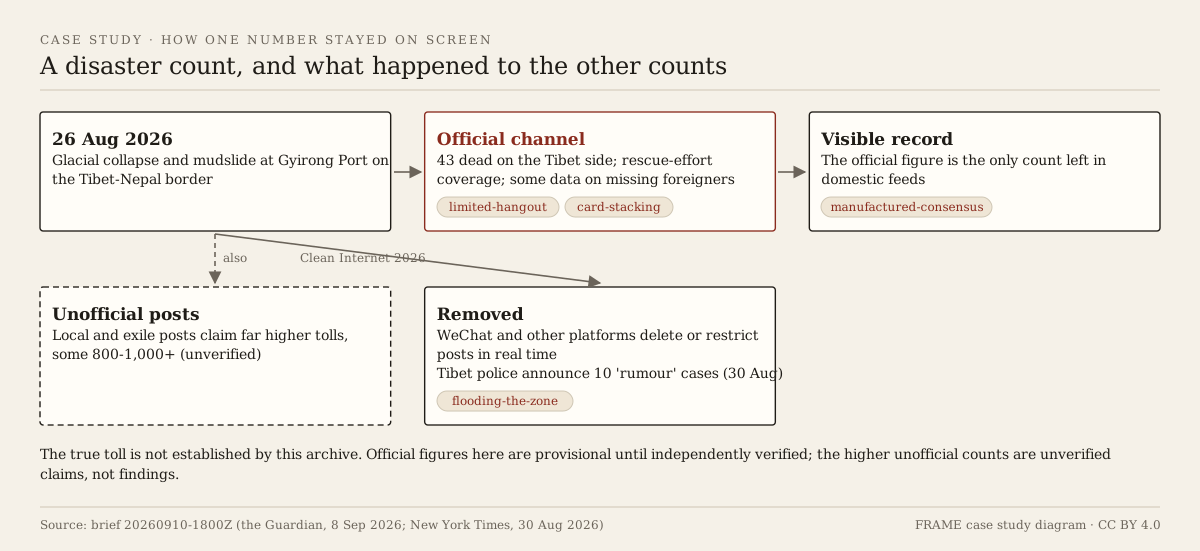
Content note. This case concerns a disaster with a disputed death toll. It includes security-camera footage of the mudslide striking the port.
In one line: after a deadly flood on the Tibet-Nepal border, officials published one death toll with rescue imagery, while police and platforms removed posts giving higher counts, so the official figure became the one most visible on domestic platforms.
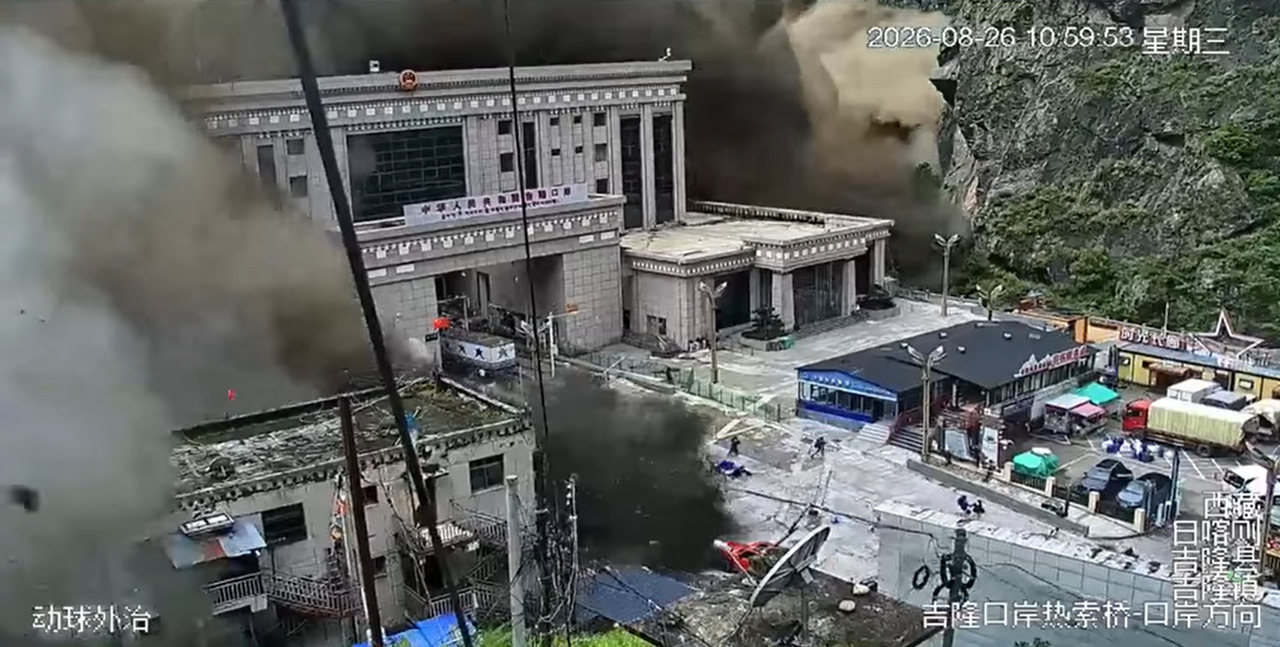
Still from a fixed security camera at Gyirong Port as the mudslide reaches the port buildings, 26 August 2026, 10:59. Public domain per Wikimedia Commons (PD-automated: no human author). This is surveillance footage, not a China Central Television broadcast.
What happened
- 26 August 2026. A glacial collapse sends a flood and mudslide through Gyirong Port on the Tibet-Nepal border.
- Official figures. 43 dead on the Tibet side, with hundreds missing, including foreign nationals (New York Times, 30 August, reporting the official accounting). Official coverage centres on the rescue effort.
- 30 August. Tibet's public-security cyber police (西藏网警) publish ten "typical cases" of online rumours about the flood, each ending in an administrative penalty. The notice, reprinted by China News Service, Guangming Daily and the Beijing News, says Tibet's police are pursuing the Clean Internet 2026 campaign and 依法打击编造虚假灾情信息误导公众、扰乱网络秩序相关违法犯罪 ("cracking down, in accordance with the law, on offences of fabricating false disaster information that misleads the public and disrupts online order"). Most of the ten cases are posts giving a higher toll, for example 中国这边已经死亡3000多人 ("more than 3,000 have already died on the Chinese side") and 新闻说1400人遇难,实际之前有3000人失联了 ("the news says 1,400 died, but actually 3,000 were missing before that").
- In parallel. WeChat and other platforms delete or restrict posts in real time. Some unofficial posts claimed 800 to 1,000 or more people swept away. These counts are unverified. Tibetan exile and advocacy groups allege an undercount.
- 10 September. A further Tibet cyber-police notice, reprinted by China News Service, lists more penalties. Three people were punished for claiming an earthquake or human activity caused the collapse, and one for 歪曲救援工作,片面套用他国案例恶意对比 ("distorting the rescue work and one-sidedly applying other countries' cases in malicious comparison"). The notice closes: 网络不是法外之地 ("the internet is not a place beyond the law").
- 8 September. The Guardian reports how the Ministry of Public Security's Clean Internet 2026 campaign was applied to the disaster. It draws on the police notices, screenshots of platform restrictions, and interviews with China Media Project director David Bandurski, the International Campaign for Tibet and former state-media journalists.
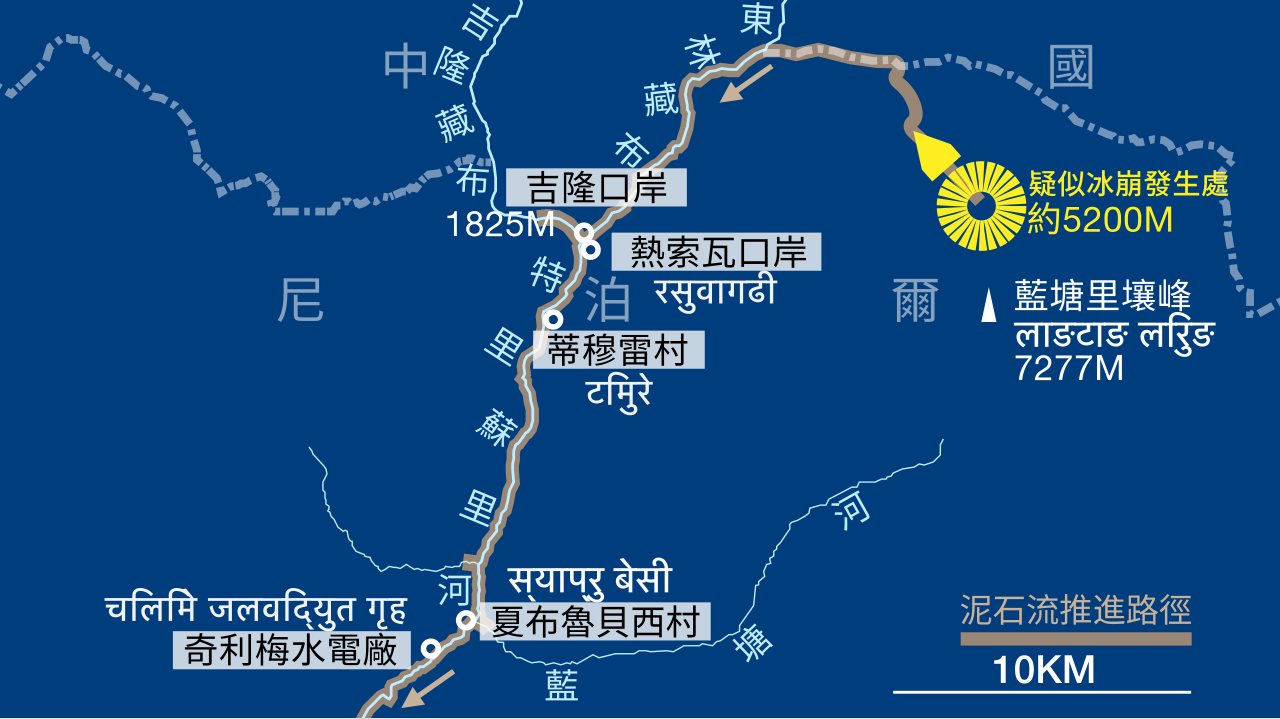
Map of the mudslide's path from a suspected ice collapse at about 5,200 m, past Gyirong Port and Rasuwagadhi, into Nepal. Chinese and Nepali labels. By Wikimedia user 王桁霽, CC BY-SA 4.0.
How it works
- Limited hangout: some data is released (a timeline, a toll, counts of missing foreigners), a partial account that can stand in for a full one. Granular missing-person lists and independent tallies are not.
- Card stacking: coverage centres on evidence of state effort and gives little that a reader could use to check the scale.
- Flooding the zone: continuous deletion and routine "public-opinion guidance", rather than one dramatic crackdown, keep the space filled with the official account. (Bandurski's point in the Guardian is that this is everyday practice, not an exception.)
- Manufactured consensus: once other counts are labelled false and removed, the official figure looks like the one everyone agrees on.
The police notice gives the stated purpose: ensuring that relief work proceeds smoothly. The campaign is framed as tackling both fraud and "rumours", The brief notes that this dual framing lets the same rules reach both fraud and disputed casualty counts.
Then and now
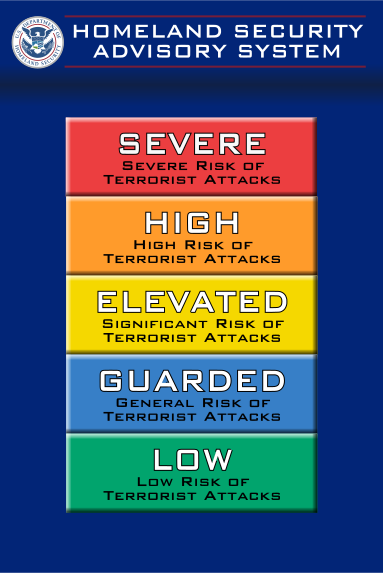
Homeland Security Advisory System threat-level chart, U.S. Department of Homeland Security, 2002. Public domain.
A different context and a narrower parallel: in both, one official indicator stands in for the full picture, and the evidence behind it is not disclosed. The U.S. colour chart ran from 2002 to 2011 without the intelligence behind each level being shown. The Gyirong toll was published while the counts that would test it were removed.
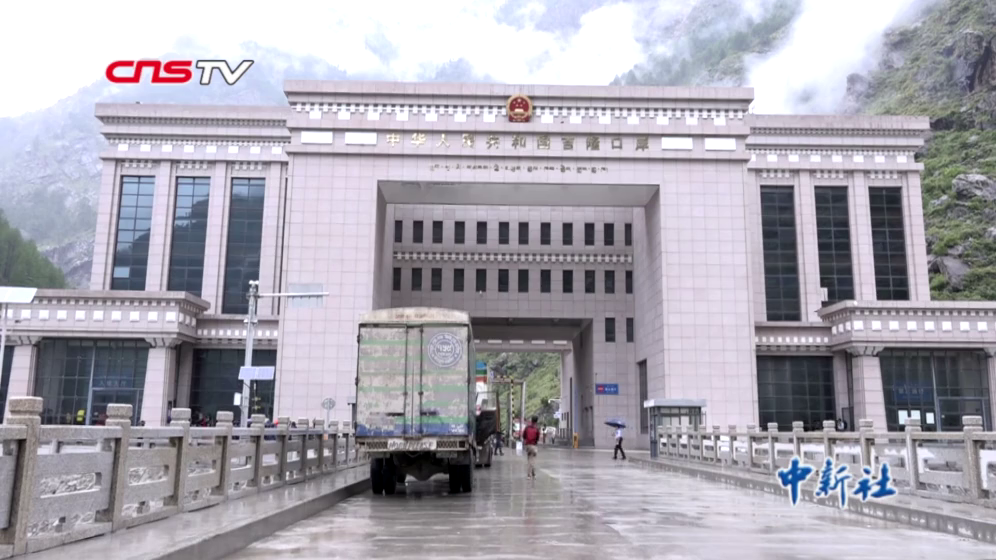
The Gyirong Port of Entry building in 2019, the same building seen in the security-camera still. Frame from a China News Service video, CC BY 4.0.
Positions on the record
- Official position: the toll is 43 dead on the Tibet side with others missing, the rescue was effective, and the "rumour" cases target "false disaster information that misleads the public and disrupts online order" (Tibet cyber police, 30 August).
- Exile and advocacy groups: the toll is undercounted.
- This archive's reading: the true toll is not established here. Official figures under tight information control are treated as provisional until independent sources can check them. The higher unofficial counts are unverified claims, not findings.
Same-method test
The brief notes that selective official data, real-time deletion of higher casualty claims, and dual-purpose "anti-rumour" rules have been documented in both authoritarian and democratic crisis settings. Any government that did this after any disaster would be scored the same way. Two documented cases from elected governments, India and the U.S. territory of Puerto Rico, show which parts of the method recur and which do not.
India, COVID-19, 2021. Parts of the method recur here.
- On 23 April 2021, at the peak of the second wave, India's Ministry of Electronics and Information Technology ordered Twitter to withhold posts critical of the pandemic response, including posts by an MP, a West Bengal minister and a filmmaker. Twitter disclosed the order on the Lumen database and complied in India. The ministry said it acted "in view of the misuse of social media platforms by certain users to spread fake or misleading information" and to stop posts creating "panic".
- In Amethi, Uttar Pradesh, police registered a case under the Epidemic Diseases Act against a man who had tweeted an appeal for an oxygen cylinder for his grandfather. Police said the patient did not need oxygen and that the tweet spread a false alarm; he was released with a warning.
- On 30 April 2021 the Supreme Court said: "If citizens communicate their grievances either on the Internet or on social media, there cannot be a clampdown. We don't want a clampdown of information." It said it would treat any such action by a state as contempt of court.
- On 5 May 2022 the World Health Organization estimated 4.7 million excess deaths in India in 2020-21, about ten times the official COVID-19 toll for that period. The Health Ministry rejected the estimate, saying the "validity and robustness of the models used and methodology of data collection are questionable".
Puerto Rico, Hurricane Maria, 2017-18. Here only the single official figure recurs.
- The official toll stayed at 64 for most of a year. CNN and the Centro de Periodismo Investigativo sued the island's Demographic Registry for its death records, and a court ordered their release in June 2018.
- In August 2018 the Puerto Rico government adopted 2,975, the estimate of a George Washington University study it had commissioned.
What differs. The overlap is real: an official figure contested by much higher outside estimates (India), takedowns of posts at a government's request on grounds of "fake or misleading information" (India), a police case over a crisis post called a false alarm (India), and a low official figure held while the records that could test it were withheld (Puerto Rico). The differences are also on the record:
- In India the Supreme Court publicly warned states against penalising such posts. The higher estimates, the takedown orders and the court's rebuke were all reported openly in the domestic press.
- In Puerto Rico journalists obtained the records through the courts, and the government itself adopted the higher figure.
- In Gyirong no court challenge or independent count is on the record so far, and a post comparing the rescue with other countries' disasters was itself penalised.
Scale and context also differ: a nationwide pandemic, a hurricane across a whole island, and a single flood.
How to spot it
- Treat official casualty figures released under tight information control as provisional, not final, until independent sources can check them.
- Ask for named missing-person lists and search logs, not only rescue imagery.
- When a platform or police notice calls a number a "rumour", look for contemporaneous screenshots and advocacy tallies, and weigh them as claims too.
Images
| Image | Source | Licence |
|---|---|---|
| Mechanism diagram (above) | Drawn for FRAME from the brief's sourced facts (make_diagrams.py) |
CC BY 4.0, FRAME |
| Security-camera still of the mudslide (26 Aug 2026) | Wikimedia Commons | Public domain (Commons licence tag PD-automated: fixed security camera, no human author) |
| Map of the 2026 mudslide | Wikimedia Commons, 王桁霽 | CC BY-SA 4.0 (rendered to PNG, unmodified) |
| Gyirong Port building (2019) | Wikimedia Commons, China News Service | CC BY 4.0 |
| Homeland Security Advisory System chart (2002) | FRAME gallery | Public domain (U.S. government work) |
.png)


Image gaps
- The Tibet police "rumour" notices of 30 August, and screenshots of deleted WeChat posts. Not included: no openly licensed copies were found. The Guardian's reproductions are copyrighted.
- Official Chinese state-media coverage of the rescue (Xinhua, China Central Television). Not included: not openly licensed.
- An English-language map. The only openly licensed map found is labelled in Chinese and Nepali.
Sources
- The Guardian, 8 September 2026: the Nepal-Tibet disaster and China's Clean Internet campaign
- New York Times, 30 August 2026: official accounting of the death toll and missing foreigners
- Tibet cyber police (西藏网警), ten typical cases of flood rumours, 30 August 2026, as reprinted by China News Service, 31 August 2026, Guangming Daily and the Beijing News.
- Tibet cyber police, further cases, as reprinted by China News Service, 10 September 2026.
- Watch brief: China’s Clean Internet 2026 campaign criminalizes unofficial accounts of Tibet-Nepal border flood, enforcing official death-toll narrative while deleting alternative reports.
Same-method test sources
- Al Jazeera, 25 April 2021: India asks Twitter to take down tweets critical of COVID handling (Reuters reporting; order disclosed on Lumen). Deccan Herald: the ministry's stated reasons.
- ThePrint, 28 April 2021: Amethi man booked under Epidemic Act over tweet asking for oxygen cylinder; ANI: police statement that the tweet created a "false alarm".
- Hindustan Times, 1 May 2021: "No clampdown for asking help, says SC".
- Business Standard, 5 May 2022: WHO estimate of 4.7 million and the government's rejection; Ministry of Health statement via PIB, 5 May 2022.
- CNN, 29 August 2018: how Puerto Rico's toll climbed from 64 to 2,975; NBC News: Puerto Rico faces lawsuits over hurricane death count data.
Sourcing note (28 September 2026): the Chinese quotations were checked against the opened reprints https://www.chinanews.com.cn/gn/2026/08-31/10687017.shtml, https://m.gmw.cn/2026-08/31/content_1304556652.htm, https://www.bjnews.com.cn/detail/1788095452129864.html and https://www.chinanews.com.cn/sh/2026/09-10/10694349.shtml, and the quoted wording matches those pages. The India and Puerto Rico pages cited above were not opened for this check.