Also called Partial confession, Controlled disclosure
Release a partial, survivable truth to block a larger one.
The tell
Confession of the small thing; silence on the load-bearing thing; timing that pre-empts a leak.
Not this
A complete primary-document dump.
History and effect
Intelligence tradecraft term associated with Richard Helms and popularized in Watergate-era reporting.
It satisfies the audience's demand for accountability with a survivable admission, closing the story before the load-bearing fact surfaces.
Lineage: Intelligence tradecraft (Helms / Watergate-era usage)
How it works
A limited hangout is a disclosure decision made when a denial or cover story is failing: a leak is coming, a foreign monitor has detected something, a regulator's tests cannot be explained. The actor chooses which part of the truth to release. That part tends to be true or mostly true, survivable (absorbed by an apology, a fine or the prosecution of junior staff) and plausible as the whole story. The part withheld is the load-bearing fact: who authorised it, how large it was, how long it had been known, or whether it is still going on.
Timing: the release comes just before or just after an outside party's discovery, so the actor frames the story first. Bounding: the admission is scoped ("a couple of software engineers", "no obvious human-to-human transmission") so the next question looks answered. Packaging: the disclosure is made to look complete by volume (binders of transcripts), ritual (an apology, a recall) or the departure of a mid-level figure. Closure: further questions are treated as going over old ground.
The phrase is recorded on the Watergate tapes: in a White House conversation on 22 March 1973 about how much to disclose, John Ehrlichman is heard calling one option "a modified limited hang out". Former CIA officer Victor Marchetti, co-author of The CIA and the Cult of Intelligence (1974), later described it as intelligence jargon for what clandestine officers do when a cover story can no longer hold: admit, sometimes volunteer, part of the truth while withholding the key and damaging facts.
Why it works
Admissions against interest are persuasive. Eagly, Wood and Chaiken (1978) found that audiences rate a communicator as more credible when the message runs against the communicator's apparent interests; a confession looks like the opposite of spin. Research on "stealing thunder" (Williams, Bourgeois and Croyle 1993; Arpan and Roskos-Ewoldsen 2005) found that disclosing damaging information oneself, before an opponent or the press does, reduces its impact and raises the discloser's credibility. A limited hangout spends the credit earned for candour on protecting the withheld part.
Anchoring (Tversky and Kahneman 1974) means the first figure or scope put into circulation shapes later estimates even after it is revised. The need for cognitive closure (Kruglanski and Webster 1996) inclines audiences, and newsrooms, to "seize" on an explanation that seems sufficient and "freeze" on it. An admission gives the story an ending; a later, larger disclosure has to reopen a case already filed as closed.
Examples across eras and sides
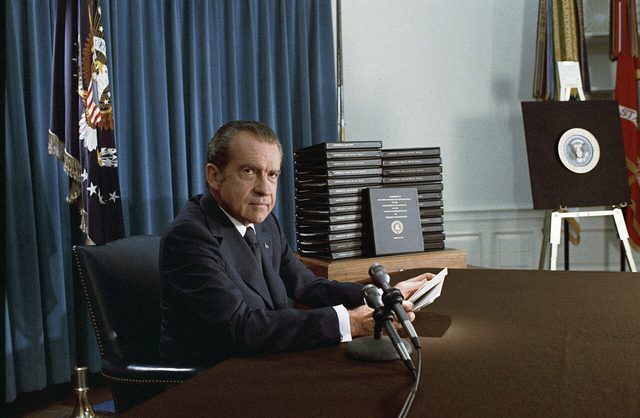
- The edited transcripts (1973 to 1974, United States, Nixon White House). On 29 April 1974 President Nixon announced that he would release edited transcripts of subpoenaed conversations instead of the recordings, and they were published the next day; the House Judiciary Committee's own transcripts of eight of them documented passages the White House versions had omitted or rendered differently. After United States v. Nixon (24 July 1974) forced release of the tapes, the 23 June 1972 conversation, in which Nixon approved having the CIA ask the FBI to halt part of its investigation, led to his resignation on 9 August. See Nixon with the edited White House tape transcripts (House Judiciary Committee, Transcripts of Eight Recorded Presidential Conversations, 1974; United States v. Nixon, 418 U.S. 683).
- Chernobyl (1986, Soviet Union, Soviet government and TASS). The reactor exploded early on 26 April 1986. The first public statement came on the evening of 28 April, after radiation was detected at the Forsmark plant in Sweden: a brief TASS item said an accident had occurred, a reactor had been damaged and a government commission set up. It gave no account of the radioactive release; the May Day parade in Kyiv went ahead, and Mikhail Gorbachev's first televised address on the accident came on 14 May (Serhii Plokhy, Chernobyl: History of a Tragedy, 2018).
- Katyn (1990 to 1992, Soviet Union and Russia). In spring 1940 the NKVD shot about 22,000 Polish officers, police and others; from 1943 the Soviet Union blamed Germany. On 13 April 1990 a TASS statement acknowledged NKVD responsibility, naming Lavrentiy Beria, Vsevolod Merkulov and their subordinates. The Politburo decision of 5 March 1940 ordering the executions, signed by Stalin and others, was handed to Poland only in October 1992, under Boris Yeltsin (Anna Cienciala, Natalia Lebedeva and Wojciech Materski, eds., Katyn: A Crime Without Punishment, 2007).
- Abu Ghraib (2004, Iraq, United States Department of Defense). After photographs of detainee abuse were published in April 2004, officials presented it as misconduct by a small group of soldiers, and a number of low-ranking military police were court-martialled. A bipartisan Senate Armed Services Committee report (December 2008) concluded that the abuse "was not simply the result of a few soldiers acting on their own" and linked it to interrogation policies approved at senior levels. (Senate Armed Services Committee, Inquiry into the Treatment of Detainees in U.S. Custody, executive summary 2008, full report 2009).
- Volkswagen diesel emissions (2014 to 2015, United States and Germany, Volkswagen AG). After 2014 road tests showed some VW diesels emitting far more nitrogen oxides than in laboratory tests, VW attributed the gap to technical issues and ran a voluntary recall that did not resolve it. According to the EPA's notice of violation of 18 September 2015, VW admitted the defeat device only after regulators said they would not certify its 2016 diesel models. In October 2015 VW's US chief executive Michael Horn told a House hearing it was not a corporate decision but the work of "a couple of software engineers"; in 2018 US prosecutors charged former chief executive Martin Winterkorn, after VW had pleaded guilty to three felony counts in 2017 (US EPA, 2015; US Department of Justice, 2017).
- The Pennsylvania grand jury report (2018, United States, six Catholic dioceses). The 40th Statewide Investigating Grand Jury reported on allegations against more than 300 priests over seven decades and described what it called a "playbook for concealing the truth": when a priest had to be removed, parishioners were told only that he was on "sick leave" or suffering from "nervous exhaustion". The removal was disclosed; the reason was not. Some clergy named in the report challenged it, and the state Supreme Court ordered some names redacted (Pennsylvania Office of Attorney General, Report I of the 40th Statewide Investigating Grand Jury, 2018).
- Early Wuhan pneumonia notices (2019 to 2020, China, Wuhan health authorities and national government). On 31 December 2019 the Wuhan Municipal Health Commission announced 27 cases of viral pneumonia and said no obvious human-to-human transmission had been found. Police then admonished doctors including Li Wenliang for sharing warnings, and human-to-human transmission was publicly confirmed on 20 January 2020. An Associated Press investigation in June 2020 reported that Chinese authorities held back genetic and patient data for periods in January; China's government states that it reported information promptly (Associated Press, June 2020; State Council Information Office, Fighting COVID-19: China in Action, 2020).
- The Gyirong flood toll (2026, China, Ministry of Public Security and Tibet authorities). After a flood and mudslide at Gyirong Port on 26 August 2026, officials published a death toll and missing counts, while police punished "rumours" of higher tolls and platforms removed posts. Independent tallies and missing-person lists were not released; the true toll is not established. See The Gyirong flood and the official death toll (The Guardian, 8 September 2026; New York Times, 30 August 2026).
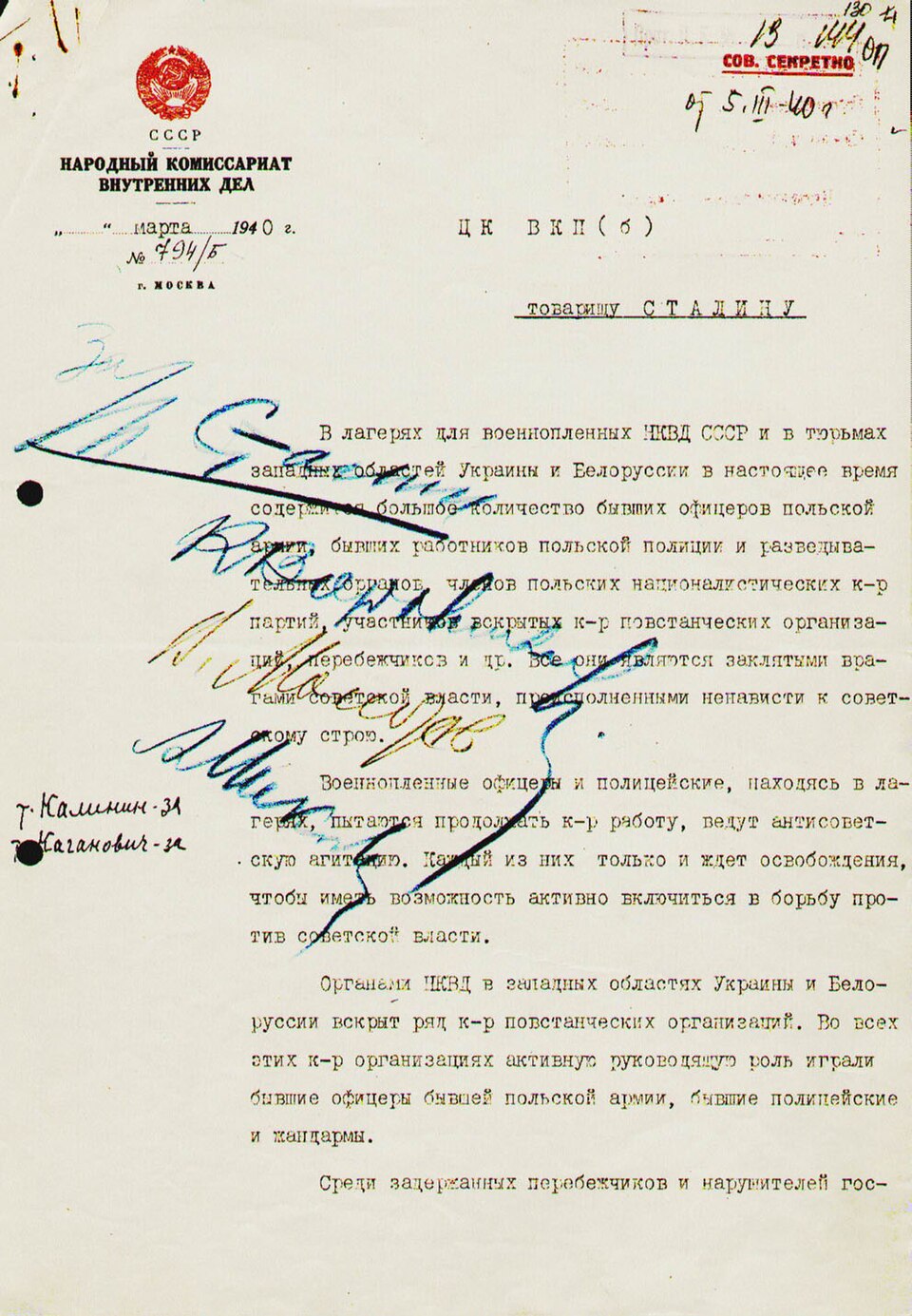
First page of NKVD document no. 794/B, addressed to Stalin and dated March 1940, proposing the execution of Polish prisoners of war and detainees. It carries the approval marks of Stalin, Voroshilov, Molotov and Mikoyan, with notes of assent for Kalinin and Kaganovich; the Wikimedia Commons record dates it to 5 March 1940. Original in the Russian State Archive of Socio-Political History; first published in Poland in 1992. Public domain (official document, Russian Civil Code art. 1259).
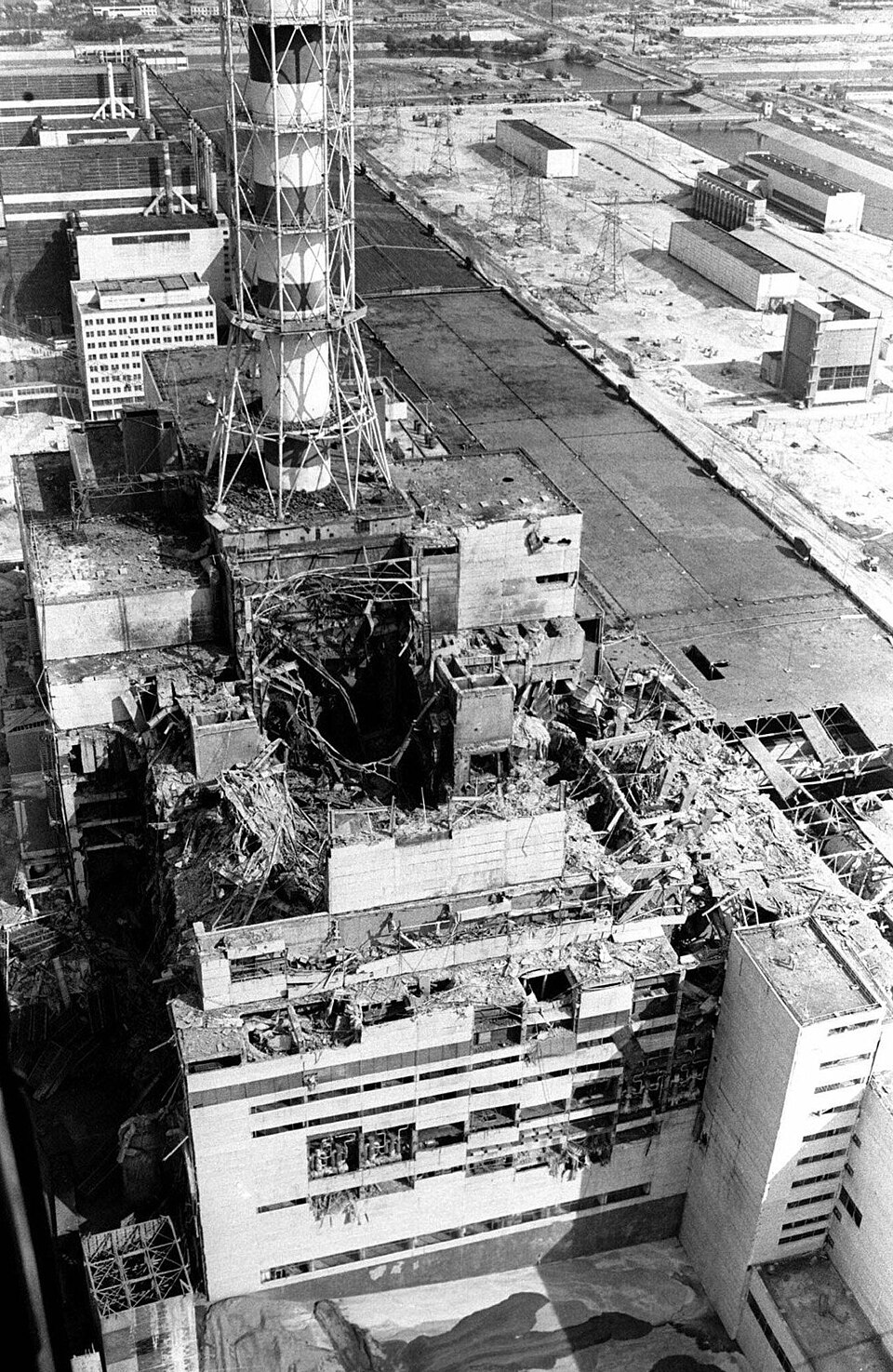
Aerial photograph from a helicopter of the destroyed Unit 4 reactor building at the Chernobyl Nuclear Power Plant after the explosion of 26 April 1986; the Commons record gives only the year. IAEA Imagebank; photo credit USFCRFC (Ukrainian Society for Friendship and Cultural Relations with Foreign Countries). Wikimedia Commons, CC BY-SA 2.0.
How to spot it
- Did the admission arrive just as an outside party (a leak, a foreign monitor, a regulator, a court) was about to reveal something? What did that party hold?
- Is the admission scoped lower, smaller or earlier than the questions being asked? Who authorised it is the most commonly withheld fact.
- Is volume standing in for completeness? Ask for the primary record (the recording, the raw data, the full file), not an edited version.
- Does the disclosure include the means to check it: named lists, raw data, independent access?
- After the admission, are further questions treated as settled ("we have already addressed that")?
Where it ends: edge cases and legitimate persuasion
- Staged disclosure is not automatically a hangout. Investigations release findings as they are confirmed, and privacy, legal proceedings or security can justify withholding parts. The test is whether the released part is presented as the whole and whether the withheld part changes its meaning.
- An honest partial disclosure says what it does not yet include and why ("this covers X; Y is under review and will be published by a stated date"). That is the reverse of this technique.
- Not every revised first account was a hangout: early disaster tolls often rise in good faith. The label fits only where the record shows the withheld fact was known, or actively suppressed, when the partial account was given.
- Some writers apply the phrase to any official admission, to argue the real truth must be larger still. The label needs evidence of the larger withheld fact, not only suspicion of one.
- Neighbours: Disclosure theater keeps a disclosure present but out of view; Card stacking selects evidence without any admission; Flooding the zone and Manufactured consensus can make the partial account the only one visible, as in the Gyirong case.
Sources
- Arpan, Laura M., and David R. Roskos-Ewoldsen. "Stealing Thunder: Analysis of the Effects of Proactive Disclosure of Crisis Information." Public Relations Review 31(3), 2005.
- Cienciala, Anna M., Natalia S. Lebedeva and Wojciech Materski, eds. Katyn: A Crime Without Punishment. Yale University Press, 2007.
- Eagly, Alice H., Wendy Wood and Shelly Chaiken. "Causal Inferences about Communicators and Their Effect on Opinion Change." Journal of Personality and Social Psychology 36(4), 1978.
- Kruglanski, Arie W., and Donna M. Webster. "Motivated Closing of the Mind: 'Seizing' and 'Freezing'." Psychological Review 103(2), 1996.
- Marchetti, Victor, and John D. Marks. The CIA and the Cult of Intelligence. Knopf, 1974.
- Plokhy, Serhii. Chernobyl: History of a Tragedy. Allen Lane, 2018.
- Tversky, Amos, and Daniel Kahneman. "Judgment under Uncertainty: Heuristics and Biases." Science 185(4157), 1974.
- Williams, Kipling D., Martin J. Bourgeois and Robert T. Croyle. "The Effects of Stealing Thunder in Criminal and Civil Trials." Law and Human Behavior 17(6), 1993.
- Associated Press investigation into China's early disclosure of coronavirus data, June 2020.
- Pennsylvania Office of Attorney General. Report I of the 40th Statewide Investigating Grand Jury. 2018.
- State Council Information Office of the People's Republic of China. Fighting COVID-19: China in Action. White paper, June 2020.
- United States House of Representatives, Committee on the Judiciary. Transcripts of Eight Recorded Presidential Conversations. 1974.
- United States Senate, Committee on Armed Services. Inquiry into the Treatment of Detainees in U.S. Custody. Executive summary December 2008; full report April 2009.
- United States v. Nixon, 418 U.S. 683 (1974).
- US Environmental Protection Agency. Notice of violation to Volkswagen AG, Audi AG and Volkswagen Group of America, 18 September 2015.
- US Department of Justice. Plea agreement and statement of facts, United States v. Volkswagen AG, January 2017.
- The Guardian, 8 September 2026, and New York Times, 30 August 2026 (see The Gyirong flood and the official death toll).
The science
Research on the psychology this technique relies on, from the Learn library:
- Anchoring — Anchoring
- Continued influence effect — Continued influence effect
Case studies
- The Gyirong flood and the official death toll — The Gyirong flood and the official death toll
- Collectivisation, the 1932-33 famine and its denial: the kulak label, the silence and the foreign press — Collectivisation, the 1932-33 famine and its denial
- The Kenya Emergency, 1952-1960: 'rehabilitation', the Hola water cart, and the oath — The Kenya Emergency, 1952-1960: 'rehabilitation', the Hola water cart, and the oath
- The Congo Free State press war: Leopold II's Press Bureau and the Congo Reform Association — The Congo Free State press war: Leopold II's Press Bureau and the Congo Reform Association
- Xinjiang's 'vocational training centres': the government's messaging and its critics' — Xinjiang's 'vocational training centres': the government's messaging and its critics'
- Glavlit and the retouched photographic record — Glavlit and the retouched photographic record
- China's Great Firewall and the June Fourth anniversary — China's Great Firewall and the June Fourth anniversary
- Imperial Japan's wartime propaganda at home: the Information Bureau, the neighbourhood associations and the war communiqués — Imperial Japan's wartime propaganda at home: the Information Bureau, the neighbourhood associations and the war communiqués
- The Wehrmachtbericht's collapse: from 'Endsieg' to Dönitz's surrender broadcasts, 1944-1945 — The Wehrmachtbericht's collapse: from 'Endsieg' to Dönitz's surrender broadcasts, 1944-1945
- Glasnost: the controlled opening that outran the Soviet state (1985-1989) — Glasnost: the controlled opening that outran the Soviet state (1985-1989)
- The Gang of Four: arrest, denunciation and a trial that closed the Cultural Revolution's books (1976-1981) — The Gang of Four: arrest, denunciation and a trial that closed the Cultural Revolution's books (1976-1981)
- Boluan Fanzheng: how Deng Xiaoping's faction used a debate about truth to break Hua Guofeng's hold on power, 1977-1981 — Boluan Fanzheng: how Deng Xiaoping's faction used a debate about truth to break Hua Guofeng's hold on power, 1977-1981
- The 1981 Resolution: how the Chinese Communist Party engineered a single verdict on Mao — The 1981 Resolution: how the Chinese Communist Party engineered a single verdict on Mao
- Scar literature: China's state-permitted reckoning with the Cultural Revolution, 1977-1981 — Scar literature: China's state-permitted reckoning with the Cultural Revolution, 1977-1981
Images
| Image | Source | Licence |
|---|---|---|
| NKVD document no. 794/B, March 1940 | Wikimedia Commons, Katyn - decision of massacre p1.jpg (RGASPI) | Public domain (official document, Russian Civil Code art. 1259) |
| Chernobyl Unit 4 from the air, 1986 | Wikimedia Commons, IAEA 02790015 (5613115146).jpg (IAEA Imagebank / USFCRFC) | CC BY-SA 2.0 |

.jpg)