In one line: Egypt's Voice of the Arabs broadcast to the whole Arab world, calling pro-Western rulers "lackeys of imperialism", while Britain ran an Arabic station that presented itself as a commercial Arab broadcaster; in the 1956 Suez war the British station was renamed the Voice of Britain, and in the 1967 war Cairo radio reported victories over an air force that had destroyed Egypt's own.
What happened
Egypt: Sawt al-Arab
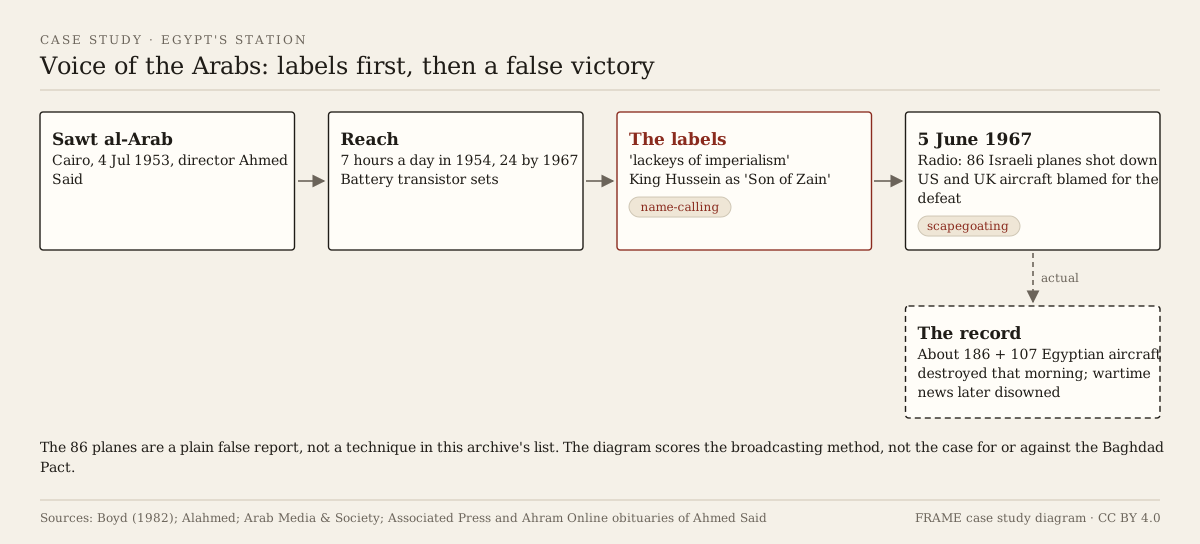
- 4 July 1953. A year after the July 1952 revolution, Cairo Radio launches Sawt al-Arab (Voice of the Arabs) as a half-hour programme. Its first director and main voice is Ahmed Said, who holds the post until 1967. Airtime grows from about 7 hours a day in 1954 to 24 hours by 1967, carried to villages without electricity by cheap battery transistor sets.
- 1954 to 1955. The station runs a sustained campaign against Iraq's prime minister Nuri al-Said over the British-backed Baghdad Pact, and appeals directly to Jordanians to keep Jordan out of it. Pro-Western Arab rulers are grouped as "lackeys of imperialism"; the government of Jordan is described as "serving American imperialism"; King Hussein is called "Son of Zain", a derogatory reference to his mother, Queen Zain.
- 14 July 1958. Army officers overthrow Iraq's Hashemite monarchy; Nuri al-Said is caught and killed. Some accounts credit the station with helping create the climate for the coup. The coup itself was carried out by officers who seized Baghdad's own radio station, and the station's causal role is interpretation, not established fact.
- 5 June 1967. Israel's opening air strike destroys most of the Egyptian air force on the ground: about 186 aircraft in the first wave and about 107 in a second. The same morning Egyptian radio announces that 86 Israeli planes have been shot down, and says Arab aircraft and missiles are "at this moment shelling all Israel's towns and villages". Cairo also claims American and British aircraft are fighting for Israel. On 8 June Said reports that Arab forces have defeated Israel in Sinai.
- After the war. Egyptian authorities disown most of the wartime news. Sources differ on whether Said resigned in September 1967 or was removed. He later said the aircraft figures came from officials "whose numbers added up wrong", and that in wartime it was his duty to broadcast what he was given.
Britain: Sharq al-Adna and the Voice of Britain
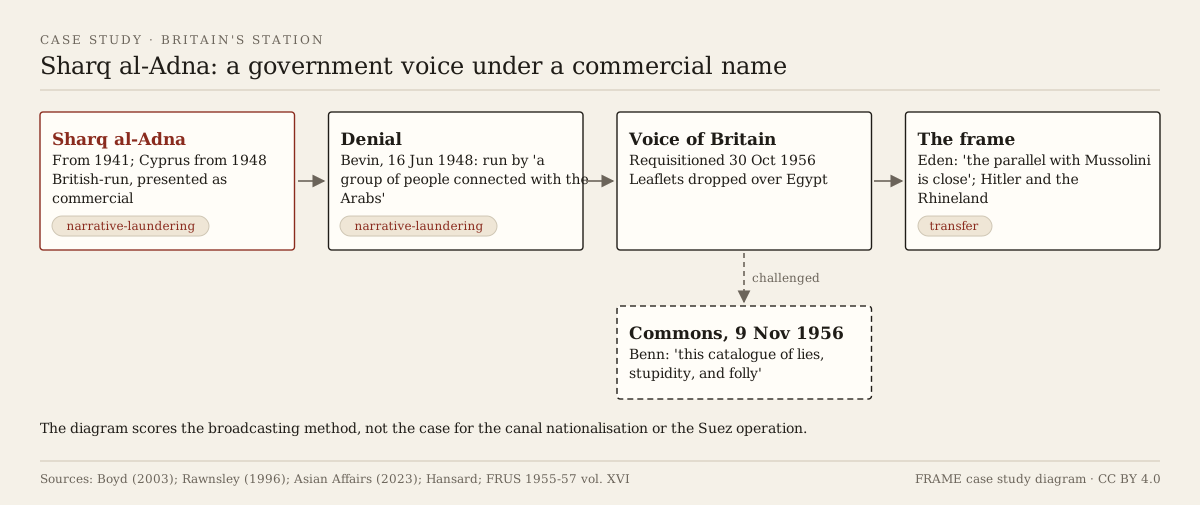
- 1941 to 1948. The Near East Arab Broadcasting Station, Sharq al-Adna ("the Near East"), begins Arabic broadcasts from Jenin and then Jaffa in Mandate Palestine, and moves to Cyprus in May 1948. It presents itself as a commercial station but is financed and run by the British government and controlled by British intelligence.
- 16 June 1948. Foreign Secretary Ernest Bevin tells Parliament the station is operated by "a group of people connected with the Arabs", and denies that the Foreign Office runs it.
- March 1956. The Foreign Office's Information Research Department (IRD), set up to counter Soviet propaganda, is told to shift its focus to Nasser's Egypt. Related unattributed outlets include the Arab News Agency, presented as independent but linked to MI6 and the IRD.
- Summer 1956. After Egypt nationalises the Suez Canal Company on 26 July, Prime Minister Anthony Eden says, "The Egyptian has his thumb on our windpipe." He writes to President Eisenhower that "the parallel with Mussolini is close", and on 6 September compares the seizure to Hitler's reoccupation of the Rhineland. In a televised address he says "this is how fascist governments behave". The Labour leader Hugh Gaitskell uses a similar comparison.
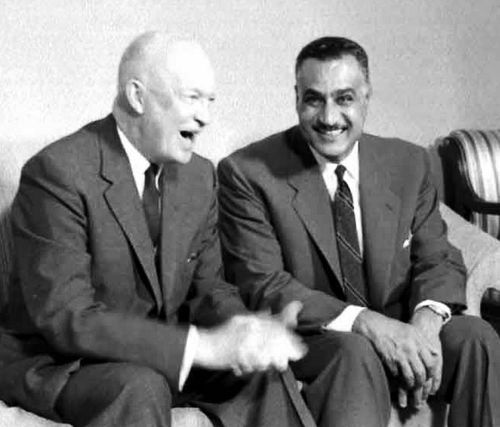
President Gamal Abdel Nasser and President Dwight Eisenhower, 1960, four years after the crisis their governments had opposed each other over. Photo: Nat Fein, public domain. - 30 October 1956. The day after Israel invades Sinai, the British government requisitions Sharq al-Adna and renames it the Voice of Britain. It broadcasts anti-Nasser news, warnings to civilians to keep clear of military targets, and edited BBC bulletins. Accounts of what followed differ in detail: the British director, Ralph Poston, protested, and the Arab staff walked out or were told to broadcast under duress. - 5 November 1956. British paratroops of 3 Para take the El Gamil airfield at Port Said as the Suez operation's ground assault begins; Fleet Air Arm aircraft photograph oil storage tanks burning at Port Said the same day. - October and November 1956. Under Brigadier Bernard Fergusson, Operation Musketeer's psychological-warfare staff broadcast in Arabic from Cyprus, and the RAF drops leaflets on Egyptian cities. Five illustrated leaflets were designed by the cartoonist Ronald Searle. Printing presses in Cyprus broke down, and Arabic speakers were hard to recruit. Later assessments found the campaign made little impact on Egyptian morale.
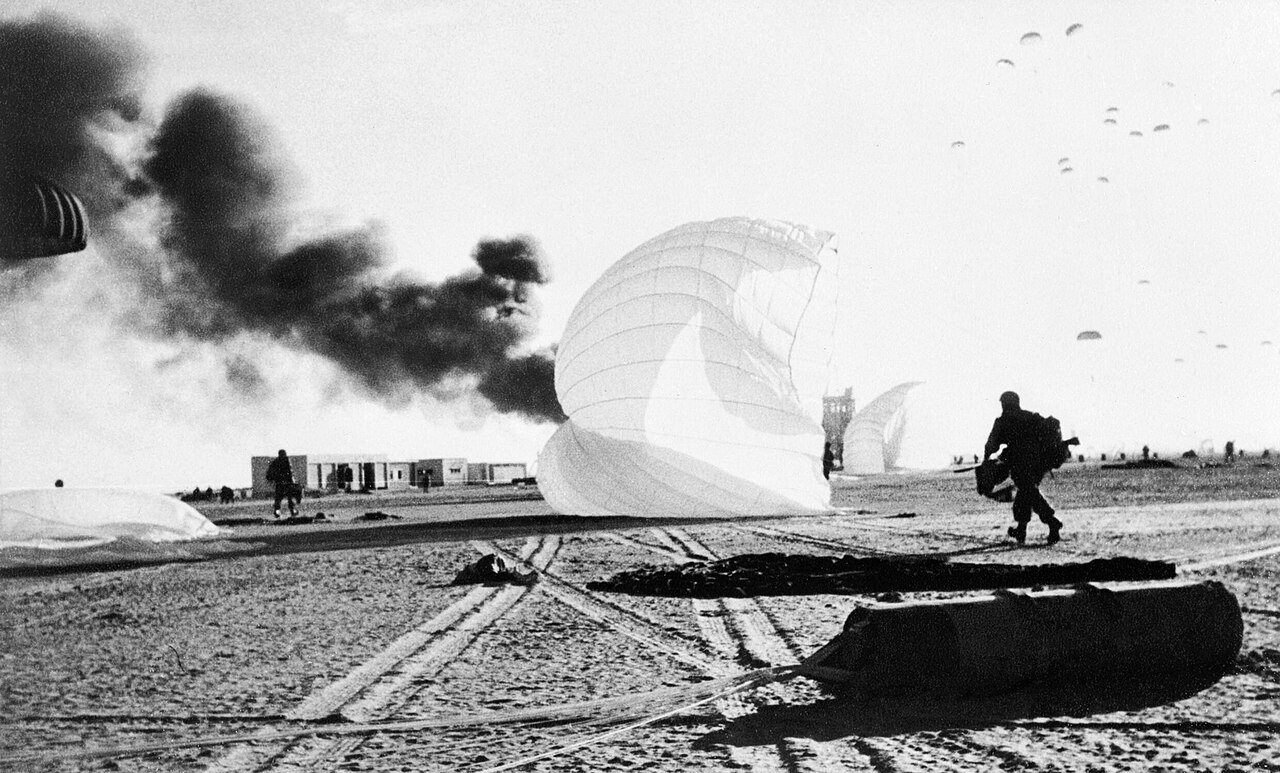
3 Para at El Gamil airfield, Port Said, 5 November 1956. Crown copyright, public domain. - 9 November 1956. Tony Benn MP calls in the Commons for an inquiry into "this catalogue of lies, stupidity, and folly". The station is closed in 1957 and its transmitters pass to the BBC; many of its Arab staff join the BBC Arabic Service.
How it works
- Name-calling: "lackeys of imperialism", "collaborators of imperialism" and "Son of Zain" came before, and often in place of, an argument about the Baghdad Pact or a ruler's policy. The label told a listener what to think of the man before the case against him began.
- Narrative laundering: Sharq al-Adna carried a British government message under the name of a commercial Arab station, and the Foreign Secretary told Parliament it was run by people "connected with the Arabs". The Arab News Agency did the same for print. The source was hidden so that the message would sound local.
- Transfer: Eden's comparisons of Nasser with Mussolini and Hitler borrowed the stigma of the 1930s, still recent for his audience, and applied it to the nationalisation of the Suez Canal Company. The comparison carried the conclusion (appeasement failed, so act now) without the argument.
- Scapegoating: in June 1967 Cairo placed a military defeat on American and British aircraft that were not there, a claim Egyptian authorities later disowned. The 86 planes "shot down" on 5 June are a plain false report, not one of this archive's techniques, and are recorded here as that.
Then and now
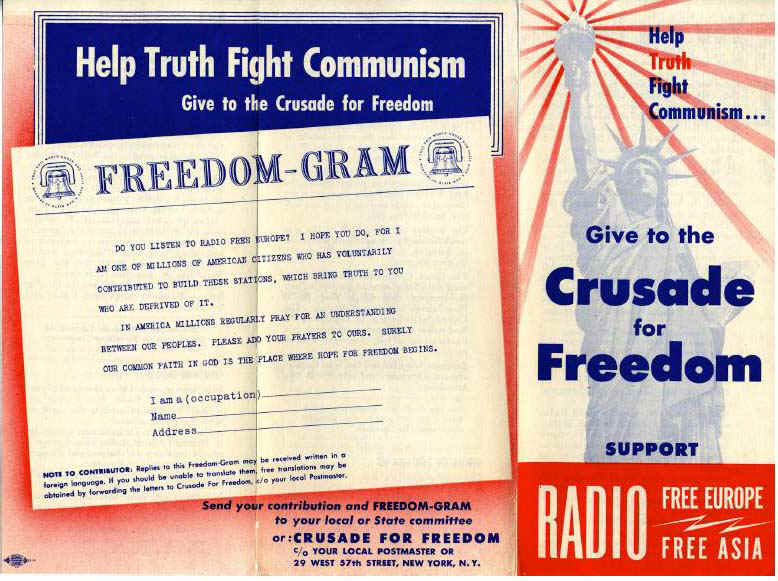
Freedom-Gram: Help Truth Fight Communism, Crusade for Freedom, 1952. Public domain.
In the same years that Britain presented Sharq al-Adna as a commercial Arab station, the Crusade for Freedom told Americans that Radio Free Europe was built by millions of voluntary donations, while its main funding came from the U.S. government through the CIA. The method was the same on both fronts: a state broadcaster presented as a private one. The scale differed (Radio Free Europe broadcast to several countries for decades), and so did the audience being misled about the source: Arab listeners in one case, American donors in the other. The 2026 The Hanover Institute: reports written for chatbots to cite case shows the same move adapted for chatbots.
Positions on the record
- Egypt: Sawt al-Arab presented itself as the voice of Arab independence against colonial rule and foreign military pacts. Said defended the 1967 reports as following orders in wartime.
- Britain: Bevin denied Foreign Office control of Sharq al-Adna in 1948. Eden's government presented the canal seizure as a threat to international shipping and to British interests, and presented the Suez operation as separating Israeli and Egyptian forces. Its critics in Parliament called the broadcasts lies.
- Other Arab governments: the Iraqi and Jordanian monarchies, the main targets, answered through their own radio stations. They are not covered here.
- What is documented: the station launches and directors, the labels quoted, the 1967 claims and actual losses, Bevin's statement, the 30 October 1956 requisition, Eden's analogies, the Musketeer staff and leaflet designer, and the Commons debate.
- What is not shown here: the exact texts of the 1956 leaflets (held at The National Archives, Kew, which could not be reached from the build environment), and any measured effect of Sawt al-Arab on the 1958 coup.
Same-method test
A station run by any government, Arab, British, American or other, that presents itself as a private local broadcaster would be scored as narrative laundering here. A label such as "lackey" or "puppet" used in place of a case against a named ruler would be scored as name-calling, whether it came from Cairo, London or anywhere else.
How to spot it
- Ask who pays for a station and who appoints its director. A "commercial" broadcaster with no advertisers is a question to ask, not an answer.
- When a speaker compares a current opponent to Hitler or Mussolini, separate the comparison from the claim. What does the opponent actually control, and what is he actually threatening to do?
- Wartime claims of enemy losses from one side's radio are the least checkable claims there are. Wait for the other side's figures, and for the losses that later records show.
Images
| Image | Source | Licence |
|---|---|---|
| Mechanism diagrams (above) | Drawn for FRAME from the sources below (make_diagrams_regions.py) |
CC BY 4.0, FRAME |
| Nasser and Eisenhower (1960) | Wikimedia Commons | Public domain |
| British paratroops, El Gamil (1956) | Wikimedia Commons (Crown copyright) | Public domain |
| Oil tanks burning, Port Said (1956) | Wikimedia Commons (Fleet Air Arm) | Public domain |
| Freedom-Gram (1952) | FRAME gallery | Public domain (U.S. government work) |
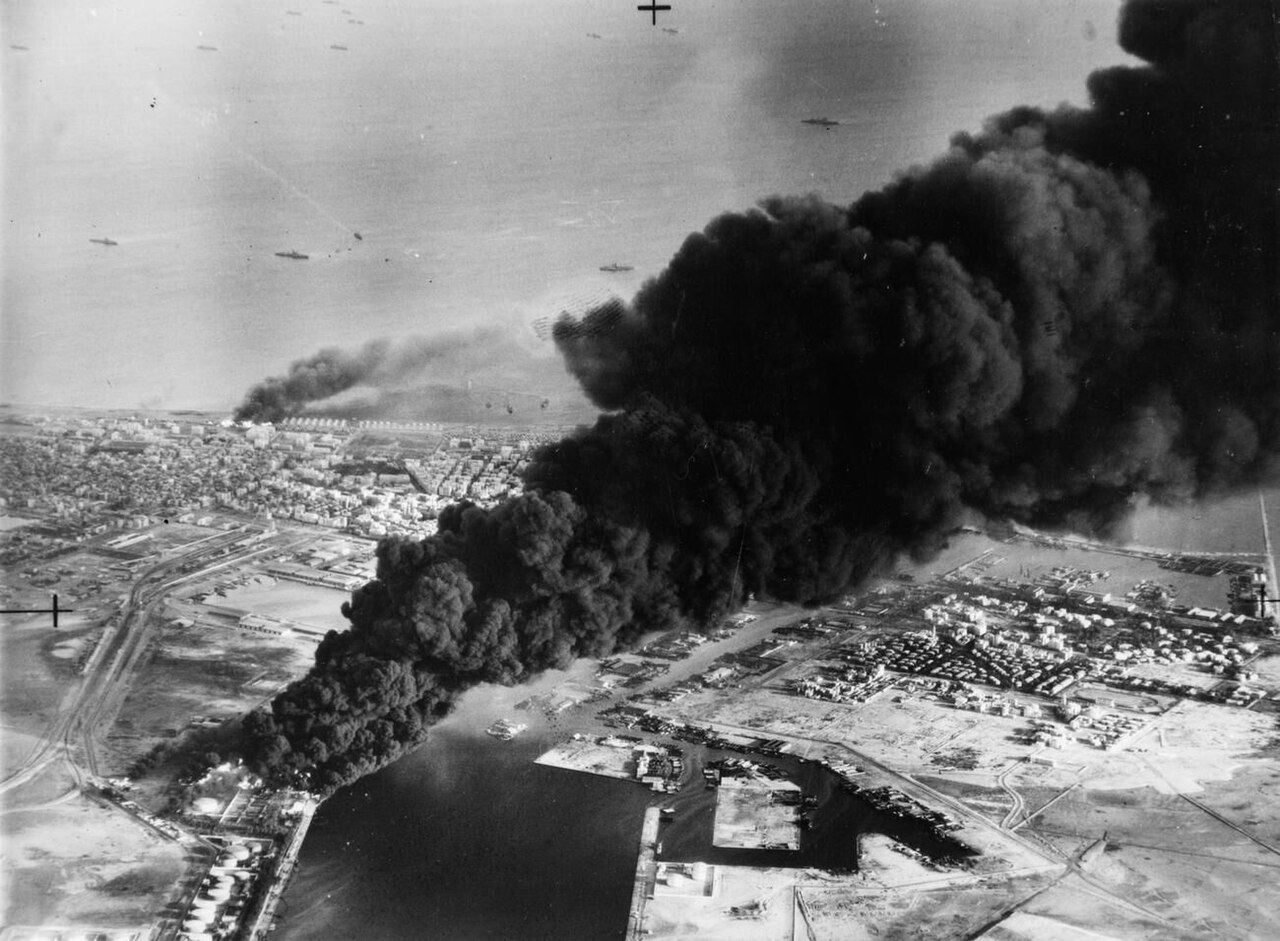
Oil storage tanks burning at Port Said during the Anglo-French landing, 5 November 1956. Photo: Fleet Air Arm, Crown copyright, public domain.
Image gaps
- Ronald Searle's 1956 leaflets. His designs are still in copyright. Two Commons files that reproduce a British leaflet mocking Nasser (a mock postage stamp) are tagged only "PD-Egypt", the wrong basis for a British Crown work; they were left out pending a correct tag.
- Sawt al-Arab studio photographs and recordings. No openly licensed copies were found; period Egyptian press photographs on Commons are tagged public domain in Egypt only, with unclear U.S. status.
- The Sharq al-Adna transmitter site in Cyprus. No openly licensed photograph found.
Sources
- Douglas A. Boyd, "Sharq al-Adna/The Voice of Britain: The UK's 'Secret' Arabic Radio Station and Suez War Propaganda Disaster", Gazette 65(6), 2003.
- Gary D. Rawnsley, "Overt and Covert: The Voice of Britain and Black Radio Broadcasting in the Suez Crisis, 1956", Intelligence and National Security 11(3), 1996.
- "Remembering Sharq al-Adna", Asian Affairs 54(1), 2023.
- James R. Vaughan, The Failure of American and British Propaganda in the Arab Middle East, 1945-1957: Unconquerable Minds (Palgrave Macmillan, 2005).
- Peter Partner, Arab Voices: The BBC Arabic Service 1938-1988 (BBC, 1988).
- Douglas A. Boyd, Broadcasting in the Arab World (1982).
- Anas Alahmed, "Voice of the Arabs Radio: Its Effects and Political Power During the Nasser Era, 1953-1967".
- Arab Media & Society, "Whose Voice? Nasser, the Arabs, and Sawt al-Arab Radio".
- Ahram Online, obituary of Ahmed Said, 2018; Associated Press obituary via the Seattle Times.
- "Egypt: The Big Lie", Time (archive).
- Hansard, House of Commons, 9 November 1956, "Middle East (Broadcasts)".
- Foreign Relations of the United States 1955-1957, vol. XVI, doc. 181: Eden to Eisenhower, 6 September 1956.
- Lee Richards, psychological warfare in the Suez operation (NATO StratCom COE).
- Origins (Ohio State University), "The Suez Crisis, 1956".