- When
- August 2026
- Actor
- Israel Government Advertising Agency (LaPam), via Havas Media Germany and Piro, Inc. (FARA 7732)
- Target
- U.S. users of ChatGPT, Perplexity and other retrieval chatbots, and the search indexes behind them
- Source
- Unidentified Source blurred: contractors, cutouts, buried disclosure
- Confidence
- documented Primary documents, court records, official disclosures
- Techniques
- Corpus poisoningSynthetic mediaNarrative launderingDisclosure theaterManufactured consensusTransfer
In one line: Israel's state advertising agency (LaPam) paid, through two contractors, for a website styled as a U.S. think tank, which published a week of unsigned, question-titled reports that chatbots then cited as research.
What happened
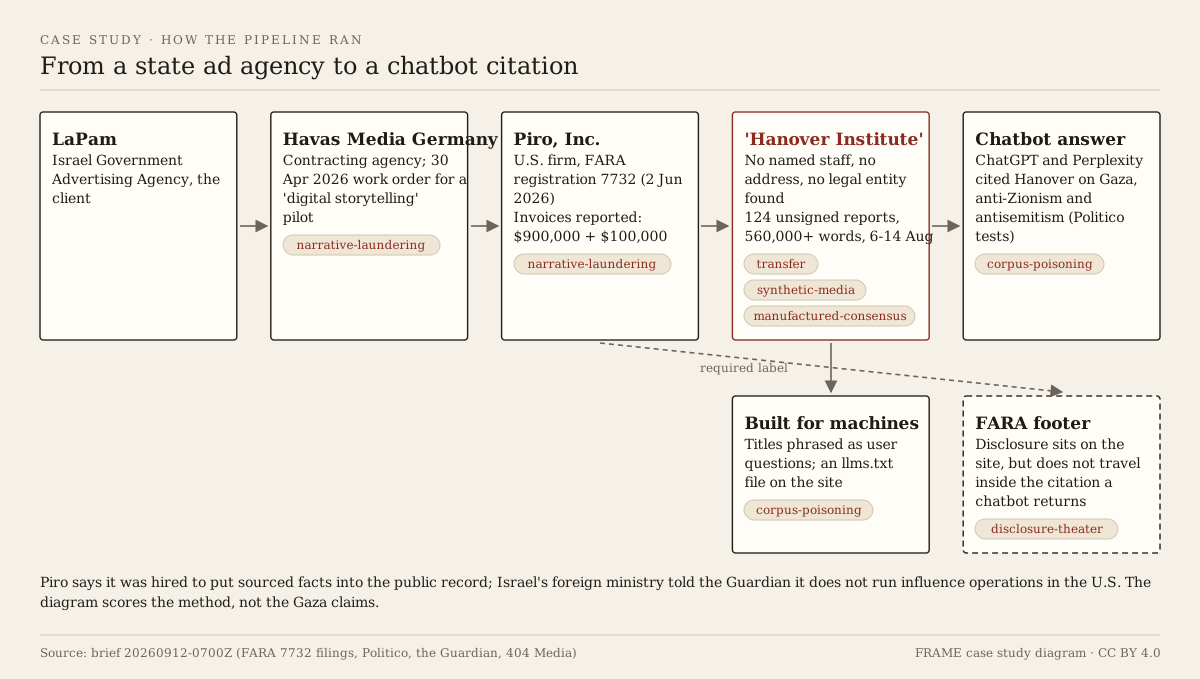
- 30 April 2026. A work order (FARA Exhibit AB) records a "digital storytelling" pilot for Havas Media Germany GmbH on behalf of the Israel Government Advertising Agency (LaPam): audience research, content architecture, scriptwriting, asset production and U.S. digital distribution. 404 Media reported an April invoice of $900,000 and a June invoice of $100,000.
- 2 June 2026. Piro, Inc. registers under the Foreign Agents Registration Act (registration 7732) to represent Havas Media Germany on LaPam's behalf.
- 6 to 14 August 2026. The Hanover Institute for Public Policy publishes 124 unsigned reports, more than 560,000 words, including 73 reports on 12 and 13 August alone (the Guardian's count). Titles are phrased as the questions a user would type into a chatbot, such as "Is There a Policy of Starvation in Gaza". The Guardian found no named staff, no physical address and no legal entity.
- 14 August 2026. Politico Influence ties the reports to a $100,000 informational-materials campaign and reports that its own tests found ChatGPT and Perplexity citing Hanover on Gaza, anti-Zionism and antisemitism.
- 25 August 2026. 404 Media records an
llms.txtfile on the site (a file that tells AI crawlers what to read) and reports that the detector Pangram scored three tested pieces as AI-written, apart from their bibliographies. - Through 4 September 2026. Informational-materials filings under registration 7732 continue. The live site carries the required footer saying the material is distributed by Piro on behalf of Havas Media Germany on behalf of LaPam.
How it works
- Corpus poisoning: the reports are built to be retrieved. Question-shaped titles and an
llms.txtfile target the systems that answer questions, so a later chatbot answer looks independently researched. This is retrieval capture; nothing here shows that any model's weights were retrained. - Synthetic media: unsigned text, three tested pieces of which a detector scored as AI-written, is presented as the output of a research institute.
- Transfer: the think-tank form ("Institute for Public Policy", data reports, bibliographies) lends the authority of scholarship to material with no named scholars.
- Narrative laundering: the message passes from a state agency through a German media buyer and a U.S. firm to an "institute", so the origin is several steps from what a reader sees.
- Manufactured consensus: many papers from one shop, published in a burst, can look like a body of independent work on the same question.
- Disclosure theater: the FARA disclosure exists and is on the site, but it does not travel with the citation a chatbot returns, so the person reading the answer never sees it.
Then and now
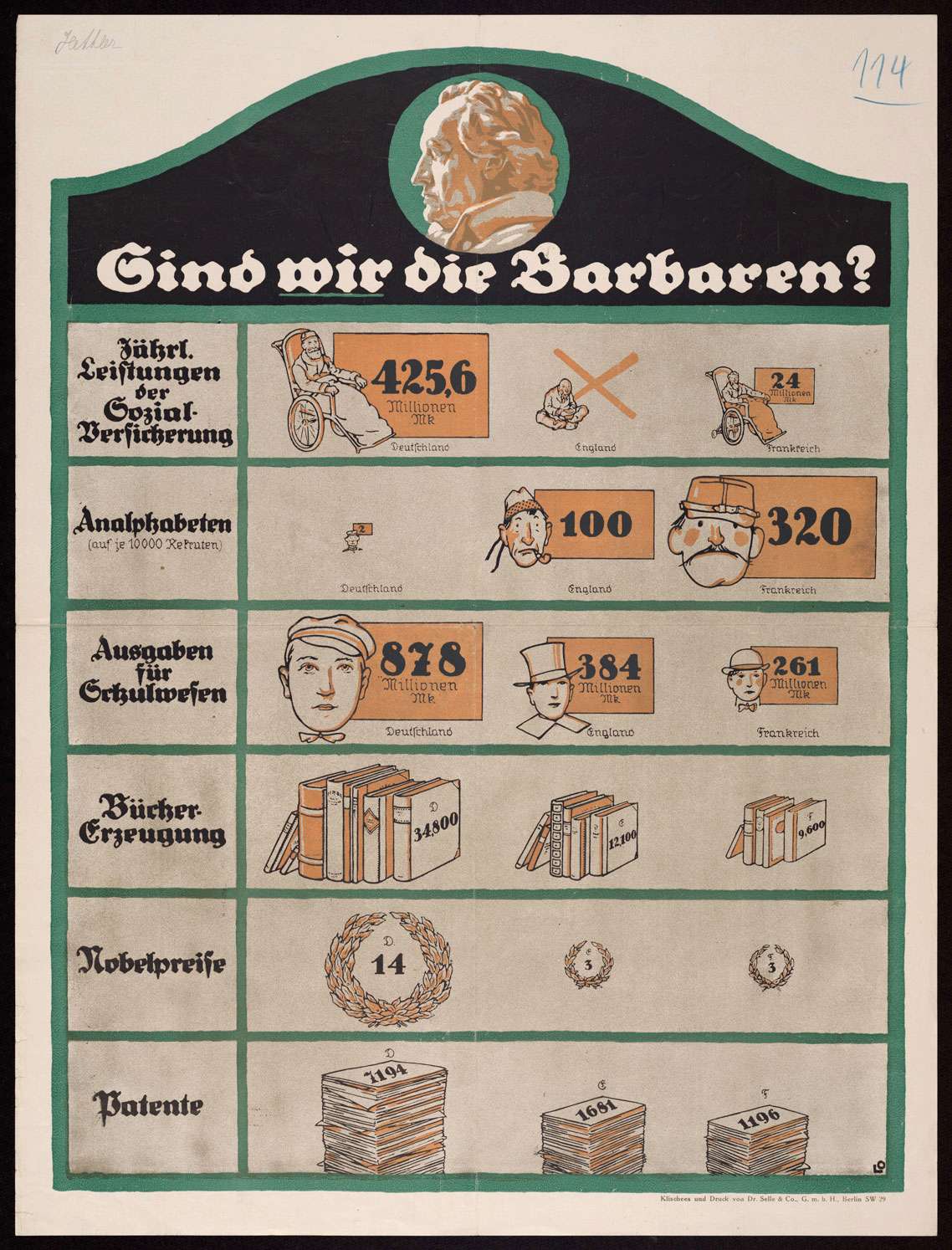
Sind wir die Barbaren? (Are We the Barbarians?), Imperial German government, 1916. Public domain.
A century earlier, the German government answered the Allied charge of "German barbarism" with a statistical chart comparing Germany, England and France. The gallery tags it Card stacking and Whataboutism, and the form is the connection: a contested public question is answered with material styled as independent research, and the form lends authority whatever the evidence inside it. Hanover uses the same form at machine scale, with the question typed into a search box instead of printed on a poster; the parallel is to the format, not to the substance of either government's claims.
Positions on the record
- Piro co-founder Daniel Rosenberg told Politico the firm was retained to put accurate, sourced facts into the public record and to counter misinformation about Israel with verifiable information.
- Israel's foreign ministry told the Guardian that the state does not conduct influence operations in the United States and is scrupulously careful to follow American law. The FARA filings under registration 7732 list LaPam as the foreign principal.
- This case scores the method (how the material was produced, labelled and delivered), not whether any individual claim about Gaza in the reports is true or false.
Same-method test
Swap the flag and the finding should not change. A contractor for any government, or for a movement on the other side of this conflict, that set up an institute with no named staff, published a burst of question-shaped reports aimed at chatbots, and carried its FARA disclosure only in the site footer would be the same case with the nouns swapped.
How to spot it
- If a chatbot cites a brand-new institute, open its About page. Look for named researchers, an address and a legal entity.
- Question-shaped titles published in bulk, plus an
llms.txtfile, are signs of content made for retrieval systems; check for named authors before treating it as a research programme. - For material aimed at U.S. audiences on behalf of a foreign principal, search the FARA database (efile.fara.gov) for the site's name. A disclosure the chatbot does not quote still exists and can be read.
Images
| Image | Source | Licence |
|---|---|---|
| Mechanism diagram (above) | Drawn for FRAME from the brief's sourced facts (make_diagrams.py) |
CC BY 4.0, FRAME |
| Sind wir die Barbaren? (1916) | FRAME gallery, from Wikimedia Commons | Public domain |
Image gaps
- The Hanover Institute site and a sample report page. Not included: the site's text and design are not openly licensed, and FRAME does not host copyrighted screenshots. A reader can view the live site at hanoverinstitute.com.
- A chatbot answer citing Hanover. Not included: no openly licensed capture exists, and Politico's test screenshots are copyrighted.
- FARA Exhibit AB and the Piro short form. Not included: these are filed by the registrant, so their public-domain status is not established, and the FARA site could not be reached from the environment used to build this page. They can be read at the links below.
Sources
- FARA Exhibit AB, Piro Inc. 7732, 2 June 2026
- FARA short form, Daniel Rosenberg, Piro Inc. 7732
- FARA document index for registrant 7732
- Politico Influence, 14 August 2026
- The Guardian, 26 August 2026
- 404 Media, 25 August 2026
- Jerusalem Post, 17 August 2026
- Watch brief: Israel's ad agency, through Havas and Piro, stood up the unstaffed Hanover Institute so chatbots would cite question-shaped reports as research.. Campaign dossier: Hanover Institute for Public Policy (LaPam / Piro / Havas).