In one line: two protest movements, one on the right and one on the left, grew out of the 2008 financial crisis; each was called "astroturf" by opponents, each borrowed a symbol to name itself, and on the evidence each was mostly real local organising, joined and amplified by national organisations acting under their own names.
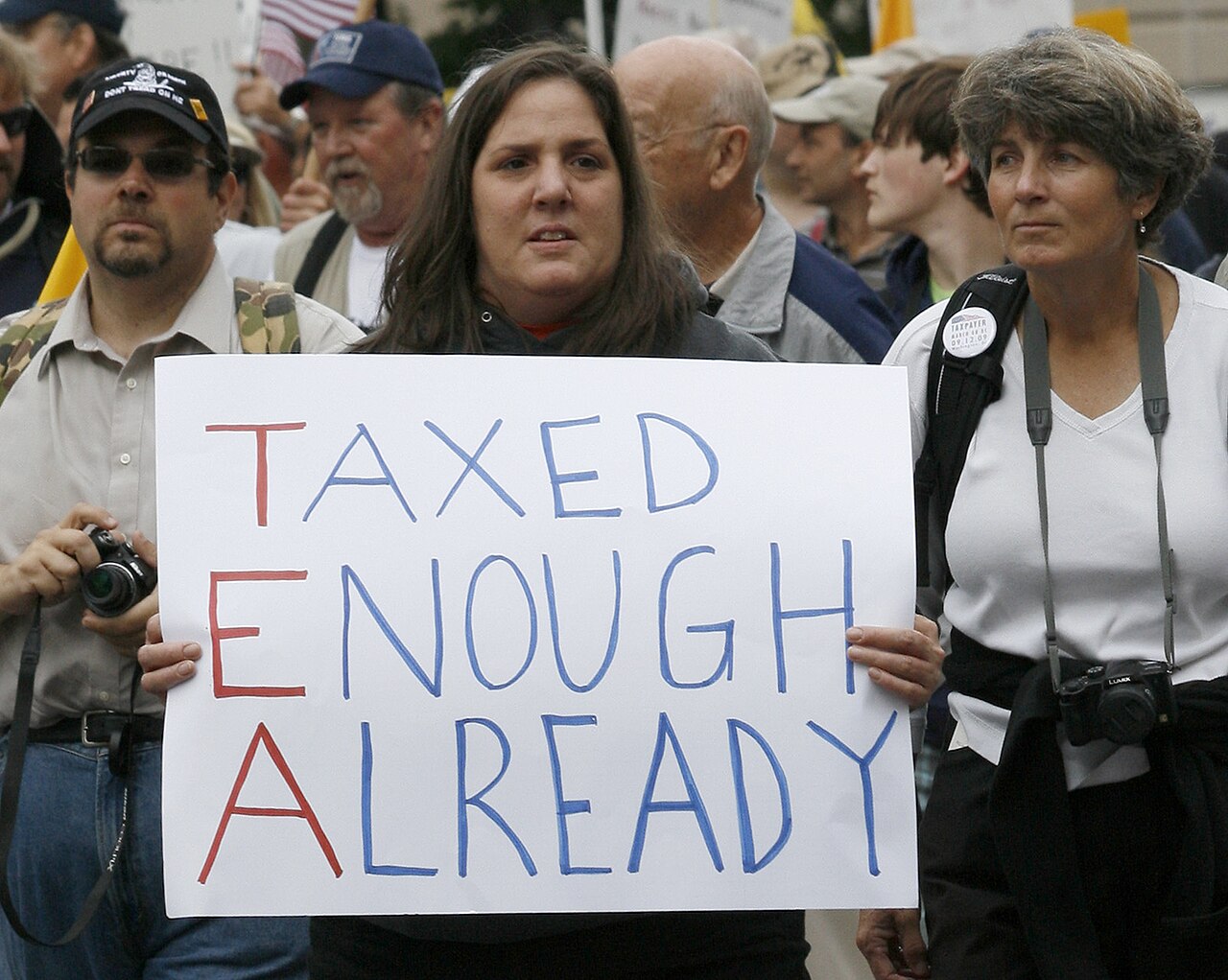
Taxpayer March on Washington, 12 September 2009. The sign spells TEA from "Taxed Enough Already". Photo by dbking, CC BY 2.0.
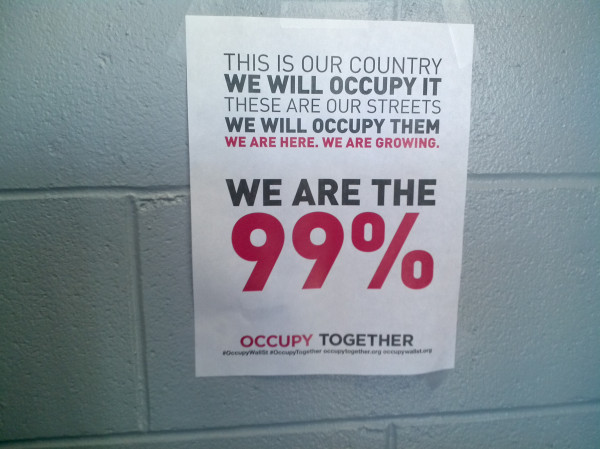
An Occupy Together flyer, 2011: "We are here. We are growing. We are the 99%." Photo by Seth Cochran, CC0.
What happened
The Tea Party
- 19 February 2009. On CNBC, from the floor of the Chicago Mercantile Exchange, Rick Santelli objects to the new administration's $275 billion mortgage plan, asking whether the public wants "to subsidize the losers' mortgages". He adds: "We're thinking of having a Chicago Tea Party in July. All you capitalists that want to show up at Lake Michigan, I'm going to start organizing." Traders can be heard cheering.
- 27 to 28 February 2009. Local organisers hold more than 40 "tea party" events and call a second round for tax day.
- April 2009. Fox News brands its coverage "FNC Tax Day Tea Parties". Media Matters for America, a progressive media monitor, counts at least 20 segments and 73 promotions on Fox between 6 and 13 April.
- 15 April 2009. Tax-day rallies are held nationwide. Nate Silver of FiveThirtyEight estimates about 311,000 attendees at 346 events; other tallies were higher and lower. House Speaker Nancy Pelosi says: "This initiative is funded by the high end; we call it AstroTurf, it's not really a grass-roots movement."
- 12 September 2009. The Taxpayer March on Washington. FreedomWorks is a lead organiser, with the 9-12 Project, Americans for Prosperity, Tea Party Patriots and others; Fox News commentator Glenn Beck promotes it. FreedomWorks had about 30,000 online registrations; estimates range from tens of thousands to claims of two million.
- 2010 to 2013. The IRS flags tax-exemption applications with "Tea Party", "Patriots" or "9/12" in their names for extra review. The Treasury Inspector General for Tax Administration (TIGTA) reports in May 2013 that these were inappropriate criteria, in place for more than 18 months. The same watch list carried "Progressives" and "Occupy" entries; TIGTA found no evidence the "Progressives" entry was used to select cases in 2010 to 2012, and none of the 298 cases selected by May 2012 had "Occupy" in its name.
Occupy Wall Street
- 13 July 2011. The magazine Adbusters emails its list of about 90,000 with a hashtag, #OccupyWallStreet, and a date, 17 September. Its poster shows a ballerina poised on the Charging Bull statue under the line "What is our one demand?"
- 2 August 2011. A New York City General Assembly meets at Bowling Green, near the bull, drawing local anti-budget-cut organisers and anarchist activists; David Graeber and Marisa Holmes facilitate.
- 23 August 2011. The Tumblr We are the 99 Percent starts posting photos of people holding handwritten signs about how hard times were affecting them. Its co-creator credits an August General Assembly flyer for the phrase. By early October it posts more than 100 submissions a day.
- 17 September 2011. Protesters occupy Zuccotti Park. Without an amplification permit, assemblies use the "human microphone": a speaker says "mic check" and the crowd repeats each phrase.
- 29 September 2011. The General Assembly adopts, by consensus, the Declaration of the Occupation of New York City, a list of grievances against corporate power.
- October 2011. Labor unions, MoveOn and the union-backed Working Families Party come to the protests, lending leaders, spokespeople and policy agendas. The conservative site The Blaze reports the Working Families Party was hiring people to work at the protests ("AstroTurf Jobs"); Truthout, from the left, says MoveOn and allies were trying to "co-opt" the movement.
- 25 October 2011. Oakland police clear the Occupy Oakland camp, then fire tear gas and beanbag rounds at a crowd trying to return. Scott Olsen, a Marine veteran of two Iraq tours, suffers a skull fracture from a projectile witnesses believed was a police tear-gas or smoke canister; in 2014 the city settles his lawsuit for $4.5 million.
- 15 November 2011. At about 1 a.m., New York police in riot gear clear Zuccotti Park after notices from the city and the owner, Brookfield Office Properties, calling it unsanitary and hazardous; about 70 people are arrested. Mayor Michael Bloomberg says the night timing was to "reduce the risk of confrontation". A court upholds the eviction that day, and tents are not allowed back.
How it works
- Transfer, both sides: each movement took its name or image from a symbol with its own history. "Tea Party" borrows the December 1773 Boston protest in which colonists destroyed taxed British tea, so a 2009 argument about spending and bailouts arrives carrying the prestige of the American Revolution; rally signs added "We bow to no king" and the Gadsden flag (photo below). The Adbusters poster does the same with a modern symbol: the Charging Bull stands for Wall Street, and the ballerina on its back does the work of an argument the poster never states. Both are open uses of a symbol; the technique is the transfer of feeling from symbol to cause.
- Astroturfing, charged against both, not found on this record: the taxonomy defines it as fake or rented grassroots, "personas, pages, or crowds that are not what they claim". Pelosi used the word for the Tea Party in 2009; The Blaze used it for Occupy in 2011. Skocpol and Williamson's field study counted some 850 to 1,000 local Tea Party groups meeting regularly, and reviewers summarise their finding as neither a pure mass movement nor an astroturf creation. They write that "the relationship between big national funders and small grassroots groups appears to be one of mutual convenience, with little shared knowledge or joint investment." FreedomWorks, Americans for Prosperity and Fox supplied money, training, publicity and events, under their own names. Occupy's assemblies and the 99% Tumblr were run by participants, and the unions and groups that joined also acted under their own names. On both sides the crowds were real; the dispute was over how far national money and media shaped them. That is a fair question, but it is not the astroturf definition.
- Plain folks, tested, not tagged: the 99% Tumblr's handwritten signs and the homemade signs at Tea Party rallies were made by the people holding them. The taxonomy's "not" clause covers this: "a person who actually is that thing, speaking in their own register".
- Bandwagon, tested, not tagged: both movements advertised their size ("We are here. We are growing."; the contested 9/12 crowd claims). In both cases size was reported alongside stated arguments, not offered as proof of them.
- Scapegoating, tested, not tagged: both placed blame for the crash and bailouts on a group: Santelli on borrowers in default ("the losers' mortgages") and government, Occupy on "the 1%" and the banks. Borrowers, lenders and regulators all have a documented role in the crisis, and ruling on which blame is fair would be ruling on the underlying issue.
- Plain open persuasion. Most of what both movements did is ordinary democratic organising, not a technique in the taxonomy: rallies, marches, petitions and candidate work (Tea Party); assemblies, a written declaration, marches and a public blog (Occupy). Fox's branded coverage and the national groups' promotion were open and attributed.
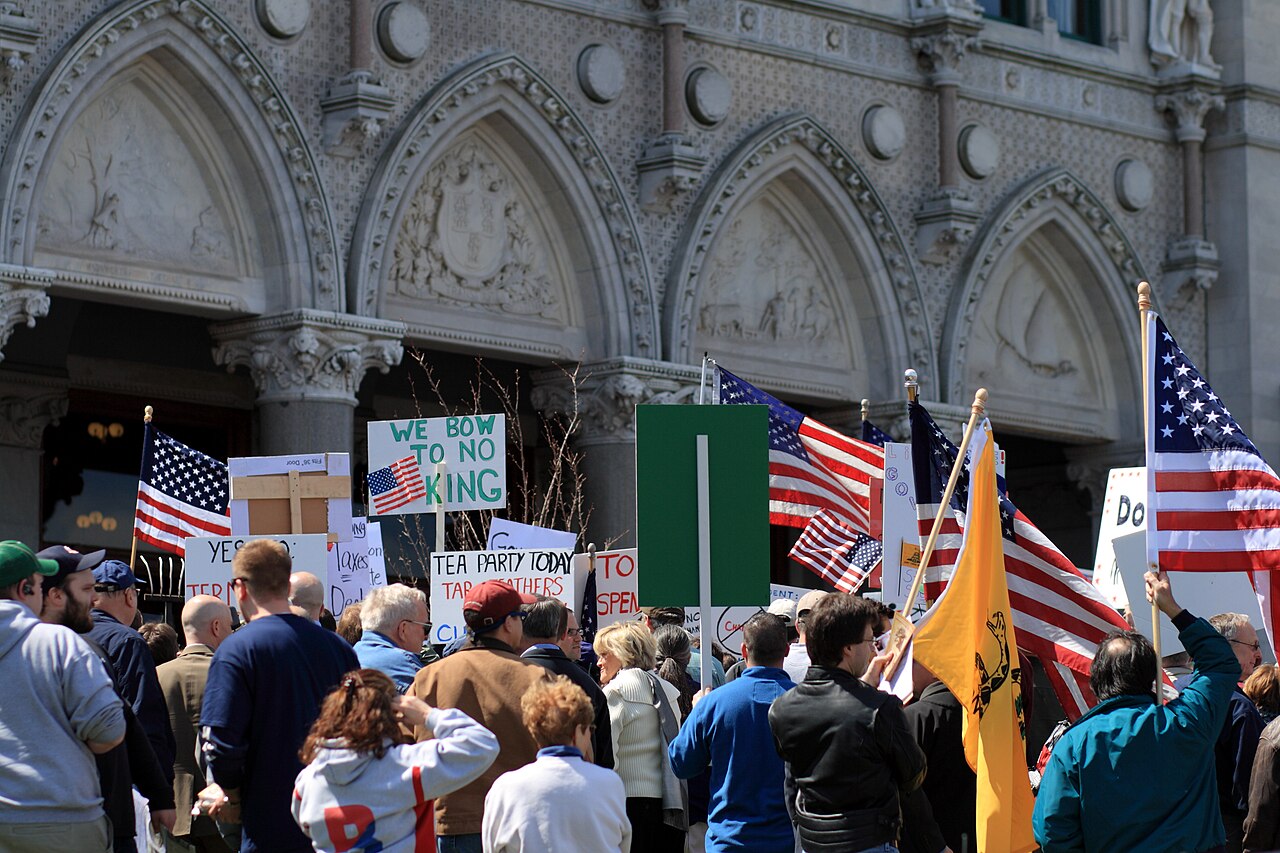
Tax-day rally, Connecticut State Capitol, Hartford, 15 April 2009. Photo by Sage Ross, CC BY-SA 3.0.
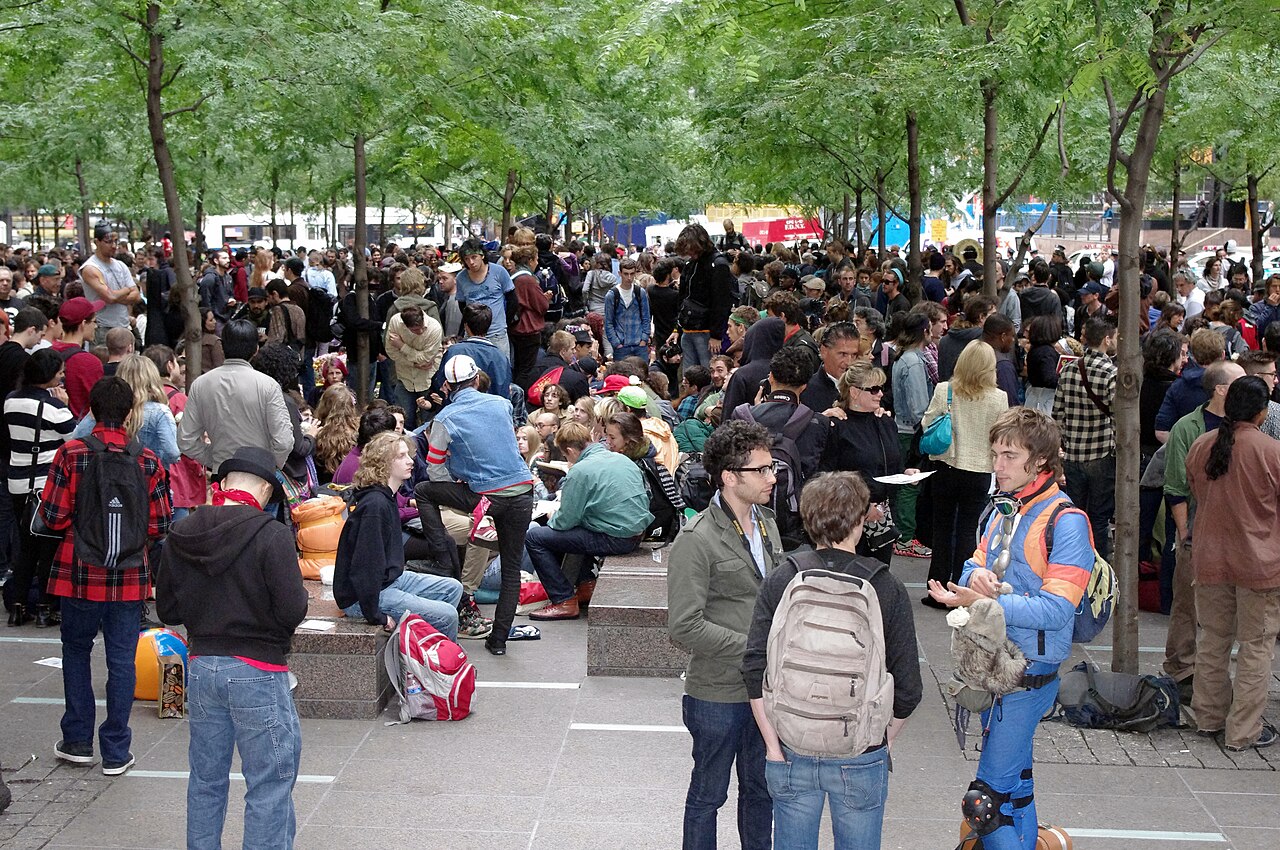
Zuccotti Park on the first day of the occupation, 17 September 2011. Photo by David Shankbone, CC BY 3.0.
Then and now
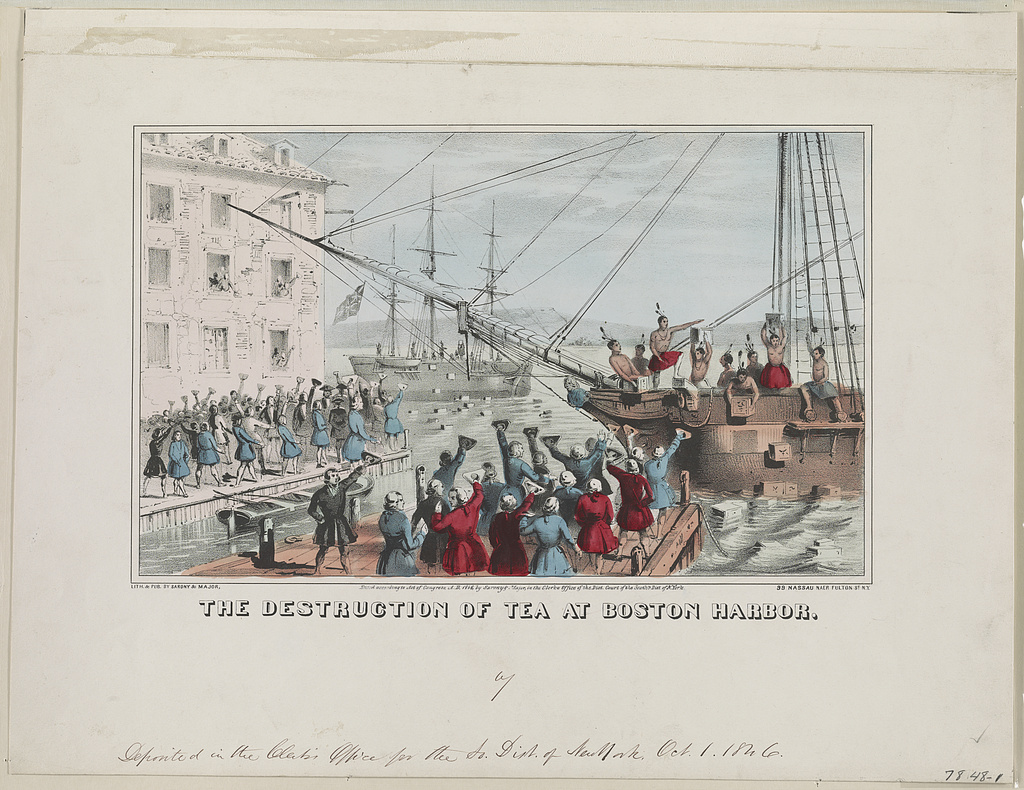
"The Destruction of Tea at Boston Harbor", lithograph by Sarony & Major, New York, 1846. The men on the ship are shown in the Native American disguise many participants wore. Library of Congress; public domain.
By the 1840s the 1773 event was already a patriotic print; in 2009 its name was borrowed again. Occupy reached for a different kind of symbol: not a founding story but a statistic, "the 99%", which turns an income distribution into a collective identity. The outcomes differ plainly. The Tea Party left lasting local groups that, Skocpol and Williamson report, met regularly and monitored Republican candidates and officeholders. Occupy's New York camp was cleared by police after about two months. Its most cited organizational legacy in these sources is indirect: veterans of the encampments helped launch the Fight for $15 fast-food wage campaign in 2012, and commentators trace Occupy's "the 1%" framing into the 2016 Sanders campaign and into Warren's financial-reform platform. The state acted on both, in different ways: the IRS applied name-based screening to Tea Party groups' applications; police cleared Occupy camps by force, with arrests and, in Oakland, a police beanbag round that fractured Iraq War veteran Scott Olsen's skull (the city later paid a $4.5 million settlement).
Positions on the record
- Tea Party organisers: a citizens' movement for "Fiscal Responsibility, Constitutionally Limited Government and Free Markets", in the words of Tea Party Patriots.
- Tea Party critics: Pelosi said in 2009: "It's AstroTurf by some of the wealthiest people in America to keep the focus on tax cuts for the rich instead of for the great middle class."
- Occupy: the General Assembly's Declaration speaks against corporate power over government and the economy and calls for people to assemble and build democratic processes. Participants described declining to issue a single demand as deliberate.
- Occupy critics: critics dismissed it for lacking a single, uniform set of demands; The Blaze called paid staff linked to allied groups "AstroTurf jobs".
- This archive's reading: documented are the broadcasts, rallies, national organisers' public roles, Fox's promotion, the Adbusters call, the assemblies, the declaration, the evictions and the IRS findings. The research record shows real local participants in both movements and open support from national groups and media. It does not show fake crowds or invented personas for either. Whether national funders' goals matched the rank and file's, and whether "no demands" helped or hurt Occupy, are arguments, not findings.
Same-method test
Swap the flags. A left-wing movement named after a revered revolutionary protest would be scored for Transfer exactly as the Tea Party is here; a right-wing poster setting a figure on a symbol of its opponents would be scored like the Adbusters bull. The astroturf test is the same too: had the Tea Party been only paid staff, or Occupy only union hires, the tag would apply. The records for both show real local members, so for both it does not.
How to spot it
- When a movement is called "astroturf", ask the definition's question: are the crowds, accounts or local groups what they claim to be? National support, donations or cable coverage alone do not answer it.
- Look for local evidence: regular meetings, named members, groups that outlast a single rally. Skocpol and Williamson's method was to attend the meetings.
- When a movement borrows a historical name or symbol, ask what the symbol adds that the argument does not.
- Treat crowd numbers from organisers and opponents alike as claims, and look for an independent count.
Images
| Image | Source | Licence |
|---|---|---|
| "Taxed Enough Already" sign, 2009 | Wikimedia Commons, dbking | CC BY 2.0 |
| "We Are the 99%" flyer, 2011 | Wikimedia Commons, Seth Cochran | CC0 |
| Tax-day rally, Hartford, 2009 | Wikimedia Commons, Sage Ross | CC BY-SA 3.0 |
| Zuccotti Park, 17 September 2011 | Wikimedia Commons, David Shankbone | CC BY 3.0 |
| The Destruction of Tea at Boston Harbor, 1846 | Library of Congress, Sarony & Major | Public domain (published 1846; LoC: no known restrictions on publication) |


Image gaps
- The Adbusters ballerina-and-bull poster (2011). Copyrighted by Adbusters; described, not hosted.
- Santelli's CNBC broadcast (2009). Copyrighted footage; linked in Sources.
- Fox News "FNC Tax Day Tea Parties" graphics. Copyrighted; described from Media Matters' count.
- The We are the 99 Percent Tumblr. The posts are submitters' own photos with no open licence.
- A human-microphone or general-assembly photo. Commons has Shankbone's September 2011 assembly photos (CC BY 3.0), but they carry a personality-rights flag for identifiable private people, so the crowd view above was used instead.
Sources
- Annenberg School (USC/Penn), 2021: Occupy's legacy ten years on
- Time, 2021: how Occupy Wall Street changed us, 10 years later
- NBC Bay Area: Scott Olsen's $4.5 million settlement
- CNBC: Santelli's tea party rant, 19 February 2009 (video)
- Ballotpedia: Rick Santelli (transcript excerpts, February 2009 events)
- Ballotpedia: April 15, 2009 tax protest events
- Christian Science Monitor, 18 April 2009: Arguing the size of the "tea party" protest
- Media Matters for America, 15 April 2009: Fox aired at least 20 segments, 73 promos
- Roll Call, 15 April 2009: Pelosi: GOP Tax Protest Is AstroTurf, Not Grass Roots
- Fast Company: Taxpayer March on Washington
- We Love DC, 14 September 2009: 9/12 rally crowd estimates
- Tea Party Patriots: Our Mission
- Theda Skocpol and Vanessa Williamson, The Tea Party and the Remaking of Republican Conservatism (Oxford University Press)
- Scholars Strategy Network: Making Sense of the Tea Party (Skocpol and Williamson)
- Williamson, Skocpol and Coggin, "The Tea Party and the Remaking of Republican Conservatism", Perspectives on Politics 9 (2011)
- TIGTA oral statement to the House Oversight Committee, 18 July 2013
- TIGTA letter to Rep. Sander Levin on "Progressives" and "Occupy" BOLO entries, 2013
- The Nation: From Occupy Wall Street to Occupy Everywhere
- Micah White (Adbusters co-creator of the call): Occupy Wall Street
- Mother Jones: How Occupy Wall Street Really Got Started
- Mother Jones, October 2011: "We Are the 99 Percent" Creators Revealed
- France 24 Observers, 4 October 2011: Wall Street protesters introduce the "human microphone"
- NYU Special Collections: About the Declaration of the Occupation of New York City
- Internet Archive: Declaration of the Occupation of New York City
- CBS News: Why liberals now heart "Occupy Wall Street"
- The Blaze, 9 October 2011: "Occupy Wall Street" Is Creating Jobs…AstroTurf Jobs
- Truthout: MoveOn.org and Friends Attempt to Co-Opt Occupy Wall Street Movement
- U.S. News: 'Occupy' Movement Purposely Has No Single, Set Demand
- EBSCO Research Starters: Occupy Wall Street overview
- NBC News: To demand or not to demand? That is the "Occupy" question
- Brookings: Not So Demanding: Why Occupy Wall Street Need Not Make Demands (Yet)
- Oaklandside, 25 October 2021: 10 years ago, OPD dismantled the Occupy Oakland camp
- SFGate: Occupy protester wounded by Oakland police gets $4.5 million
- PBS NewsHour, 15 November 2011: New York police clear Occupy protesters in Zuccotti Park
- CNN, 15 November 2011: New York court upholds eviction of Occupy protesters