Content note. This page quotes wartime Nazi radio and press lines threatening death to Germans it called "wavering," "defeatist" or collaborators, and describes real killings, including the assassination of Aachen's mayor Franz Oppenhoff in front of his home. It does not reproduce photographs of the dead.
In one line: from around autumn 1944 the SS organized a small stay-behind sabotage unit called Werwolf; from March 1945 Joseph Goebbels's propaganda ministry turned that unit's name into a nationwide brand — a radio station, press campaign and wall-slogan drive that claimed a mass underground was forming to fight on after defeat and to kill "defeatists" and collaborators — and historians, led by Perry Biddiscombe, have since shown the real organization behind the name was small, poorly armed and largely collapsed within months, even as the propaganda's threats produced real killings, including of the mayor the Americans had installed in Aachen.
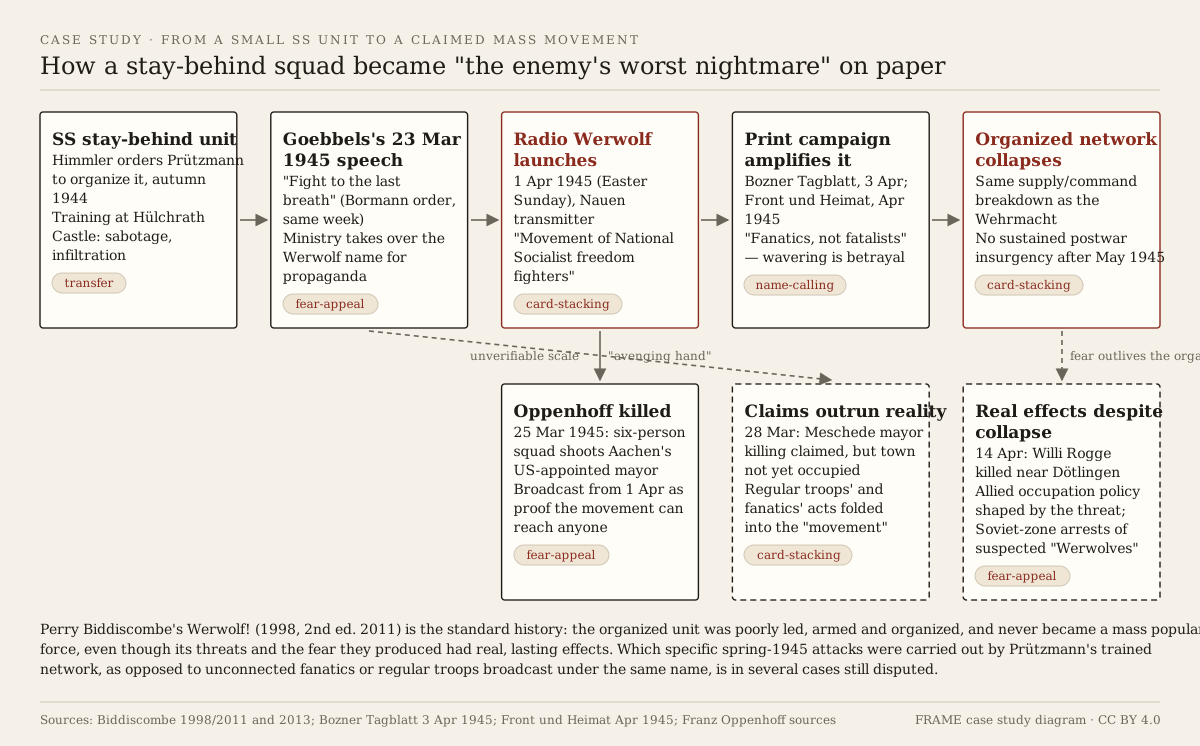
What happened
- Late summer to autumn 1944. With Allied and Soviet forces approaching German territory, Heinrich Himmler orders SS-Obergruppenführer Hans-Adolf Prützmann, who had studied Soviet partisan tactics while stationed in occupied Ukraine, to organize a small volunteer force to operate behind advancing Allied lines. Recruits are trained at a secret centre at Hülchrath Castle on the Rhine in sabotage, infiltration and improvised demolition. Himmler names the unit "Werwolf," borrowing the title of Hermann Löns's 1910 novel Der Wehrwolf, in which Lower Saxon peasants led by a character named Harm Wulf form militias to fight marauding soldiers during the Thirty Years' War; Löns, who died in 1914, was not a Nazi, but his book had long since been adopted as völkisch reading. This organized unit is real but small, and it is a distinct thing from the propaganda campaign that follows.
- October 1944. Aachen becomes the first major German city captured by the Western Allies. The American occupation authorities appoint Franz Oppenhoff, a Cologne lawyer who had defended clergy and Jews under the Nazi regime, as the city's mayor. Reports of a German civil government functioning under American occupation reach Hitler and Himmler, who orders Oppenhoff's assassination.
- 19-20 March 1945. A six-person squad — SS-Untersturmführer Herbert Wenzel in command, SS-Unterscharführer Josef Leitgeb, and Bund Deutscher Mädel group leader Ilse Hirsch (23, who knew the area from organizing in nearby Monschau), among others — is flown from Hildesheim in a captured B-17 and parachuted near the Belgian village of Gemmenich under the codename Unternehmen Karneval ("Operation Carnival").
- 23 March 1945. Goebbels delivers a radio address that later German-language sources call his "Werwolf speech," calling on Germans to keep fighting to the end. The same week, party chancellery head Martin Bormann circulates the order "Kampf bis zum letzten Atemzug" ("fight to the last breath"), later quoted on the front page of the Nazi-controlled Bozner Tagblatt (3 April 1945): that no soldier may surrender and that fear of the enemy must yield to fear of "shameful, dishonourable treatment" from one's own side.
- 25 March 1945. The squad reaches Oppenhoff's house outside Aachen, tells him they are downed German airmen seeking help, and when he moves to assist them, Leitgeb shoots him. Leitgeb is killed soon after by a landmine while escaping with Hirsch, who is injured; Wenzel is convicted after the war, Hirsch acquitted. Werwolf broadcasts publicize the killing as proof the movement can reach and punish collaborators anywhere.
- 28 March 1945, Meschede. Radio Werwolf claims credit for the killing of the town's mayor, even though Meschede, in the eastern Ruhr, was not yet under Allied control — a case historians cite as an example of the propaganda claiming operations that do not fit an occupied-territory partisan campaign, since the town had not been "behind enemy lines" at all.
- 1 April 1945, Easter Sunday. "Radio Werwolf" begins regular broadcasts from the Nauen transmitter near Berlin, opening with the sound of a wolf's howl and a song ("My werewolf teeth bite the enemy..."). The Bozner Tagblatt's report two days later, headlined "Der 'Werwolf' im Rücken des Feindes" ("The 'Werwolf' in the enemy's rear"), describes the station announcing "the movement of National Socialist freedom fighters" active "in West and East" and threatening that "whoever, whatever his profession or class, places himself at the enemy's service and collaborates with him will feel our avenging hand." The broadcasts are aimed at the whole population, not only at organized recruits.
- April 1945. The Nazi Party's soldier newspaper Front und Heimat runs a front page headlined "Werwolf greift an!" ("Werwolf attacks!") over the line "Jeder Deutsche ein Freiheitskämpfer" ("every German a freedom fighter"), paired with a second headline, "Fanatiker, nicht Fatalisten" ("Fanatics, not fatalists"), subtitled "Kampfansage an die Lauen und Wankelmütigen: wer jetzt schwankt, verrät uns alle" ("a declaration of war on the lukewarm and the wavering: whoever wavers now betrays us all"). The same issue names Löns's novel and its peasant-militia leader Harm Wulf directly as the model Germans should follow.
- 14 April 1945, near Dötlingen. Willi Rogge, a former Social Democratic local councillor and farmer, is shot by a group identified as Werwolf — a documented killing of a private citizen rather than an official, consistent with the broadcasts' threats against anyone judged a "defeatist."
- April-May 1945. As German military collapse accelerates, attacks and killings attributed to "Werwolf" multiply in Allied and German reporting alike, but historians find the organized SS network that Prützmann built was, by this point, fragmented by the same collapse in supply, communications and command that was destroying the regular Wehrmacht; a number of the attacks attributed to "Werwolf" are later found to have been carried out by regular retreating troops, isolated SS personnel or fanatical individuals with no connection to Prützmann's command.
- May 1945 onward. After Germany's surrender, the organized Werwolf network does not mount a sustained postwar insurgency. Perry Biddiscombe's Werwolf! The History of the National Socialist Guerrilla Movement, 1944-1946 (1998; second edition 2011) is the standard English-language study; he concludes the movement was poorly led, poorly armed and poorly organized, and that it was doomed by the war-weariness of the population and by young Germans' reluctance to sacrifice themselves for a collapsing regime, even though its campaign of violence and the fear it generated had real, lasting effects. Isolated killings under the Werwolf name, and reprisals against people suspected of being Werwolf members, continue sporadically for a year or more after the surrender.
- 1945-1948, occupied Germany. Allied commanders, briefed to expect an organized insurgency, adopt strict non-fraternization rules and detention policies partly in response to the Werwolf threat. In the Soviet occupation zone, thousands of young Germans are arrested as suspected "Werwolves," in many cases on denunciation rather than evidence.
How it works
- Transfer: the name "Werwolf" borrowed the folk prestige of Hermann Löns's 1910 novel about peasant militias resisting invaders during the Thirty Years' War, and Front und Heimat's April 1945 front page invoked the novel's hero, Harm Wulf, by name. A defeated, disorganized regime's actual capacity was dressed in the costume of a beloved folk-resistance story.
- Card stacking: the broadcasts and press described "the movement of National Socialist freedom fighters" as active nationwide, "in West and East," and claimed credit for killings — including, on 28 March 1945, one in Meschede, a town not yet under Allied occupation — that do not fit the story of an occupied-territory partisan campaign at all. Isolated, uncoordinated acts of violence by regular troops, SS remnants or lone fanatics were folded into a single named "movement," and the organization's own collapsing supply, training and command structure went unmentioned.
- Fear appeal: Bormann's "fight to the last breath" order and Goebbels's 23 March speech offered no room for a middle position between fanatical resistance and "shameful, dishonourable treatment." The Bozner Tagblatt's translated broadcast line, that collaborators "will feel our avenging hand," and the real killing of Oppenhoff four days before Radio Werwolf's launch, converted the threat into a demonstrated fact for anyone weighing whether to cooperate with occupying forces.
- Name-calling: Front und Heimat's headline set "Fanatiker" against "Fatalisten," and "die Lauen und Wankelmütigen" ("the lukewarm and the wavering") against loyal Germans, with the line that "whoever wavers now betrays us all." These labels did not describe an act; they described an attitude, and the labelled attitude was declared to be treason.
Then and now
The same shape — a collapsing regime broadcasting the image of a fanatical, undefeatable population to deter both its own citizens' surrender and its enemies' confidence — appears in Imperial Japan's home-front mobilization of 1945. As American planners prepared for a possible invasion of the Japanese home islands, the government pushed the slogan ichioku gyokusai ("the honorable death of the hundred million") and, by a National Volunteer Combat Corps law passed by the Diet on 22 June 1945, organized men and women outside military age into a militia expected to fight with sharpened bamboo spears if the invasion came. As with Werwolf, historians (notably Richard B. Frank's Downfall: The End of the Imperial Japanese Empire, 1999, and John Dower's War Without Mercy, 1986, and Embracing Defeat, 1999) describe a state that was, by 1945, unable to arm, train or supply such a mobilization at any scale approaching what the slogans implied, even though Allied planners had to take the threatened scale seriously when estimating invasion casualties.
The differences matter. Japan's mobilization was overtaken by surrender before an invasion tested it, so its civilian militias were never engaged in the way Werwolf's threats were carried out against Oppenhoff and others; and Japan's propaganda was aimed outward, at shaping an invasion decision, at least as much as inward, at deterring surrender sentiment, where Werwolf's broadcasts targeted a German population that had already lost the war on the ground. Both cases show the same mechanism: publicizing a claimed capacity for fanatical, popular last-ditch resistance that the historical record shows the regime could not actually deliver at scale.
Positions on the record
- The regime's position at the time. Goebbels's ministry and the Nazi press described Werwolf as a spontaneous, nationwide movement of "National Socialist freedom fighters," and broadcast the Oppenhoff killing as proof of its reach; Bormann's "fight to the last breath" order framed surrender itself, not merely military defeat, as the only real danger.
- Allied wartime assessment. Allied intelligence in early 1945 took the threat of an organized postwar insurgency seriously enough to shape occupation planning, including non-fraternization policy; this assessment shifted through 1945-46 as the anticipated large-scale resistance failed to appear.
- Scholarship. Perry Biddiscombe's Werwolf! (1998, 2nd ed. 2011) and The Last Nazis: SS Werewolf Guerrilla Resistance in Europe, 1944-1947 (2013) are the standard English-language histories; he documents real organizational structure, training and violence under Prützmann's command, while concluding the movement failed to become a popular force and was doomed by war-weariness, poor arms and poor organization. He and other historians also note that the partial, disorganized dismantling of the SS unit, combined with the psychological effect of Goebbels's broadcasts, made it genuinely difficult at the time — and remains difficult for historians now — to separate attacks by Prützmann's organized network from acts by unconnected fanatics, regular troops or SS remnants that were broadcast or later remembered under the same "Werwolf" name.
- What is documented. Himmler and Prützmann's organization of a training unit from around autumn 1944; Goebbels's 23 March 1945 speech and the 1 April 1945 launch of Radio Werwolf from Nauen; the killing of Franz Oppenhoff on 25 March 1945 by a named SS-led squad, and its postwar prosecution; the killing of Willi Rogge on 14 April 1945; and the broadcasts' own printed threats, as reproduced contemporaneously in the Bozner Tagblatt and Front und Heimat.
- What is contested. The total real strength of Prützmann's organization at its peak is estimated rather than precisely counted, and estimates vary between sources; how many of the killings and acts of sabotage publicized under the Werwolf name in spring 1945 were actually carried out by Prützmann's trained network, as opposed to unconnected individuals or units, is in a number of specific cases — including the 28 March 1945 Meschede killing — disputed or unresolved; and the total death toll from Werwolf-attributed violence and the reprisals it triggered through 1947 is estimated differently by different historians.
- Not ruled on here. Whether any specific unattributed killing in occupied Germany in 1945 was or was not a genuine Werwolf operation, case by case, beyond what is cited above.
Same-method test
The same test — did the regime's propaganda claim an organized, omnipresent capacity to detect and punish "traitors" that outran what the regime could actually enforce — applies to Democratic Kampuchea's Angkar, covered on Angkar: language control in Democratic Kampuchea, 1975-1979, and the contests over its record. Angkar's collected sayings, recorded by Henri Locard from survivor interviews, include "Angkar has the eyes of the pineapple," meaning it sees in every direction, and its cadres invoked an unnamed, unseen, all-knowing authority to make betrayal feel impossible to hide. Fear appeal and Card stacking both score on that page under exactly the same test used here: a claimed enforcement capacity (the pineapple's eyes; the "avenging hand") standing in for whatever the regime's own administrative reach actually was.
The mechanism and the outcome diverge sharply. Angkar's claimed omniscience was backed by a real, sustained internal-security apparatus (S-21 and its network of local officials) that operated for nearly four years and killed on a mass scale as a matter of ongoing state policy. Werwolf's claimed nationwide reach was backed by an SS unit that had, within weeks of the propaganda campaign's own launch, lost the military and logistical base that any real nationwide capacity would have required — its threats were carried out in specific, traceable cases like Oppenhoff's killing, but the "movement" behind the threats collapsed as an organized force within months, not years.
How to spot it
- Ask whether a named "movement" is described only in the state's own broadcasts and press, with no independent account, before treating its claimed scale as real.
- Separate the propaganda's claimed geography from what is militarily possible: a claimed operation in a town not yet under enemy control, as at Meschede, is a tell that the claim is serving morale or fear rather than describing an occupied-territory campaign.
- Watch for language that turns an attitude — hesitation, "wavering," fatalism — into the crime itself, with no act required, since that is usually cover for punishing anyone who might be considering surrender or cooperation.
- Do not let a real, documented killing carried out under a movement's name stand in for evidence that the movement is large; check the organizer's own supply, training and command capacity independently of the attacks publicized in its name.
Images
| Image | Source | Licence |
|---|---|---|
| Mechanism diagram (above) | Drawn for FRAME from the sources below (make_diagrams_fall_werwolf.py) |
CC BY 4.0, FRAME |
| Franz Oppenhoff, undated portrait photograph | Wikimedia Commons, credited via liberationroute.com | Public domain |
| Bozner Tagblatt front page, 3 April 1945, "Der 'Werwolf' im Rücken des Feindes" | Wikimedia Commons | CC BY-SA 4.0 (attribution: Bozner Tagblatt 1945) |
| Front und Heimat, Nr. 94, April 1945, front page, "Werwolf greift an!" | Wikimedia Commons, sourced from an archive.org copy of the original | Public domain (publisher: Franz Eher Nachf. GmbH, Berlin, April 1945) |

.png)
.jpg)
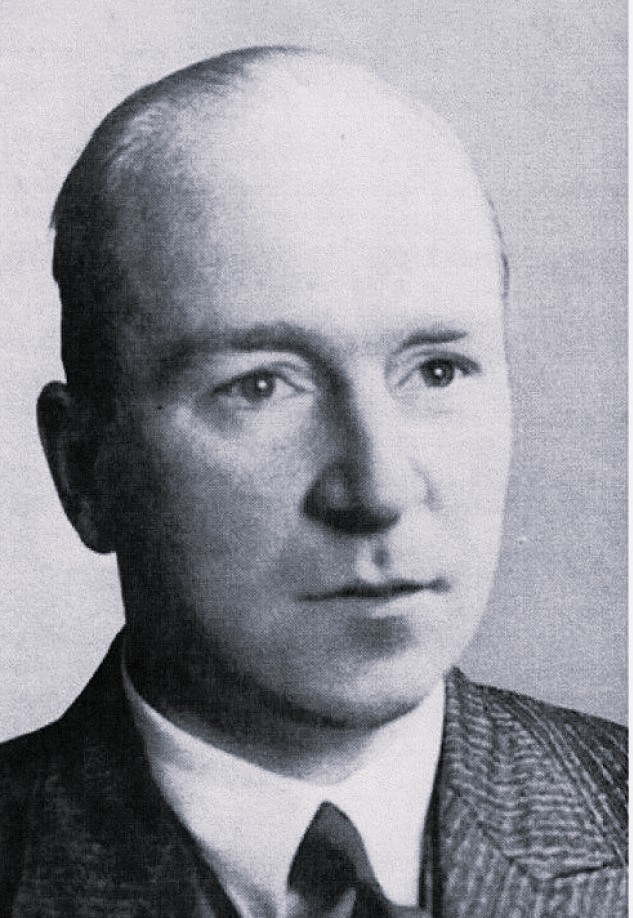
Franz Oppenhoff (1902-1945), undated portrait. Appointed mayor of Aachen by U.S. occupation authorities in October 1944, he was assassinated by a Werwolf squad on 25 March 1945. Public domain, via Wikimedia Commons.
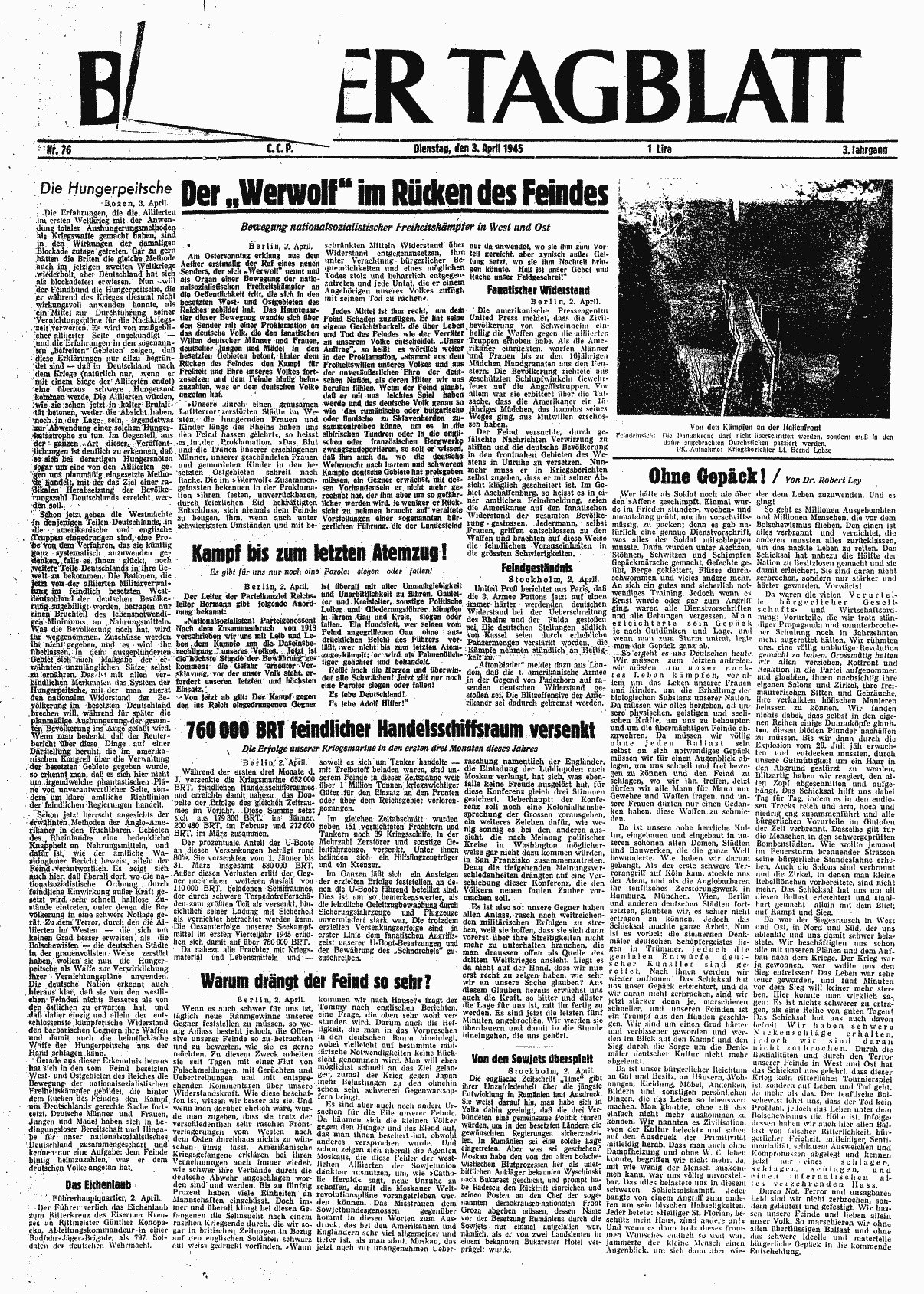
Front page of the Nazi-controlled Bozner Tagblatt, 3 April 1945, reporting the launch of Radio Werwolf ("Der 'Werwolf' im Rücken des Feindes") alongside Martin Bormann's "fight to the last breath" order. Photo: Bozner Tagblatt 1945, CC BY-SA 4.0, via Wikimedia Commons.
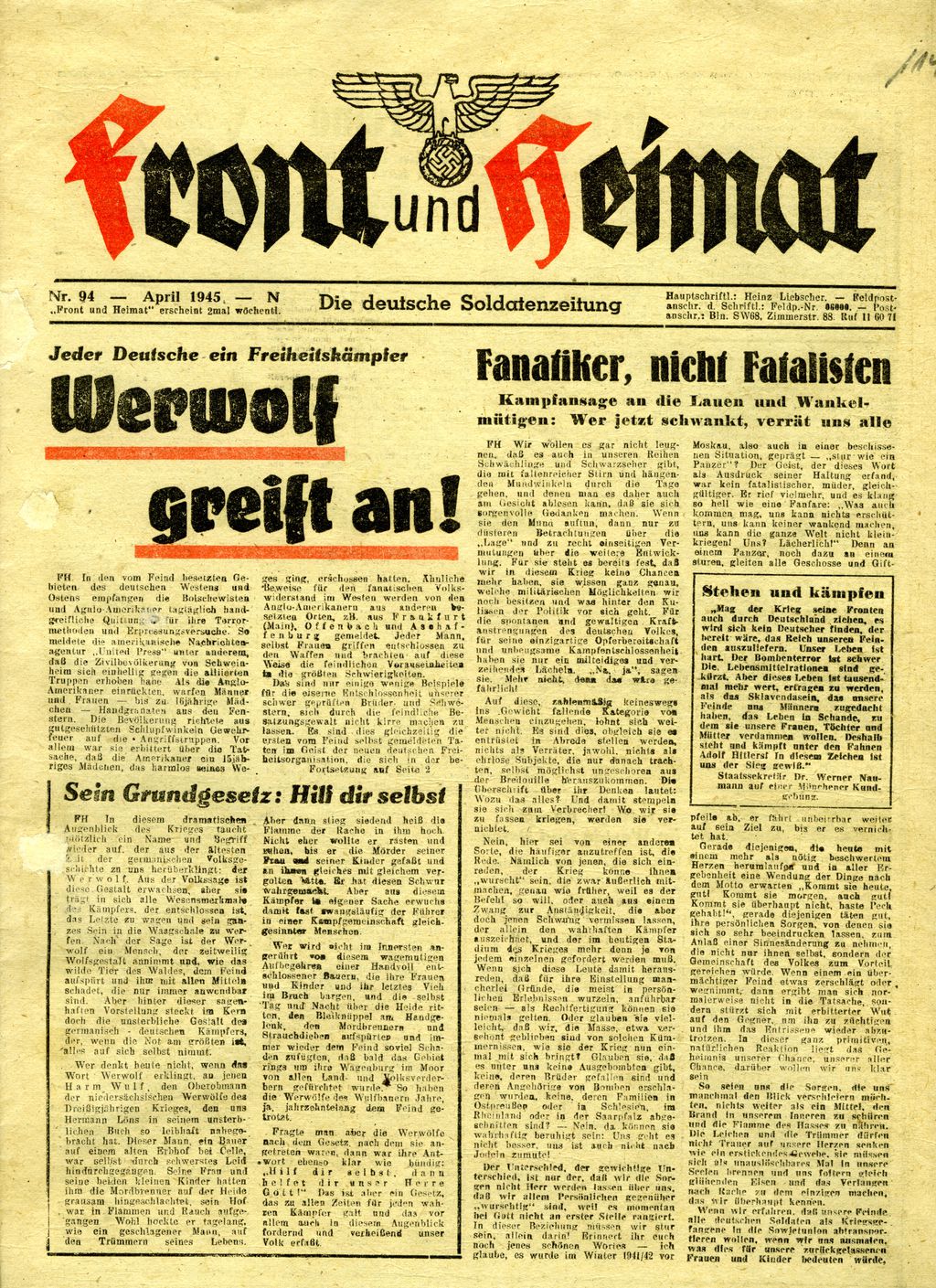
Front page of Front und Heimat, the Nazi Party's soldier newspaper, April 1945: "Werwolf greift an!" ("Werwolf attacks!") and "Fanatiker, nicht Fatalisten" ("Fanatics, not fatalists"), threatening that "whoever wavers now betrays us all." Publisher: Franz Eher Nachf. GmbH, Berlin. Public domain, via Wikimedia Commons.
Image gaps
- A photograph of Radio Werwolf's Nauen transmitter site, or of Heinrich Himmler, Hans-Adolf Prützmann or Joseph Goebbels specifically captioned in connection with Werwolf. No openly licensed photograph tying a portrait of these men directly to the Werwolf campaign was found; generic wartime portraits exist but were not used here to avoid implying a documentary connection the image itself does not show.
- The Hülchrath Castle training site. No openly licensed period photograph of the training centre was found.
- A photograph of the Oppenhoff assassination squad, or of Ilse Hirsch, Herbert Wenzel or Josef Leitgeb. No openly licensed photograph of any of the three was found.
- A Werwolf recruitment or threat leaflet or poster (as opposed to newspaper coverage). No openly licensed scan of an original Werwolf leaflet or poster was found on Wikimedia Commons; the two newspaper front pages used above carry Werwolf-themed headlines and text but are general-circulation newspapers, not the organization's own leaflets.
- Photographs of Soviet-zone arrests of suspected "Werwolves," 1945-46. No openly licensed photograph was found.
Sources
- Perry Biddiscombe, Werwolf! The History of the National Socialist Guerrilla Movement, 1944-1946 (University of Toronto Press, 1998; 2nd ed. 2011): publisher page.
- Perry Biddiscombe, The Last Nazis: SS Werewolf Guerrilla Resistance in Europe, 1944-1947 (Tempus/History Press, 2013).
- Bozner Tagblatt, 3 April 1945, front page, "Der 'Werwolf' im Rücken des Feindes" and "Kampf bis zum letzten Atemzug!": Wikimedia Commons (primary source, read directly for this page).
- Front und Heimat, Nr. 94, April 1945, front page, "Werwolf greift an!" and "Fanatiker, nicht Fatalisten": Wikimedia Commons (primary source, read directly for this page).
- Franz Oppenhoff, biography and assassination account, including the October 1944 appointment and 25 March 1945 killing: Wikipedia summary citing standard sources; "Werewolves of Aachen," HistoryNet (from Military History magazine): historynet.com.
- Ilse Hirsch's role and biography: Wikipedia and Military Wiki summaries of standard published accounts, cross-checked against the HistoryNet account above.
- Radio Werwolf's 1 April 1945 launch, broadcast content and the "avenging hand" line: contemporaneous reporting reproduced in the Bozner Tagblatt front page above, and standard secondary summaries.
- Henri Locard, Pol Pot's Little Red Book: The Sayings of Angkar (Silkworm Books, 2004), for the same-method comparison to Angkar: language control in Democratic Kampuchea, 1975-1979, and the contests over its record.
- Richard B. Frank, Downfall: The End of the Imperial Japanese Empire (Random House, 1999), and John Dower, War Without Mercy: Race and Power in the Pacific War (Pantheon, 1986) and Embracing Defeat: Japan in the Wake of World War II (Norton, 1999), for the "Then and now" comparison to Japan's 1945 home-front mobilization.