Content note. This page quotes Khmer Rouge slogans and broadcast lines that threatened death and called for killing Vietnamese people, including the slur "Yuon" for Vietnamese. It shows a photograph of human skulls displayed at Tuol Sleng. The words are quoted as evidence of the method.
In one line: the Khmer Rouge governed Cambodia as Angkar, "the Organization", an authority with no public face that emptied the cities on a false bombing warning, sorted people into trusted and suspect classes, named its internal "enemies" and "microbes", replaced the word for killing with "smash", and produced confessions that confirmed the enemies it had already named; after 1979 its successors, its foreign backers and Western writers contested what the record showed.
What happened
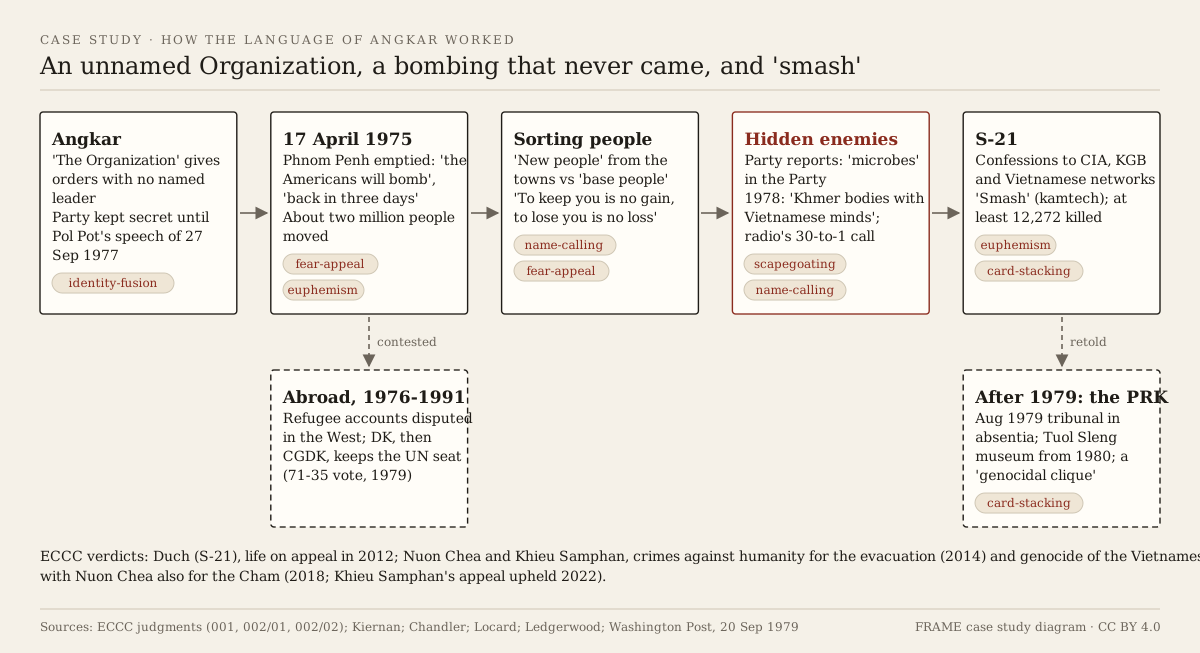
- 1960-1975. A party without a name. The Communist Party of Kampuchea (CPK) fought the Khmer Republic of Lon Nol from 1970 and spoke to the public only as Angkar or Angkar Loeu ("the Organization", "the Upper Organization"). Its leaders and its communist identity were kept from non-members.
- 12 April 1975. The US embassy leaves Phnom Penh by helicopter in Operation Eagle Pull. US bombing of Cambodia, heavy from 1969 and heaviest in 1973 (about 540,000 tons by the long-cited Air Force total; Owen and Kiernan's 2006 analysis of later-released data gives a far higher figure), had ended by act of Congress on 15 August 1973.
- 17 April 1975. The evacuation. CPK forces take Phnom Penh and order the whole city out. Residents are told the Americans are about to bomb the city and that they will be able to return in a few days. The ECCC Trial Chamber found that about two million people were moved from the capital, and that the claims of imminent US bombing and a short absence were false assurances. Other towns are emptied the same way.
- 1975-1976. Sorting the people. Townspeople become "new people" or "17 April people"; peasants from the older Khmer Rouge zones are "base people". Kiernan documents a 1976 reclassification into "full-rights" people, "candidates" and "depositees", the last made up mostly of new people, with the lowest rations and first exposure to purges.
- Slogans. Cadres spoke in fixed sayings attributed to Angkar. The historian Henri Locard collected them from survivors between 1991 and 1995 and published them as Pol Pot's Little Red Book: The Sayings of Angkar (2004). Among them: "To keep you is no gain, to lose you is no loss"; "Angkar has the eyes of the pineapple" (it sees in every direction); "Better to arrest ten innocent people by mistake than free a single guilty party". Locard testified on these slogans before the ECCC in July 2016.
- Euphemisms for killing. Being "taken to study" (yok tov rean) or sent to be "rebuilt" was widely understood to mean execution. At S-21 the working word was kamtech, "smash"; a former S-21 list-maker, Suos Thy, told the ECCC that prisoner lists were annotated "kam" for kamtech.
- January 1975 to at least September 1978. Tung Padevat (Revolutionary Flag). The CPK's monthly theoretical journal, with a companion youth magazine, circulated inside the party. It carried party history, leaders' speeches and production targets, and tracked who the party counted as its enemies at each stage. The ECCC used both journals as evidence of the leaders' policies.
- 20 December 1976. "Microbes". A Party Center report later published by Chandler, Kiernan and Boua described "microbes" inside the party that had to be found and removed. Chandler shows the same frame at work at S-21: food shortages and failures were read as the work of traitors burrowing within.
- 1975-1979. S-21 (Tuol Sleng). A former high school in Phnom Penh became the party's central security office under Kaing Guek Eav, alias Duch. Each prisoner was photographed on arrival and interrogated, usually under torture, until he or she wrote a confession. Chandler shows that the confessions named networks of CIA, KGB and Vietnamese agents, which became the party's catch-all terms for an enemy, and that interrogators worked to produce a document matching what the party said it already knew. Named associates were then arrested in turn. The ECCC found that at least 12,272 people were held and executed there, many of them at Choeung Ek.
- 27 September 1977. In a five-hour speech broadcast on Radio Phnom Penh, Pol Pot announces the existence of the CPK and its founding date of 30 September 1960. Angkar now has a named party behind it.
- 1977-1978. The anti-Vietnamese line. As border fighting with Vietnam escalated, Radio Phnom Penh turned on the "Yuon", the term DK media used for Vietnamese. In May 1978 it told listeners that if each Cambodian killed 30 Vietnamese, two million troops would be enough to eliminate Vietnam's 50 million people and six million Cambodians would remain (Kiernan, citing the BBC Summary of World Broadcasts, FE/5813/A3/1-4). In the purge of the Eastern Zone that year, cadres and villagers were labelled people with "Khmer bodies and Vietnamese minds". In September 1978 the Foreign Ministry's Black Paper cast Vietnam as an "aggressor, annexationist and swallower of territories".
- August and December 1978. Guided visits. A four-member Swedish-Kampuchean Friendship Association delegation, led by Gunnar Bergström, toured the country for about two weeks in August and spoke in support of DK on its return. Bergström later called it a "propaganda tour". In December the journalists Elizabeth Becker and Richard Dudman and the academic Malcolm Caldwell were given a structured tour; Caldwell was shot dead in their guesthouse on 22-23 December.
- 7 January 1979. Vietnamese forces and the Kampuchean United Front for National Salvation take Phnom Penh. The People's Republic of Kampuchea (PRK) is set up. Kiernan estimates about 1.7 million deaths under DK.
- 15-19 August 1979. The People's Revolutionary Tribunal. A PRK court in the Chaktomuk Theatre tries Pol Pot and Ieng Sary in absentia for genocide, hears 39 witnesses over five days, and sentences both to death. Its documents, published in English in 2000, include survivors' testimony and DK papers.
- September 1979. The UN seat. The UN Credentials Committee votes 6-3 to seat Democratic Kampuchea's delegation (China and the United States among those in favour, the Soviet Union against); the General Assembly accepts it 71 to 35, with 34 abstentions. From 1982 the seat is held by the Coalition Government of Democratic Kampuchea (CGDK), joining the Khmer Rouge with the royalist and republican factions of Norodom Sihanouk and Son Sann, with the backing of China, ASEAN and Western governments, until the settlement that ended in the 1991 Paris agreements.
- 13 July 1980. Tuol Sleng museum. The PRK opens S-21 as the Tuol Sleng Museum of Genocidal Crimes, organised by the Vietnamese colonel Mai Lam. A map of Cambodia made of about 300 victims' skulls hung there until 2002. From 1984 the PRK held a "Day of Hatred" each 20 May against the "genocidal Pol Pot-Ieng Sary-Khieu Samphan clique" and the resistance groups allied with it.
- 2010-2022. The ECCC. The UN-backed Extraordinary Chambers in the Courts of Cambodia convict Duch of crimes against humanity and grave breaches of the Geneva Conventions for S-21 (Case 001: 35 years on 26 July 2010, raised to life on appeal on 3 February 2012). Case 002/01 (7 August 2014) convicts Nuon Chea and Khieu Samphan of crimes against humanity, including for the evacuation of Phnom Penh; life sentences are upheld on appeal on 23 November 2016. Case 002/02 (16 November 2018) convicts both of genocide of the Vietnamese and Nuon Chea also of genocide of the Cham, with further crimes against humanity; Nuon Chea dies in 2019, and on 22 September 2022 the Supreme Court Chamber upholds Khieu Samphan's conviction, including genocide of the Vietnamese, and his life sentence.
How it works
- Euphemism / doublespeak: "evacuation for three days" for a permanent forced transfer; "taken to study" and "rebuilt" for execution; kamtech, "smash", on S-21's prisoner lists. The ordinary word for killing is absent from the working vocabulary.
- Fear appeal: the 17 April order staged an imminent harm (a US bombing, with no US bombing under way since 1973 and the US embassy already gone) with one remedy: leave now. Afterwards, "To keep you is no gain, to lose you is no loss" and "Angkar has the eyes of the pineapple" told listeners that the Organization was watching and that their lives were disposable.
- Name-calling: "new people", "17 April people", "depositees", "microbes", "enemy", "CIA", "KGB" and "Yuon" arrived before any charge. The label placed a person in a category that decided rations, trust and survival.
- Scapegoating: the Party Center explained failed harvests and hunger by "microbes" and traitors inside the party, and from 1977 by Vietnam and those said to serve it. A bounded out-group carried the blame for outcomes of the party's own policy.
- Identity fusion: Angkar spoke as the collective with no face to question, and in 1978 the label "Khmer bodies with Vietnamese minds" made doubted loyalty a question of hidden ethnic identity. Questioning the Organization marked the questioner as one of its enemies.
- Card stacking: S-21 confessions were written to match what the party said it already knew, so the pile of files could only confirm a CIA-KGB-Vietnamese conspiracy; each confession supplied the next arrests. After 1979 the PRK's own account used the same device on a smaller scale: its "Pol Pot-Ieng Sary clique" framing placed the crimes on a small leadership group and left out that several PRK leaders, among them Heng Samrin and Hun Sen, had served as Khmer Rouge cadres before defecting in 1977-1978.
Then and now
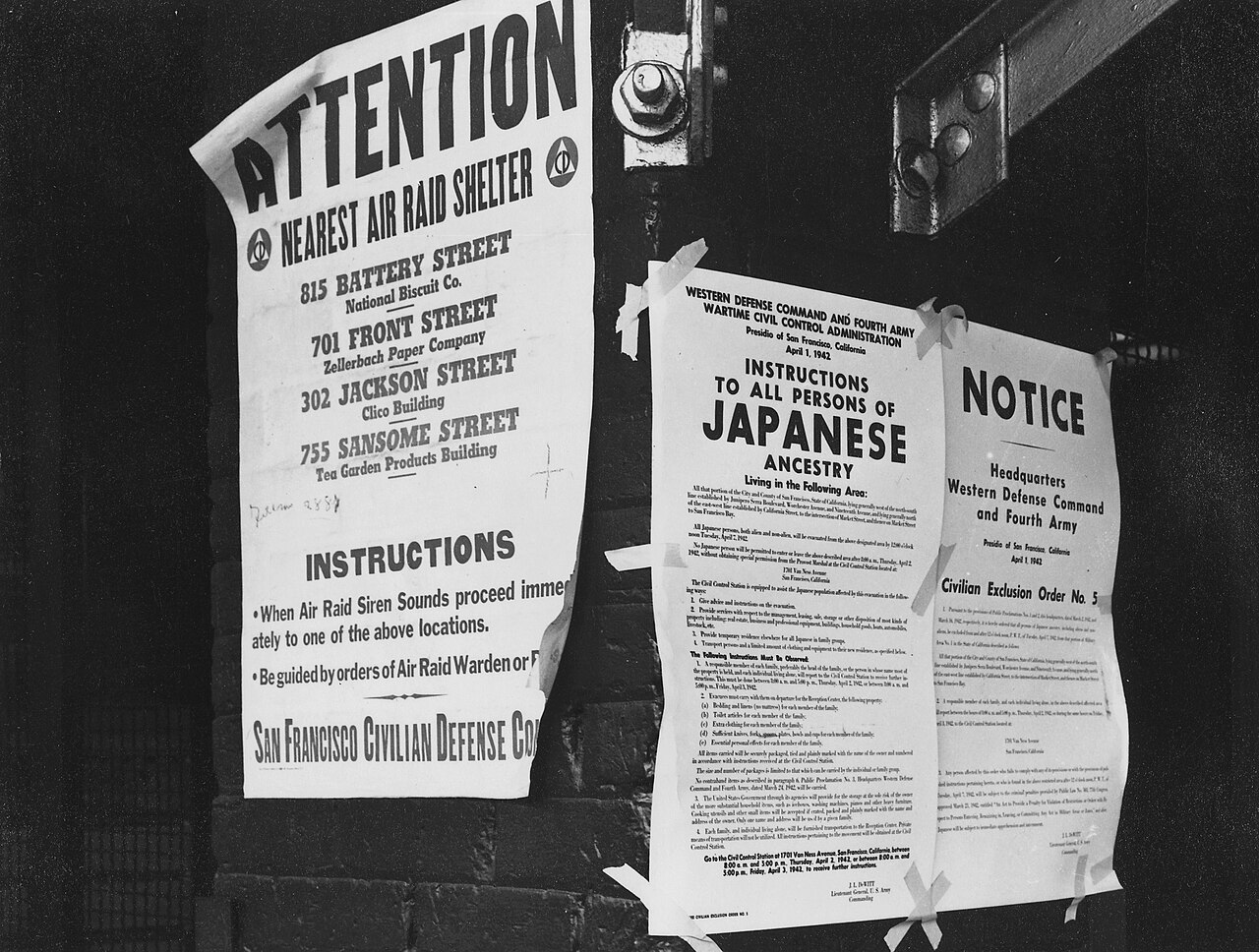
'Instructions to All Persons of Japanese Ancestry' (exclusion order posted in San Francisco), U.S. Army Western Defense Command, San Francisco, April 1942. Photograph by Dorothea Lange for the War Relocation Authority. Public domain.
The U.S. exclusion orders of 1942 called the forced removal of about 120,000 people of Japanese ancestry an "evacuation", described citizens as "non-aliens" and held families in "assembly centers". The official wording carried the policy, as "evacuation" did in Phnom Penh in 1975. The differences are large and plain: the U.S. camps were not places of mass execution, and in 1983 a U.S. commission found the policy was driven by "race prejudice, war hysteria and a failure of political leadership", followed by a formal apology and redress in 1988. DK's evacuation was followed by forced labour, famine and killings that the ECCC found to be crimes against humanity. The shared element is the word that turns a forced removal into a protective measure.
The S-21 confession pipeline has a close parallel in the Soviet Great Terror of 1936-1938, where defendants confessed in open court to working for foreign intelligence services. The 1978 "Yuon" broadcasts have a parallel in the 1994 broadcasts of RTLM radio in Rwanda, which also named a group as an enemy within before calling for violence against it.
Positions on the record
- As stated by DK then. DK leaders explained the evacuation in several ways: the claimed bombing threat at the time; later, the need to feed the population and to break up enemy networks in the cities. Before the ECCC, Nuon Chea gave security reasons linked to Vietnam. Ieng Sary told interviewers that he arrived after the evacuation had begun and was not part of the decision. Khieu Samphan's defence denied that he knew of or intended the crimes charged.
- What the ECCC found. The Chambers found the evacuation of Phnom Penh, the forced movements, the S-21 system and the killings to be crimes against humanity, and the treatment of the Vietnamese (and, for Nuon Chea, the Cham) to be genocide. The genocide findings cover these groups; the Chambers did not classify the killing of the Khmer majority as genocide in law, though historians including Kiernan use the word for the regime's crimes as a whole.
- The PRK and Vietnam. The PRK presented Vietnam's intervention as support for a Kampuchean uprising and the 1979 tribunal as the first genocide trial under the 1948 Convention. The tribunal heard testimony about crimes that later research and the ECCC confirmed. At the time, the United States and other Western governments dismissed it as a show trial by a government installed by Vietnam; it was held in absentia, and its judgment used the "Pol Pot-Ieng Sary clique" frame that the PRK also applied to its non-communist rivals. The ECCC held in 2011 that neither the 1979 conviction nor Ieng Sary's 1996 royal pardon barred his prosecution; he died in 2013 before judgment.
- The UN seat. China, the United States, ASEAN and most Western governments said they would not recognise a government installed by a foreign army, and backed the DK and then the CGDK delegation. Vietnam, the Soviet Union and their allies backed the PRK. The record here is diplomatic, and this page makes no finding on the Cambodian-Vietnamese war.
- The Western debate over refugee accounts, 1976-1979. François Ponchaud's Cambodge année zéro (1977; English 1978) and John Barron and Anthony Paul's Murder of a Gentle Land: The Untold Story of Communist Genocide in Cambodia (1977) drew on refugee interviews and described mass killing. George Hildebrand and Gareth Porter's Cambodia: Starvation and Revolution (1976) argued the evacuation averted famine, the rationale DK itself gave. Noam Chomsky and Edward Herman's "Distortions at Fourth Hand" (The Nation, 25 June 1977) reviewed all three, treated Ponchaud's book as serious, called Hildebrand and Porter's "a carefully documented study", criticised the press's use of refugee accounts and figures, and wrote that they did not claim to know where the truth lay. Critics, among them Sophal Ear (1995), argued that their work understated the killing; Chomsky has said the article concerned media treatment, not a denial of atrocities. Later research, the documents of S-21 and the ECCC judgments confirmed the broad substance of the refugee accounts.
- Documented versus not shown. The slogans come from survivors' recollections gathered after 1979 and from DK documents; exact wording varies between sources. The total death toll is an estimate (Kiernan's 1.7 million is one of several scholarly figures in a similar range). The ECCC did not rule on every euphemism or slogan quoted here.
Same-method test
The finding is the same whoever speaks. A government that forces a city out on a false air-raid warning, calls the removal an evacuation, labels a class of its citizens as disposable and sorts them by origin, writes "smash" where it means kill, and builds confession files that can only confirm the conspiracy it named first would be scored with the same six techniques. The same standard applies to the U.S. wartime "evacuation" vocabulary above, to the Soviet show-trial confessions of 1936-1938, and to the PRK's later "clique" framing of the same history.
How to spot it
- When an order to move comes with a short deadline, a named threat and a promise of quick return, ask who has confirmed the threat and what the plan for return is.
- Watch for working words that replace "kill", "arrest" or "torture": "study", "rebuild", "smash", "process". Ask what happens to people after the word is used.
- A confession that names exactly the enemies the authority already announced is not independent evidence of them. Look for any record made outside the interrogation.
- When a later government tells the history, check which people and facts the account includes and which it leaves out, including its own members' past.
Images
| Image | Source | Licence |
|---|---|---|
| Mechanism diagram (above) | Drawn for FRAME from the sources below (make_diagrams_atrocity.py) |
CC BY 4.0, FRAME |
| U.S. Marines deploy at LZ Hotel, Phnom Penh, 12 April 1975 | Wikimedia Commons, U.S. Department of Defense (USMC) | Public domain (U.S. government work) |
| Photographs of S-21 prisoners on display at Tuol Sleng, 2013 | Wikimedia Commons, Dudva | CC BY-SA 3.0 |
| The skull map at Tuol Sleng, 1997 | Wikimedia Commons, Donovan Govan | CC BY-SA 3.0 |
| Gunnar Bergström beside a 1978 photograph of his DK visit, 2016 | Wikimedia Commons, Nem Sopheakpanha / VOA Khmer | Public domain (U.S. government work, VOA) |
| Instructions to All Persons of Japanese Ancestry (1942) | FRAME gallery | Public domain (U.S. government work) |

.JPG)


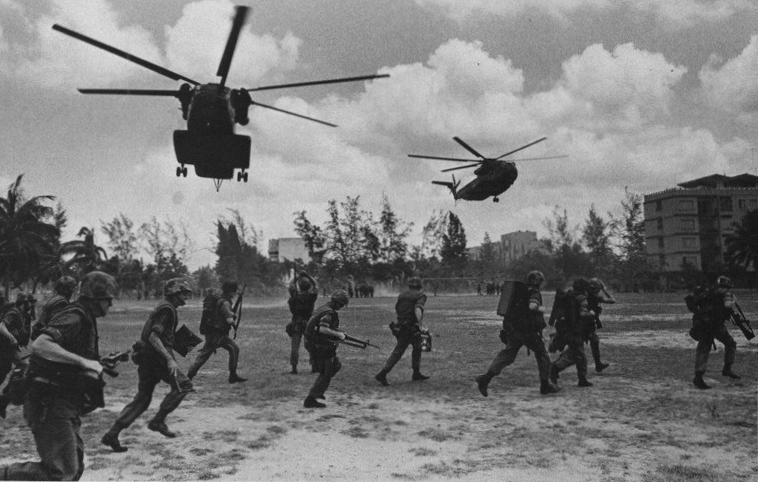
U.S. Marines of BLT 2/4 at Landing Zone Hotel, Phnom Penh, 12 April 1975, during Operation Eagle Pull, the evacuation of the U.S. embassy. U.S. Department of Defense photograph (USMC), public domain, via Wikimedia Commons. On the page because the U.S. presence had left the city five days before residents were told a U.S. bombing was imminent.
Content note: Prisoner intake photographs from the Khmer Rouge's S-21 torture centre. This object is shown as it was published. Why 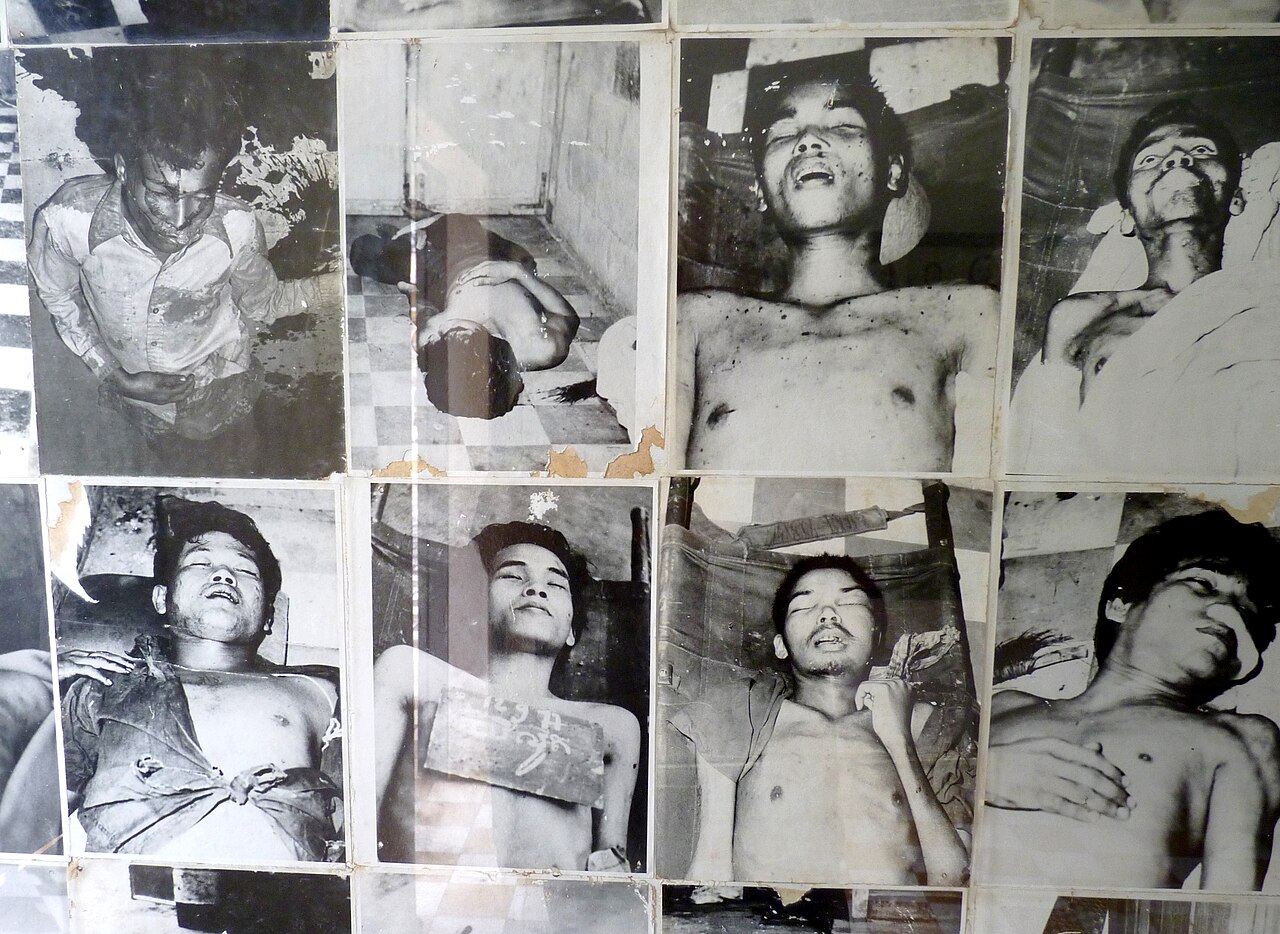
Photographs of S-21 prisoners, taken on arrival by prison staff in 1975-1979, as displayed at the Tuol Sleng Genocide Museum. Photo by Dudva, 2013, CC BY-SA 3.0, via Wikimedia Commons. On the page because the arrival photograph was the first document in each S-21 file that ended in a confession.
Content note: Map of Cambodia made from victims' skulls. This object is shown as it was published. Why 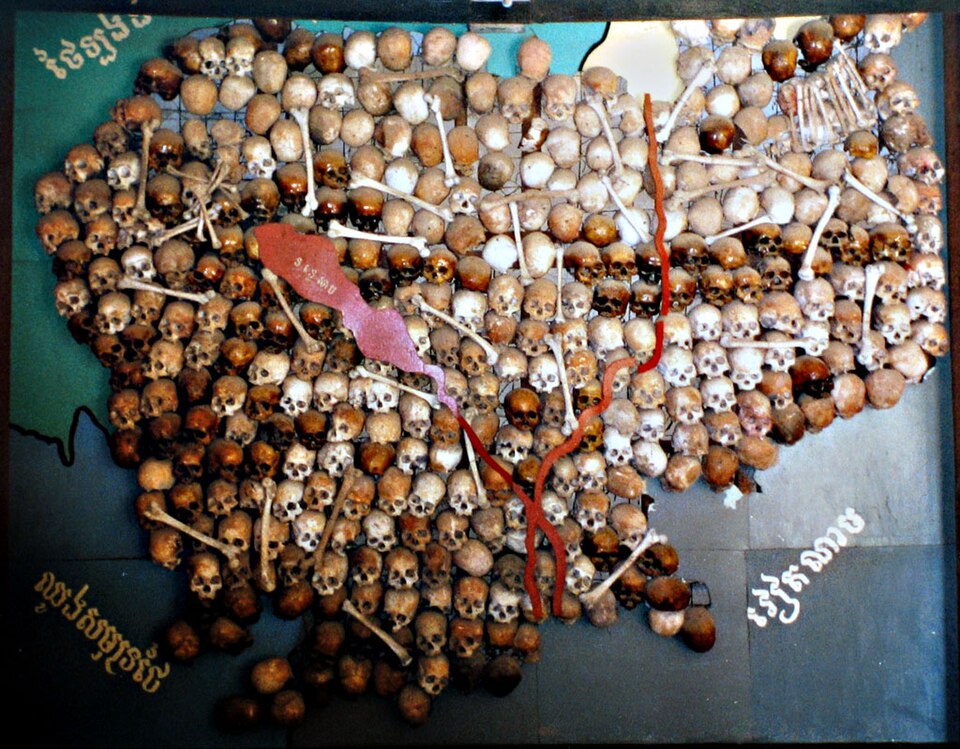
The skull map at the Tuol Sleng museum, photographed in January 1997 by Donovan Govan, CC BY-SA 3.0, via Wikimedia Commons. Assembled during the PRK period and dismantled in 2002. On the page as an example of how the post-1979 government displayed the record.
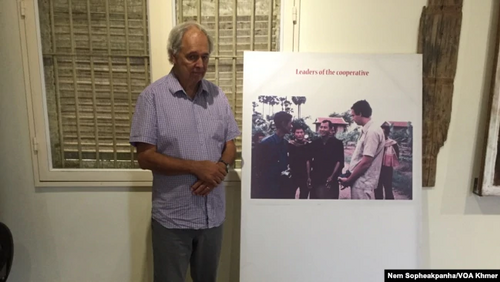
Gunnar Bergström at the Documentation Center of Cambodia's gallery in Phnom Penh, 12 September 2016, beside an enlarged photograph from his August 1978 visit, captioned "Leaders of the cooperative". Photo by Nem Sopheakpanha, VOA Khmer, public domain, via Wikimedia Commons. On the page because the 1978 friendship delegation's guided tour was DK's outward-facing propaganda, which Bergström later described as a "propaganda tour".
Image gaps
- Issues of Tung Padevat and Revolutionary Youth. Scans exist (DC-Cam, Internet Archive), but their copyright status in Cambodia and the United States is not established, so none is shown. Could be filled if a rights holder or archive releases them under an open licence.
- Radio Phnom Penh or Voice of Democratic Kampuchea recordings and transcripts. The BBC Summary of World Broadcasts is under BBC copyright, and no openly licensed recording was found. Not fillable from open sources now.
- DK-era photographs of the 17 April evacuation. Known photographs (for example by foreign journalists who stayed in the city) are under copyright. Not fillable from open sources now.
- The People's Revolutionary Tribunal of August 1979 and the "Day of Hatred". No openly licensed photographs were found. Could be filled if PRK-era state photographs are released.
- ECCC courtroom photographs of the verdicts. The ECCC published photographs, but eccc.gov.kh could not be reached from the build environment to confirm their licence. Could be filled.
- The "Security Regulations" board at Tuol Sleng. Openly licensed photographs exist on Commons, but when and by whom the board was written is not established in the sources used here, so it is not shown.
Sources
- Taylor Owen and Ben Kiernan, "Bombs over Cambodia", The Walrus, October 2006
- ECCC, Case 002/02 Trial Chamber summary of judgement, 16 November 2018 (UN Office of Legal Affairs copy: legal.un.org)
- ECCC historical timeline: the Democratic Kampuchea regime (evacuation under the pretext of US bombing)
- ECCC, Case 002/02 trial page
- ECCC Trial Chamber, Case 002/01 Judgement E313, 7 August 2014
- ECCC, Case 001 (Kaing Guek Eav alias Duch) and Case 001 information sheet
- ECCC Supreme Court Chamber, Case 001 summary of appeal judgement, 3 February 2012 (DC-Cam copy)
- ABC News, 22 September 2022: court upholds Khieu Samphan's genocide conviction
- Just Security: the ECCC's final case
- Pol Pot, Long Live the 17th Anniversary of the Communist Party of Kampuchea, speech of 27 September 1977
- Democratic Kampuchea Ministry of Foreign Affairs, Black Paper, September 1978
- Chandler, Kiernan and Boua (eds), Pol Pot Plans the Future: Confidential Leadership Documents from Democratic Kampuchea, 1976-1977 (Yale, 1988)
- De Nike, Quigley and Robinson (eds), Genocide in Cambodia: Documents from the Trial of Pol Pot and Ieng Sary (University of Pennsylvania Press, 2000)
- People's Revolutionary Tribunal documents, August 1979 (Internet Archive)
- Washington Post, 20 September 1979: "Pol Pot Wins First Round in U.N. Battle for Representation"
- Bulletin of Concerned Asian Scholars (1990): "The United Nations and Kampuchea: The issue of representation and its implications"
- Ben Kiernan, The Pol Pot Regime: Race, Power, and Genocide in Cambodia under the Khmer Rouge, 1975-79 (Yale University Press, 1996).
- Ben Kiernan, "Myth, Nationalism and Genocide", Journal of Genocide Research 3(2), 2001, 187-206
- Ben Kiernan, "The Pol Pot regime's simultaneous war against Vietnam and genocide of Cambodia's ethnic Vietnamese minority", Critical Asian Studies 53(3), 2021
- Ben Kiernan, "The ingratitude of the crocodiles: the 1978 Cambodian Black Paper", Bulletin of Concerned Asian Scholars 12(4), 1980
- David Chandler, Voices from S-21: Terror and History in Pol Pot's Secret Prison (University of California Press, 1999), H-Net review
- Henri Locard, Pol Pot's Little Red Book: The Sayings of Angkar (Silkworm Books, 2004) and H-Net review
- Cambodia Tribunal Monitor, 28 July 2016: Henri Locard testifies and 29 July 2016
- Sayings and slogans of the Khmer Rouge, from Locard (mekong.net)
- Phnom Penh Post: S-21 functionary testifies at KRT (Suos Thy on "kamtech")
- New Mandala: Translating atrocity at the Khmer Rouge Tribunal
- Cambodia Tribunal Monitor, 5 June 2013: Sydney Schanberg recalls the evacuation of Phnom Penh
- Cambodia Tribunal Monitor, 7 June 2013: Nuon Chea addresses the evacuation of Phnom Penh
- Cambodia Tribunal Monitor, 29 June 2016: East Zone internal purges
- Yale Genocide Studies Program: Literacy and education under the Khmer Rouge (on Tung Padevat)
- Judy Ledgerwood, "The Cambodian Tuol Sleng Museum of Genocidal Crimes: National Narrative", Museum Anthropology 21(1), 1997
- Frank Selbmann, "The 1979 Trial of the People's Revolutionary Tribunal and Implications for ECCC" (T.M.C. Asser Press, 2016)
- VOA Khmer, 2016: Digesting the details long after a dinner with Pol Pot (Gunnar Bergström)
- Inter Press Service, 2008: Khmer Rouge through blinkered eyes
- Phnom Penh Post: Khmer Rouge documents shed light on journalists' 1978 visit
- Noam Chomsky and Edward S. Herman, "Distortions at Fourth Hand", The Nation, 25 June 1977
- François Ponchaud, Cambodia: Year Zero (1978), Foreign Affairs capsule review
- John Barron and Anthony Paul, Murder of a Gentle Land: The Untold Story of Communist Genocide in Cambodia (Reader's Digest Press, 1977); George C. Hildebrand and Gareth Porter, Cambodia: Starvation and Revolution (Monthly Review Press, 1976); Sophal Ear, The Khmer Rouge Canon 1975-1979: The Standard Total Academic View on Cambodia (University of California, Berkeley, 1995).
- Wikipedia: National Day of Remembrance (Cambodia), on the PRK "Day of Hatred"