Сдал австриец русским Львов (The Austrian Surrendered Lvov to the Russians)
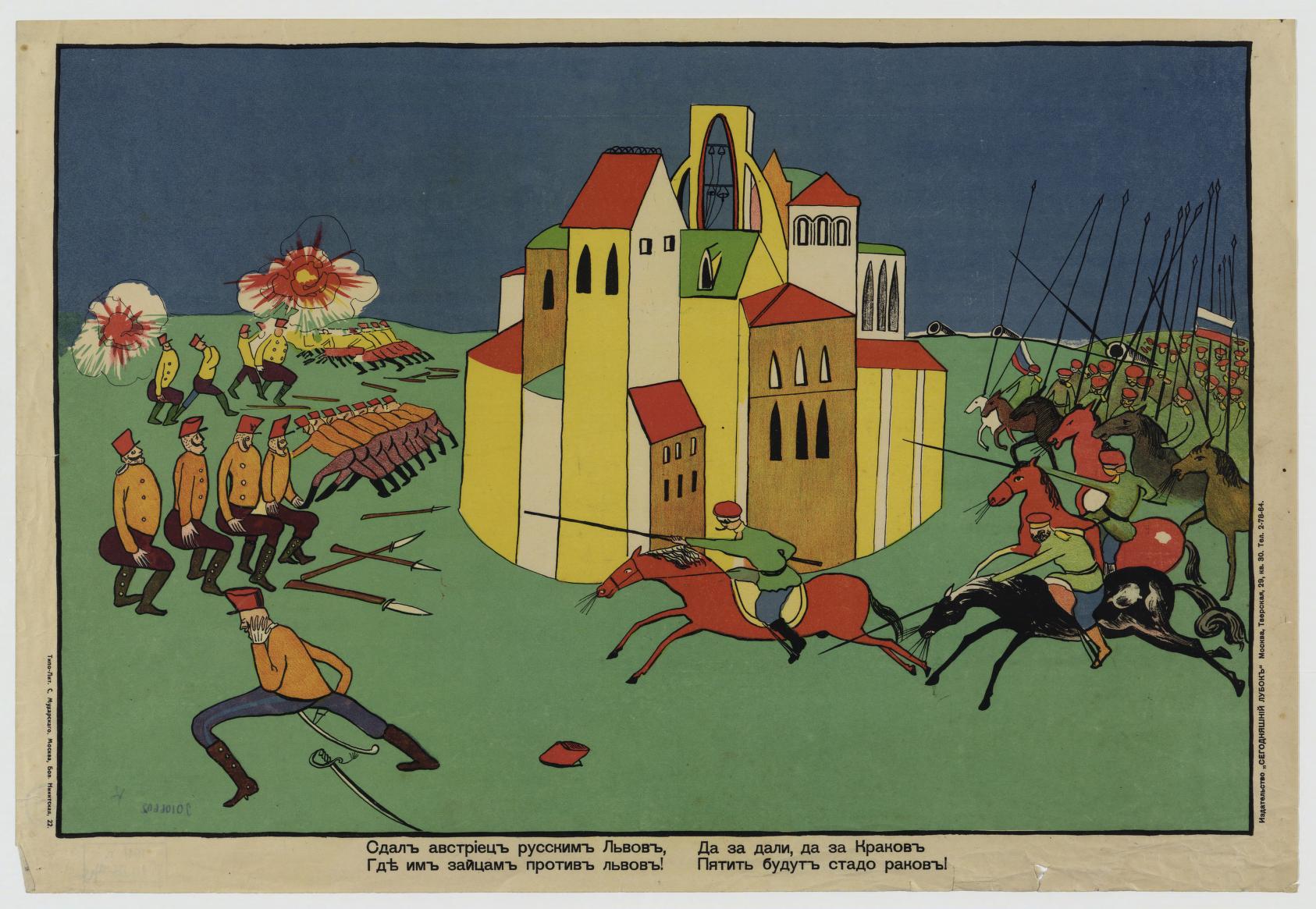
Russian lancers under the tricolour charge past a Cubist-styled Lvov while Austrian soldiers crouch, flee and drop their weapons. Mayakovsky's couplet puns on the city's name (Lvov, 'of lions') and calls the Austrians hares against lions and a herd of crayfish backing away past Krakow. The animal labels carry the argument: the enemy is timid by nature, so the battle needs no further account.
- Date
- 1914
- Period
- First World War
- Made by
- Segodniashnii Lubok publishers, Moscow; Aristarkh Lentulov (image), Vladimir Mayakovsky (verse)
- Region
- Eastern Europe and Eurasia
- Country
- Russian Empire
- Medium
- Issuer type
- Media
- Regime
- Russian Empire
- Leader
- Nicholas II
- Audience
- Domestic public
- Purpose
- Reassure
- Themes
- War and the military, Home front
- Event
- World War I
- Techniques
- Name-calling
- Source
- Identified Openly sourced: the speaker is who they say they are
- Source
- Library of Congress, retrieved September 27, 2026
- Rights
- Public domain in the U.S. (published before 1931)
Lentulov, Aristarkh Vasilievich, 1882-1943 Artist.. 1914. Library of Congress.
Text on the object
Сдалъ австріецъ русскимъ Львовъ,          Да за дали, да за Краковъ,
Гдѣ имъ зайцамъ противъ львовъ!       Пятить будутъ стадо раковъ!

Типо-Лит. С. Мухарскаго. Москва, Бол. Никитская, 22.

Издательство «Сегодняшній Лубокъ» Москва, Тверская, 29, кв. 30. Тел. 2-78-64.
The Austrian surrendered Lvov to the Russians,          Yes, [they'll be pushed back] as far as Kraków too,
Where can hares stand against lions!          A herd of crayfish will back away!

Lithography of S. Mukharsky. Moscow, Bolshaya Nikitskaya St., 22.

Publisher "Today's Lubok." Moscow, Tverskaya St., 29, apt. 30. Tel. 2-78-64.
The verse is a double pun the translation cannot carry: 'Львовъ' (Lvov, genitive plural also reads as 'of lions') set against 'зайцамъ' (hares), and 'раковъ' (crayfish, which move backward) for the retreating Austrians. A small handwritten catalog number near the lower-left corner of the sheet is an archival annotation, not part of the print, and is not transcribed.