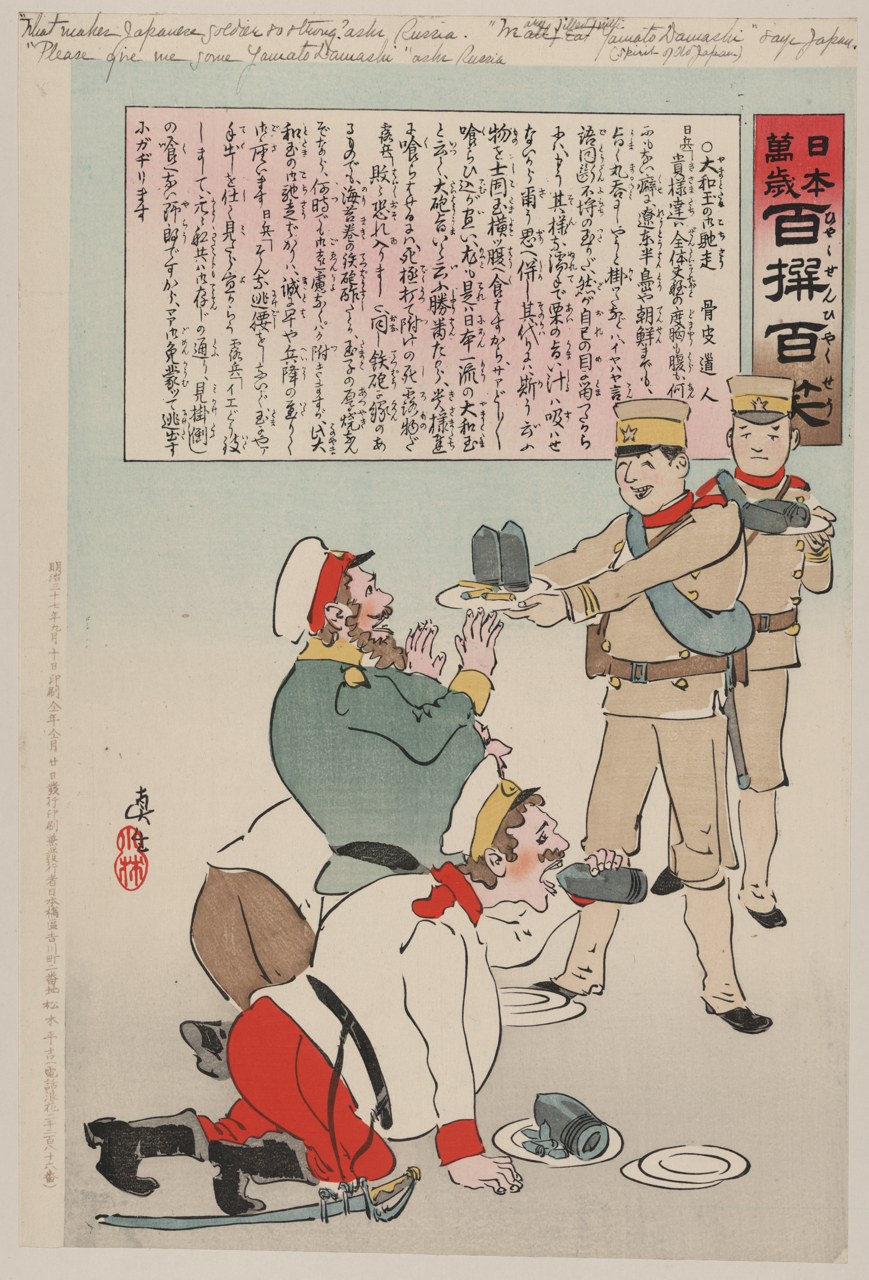
"Yamato-damashii no gochisō" (Nihon banzai hyakusen hyakushō print, 1904)
Colour woodblock print under a red 'Nihon banzai' title cartouche: two trim Japanese soldiers serve shells and cartridges on a plate to two bloated, kneeling Russian officers, one tipping a shell into his mouth, beneath a block of text headed 'Yamato-damashii no gochisō'. The tell is the virtue word doing the explaining: Japanese strength is 'Yamato spirit', a term no evidence on the sheet can test.
- Date
- September 20, 1904
- Period
- Pre-1914
- Made by
- Empire of Japan, commercial war-print publisher Matsuki Heikichi (Nihonbashi, Tokyo); artist Kobayashi Kiyochika
- Region
- East Asia
- Country
- Empire of Japan
- Medium
- Issuer type
- Media
- Regime
- Meiji Japan
- Leader
- Katsura Taro
- Audience
- Domestic public
- Purpose
- Reassure
- Theme
- War and the military
- Event
- Russo Japanese War
- Techniques
- Glittering generalities
- Source
- Identified Openly sourced: the speaker is who they say they are
- Source
- Library of Congress, Prints and Photographs Division, retrieved September 29, 2026
- Rights
- Public domain (published 1904; artist d. 1915; LOC: no known restrictions on publication)
Kobayashi Kiyochika, Nihon banzai hyakusen hyakushō, Matsuki Heikichi, Tokyo, 1904. Library of Congress, FP 2 - JPD, no. 917, LC-DIG-jpd-00998.
Text on the object
日本萬歳 百撰百笑
○大和魂の御馳走 骨皮道人
[main text block of about fourteen columns in cursive kana with furigana, opening with a Japanese soldier's speech to the Russians: 貴様達ハ … — not transcribed: illegible to this reader]
明治三十七年九月十日印刷 仝年仝月廿日發行 印刷兼發行者 日本橋區吉川町二番地 松木平吉 (電話浪花二千二百八十六番)
[artist's signature and red chop, lower left]
[handwritten English lines across the top edge, added by later cataloguers, not part of the print]
Long live Japan: One hundred selections, one hundred laughs
○ A feast of Yamato-damashii. Honekawa Dōjin (text)
[main text block not transcribed]
Printed 10 September, Meiji 37 [1904]; published 20 September of the same year. Printer and publisher: Matsuki Heikichi, 2 Yoshikawa-chō, Nihonbashi ward (telephone Naniwa 2286).
[artist's signature and red chop, lower left]
[handwritten English lines across the top edge, added by later cataloguers]
Only the series title, the block heading with the author's name and the imprint line are transcribed. The body is set in dense cursive kana and was not transcribed rather than guessed at; the LOC record supplies a paraphrase of the dialogue. Translation is by Claude and unverified by a fluent reader.