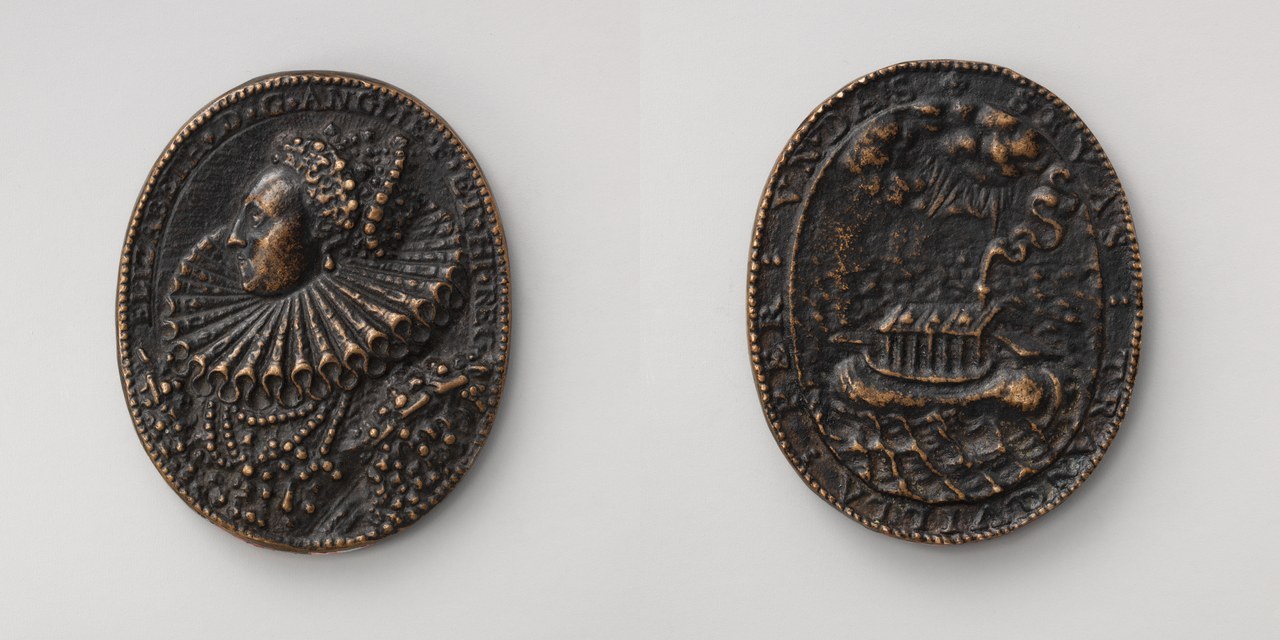
Medal of Elizabeth I: portrait in a ruff, reverse an ark on stormy waves with SAEVAS TRANQVILLA PER VNDAS (18th-century aftercast of a 1588 model)
A bronze oval medal: on one side Elizabeth I in profile in a large ruff, with her name and titles; on the other a ship, an ark, riding a rough sea beneath clouds and rays with the motto 'calm through the raging waves'. It ties the queen to divine protection at the time of the Spanish Armada.
Propaganda techniques used in this object
- Date
- 1588
- Period
- Pre-1914
- Made by
- Elizabethan court model of 1588, cast in the 18th century (Met: 'Naval Reward Medal of Elizabeth I')
Full record
Region, Country, Medium, Issuer type, Regime, Leader, Audience, Purpose, Themes, Source, Rights
- Region
- Western and Central Europe
- Country
- England
- Medium
- Object
- Issuer type
- State
- Regime
- Tudor England
- Leader
- Elizabeth I
- Audience
- Domestic public
- Purpose
- Commemorate
- Themes
- War and the military, Religion
- Regime
- Tudor England
- Leader
- Henry VIII
- Source
- Identified Openly sourced: the speaker is who they say they are
- Source
- The Metropolitan Museum of Art (Open Access), retrieved October 2, 2026
- Rights
- Public domain (The Met Open Access, CC0; isPublicDomain true in the Met API)
The Metropolitan Museum of Art, Gift of Assunta Sommella Peluso, Ignazio Peluso, Ada Peluso and Romano I. Peluso, 2007 (2007.160.5), Open Access
Text on the object
Original (Latin) · read from the image, not independently checked
Obverse: ELIZABETH·D·G·ANGLIE·F·ET·HI·REG

Reverse: SAEVAS·TRANQVILLA·PER·VNDAS
Obverse: Elizabeth, by the grace of God, queen of England, France and Ireland.

Reverse: Calm through the raging waves.
Both legends are worn in places and the reverse is read clockwise from the upper right; the F is expanded as F(RANCIE) and the final REG as REG(INA) from the standard formula, not from clear letters. The reverse reading is read with less certainty than the obverse.