How to Fight Fire Bombs
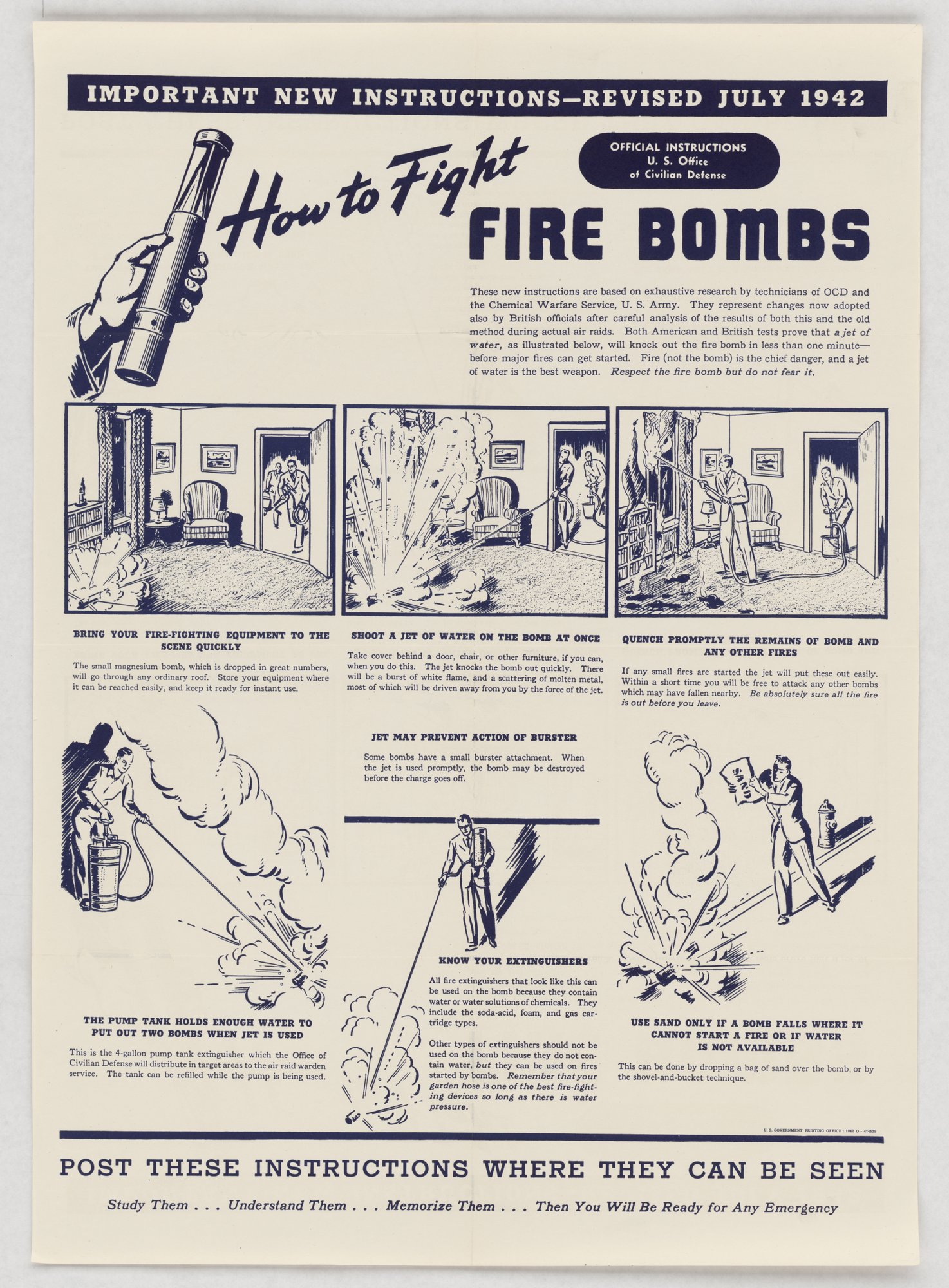
Civil-defense instruction sheet: six drawn panels show a householder in a suit and tie fighting an incendiary bomb with a pump-tank water jet, an extinguisher and sand. The text tells readers to respect the fire bomb but not fear it. The technique is faint: ordinary men in ordinary rooms model the action, and the tone is instructional, not a fear-appeal.
Propaganda techniques used in this poster
- Date
- 1942
- Period
- Second World War
- Made by
- U.S. Office of Civilian Defense
- Region
- North America
- Country
- United States
- Medium
- Poster
- Issuer type
- State
- Regime
- Roosevelt Administration
- Leader
- Franklin D. Roosevelt
- Audience
- Domestic public
- Purpose
- Warn or inform
- Themes
- Home front, Security and surveillance
- Event
- World War II
- Regime
- Roosevelt administration
- Leader
- Franklin D. Roosevelt
- Source
- Identified Openly sourced: the speaker is who they say they are
- Source
- U.S. National Archives and Records Administration, Record Group 44, World War II Posters, retrieved October 4, 2026
- Rights
- Public domain (U.S. government work)
U.S. Office of Civilian Defense. National Archives and Records Administration, RG 44, 44-PA-1018 (NAID 514544).
Text on the object
IMPORTANT NEW INSTRUCTIONS---REVISED JULY 1942
How to Fight FIRE BOMBS
OFFICIAL INSTRUCTIONS U. S. Office of Civilian Defense
These new instructions are based on exhaustive research by technicians of OCD and the Chemical Warfare Service, U. S. Army. They represent changes now adopted also by British officials after careful analysis of the results of both this and the old method during actual air raids. Both American and British tests prove that a jet of water, as illustrated below, will knock out the fire bomb in less than one minute---before major fires can get started. Fire (not the bomb) is the chief danger, and a jet of water is the best weapon. Respect the fire bomb but do not fear it.
BRING YOUR FIRE-FIGHTING EQUIPMENT TO THE SCENE QUICKLY
The small magnesium bomb, which is dropped in great numbers, will go through any ordinary roof. Store your equipment where it can be reached easily, and keep it ready for instant use.
SHOOT A JET OF WATER ON THE BOMB AT ONCE
Take cover behind a door, chair, or other furniture, if you can, when you do this. The jet knocks the bomb out quickly. There will be a burst of white flame, and a scattering of molten metal, most of which will be driven away from you by the force of the jet.
QUENCH PROMPTLY THE REMAINS OF BOMB AND ANY OTHER FIRES
If any small fires are started the jet will put these out easily. Within a short time you will be free to attack any other bombs which may have fallen nearby. Be absolutely sure all the fire is out before you leave.
JET MAY PREVENT ACTION OF BURSTER
Some bombs have a small burster attachment. When the jet is used promptly, the bomb may be destroyed before the charge goes off.
THE PUMP TANK HOLDS ENOUGH WATER TO PUT OUT TWO BOMBS WHEN JET IS USED
This is the 4-gallon pump tank extinguisher which the Office of Civilian Defense will distribute in target areas to the air raid warden service. The tank can be refilled while the pump is being used.
KNOW YOUR EXTINGUISHERS
All fire extinguishers that look like this can be used on the bomb because they contain water or water solutions of chemicals. They include the soda-acid, foam, and gas cartridge types.
Other types of extinguishers should not be used on the bomb because they do not contain water, but they can be used on fires started by bombs. Remember that your garden hose is one of the best fire-fighting devices so long as there is water pressure.
USE SAND ONLY IF A BOMB FALLS WHERE IT CANNOT START A FIRE OR IF WATER IS NOT AVAILABLE
This can be done by dropping a bag of sand over the bomb, or by the shovel-and-bucket technique.
[on sandbag:] SAND
[imprint:] U. S. GOVERNMENT PRINTING OFFICE : 1942 O - 474629
POST THESE INSTRUCTIONS WHERE THEY CAN BE SEEN
Study Them . . . Understand Them . . . Memorize Them . . . Then You Will Be Ready for Any Emergency