Content note: Posed photographs of wounded soldiers with blood-stained uniforms and bandaged heads, and a soldier with fixed bayonet over a fallen comrade. This object is shown as it was published. Why
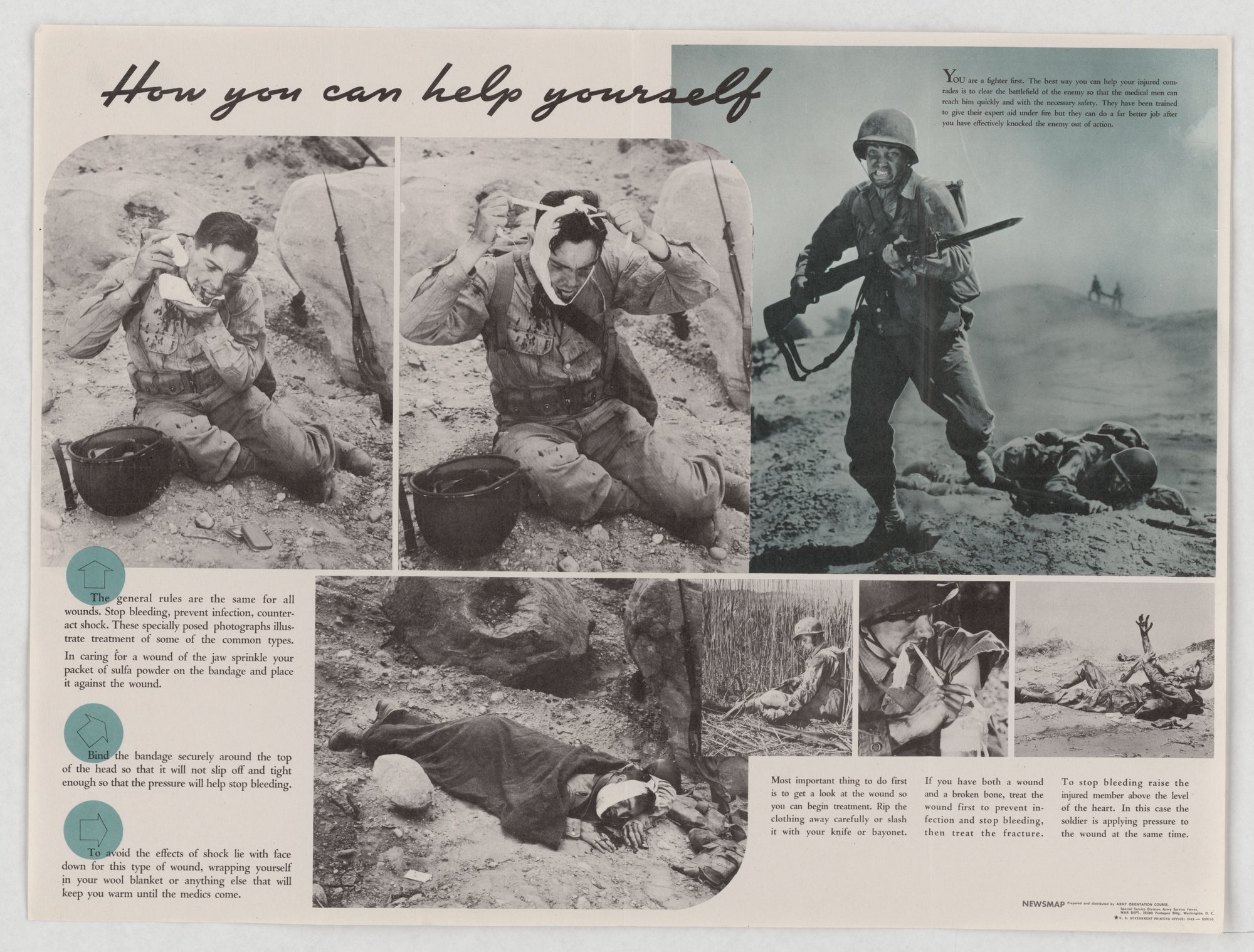
How you can help yourself
Newsmap sheet of posed photographs showing soldiers treating their own wounds, with first-aid captions. The upper right photograph shows a snarling soldier with fixed bayonet over a fallen comrade under the line 'You are a fighter first.' That line casts the soldier's role as fighter before helper (identity-fusion); the rest is instruction.
Propaganda techniques used in this poster
- Date
- 1943
- Period
- Second World War
- Made by
- U.S. War Department, Army Service Forces, Special Service Division (Army Orientation Course, Newsmap)
- Region
- North America
- Country
- United States
- Medium
- Poster
- Issuer type
- Military
- Regime
- Roosevelt Administration
- Leader
- Franklin D. Roosevelt
- Audience
- Own forces
- Purpose
- Warn or inform
- Themes
- War and the military, Health
- Event
- World War II
- Regime
- Roosevelt administration
- Leader
- Franklin D. Roosevelt
- Source
- Identified Openly sourced: the speaker is who they say they are
- Source
- U.S. National Archives and Records Administration, Record Group 44, World War II Posters, retrieved October 4, 2026
- Rights
- Public domain (U.S. government work)
U.S. War Department, Army Service Forces. National Archives and Records Administration, RG 44, 44-PA-1025 (NAID 514551).
Text on the object
How you can help yourself
YOU are a fighter first. The best way you can help your injured comrades is to clear the battlefield of the enemy so that the medical men can reach him quickly and with the necessary safety. They have been trained to give their expert aid under fire but they can do a far better job after you have effectively knocked the enemy out of action.
The general rules are the same for all wounds. Stop bleeding, prevent infection, counteract shock. These specially posed photographs illustrate treatment of some of the common types.
In caring for a wound of the jaw sprinkle your packet of sulfa powder on the bandage and place it against the wound.
Bind the bandage securely around the top of the head so that it will not slip off and tight enough so that the pressure will help stop bleeding.
To avoid the effects of shock lie with face down for this type of wound, wrapping yourself in your wool blanket or anything else that will keep you warm until the medics come.
Most important thing to do first is to get a look at the wound so you can begin treatment. Rip the clothing away carefully or slash it with your knife or bayonet.
If you have both a wound and a broken bone, treat the wound first to prevent infection and stop bleeding, then treat the fracture.
To stop bleeding raise the injured member above the level of the heart. In this case the soldier is applying pressure to the wound at the same time.
[imprint:] NEWSMAP Prepared and distributed by ARMY ORIENTATION COURSE, Special Service Division Army Service Forces, WAR DEPT., 2E580 Pentagon Bldg., Washington, D. C. U. S. GOVERNMENT PRINTING OFFICE: 1943 - 5381[illegible]